A mobile crane lift that goes wrong takes about four seconds to become fatal — the window between a load swinging off-radius and the boom overturning. That's why every OSHA 1926.1417 audit trail starts with what happened in the fifteen minutes before the lift, not the four seconds during it. This mobile crane pre-lift inspection guide walks the 30 checks OSHA holds a lift director accountable for — from load chart to signal plan — or book a 15-min HVI demo to see the digital version.
The Pre-Lift Compliance Panel
Every zone OSHA holds you accountable for. Every subsection. Every check that has to be done before the boom moves.
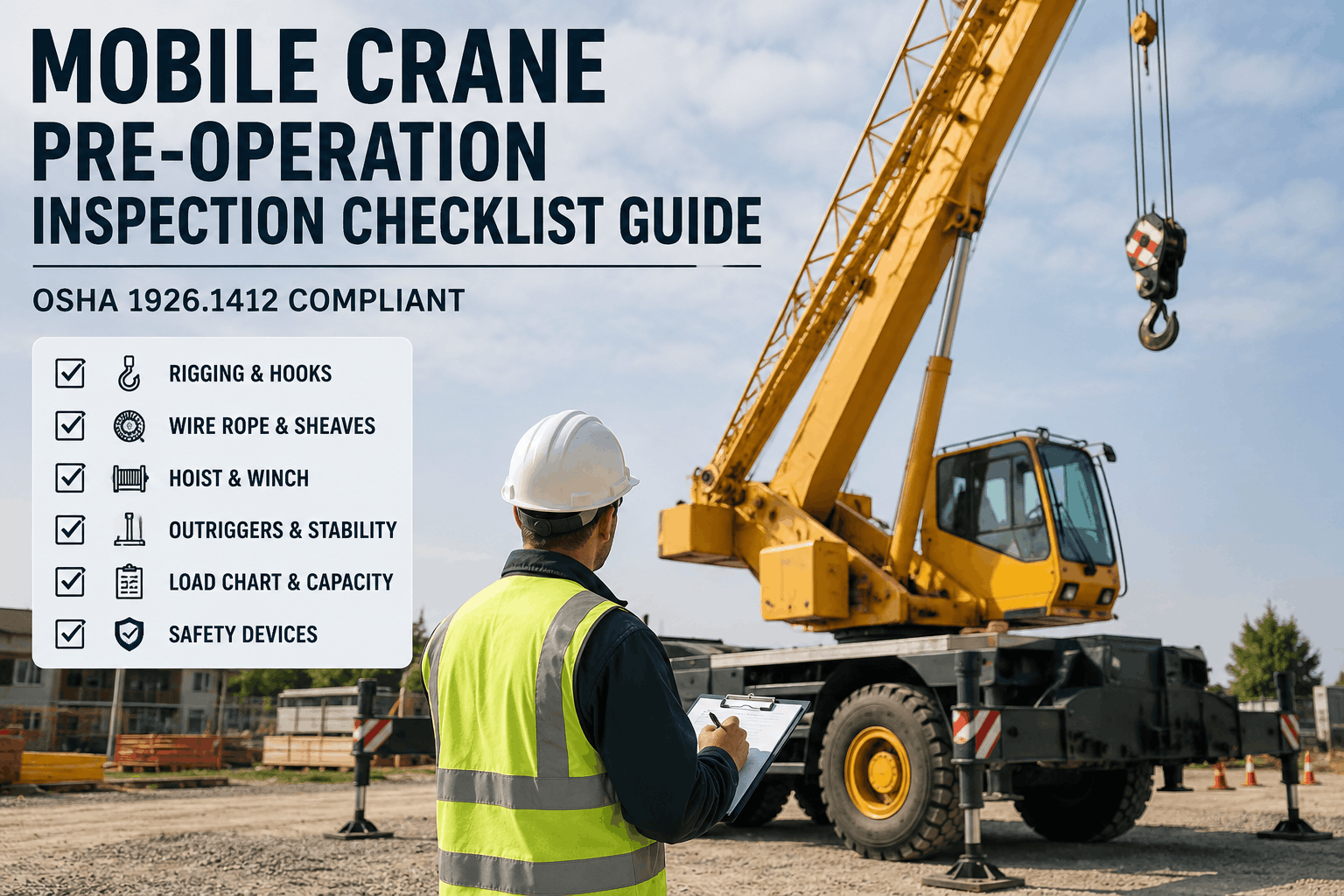
A mobile crane pre-lift inspection covers eight zones under OSHA 29 CFR 1926 Subpart CC: crane documentation (annual, monthly, shift inspections current), load chart (in cab, matching current config), load weight (verified within rated capacity, weighed if approaching 75% of max at longest radius), ground conditions (firm, drained, graded per 1926.1402), outriggers (fully extended, mats sized to PSI), rigging (tagged, within WLL, no visible damage per 1926.251/.1413), wind and weather (below manufacturer limit), and signal & communication (qualified signal person per 1926.1428, radio or hand signals confirmed). Thirty checks. Four signatures. Fifteen minutes.
OSHA's 1926.1417 puts the operator, the lift director, the signal person, and the rigger on the hook by name. If a check gets skipped and the load drops, all four sign the incident report. Crane-related fatalities average 42 to 44 per year in the U.S. — nearly all traced back to a pre-lift step that didn't happen. The checklist below is the version the audit will ask for. Every section maps to an OSHA subsection with the specific triggers and disqualifying conditions.
OSHA 1926.1417 — What It Actually RequiresThe operation standard sits on top of the inspection standard — both apply, both get audited
OSHA has two crane rules that get confused. 1926.1412 is the inspection standard — annual, monthly, and shift condition checks. 1926.1417 is the operation standard — what happens the moment a lift begins. Pre-lift inspection lives at the intersection: it uses 1412 inspection records as inputs and produces the 1417 operational readiness decision. Miss either side and the audit will find it.
Firm, drained, graded surface with sufficient bearing capacity. Controlling entity must inform operator of hazards.
Shift (visual, competent person), monthly (documented, 3-month retention), annual (qualified person, 12-month retention).
Load chart, rated capacity, 75% weighing rule, wind/ice/snow adjustments, boom clearance from obstructions.
No employee under a suspended load. Barricaded lift zone. Communication before any personnel enters.
Certified through accredited testing organization. Documentation of certification on-site during operation.
Qualified signal person required when operator's view is obstructed or when directed to work in a location requiring signals.
Book a demo to see 1926.1417 mapped inside HVI — every subsection tied to a checkbox, every signature timestamped, every record retained per OSHA.
Zone 01 — Crane Documentation ReviewIf the paperwork isn't current, the lift doesn't start
The lift director signs a lift plan certifying the crane is fit for operation. If any of the four documents below are missing, expired, or inaccessible on-site, the lift is non-compliant before the boom moves.
- Annual inspection — performed by qualified person within the last 12 months, retained 12+ months
- Monthly inspection — documented within the current or prior month, retained 3 months
- Shift inspection — visual walkaround by competent person, completed the current shift
- Operator certification — accredited testing org card, matching the crane class, on-site
Zone 02 — Load Chart VerificationThe chart in the cab, the config on the machine, the lift on the plan — all three must match
Rated capacity varies by boom length, boom angle, work quadrant, counterweight, outrigger extension, and jib configuration. A load chart from the wrong config is worse than no chart — it produces a false green light. The check takes 90 seconds; it prevents the most common cause of over-capacity boom collapse.
- Load chart present, legible, and in the cab (per 1926.1417(c))
- Chart applies to current boom length, angle, and jib configuration
- Chart applies to current outrigger and counterweight configuration
Zone 03 — Load Weight VerificationThe 75% rule — the moment you cross this threshold, weighing is mandatory
Load weight has to come from an industry-recognized source (manufacturer spec, engineered calculation, or a load-weighing device) — not a foreman's guess. The 75% rule is where OSHA holds the operator individually accountable: if the load approaches 75% of maximum rated capacity at the longest radius used, the operator must begin hoisting with a load-weighing device and verify weight before the lift proceeds.
- Load weight from manufacturer spec, engineered calc, or load-weighing device
- Weight includes rigging (slings, spreader bars, shackles) and load-block hardware
- Weight < rated capacity at longest radius that will be used during the lift
- If ≥ 75% of max at longest radius: weigh before proceeding (per 1926.1417(o)(3))
Book a demo — log every lift chart and weight verification so the audit trail exists before the boom moves, not after.
Zone 04 — Ground Bearing CapacityThe crane sits on soil that has to hold it — PSI is the number, not "looks OK"
Under 1926.1402 the controlling entity must inform the crane operator of ground conditions and known hazards. In practice, the operator and lift director verify: is the surface firm, drained, and graded? Is the estimated bearing capacity sufficient for outrigger reaction load (typically 5,000–15,000 PSI concentrated)? Are underground utilities marked? Any buried voids, vaults, or backfill?
- Surface firm, drained, graded — no fresh fill, no visible cracking
- Ground bearing capacity documented and adequate for reaction load
- Underground utilities located and marked (call-before-you-dig)
- No backfill, voids, vaults, or trenches within the setup footprint
Zone 05 — Outriggers & MatsFull extension. Level. Mats sized for the ground. All four floating.
Partial-extension load charts exist but they're vastly reduced — and rarely what the plan called for. If the plan assumes full extension, all four outriggers must be fully extended, tires must be off the ground, and the crane level within manufacturer tolerance (typically ±1°). Mats are sized to the ground bearing capacity, not to what fits in the truck.
- All four outriggers fully extended (or matching partial-extension load chart)
- Tires clearly off the ground on all four corners
- Crane level within ±1° on both axes (level bubble or laser)
- Outrigger mats sized to spread reaction load below ground PSI capacity
Zone 06 — Rigging & Lifting GearTags, wear, working load limit — every sling gets read, not glanced at
Every sling, shackle, hook, and spreader bar needs a legible tag with working load limit (WLL) or safe working load (SWL). Untagged rigging gets pulled from service — no exception. Wire rope inspection under 1926.1413 requires the crane's rigging to be inspected each shift before use.
- Every sling tagged with legible WLL/SWL rating
- WLL sufficient for actual load weight including sling angle derating
- No cuts, kinks, broken wires (wire rope), or heat damage
- Shackle pins secured with cotter or safety wire
- Hook throat opening within tolerance; safety latch functional
Try HVI free — log every sling tag with photo so the rigging inventory is verified against the pre-lift plan the moment the operator arrives on-site.
Zone 07 — Wind & WeatherThe manufacturer sets the cutoff. Your job is to know it and stop below it.
Wind creates lateral load on suspended cargo and on the boom itself. Manufacturer limits vary — typical mobile crane cutoffs sit between 20 and 30 mph at boom top, dropping to 15–20 mph for large-surface-area loads. Personnel lifts drop further. The number is in the operator's manual; it goes in the lift plan; an anemometer in the cab or on the boom verifies it in real time.
Values are typical — always verify against your specific crane's operator manual. Ice, snow, and rain trigger separate 1926.1417(d) adjustments a competent person has to make.
Zone 08 — Signal Plan & CommunicationA qualified signal person or a radio channel — not both, not neither
A qualified signal person is required whenever the operator's view of the load path is obstructed, when working near power lines, or when directed for another safety reason. "Qualified" means documented training in standard signals per Appendix A, tested by a qualified evaluator. The signal person's qualification card lives on-site for the same reason the operator's does.
- Signal person qualification card on-site (per 1926.1428)
- Signal method chosen — hand signals, radio, or both — and briefed
- Radio channel confirmed clear; standard emergency stop signal reviewed with all crew
Book a demo — every signal plan digitized alongside the pre-lift form, so who's signaling, on which channel, and with what call-out is recorded before the boom moves.
The Master Pre-Lift ChecklistAll 30 items on one page — in the order OSHA expects
This is the sequence the lift director walks with the operator, signal person, and rigger before the first pick. It lives on the clipboard — or in HVI, on the phone.
- Annual inspection current (< 12 mo)
- Monthly inspection current (this mo or prior)
- Shift inspection completed today
- Operator certification card on-site
- Site JHA / lift plan reviewed with crew
- Load chart matches boom, jib, counterweight
- Load chart matches outrigger config
- Load weight from recognized source
- Rigging weight included
- Load < capacity at longest radius used
- 75% rule: weigh with LMI if approached
- Ground firm, drained, graded
- Bearing capacity documented
- Utilities located and marked
- No voids/vaults in setup footprint
- Outriggers fully extended
- Tires off ground on all four corners
- Crane level within ±1°
- Mats sized to ground PSI capacity
- Every sling tagged (WLL/SWL)
- WLL sufficient with angle derate
- No cuts, kinks, heat damage
- Shackle pins secured
- Hook latch functional
- Wind speed below cutoff
- Weather adjustment (ice/snow) applied
- Signal person qualified & on-site
- Radio channel clear
- Emergency stop signal briefed
- Barricades in load-swing zone
Try HVI free and the entire 30-item checklist ships pre-built — operators tap through in the field, four signatures capture with GPS and timestamp, and the record retains for the OSHA-required duration automatically.
Common Failures & Corrective ActionsThe eight items most likely to fail an OSHA inspection and what stops them
| Failure | Safety Risk | OSHA Reference | Corrective Action |
|---|---|---|---|
| Load chart wrong config | Over-capacity boom collapse | § 1926.1417(c) | Verify chart before every lift; recheck at config change |
| Load weight assumed | Exceeding rated capacity | § 1926.1417(o) | Manufacturer spec or LMI weighing at 75% threshold |
| Partial outrigger extension | Tip-over on rotation | § 1926.1417(g) | Full extension or use matching partial-ext chart |
| Untagged rigging | Sling failure under load | § 1926.251 | Pull from service; replace with tagged, inspected gear |
| Wind above cutoff | Load swing, boom stability loss | § 1926.1417(d) | Anemometer verify; halt at manufacturer limit |
| Unqualified signal person | Miscommunication, personnel struck | § 1926.1428 | Qualification card required on-site |
| Ground bearing unknown | Outrigger punch-through | § 1926.1402 | Documented PSI capacity; mats sized to reaction |
| Personnel under load | Fatality on drop | § 1926.1425 | Barricaded lift zone; no entry during pick |
From a lift director running 200+ picks a year
The pre-lift used to be a clipboard nobody wanted to sign — because if the day went wrong, that signature was the piece OSHA subpoenaed first. So we'd rush it, half the boxes ticked by memory.
Digitized the whole thing two years ago. Every check takes a photo. Every signature has GPS and timestamp. What surprised me: when OSHA showed up on an unrelated site issue, we handed them 90 days of pre-lift records in eight seconds. They walked out. That was the moment I stopped resenting the checklist.
Frequently asked questions
What is a mobile crane pre-lift inspection?
A mobile crane pre-lift inspection is the operational readiness verification performed before every lifting operation under OSHA 29 CFR 1926 Subpart CC — specifically the operation standard 1926.1417. It covers eight zones: crane documentation (annual/monthly/shift inspections current), load chart applicability, load weight verification, ground bearing capacity, outrigger setup and level, rigging condition and working load limits, wind and weather against manufacturer limits, and communication plan including a qualified signal person. Thirty checks, about fifteen minutes, four required signatures — operator, lift director, signal person, and rigger. Records retain for a minimum of three months.
What does OSHA 1926.1417 require?
OSHA 1926.1417 is the operation standard for cranes in construction. It requires: the crane must not be operated in excess of its rated capacity; the operator must verify load weight from an industry-recognized source (manufacturer, engineering calc, or load-weighing device); if load approaches 75% of maximum rated capacity at the longest radius that will be used, the operator must weigh the load with a load-weighing device, LMI, or capacity indicator before proceeding; the load chart must be present in the cab and applicable to the current configuration; the competent person must adjust for wind, ice, and snow; and the boom must not contact obstructions. The standard incorporates by reference ground conditions (1926.1402), inspections (1926.1412), rigging (1926.251), signal person qualifications (1926.1428), and operator certification (1926.1427).
How do you inspect a mobile crane before lifting?
A pre-lift inspection follows a fixed sequence. First, verify documentation is current on-site — annual, monthly, and shift inspection records plus operator certification card. Second, verify the load chart in the cab matches the current boom length, jib configuration, counterweight, and outrigger extension. Third, confirm load weight from a recognized source and apply the 75% rule if triggered. Fourth, verify ground conditions are firm, drained, and graded with adequate bearing capacity. Fifth, confirm outriggers are fully extended, tires are off the ground, and crane is level within manufacturer tolerance. Sixth, inspect every sling, shackle, and hook for tags and condition. Seventh, verify wind speed is below manufacturer cutoff and account for weather. Eighth, confirm the signal person is qualified and the communication method is briefed. The lift director, operator, signal person, and rigger sign the record before the first pick.
What should be included in a crane pre-lift checklist?
A compliant crane pre-lift checklist includes thirty items grouped into four sections. Setup & documentation (5): annual/monthly/shift inspection currency, operator cert card, lift plan reviewed. Configuration & load (6): load chart matches config, load weight from recognized source, rigging weight included, capacity check at longest radius, 75% rule trigger. Ground & outriggers (8): firm/drained/graded surface, documented bearing capacity, utilities located, no voids in footprint, full outrigger extension, tires off ground, crane level, mats sized to PSI. Rigging, weather, and communication (11): every sling tagged with WLL, adequate for angle derate, no visible damage, shackle pins secured, hook latch functional, wind speed below cutoff, weather adjustments applied, qualified signal person on-site, radio channel clear, emergency stop briefed, load-swing zone barricaded.
How often should pre-lift inspections be performed?
A pre-lift inspection is performed before every lifting operation — not once per shift, not once per day. Each new lift with a materially different load, radius, or configuration triggers its own pre-lift verification. A repetitive pick of identical items in the same setup can use a single documented record, but any change to load weight, boom configuration, outrigger extension, ground conditions, weather, or signal personnel resets the requirement. The pre-lift is separate from the each-shift visual inspection required under 1926.1412(m), the monthly under 1926.1412(e), and the annual under 1926.1412(f). All four have to be current for the lift to be compliant.
Related HVI guides
Turn the paper pre-lift into a mobile OSHA record
HVI ships with the OSHA 1926.1417 pre-lift template ready to deploy. Operators walk through 30 checks on a phone, four signatures land with GPS and timestamp, photos of load charts and rigging tags attach to equipment history. When OSHA asks for the last 90 days, you hand them a filtered PDF in under 10 seconds. Live in under two weeks.
OSHA 1926.1417 · Mobile-first · 3-month retention automatic