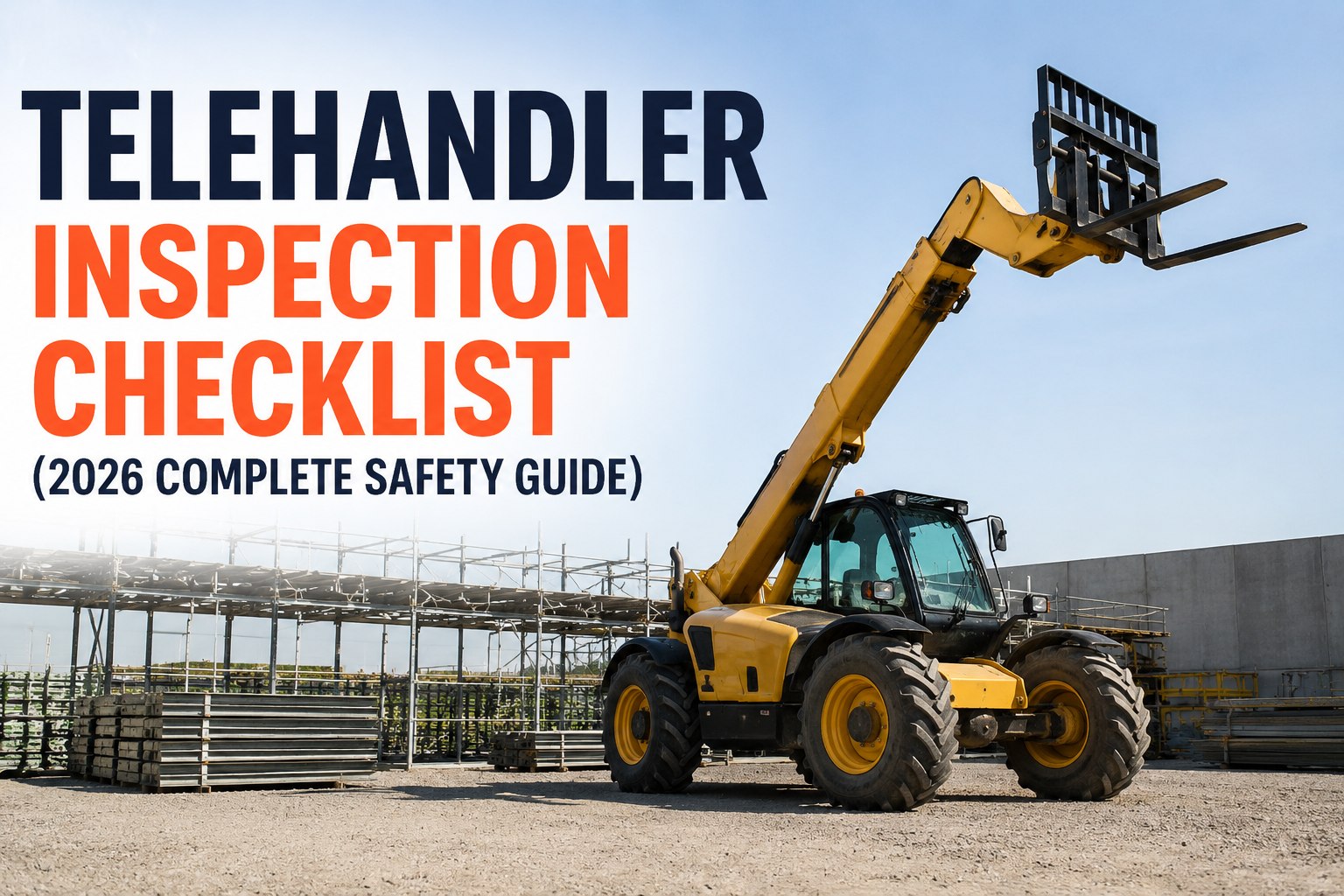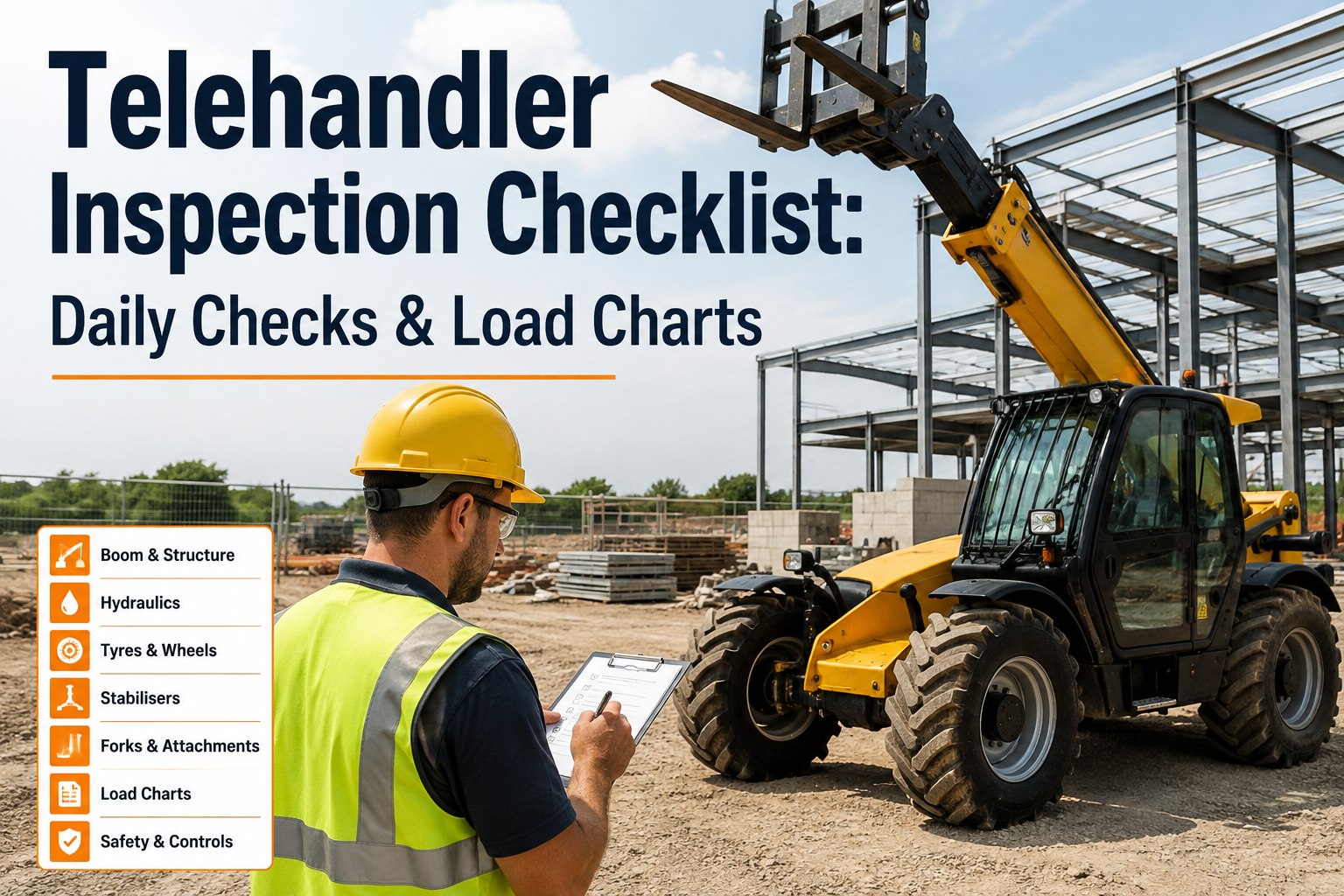
A telehandler inspection checklist has to cover a machine that doesn't have one lifting capacity — it has hundreds. A different number at every boom angle, extension, and attachment. The data plate figure is the maximum, valid only at retracted boom, low angle, stabilizers down, standard forks. Move the boom and the number changes dramatically. 42% of tip-overs involve exceeding rated capacity from the chart — most incidents are misread charts, not overloaded operators. Below: daily walkaround, load chart mechanics, LOLER cadence — book a demo to digitize in HVI.
The Load Chart Is a 2D Map — Not a Single Number
Rated capacity drops as the boom extends outward and rises upward. The same telehandler can safely lift 8,000 lb close-in and low, and only 1,500 lb fully extended at height.
Read the load chart before every lift. Boom fully retracted at low angle = maximum capacity. Boom fully extended at maximum height = a fraction of that. Add an attachment change or a non-level surface and the number moves again. The load chart in the cab, not the data plate on the frame, is the operational reference — and the operator has to be trained to read it.
The rest of this page walks the daily inspection every operator owes the machine, the load-chart discipline the incident data insists on, the LOLER / OSHA cadence separating routine checks from statutory examination, and the tracking system that keeps a fleet compliant. Book a 30-minute demo to see per-asset templates that adjust for attachment and jurisdiction.
The daily pre-start inspection — every shift, no exceptions
OSHA 29 CFR 1926.602 mandates a pre-start inspection of earthmoving equipment before use. In the UK, PUWER Regulation 6 requires the machine be maintained in efficient working order, and the daily check is the operational evidence that requirement is being met. Twelve minutes per shift catches most of what would otherwise become a tip-over, a dropped load, or a hydraulic failure at height.
Boom, chassis, welds
- Every boom section visually inspected for cracks, dents, deformation
- Wear pads between boom sections — abnormal wear, missing shims, excessive play
- Boom pivot pins for visible movement, grease presence
- Chassis and frame welds for cracks, especially at high-stress joints
- Attachment interface for damage or missing locking hardware
Hoses, cylinders, fittings
- Every hose routed along the boom for abrasion at pinch points
- Cylinder rods for scoring, damage, uneven film
- Fittings and reservoirs for leaks or seepage
- Hydraulic reservoir level in operating range
- Cold-cycle boom raise / lower / extend / retract for abnormal noise
Load-bearing components
- Fork heel thickness — ANSI removal criterion is 90% of original
- Fork blade for cracks, especially near the heel and lower hook
- Fork tips aligned, no visible bending
- Locking pins and retainer — forks positively secured on carriage
- Attachment quick-hitch: mounting pins, retention mechanism functional
Stabilisers, tyres, LMI
- Stabiliser pads for cracks; interlock preventing boom operation without deployment
- Tyre pressure to manufacturer PSI ± 2%; sidewall damage; matched sets
- Frame level indicator functional; bubble level accurate to ± 1°
- Load Moment Indicator (LMI) alarms tested; no bypass in operation
- Load chart present, legible, correct for currently fitted attachment
Every defect gets documented with photo, not verbally reported at shift change. The photo is the compliance evidence and the tip-off that the same defect keeps appearing across multiple machines — the systemic signal supervisors otherwise miss. Book a demo to see how HVI captures per-item pre-start observations with photos and defect flow to the shop.
Load chart & LMI — where 42% of tip-overs actually happen
Telehandler tip-overs follow patterns that are visible in the incident data. Analysis across the industry consistently points to the same repeat causes, and every one of them is catchable at pre-start or by an operator trained to read the chart before lifting.
| Cause of tip-over | Share of incidents | Pre-start inspection point | Operator control |
|---|---|---|---|
| Exceeded rated capacity per load chart | ~42% | Load chart present, legible, correct for attachment | Consult chart for boom position & extension before every lift |
| LMI defeated or bypassed | ~32% | LMI alarms test at pre-start; no bypass indicator lit | Never operate with LMI silenced; treat every alarm as a stop |
| Stabilisers not deployed / soft ground | ~28% | Stabiliser pads inspected; interlock functional | Full deployment on firm ground before any lift outside stability envelope |
| Tyre condition / pressure failure | ~18% | PSI ± 2% of spec; matched sets; sidewalls sound | Pressure check every shift; replace mismatched sets |
| Operating on slope > 5° | ~15% | Level indicator calibrated to ± 1° | Level frame before lift; never lift with load high on unlevelled machine |
Note two things about the causes: they overlap (a tip-over often has more than one), and every single one is either an inspection failure or an operator training failure — not a mechanical failure. Telehandlers are not typically defective when they tip. They're operated outside their working envelope, and the load chart plus LMI exist precisely to prevent that from happening. Skip the chart consultation, silence the LMI, and the machine has no way to protect the operator from an over-reach. The most consequential decision on any lift is made before the boom moves — whether the operator looks at the chart. Everything else is downstream of that one habit, and it's the habit a digital inspection program with mandatory chart-check evidence per lift actually builds. Book a demo to see how HVI can require load-chart confirmation as part of each shift's pre-start record.
LOLER thorough examination — distinct from routine inspection
In Great Britain, telehandlers used for lifting fall under the Lifting Operations and Lifting Equipment Regulations 1998 (LOLER) in addition to PUWER. LOLER Regulation 9 requires a statutory thorough examination by a competent person — this is separate from and additional to daily operator inspection, and separate from manufacturer maintenance. Getting the interval and scope wrong is a legal exposure, not a paperwork slip.
Standard lifting operations
Telehandler used for lifting loads on forks or approved load-lifting attachments. Boom sections, wear pads, hoses, cylinders, carriage, forks, quick-hitch, attachment mountings, safety devices all examined by competent person. Written report under Schedule 1 issued.
Lifting people · work platforms · man-baskets
Interval drops the moment a work platform or man-basket is fitted for lifting personnel. Compact, high-reach, or rotating telehandler — the duty is the same. Lifting accessories (chains, slings, shackles, eyebolts) all on the 6-month cycle regardless of the machine.
Damage, repair, relocation, incident
Regardless of the calendar, a thorough examination is required after substantial repair, damage, relocation likely to affect safety, or in accordance with a written scheme of examination the competent person has drawn up for the specific machine and duty.
Immediate danger — reportable
Examination report categorises defects: Cat A = immediate danger, Cat B = defect requiring timescaled repair, Cat C = defect worth observing. Cat A findings must be reported to the enforcing authority (HSE or local authority) and the equipment must not be used until rectified.
The distinction between LOLER thorough examination and routine maintenance is often misunderstood. Maintenance keeps the machine working; thorough examination proves it is safe to keep lifting. Both are required. The daily operator check is neither — it's the pre-use verification that the machine hasn't developed a fault since the last shift. Three separate activities, three separate records, three separate legal bases. Missing any one of them leaves an exposure the next incident investigation will find. Start a free HVI trial to schedule LOLER examinations against every asset at the correct interval for its current lifting mode.
The attachment problem — new attachment, new load chart
Every attachment changes the machine — and the load chart
Telehandlers are versatile because they accept a wide range of attachments: standard forks, side-shift carriages, bucket, jib, grab, block hook, man-basket, sweeper, auger, and dozens of others. Every attachment change is effectively a change to the machine itself, and the manufacturer publishes a different load chart for each approved attachment. Rated capacity, load centre position, and stability envelope all shift — sometimes significantly. A block hook cantilevered forward of the carriage changes the load moment; a heavy bucket shifts the centre of gravity; a jib extends the effective reach. Operating on the wrong load chart, or with an unapproved attachment lacking a manufacturer chart at all, defeats the LMI protection because the LMI is calibrated to specific attachment weights and geometries. The rule that keeps operations compliant and safe: every attachment must have its manufacturer-approved load chart present in the cab, the operator must be trained on the specific attachment, and the attachment must be positively locked and inspected before the first lift of that shift. Where an attachment is not from the machine's OEM, it must be manufacturer-approved for that specific telehandler model — not just "the right size." In LOLER terms, an unapproved attachment is a Cat A finding waiting to happen. In OSHA terms, it's a citation risk and a liability exposure the moment something goes wrong. The pre-start inspection must include verification of load chart, attachment approval, and attachment lock status — every shift, every attachment change.
A site safety manager on the audit that reset their whole program
We operate 14 telehandlers across five active civils sites in the Midlands. Ran daily operator checks on paper for years, LOLER examinations booked through our hire desk. HSE visited after a near-miss on one site — boom section had cracked visibly and the operator ran a full shift without flagging it. The audit pulled the last 90 days of daily inspection records and asked how a crack of that size wasn't in any of them.
Two findings stuck. Paper checks were being ticked without actually walking the machine, and our LOLER intervals were 12-monthly across the board even for the three units regularly fitted with man-baskets for facade work. Corrective plan: digital checks with mandatory photos on boom and forks, per-attachment templates so man-basket mode automatically triggers 6-month LOLER scheduling, and every daily inspection has to close on the phone before the machine keys are released. Twelve months on and we've caught two boom-pad wear issues and one hydraulic hose defect that would have made the paper trail but not the machine.
Frequently asked questions
What should be on a daily telehandler inspection checklist?
A complete daily pre-start inspection covers four areas. Structure: every boom section visually inspected for cracks, dents, deformation; wear pads between boom sections for abnormal wear or excessive play; boom pivot pins; chassis and frame welds for cracks at high-stress joints; attachment interface. Hydraulics: every hose routed along the boom for abrasion at pinch points; cylinder rods for scoring or damage; fittings and reservoirs for leaks; hydraulic reservoir level; cold-cycle full boom function test for abnormal noise. Forks / attachment: fork heel thickness against the ANSI removal criterion of 90% of original; fork blade for cracks near heel and lower hook; fork tips aligned; locking pins positively securing forks on carriage; attachment quick-hitch mounting pins and retention mechanism functional. Stability: stabiliser pads for cracks and interlock preventing boom operation without deployment; tyre pressure within manufacturer PSI ± 2% with matched sets; frame level indicator calibrated to ± 1°; Load Moment Indicator (LMI) alarms tested and not bypassed; load chart present, legible, and correct for the currently fitted attachment. Every defect gets photo-documented at the time of inspection, not verbally reported later. Required daily under OSHA 29 CFR 1926.602 and evidenced under PUWER Regulation 6 in Great Britain.
How do I read a telehandler load chart?
A telehandler load chart is a 2D map showing rated capacity as a function of two variables: how far the boom extends forward (reach) and how high it lifts (boom angle or lift height). The chart is typically plotted with reach on the horizontal axis and lift height on the vertical axis, with capacity zones drawn as coloured or numbered regions across the working envelope. To use it: identify the required lift height and reach for the intended lift, find where those two values intersect on the chart, and read off the maximum capacity at that point. Rated capacity decreases as the boom extends outward and as it rises — sometimes dramatically. A telehandler rated at 10,000 lb close-in and low may only be rated at 1,500 lb fully extended at height. Additional factors that adjust the chart: attachment fitted (each attachment has its own chart), stabilisers deployed or not, machine on level ground or slope, load centre distance. The chart in the cab, not the data plate on the frame, is the operational reference for every lift. If the intended lift falls outside the working envelope on the chart, the lift cannot be performed with that machine in that configuration. 42% of telehandler tip-overs involve exceeding rated capacity per the chart, which makes this the single most important operator skill on the machine.
How often does a telehandler need a LOLER thorough examination?
In Great Britain, LOLER Regulation 9 requires thorough examination by a competent person at statutory minimum intervals. For a telehandler used to lift loads only (fitted with forks or an approved load-lifting attachment): every 12 months. For a telehandler used to lift people (fitted with an approved work platform or man-basket): every 6 months. Lifting accessories used with the telehandler (chains, slings, shackles, eyebolts, hooks): every 6 months regardless of the machine's cadence. Additionally, thorough examination is required after any exceptional circumstances likely to affect safety — substantial repair, damage, relocation — or at intervals defined in a written scheme of examination prepared by a competent person. The examination is documented in a written report under Schedule 1 of the regulations, categorising defects as Cat A (immediate danger, reportable to HSE), Cat B (requiring timescaled repair), or Cat C (observation). LOLER thorough examination is distinct from routine maintenance and from the daily operator pre-start inspection — three separate activities with three separate records. Duty holders are legally responsible for scheduling, receiving the report, and acting on findings.
Does the load chart change with attachments?
Yes, every attachment change effectively creates a different machine from the load chart's perspective. The manufacturer publishes a separate load chart for each approved attachment because rated capacity, load centre position, and stability envelope all shift with attachment type. Standard forks have one chart; a side-shift carriage adjusts it; a bucket, jib, block hook, grab, or man-basket each produce different charts. A block hook cantilevered forward of the carriage changes the load moment; a heavy bucket shifts the centre of gravity; a jib extends the effective reach. Operating on the wrong load chart, or with an unapproved attachment lacking a manufacturer chart entirely, defeats the Load Moment Indicator (LMI) protection because the LMI is calibrated to specific attachment weights and geometries — it can only warn the operator based on what it has been told about the current setup. The compliance rule: every attachment fitted must have its manufacturer-approved load chart present in the cab; the operator must be trained on the specific attachment; the attachment must be positively locked and inspected before the first lift of that shift; and where the attachment is not from the machine's OEM, it must be manufacturer-approved for that specific telehandler model. An unapproved attachment is a LOLER Cat A finding and an OSHA citation exposure.
What are the most common telehandler tip-over causes?
Industry incident analysis consistently points to a small set of repeat causes, most of which are catchable at pre-start inspection or by operator training. Exceeding rated capacity per the load chart accounts for roughly 42% of tip-over incidents — typically operators lifting at a boom position where rated capacity is lower than assumed. Load Moment Indicator (LMI) systems defeated or bypassed accounts for approximately 32%, where the operator has silenced or overridden the safety alarm rather than adjusting the lift. Stabilisers not deployed or deployed on soft ground accounts for around 28% — the interlock preventing boom operation without stabiliser deployment is critical here, and float elimination on outriggers matters equally. Tyre condition and pressure failures account for approximately 18%, including under-inflation, mismatched sets, and sidewall damage. Operating on slopes greater than 5° accounts for around 15%, where the frame level indicator was ignored or uncalibrated. These causes overlap (a tip-over often involves more than one), and every one is either a pre-start inspection failure or an operator training failure, not a mechanical failure. Telehandlers are rarely mechanically defective when they tip — they are operated outside their working envelope with safety systems compromised.
Turn telehandler inspection from paper into a compliance dashboard
HVI holds each telehandler's daily template, adjusts checks by fitted attachment, captures photo evidence at every pre-start, schedules LOLER thorough examinations at the correct 6- or 12-month interval based on lifting mode, records Schedule 1 reports and Cat A/B/C defects, and flows corrective actions into work orders. When HSE, the AHJ, or the insurance auditor arrives, the compliance record for every unit is one click away. Live in under two weeks. No hardware. No credit card.
Trusted by construction, civils, agriculture & industrial fleets across UK, US, Canada & Australia · Ready on day one