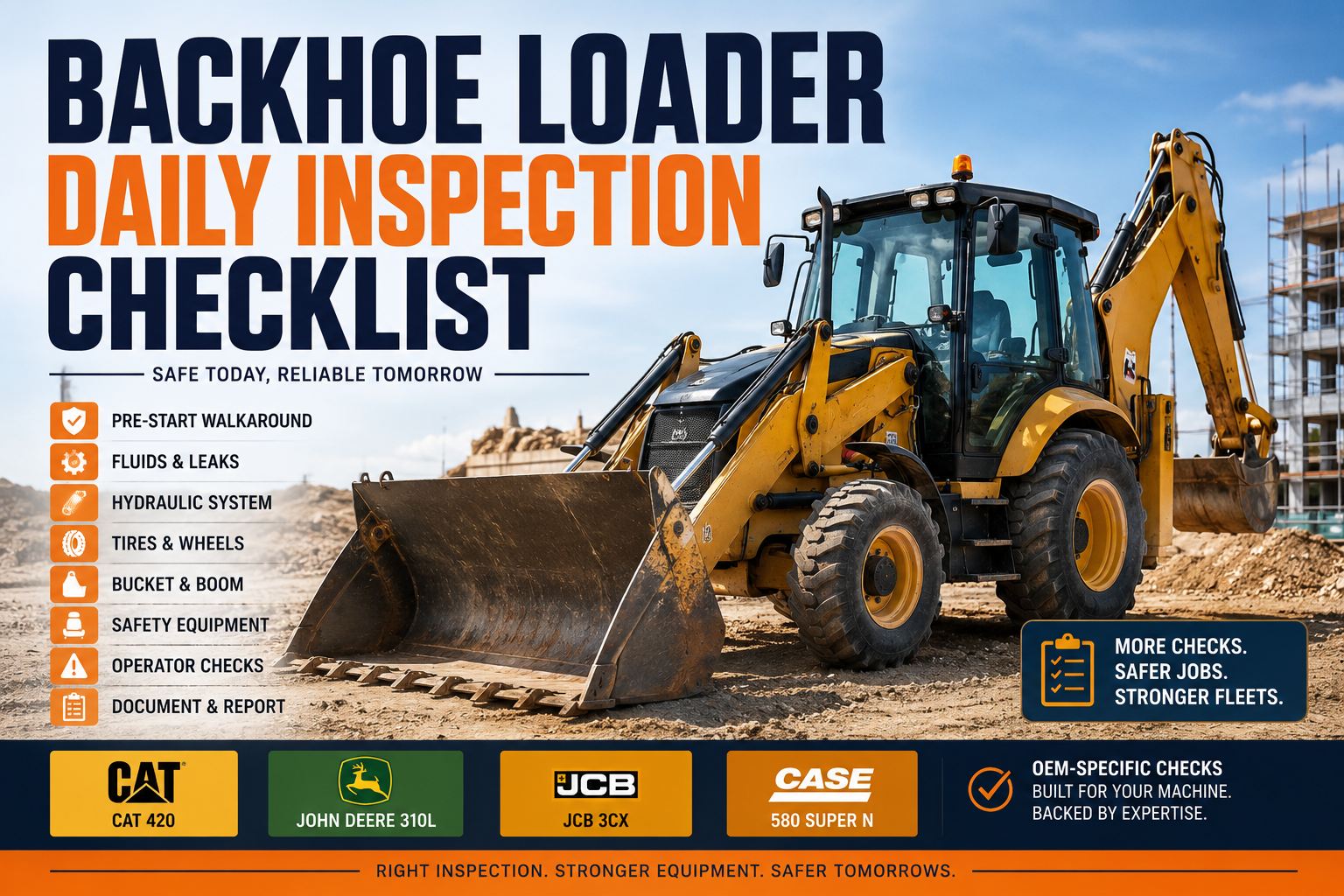
Every backhoe loader daily inspection checklist covers the same 40 checkpoints in principle — fluids, hydraulics, loader, backhoe, ROPS, controls, undercarriage. But the Cat 420, John Deere 310L, JCB 3CX, and Case 580 each have unique service-point locations and telematics that a machine-agnostic checklist misses. Get the OEM-specific points right and downtime drops; miss them and small defects propagate into $8,000-$15,000 hydraulic repairs. Book an HVI demo for OEM-specific backhoe templates.
Four brands. Same job. Four different service-point maps.
A universal checklist gets you 80% of the way. The remaining 20% — the OEM-specific service points, fluid check locations, and telematics integration — is where downtime is actually prevented.
Why the backhoe daily inspection is different from every other equipment check
Backhoe loaders are unique in the construction fleet — they combine a wheel loader front end, a hydraulic excavator rear, ROPS/FOPS operator protection, and highway-capable travel in one machine. That combination means one machine has three distinct failure surfaces the operator has to inspect every shift.
The loader circuit and backhoe circuit share a pump but run distinct hoses, cylinders, and control valves. Leak location tells the operator which circuit is compromised — and each circuit has different service-point access on each OEM platform.
Unlike an excavator or dozer, backhoe loaders roll on tires and self-drive between sites. Daily inspection has to cover tire condition, lug-nut torque, and road-legal lighting alongside jobsite inspection points that competitor equipment classes don't require.
The backhoe rides on rear stabilizer pads and pivots on a swing bearing that takes concentrated load at every dig cycle. Wear signatures show up in the pad-to-ground fit and swing bearing play — not on a checklist designed for excavators.
The operator swivels 180° between loader and backhoe operation. Seat lock, seat belt, and control-station transition points must function correctly — a stuck seat lock or worn detent creates safety risk unique to this equipment class.
Every one of the four differences translates into specific checkpoints that don't appear on generic equipment inspection templates. Book an HVI demo to see backhoe-specific inspection templates configured for your fleet
The universal 7-system daily inspection framework
Regardless of OEM, every backhoe loader daily inspection follows the same 7-system framework. Below is the universal checklist — the base every machine-specific template extends from.
- Operator & maintenance manual on machine
- ROPS/FOPS decal & certification tag intact
- Fire extinguisher charged & accessible
- Previous shift's inspection log reviewed
- Engine oil level within OEM window
- Coolant level at expansion tank
- Hydraulic fluid at sight glass
- Transmission fluid check (dipstick)
- Fuel level & visible tank condition
- Windshield washer fluid
- Tire pressure per OEM spec (all 4)
- Sidewall & tread condition
- Lug-nut torque check (visual)
- Chassis frame — no cracks or damage
- Ground under machine — no fresh puddles
- Loader arms — no cracks, bent structure
- Loader cylinders — no rod damage or leaks
- Bucket teeth, cutting edge, sidebar wear
- Quick-attach latch function (if equipped)
- Pivot pins & bushings — grease evidence
- Boom, dipper, swing casting — no cracks
- Backhoe cylinders — rod condition, no leaks
- Bucket teeth, sidecutters, wear surfaces
- Swing bearing — no play, no unusual noise
- Rear stabilizers — pad condition, cylinders
- Boom lock & travel lock function
- All hoses — no chafing, kinks, wet spots
- Fittings — no drips or seepage
- Reservoir cap & breather condition
- Cylinder drift check — 60-second hold
- Seat lock & 180° swivel function
- Seat belt — condition & retractor
- All loader controls smooth in every direction
- All backhoe controls smooth in every direction
- Steering — no excess play
- Service brakes & parking brake test
- Horn, backup alarm, work lights
- Road-legal lights (turn signals, brake)
- Windows, mirrors, wipers clean & intact
- Warning lights on dash — all clear on startup
Together these seven systems cover 40 checkpoints — a solid universal base. The OEM-specific overlay adds machine-specific service points, fluid access locations, and telematics integration on top of this framework. Try HVI free with all 40 checkpoints pre-loaded as a digital template.
OEM-specific inspection points — what changes brand-to-brand
The universal 40-checkpoint framework is where every daily inspection starts. The OEM-specific overlay is what separates a competent operator from an operator who actually catches failures before they cost the fleet money. Here's what to add for each of the four major backhoe platforms.
- Maintenance plate check — Cat's engine access panel has an integrated maintenance plate atop the air filter housing showing daily-check locations at a glance
- Product Link diagnostic — Confirm Product Link telematics is reporting; no fault codes in the CatEQ pre-start display
- Auto-lubrication reservoir — If equipped, check auto-lube reservoir fluid level and pump indicator
- Cat SIS QR reference — Use the CatEQ Service Information System (SIS) QR code on the machine data plate for real-time procedure reference
- Ride Control accumulator — Check ride control system for pressure & function (F-Series and later)
- E-Stick extension — If equipped, verify E-Stick extendable dipperstick locks/unlocks correctly and shows no cylinder rod damage
- PowerReverser oil check — Distinct from transmission fluid; check PowerReverser dipstick separately on the LH side
- Hydraulic tank sight glass — Located on LH side of chassis, not RH like most competitors
- JDLink cellular connection — Verify JDLink telematics is reporting; check for any fault codes on startup display
- Precision Ready Kit — If equipped for grade control retrofit, verify wiring harness intact and connectors sealed
- Side-shift chassis lock — The distinctive JCB side-shift backhoe requires chassis lock verification — a failed lock creates safety exposure during travel
- H-frame backhoe pins — JCB's H-frame backhoe design has specific pin locations that wear differently than fabricated-frame competitors
- Hydraulic quick-hitch — If equipped, confirm quick-hitch lock indicator and safety pin engagement
- LiveLink telematics — Verify LiveLink reporting; JCB LiveLink is a differentiated remote diagnostic capability
- DIESELMAX filter access — Engine air filter and fuel filter positions differ from competitors; know the layout for cold-start diagnostics
- PowerLift boom pressure — Case's PowerLift boom system operates at higher hydraulic pressure; check for warning indicators on startup
- Extendahoe verification — If equipped, verify extendable dipper cylinder rod is undamaged and lock function works
- Uptime Care access panel — Case's diagnostic access panel location on RH side of chassis; verify panel closes and latches securely
- SiteWatch telematics — Confirm SiteWatch reporting; check for pending service reminders on startup display
- Fabricated boom weld inspection — Case boom castings are fabricated rather than cast; visually inspect welds for hairline crack signatures
The OEM-specific overlays are 5-8 checkpoints each — short enough that a trained operator can memorize the differences and thorough enough to catch the failure modes that generic templates miss. This is where digital OEM-specific templates start to earn their keep vs paper checklists that can't be that granular. Book an HVI demo to see all four OEM templates live
The 5 most common backhoe loader failure modes
Aggregated across manufacturer warranty claim data, rental fleet return inspections, and OEM service bulletins, five failure modes account for the majority of unplanned backhoe downtime. Each is preventable with disciplined pre-start inspection.
Hoses routed through pinch points along the boom, loader arms, and swing tower chafe over hours until the outer jacket fails and the pressure line lets go. Cost: $200-$400 for the hose plus $2,000-$4,000 in cleanup and downtime. Catch signature: shiny wear patches on outer hose jacket at pinch points.
Rod damage from impact, corrosion, or debris ingest breaks the seal, causing fluid loss and eventual cylinder replacement. Cost: $1,500-$4,000 per cylinder. Catch signature: fluid film on rod, seepage at gland nut, gradual reservoir level drop.
The backhoe swing bearing takes concentrated load at every dig cycle. Missed lubrication or contaminated grease accelerates wear. Cost: $8,000-$15,000 to replace. Catch signature: audible clunk during swing, visible tower play, grease contamination in bearing race.
Worn stabilizer pads reduce contact area, cause instability during backhoe operation, and can damage jobsite surfaces. Cost: $150-$400 per pad set. Catch signature: uneven pad-to-ground contact, visible pad thickness reduction, chassis rock during dig cycles.
Cab impact from falling debris or overhead strikes compromises ROPS/FOPS certification. Cost: $6,000-$12,000 to replace the certified cab structure. Catch signature: visible frame deformation, cracked welds at mounting points, dents on overhead FOPS grate.
Every one of the five is caught with disciplined pre-start inspection using an OEM-appropriate checklist — and every one costs at least 10x more when missed. The economics of thorough daily inspection are always favorable. Try HVI free to configure failure-mode-aware inspection templates on your first 5 backhoes.
From an Equipment Manager running 34 backhoe loaders across 4 OEMs
We run 14 Cat 420s, 9 John Deere 310Ls, 7 JCB 3CXs, and 4 Case 580s — picked up over the years across acquisitions and dealer relationships. Our old paper inspection template was one generic form covering all four brands. Operators skipped the machine-specific checkpoints because they weren't on the form. Two years running we had premature swing bearing failures on the JCBs and cylinder rod issues on the Cats that a properly configured inspection would have caught 30 days earlier.
We rolled out OEM-specific digital templates — universal 40 points plus 5-8 OEM-specific per platform. First quarter results: hydraulic incident rate down 42%, catastrophic failures down 68%, and our shop pre-planning improved because defects arrived at the shop already photo-documented. Same operators, same machines, same shift patterns — different inspection framework. The delta was the OEM specificity.
Frequently asked questions
What should a daily backhoe loader inspection cover?
A complete daily backhoe loader inspection covers 7 systems and approximately 40 checkpoints. Documentation & Safety (4 items: operator manual on machine, ROPS/FOPS decal and certification tag, fire extinguisher, previous shift's inspection log). Engine & Fluids (6 items: engine oil, coolant, hydraulic fluid, transmission fluid, fuel, windshield washer). Undercarriage & Tires (5 items: tire pressure, sidewall condition, lug-nut torque, chassis frame, ground under machine). Loader Assembly (5 items: loader arms, loader cylinders, bucket teeth, quick-attach latch, pivot pins and bushings). Backhoe Assembly (6 items: boom/dipper/swing casting, backhoe cylinders, bucket teeth, swing bearing, rear stabilizers, boom lock). Hydraulic System (4 items: hoses, fittings, reservoir cap, cylinder drift check). Cab/Controls/Electrical (10 items: seat lock & swivel, seat belt, loader controls, backhoe controls, steering, brakes, horn/backup alarm/work lights, road-legal lights, windows/mirrors/wipers, warning lights). On top of this universal framework, each OEM (Cat 420, John Deere 310L, JCB 3CX, Case 580) has 5-8 machine-specific checkpoints covering telematics diagnostics, fluid access locations, and platform-specific features like Cat's maintenance plate, Deere's E-Stick, JCB's side-shift chassis, or Case's PowerLift boom pressure system.
How is the Cat 420 daily inspection different from the John Deere 310L?
The core 40 checkpoint framework is identical, but the machine-specific overlays differ meaningfully. Cat 420 / 420 XE inspection adds: maintenance plate check atop the engine air filter housing showing daily-check locations at a glance (Caterpillar's operator-friendly design), Product Link telematics verification on the CatEQ pre-start display, auto-lubrication reservoir check if equipped, Cat SIS (Service Information System) QR code on the machine data plate for real-time procedure reference, and Ride Control accumulator function check on F-Series and later models. Hydraulic tank sight glass is located on the right-hand side of the chassis on Cat platforms. John Deere 310L / 310SL inspection adds: E-Stick extension verification if equipped (extendable dipperstick lock/unlock function and cylinder rod condition), PowerReverser oil check on a separate dipstick from transmission fluid on the left-hand side, hydraulic tank sight glass on the left-hand side (opposite Cat), JDLink cellular telematics verification with startup fault code review, and Precision Ready Kit wiring harness inspection if equipped for grade control retrofit. Both machines share the same 40-checkpoint universal framework — the difference is in the 5-8 machine-specific service points, control locations, and telematics integration paths that operators need to know to catch failures the generic checklist misses.
What's unique about the JCB 3CX inspection?
JCB invented the modern backhoe loader in 1953 and the 3CX platform reflects several design decisions that no other OEM replicates. Five inspection points differentiate JCB from Cat, Deere, and Case: (1) Side-shift chassis lock verification — JCB's distinctive side-shift backhoe requires positive chassis lock confirmation before travel; a failed lock creates safety exposure during highway travel. (2) H-frame backhoe pin inspection — JCB's H-frame backhoe geometry places pin loads differently than fabricated-frame competitors, so pin wear patterns and grease requirements differ. (3) Hydraulic quick-hitch verification — if equipped, confirm quick-hitch lock indicator and safety pin engagement before every operation (this is a general MEWP-style safety concern amplified on JCB's platform because the quick-hitch is standard on many configurations). (4) LiveLink telematics — JCB's LiveLink is a differentiated remote diagnostic capability that requires verification of cellular connection and fault code status at pre-start. (5) DIESELMAX filter access — engine air filter and fuel filter positions on JCB DIESELMAX engines differ from Cat, Deere, and Case competitors; operators moving between brands need to know the layout for cold-start diagnostics and daily fluid checks. The rest of the inspection follows the universal 40-checkpoint framework.
How long should a proper backhoe daily inspection take?
A thorough pre-start backhoe loader daily inspection takes 12-18 minutes when done properly — longer than most operators think but far less than the time cost of missing a failure. The breakdown: 2 minutes for documentation & safety (previous shift log review, manual check, decal inspection); 3 minutes for engine & fluid checks (all six fluid levels including the OEM-specific access points); 2 minutes for undercarriage & tires (pressure, sidewall, lug-nut torque, chassis frame check); 3 minutes for loader assembly (arms, cylinders, bucket, quick-attach, pivot points); 3 minutes for backhoe assembly (boom/dipper/swing casting, cylinders, swing bearing, stabilizers, boom lock); 2 minutes for hydraulic hoses and fittings; 3 minutes for cab, controls, and electrical (seat swivel test, all controls, brakes, horn, lights, warning lights on startup). Operators skipping the inspection to save 15 minutes routinely cost their fleets $2,000-$15,000 per missed failure — the economics of the full inspection are always favorable. Digital inspection platforms typically reduce the documentation overhead so the same thorough inspection takes 10-12 minutes with all photo evidence captured and defects auto-routed to the maintenance shop as work orders.
Can one inspection template cover all four backhoe brands?
A generic universal template covers the 40 checkpoints common to all backhoe loaders regardless of OEM — but misses the 5-8 machine-specific checkpoints that catch the failures unique to each platform. Fleets running mixed rosters typically choose between two approaches. Approach 1: Single generic template with universal 40 points, supplemented by operator training on OEM-specific service points. Simpler to maintain but relies entirely on operator memory and discipline for the OEM specifics — which is where most inspection programs fail. Approach 2: OEM-specific templates that ship with the universal 40 points plus the machine-specific overlay pre-configured for each OEM (Cat 420/420 XE, John Deere 310L/310SL, JCB 3CX/4CX, Case 580N/Super N). The operator selects the machine at startup and gets the correct template automatically. This is where digital inspection platforms deliver clear value over paper — a single paper form can't be OEM-specific without becoming unusable, but a digital platform can present the right template for the right machine at the right time. Fleets running mixed-brand backhoe rosters that move to OEM-specific digital templates typically see a 30-50% reduction in undetected defects within the first 90 days, driven entirely by catching the machine-specific issues generic checklists miss.
40 universal checkpoints. 4 OEM overlays. One digital platform that runs them all.
HVI's equipment inspection module ships with OEM-specific backhoe loader templates pre-configured for the four major North American platforms — Cat 420/420 XE, John Deere 310L/310SL, JCB 3CX/4CX, and Case 580N/Super N. Operators select the machine at startup and get the correct template automatically. Failed checkpoints tag the machine out-of-service and route the defect to the shop as a work order. Live for your fleet in under two weeks.
Pre-loaded OEM templates · Photo evidence capture · Auto work-order routing · OSHA-ready audit records