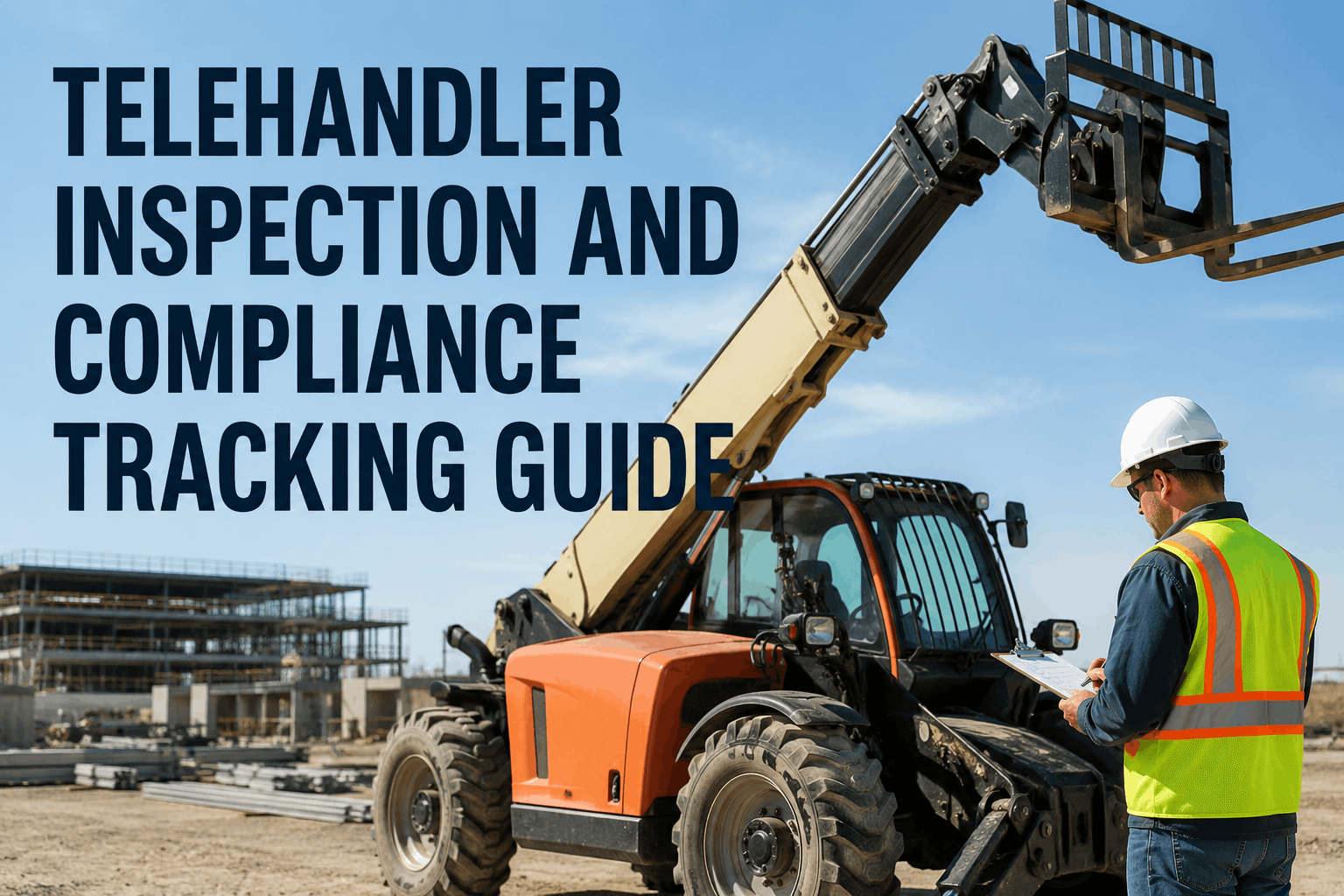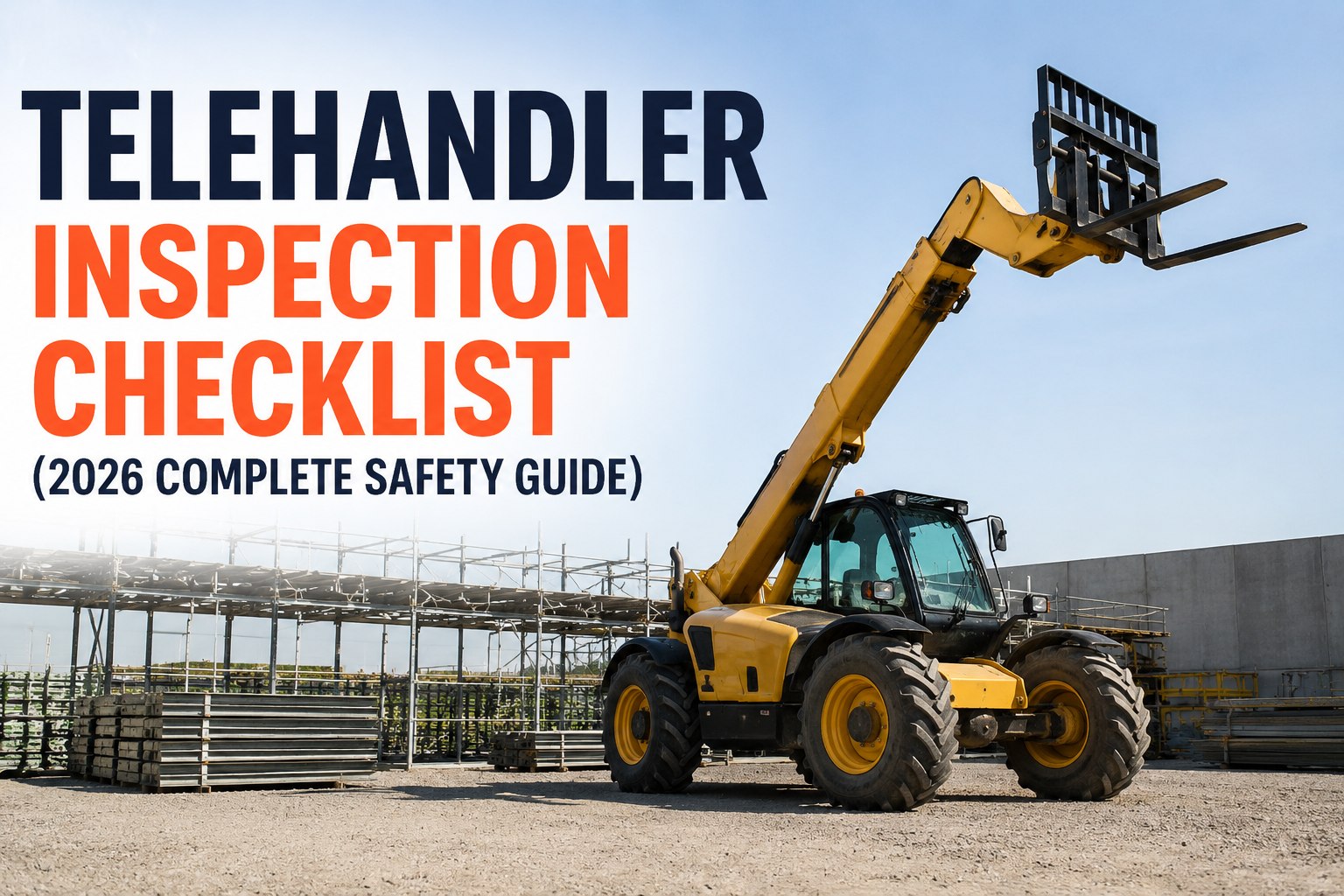
A telehandler rated at 10,000 pounds doesn't always lift 10,000 pounds. At full boom extension and maximum height, that number can drop to 3,000. The operator who doesn't check the load chart, doesn't test the LMI, and doesn't assess the ground is one pick away from a tip-over that kills. Industry data shows 42% of telehandler rollovers involve exceeding capacity, and 90% of those had a pre-use inspection failure in the chain. This is the complete telehandler inspection checklist for 2026. Book a demo to digitize every check.
Telehandler Inspection Checklist: Capacity Drops as the Boom Extends — Your Inspection Must Account for Both
The number on the data plate is the maximum. The number that matters is the one at the boom position you're actually using.
Phase 1: Engine-Off Walkaround6 zones, one loop, before the key turns — OSHA 1926.602
Park on level ground, engine off, key removed. Walk the full machine. OSHA 29 CFR 1926.602 requires daily visual inspection before each shift. ANSI B56.6-2021 specifies 56 inspection points. The 6 zones below cover everything that matters.
All sections for cracks, dents, deformation. Wear pads between sections. Extension chain or cylinder condition and attachment. Boom pins and retaining hardware. Extension markings visible for load chart reference.
Fork heels for cracks (the #1 fork failure point). Tip height difference <3% of fork length. Carriage rails for wear. Attachment locking pins fully seated. Quick-coupler condition if equipped.
Fluid level at sight glass, drum stopped. All hoses for chafe, bulge, weep at fittings. Every cylinder for rod scoring and seal leaks. Puddles under the machine. Contaminated fluid (milky = water, dark = overheated). Book a demo
Tire inflation within ±2 PSI of manufacturer spec. Cuts, sidewall damage, matched sets on each axle. Stabilizer pads for damage. Outrigger cylinders for leaks. Interlock that prevents boom operation without deployment.
Rollover and falling-object protection structure: cracks, loose bolts, damaged glass. Seatbelt latches and retracts. All mirrors clean and adjusted. Controls labeled and free-moving. Fire extinguisher charged and mounted.
Oil, coolant, DEF, fuel levels. Belt and hose condition. Air filter indicator. Load chart present, legible, and matching current configuration and attachment. Data plate with rated capacity readable. Start free — build per-model templates in HVI
Phase 2: The Live Testengine running, every control verified, before lifting anything
With the engine running and stabilizers deployed on level ground, test every control and safety system. This phase catches the defects that are invisible when the machine is off — sluggish hydraulics, drifting boom, intermittent LMI, soft brakes, steering play.
THE most critical test. Extend boom and verify LMI activates and alarms at correct thresholds. A defeated or non-functional LMI is linked to 32% of tip-overs. Non-functional = immediate shutdown. No exceptions.
Cycle full range in all directions. Must move smoothly with consistent speed, no jerking or hesitation. Hold at full height for 30 seconds — any downward drift means a cylinder seal or valve is leaking.
Turn lock to lock — smooth, no excessive play or binding. Service brake stops the machine promptly without pulling. Parking brake holds on grade. Soft or spongy brakes are an immediate tag-out. Book a demo
Bubble or electronic level reads accurately. Stabilizer interlock prevents boom operation when outriggers aren't deployed. Boom limit switches function. Horn and backup alarm operational.
Fork tilt, side shift, or specialty attachment. Quick-coupler pins fully seated and locked. An unsecured attachment at height is a dropped-object fatality risk. Verify before every lift.
The Load Chart Is Not a Stickerit's a reference the operator must consult before every single lift
42% of telehandler tip-overs involve exceeding the load chart. Not because operators are reckless — but because the chart is faded, missing, doesn't match the current attachment, or the operator doesn't have the boom position data to read it correctly. The pre-use inspection must confirm four things about the load chart.
Must match the machine's model, serial number, and current attachment. A telehandler with a man basket has a completely different chart than one with forks.
The operator must read boom angle from the cab to reference the chart. Non-functional indicator = guessing at capacity. Book a demo
The operator must know how far the boom is extended. Worn or painted-over markings turn the load chart into fiction.
The chart assumes firm, level ground. Soft soil, slopes, or uncompacted fill reduce stability beyond what any chart shows. Assess at every lift location. Start free
From a rental fleet manager running 40 telehandlers across 15 sites
Rental telehandlers come back with damage nobody reported. A customer returns a machine with a cracked boom section, and we don't know if it happened on day one or day thirty. Our paper pre-use checklists were getting done maybe half the time, and the ones that came back were all "OK" across the board — even on machines with visible hydraulic leaks.
Digital inspections with required photos at boom sections and stabilizers changed everything. We started catching damage at delivery instead of return. Customer accountability went up because both sides had timestamped, photo-documented inspections. Warranty disputes dropped about 60% in the first year. The LMI verification step alone probably prevented two or three tip-overs we'd never have known about.
Frequently asked questions
How often must telehandlers be inspected?
OSHA 29 CFR 1926.602 requires daily visual inspections before each shift with documented findings. ANSI B56.6-2021 specifies 56-point inspection criteria covering load charts, stability systems, and attachments. OSHA 1926.1417 mandates annual third-party inspections with certification for telehandlers used in crane-like lifting operations. Some states impose additional requirements (California requires quarterly inspections). The daily pre-use inspection covers an engine-off walkaround (boom, forks, hydraulics, tires, stabilizers, ROPS/FOPS, fluids, load chart) and an operational test (boom function, LMI, brakes, steering, level indicator, attachment). Any defect affecting safe operation requires immediate removal from service.
What causes most telehandler tip-overs?
Five factors account for the majority of telehandler tip-overs, all preventable through proper inspection: exceeding load chart capacity (42% of incidents, typically because the operator didn't account for reduced capacity at extended boom positions), load moment indicator defeat or failure (32%, where the LMI was bypassed or not tested), soft or uncompacted ground (28%, where stabilizers or tires sank under load), tire failure (18%, from under-inflation or construction-site damage), and slopes exceeding 5 degrees (15%, where lateral stability was exceeded). The pre-use inspection addresses each factor: load chart verification, LMI function test, ground assessment, tire inspection, and level indicator check.
Why does telehandler capacity change with boom position?
A telehandler's lifting capacity decreases as the boom extends and rises because the load moves farther from the machine's center of gravity, creating a greater tipping moment. A machine rated at 10,000 pounds with the boom retracted may only safely lift 3,000 to 4,000 pounds at full extension and maximum height. The load chart accounts for this by showing capacity at every combination of boom angle and extension. This is why the pre-use inspection must verify the load chart is present and legible, the boom angle indicator works, extension markings are visible, and the LMI functions correctly. Without these four elements, the operator has no way to determine the actual safe capacity at a given boom position.
What is the Load Moment Indicator and why is it critical?
The Load Moment Indicator (LMI) is the telehandler's primary electronic system for preventing tip-overs. It continuously monitors boom angle, extension, and load weight, and alarms or locks out boom function when the machine approaches its stability limit. Analysis shows 32% of telehandler tip-overs involve a defeated or non-functional LMI. During the pre-use inspection, the LMI must be tested with the boom extended to verify it activates at correct thresholds. Any LMI that fails to function, has been bypassed, or shows signs of tampering is an immediate shutdown condition. Monthly calibration per manufacturer specifications is recommended, with documentation maintained in the maintenance record.
Can I digitize telehandler inspections for construction and rental fleets?
Yes. HVI (Heavy Vehicle Inspection) lets construction fleets and rental companies build per-model telehandler inspection templates covering the walkaround and operational test in one digital flow. LMI verification is built in as a mandatory step that cannot be skipped. Photo capture is required at boom sections, fork heels, stabilizer pads, and the load chart. Defects auto-generate work orders to maintenance. For rental operations, delivery and return inspections create timestamped, photo-documented condition records that resolve damage disputes and protect warranty claims. Every inspection is GPS-tagged and digitally signed, creating audit-ready records for OSHA, insurance, and fleet management.
10,000 lb rated. 3,000 lb at full extension. The inspection catches the difference.
Build per-model templates. Mandate LMI testing. Require photos at boom and stabilizers. Auto-generate work orders. Delivery and return inspections for rentals. GPS and timestamp every record. Works with JCB, CAT, JLG, Manitou, and any OEM. Live in under a week.
No credit card · No hardware · OSHA-ready from day one