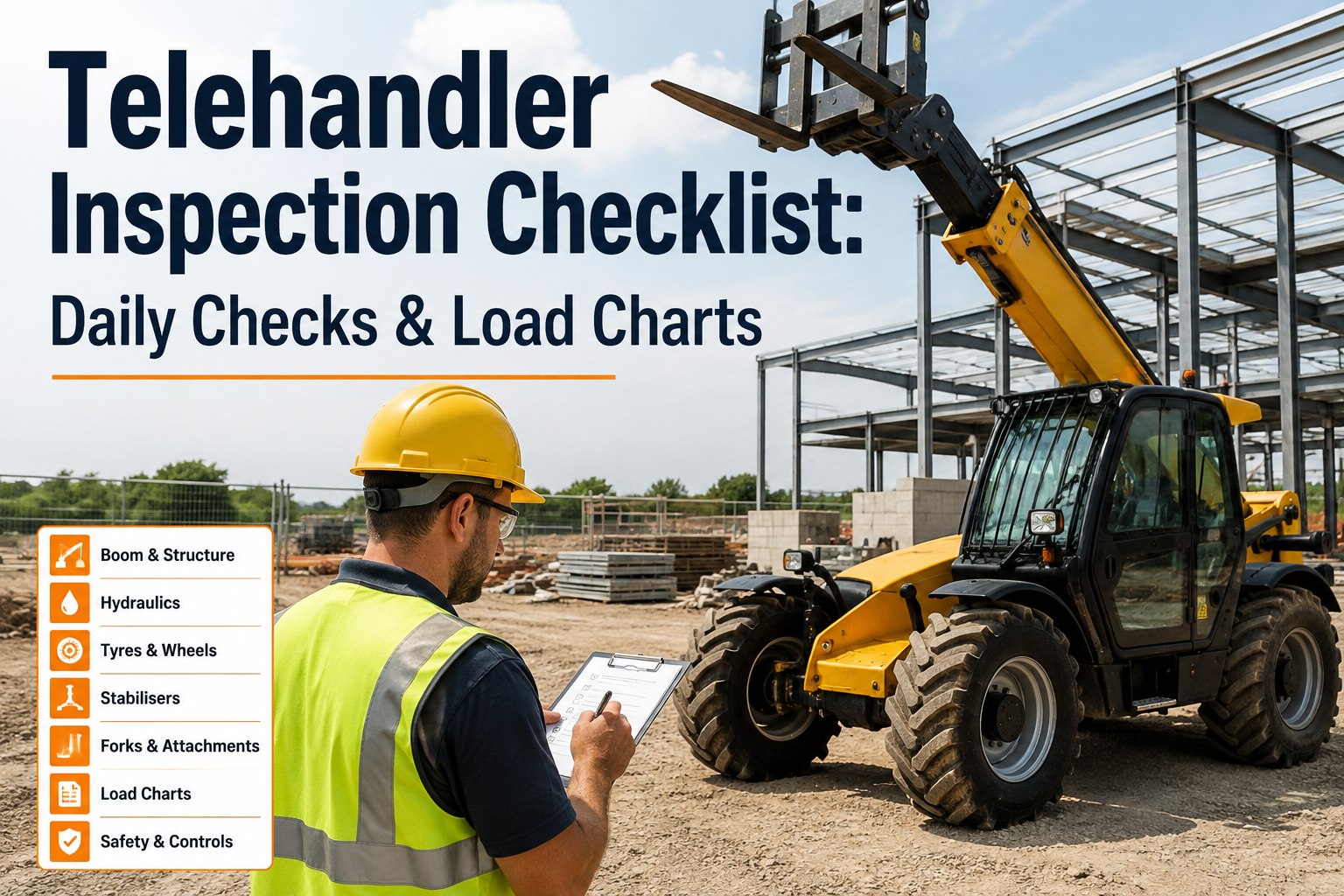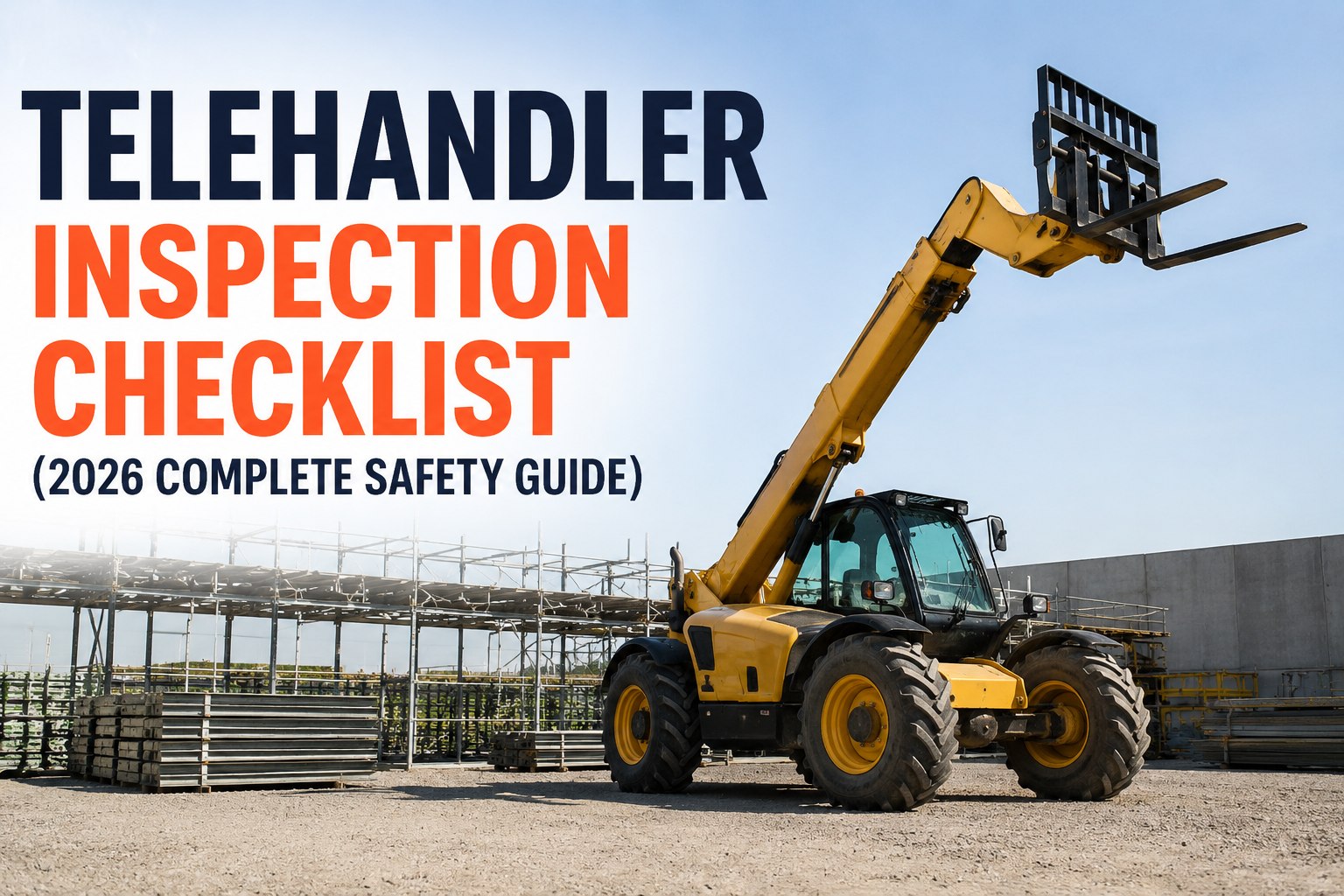
A telehandler's safe lifting capacity isn't one number — it's a load chart that changes with every degree of boom angle and every foot of extension. A machine rated 10,000 lb close-in might safely lift only a fraction of that at full reach. Here's what most maintenance programmes miss: that chart is only valid if the machine is still in the condition it was rated in. Worn boom pads, a sloppy coupler, a bent fork, or an out-of-calibration load-moment indicator quietly move the machine off its own chart — no warning light, until a lift that "should" be fine tips over. See telehandler service tracked per unit
Why worn components move a telehandler off its load chart
Switch between a machine maintained to spec and one with worn pads and a sloppy coupler. Watch the load drift toward the tip line — on the same lift.
Tight wear pads keep the boom rigid and extending true, the coupler holds the fork square, and a calibrated load-moment indicator reads the real moment. The load sits where the chart says it should — comfortably inside the stability envelope. The rated capacity is real.
Worn pads let the boom sag and flex, a sloppy coupler lets the fork tilt the load's centre of gravity outward, and an uncalibrated LMI under-reads the moment. The same lift now sits further out and lower — the machine is operating past the envelope the chart assumed, with nothing on the dash to say so.
The load chart never changes. The machine's condition does — and a telehandler maintained off-spec is running on a chart that no longer describes it. That's why wear-pad, coupler, and LMI maintenance is a stability issue, not a housekeeping one.
A telehandler is really three machines in one — a rough-terrain carrier, a hydraulic crane, and a forklift — and its maintenance has to serve all three at once. The chassis and driveline keep it moving, the boom and hydraulics do the lifting, and the forks, coupler, and stability systems keep the load and the operator safe. Miss the routine driveline service and you lose a machine; miss the boom-and-stability maintenance and you lose the safe-lift guarantee the whole machine exists to provide. Below is how the pieces fit, and why the boom end deserves the most attention.
The boom end: wear pads, coupler, and forks
The single most telehandler-specific part of the maintenance programme is the boom and its business end — the systems that don't exist on a wheel loader and that directly govern whether the machine still matches its load chart. These are the components to watch hardest.
Boom wear pads
The sliding pads between boom sections. As they wear, play opens up — the boom sags, flexes, and extends unevenly, shifting the load further out and down than the chart assumes. Measure them against the wear limit and shim or replace before the play grows.
Quick-coupler & carriage
The interface that locks attachments on. Worn locking pins, a sloppy carriage, or a coupler that doesn't fully seat lets the attachment tilt — changing the load's centre of gravity and risking a dropped attachment. Verify the locking system engages positively every attachment change.
Forks & attachments
Fork heel wear is measured against the removal criterion — commonly 90% of original thickness — and blades checked for cracks near the heel and hook, and for alignment. A bent or worn fork shifts the load's centre of gravity with no obvious warning. Each attachment has its own load chart, too.
Boom structure & pivots
Every boom section checked for cracks, dents, and deformation; pivot pins and the slide rails or extension chains for wear and play; chassis and frame welds at high-stress joints. The structure is what carries the moment — a crack here is the failure you never want.
Notice the through-line: nearly every one of these, worn, changes where the load actually sits relative to the machine's tip line — which is precisely what the load chart is computing. Measuring wear-pad play and fork thickness against their limits, and trending them over services, is how you know the machine still lifts what its chart says it does. Book a demo and log wear-pad and fork measurements against each telehandler.
Stability systems: the LMI, stabilisers, and level
Beyond the mechanical parts, a telehandler carries active stability systems — the safety net that catches the lift the load chart alone wouldn't. All three are function tests, not visual checks: when they drift, the machine loses its warning without losing its confidence.
Reads the real-time moment and warns as capacity is approached — but only if calibrated. An LMI that under-reads is worse than none: it gives false assurance.
Test: alarm confirmed at the capacity limitWhere fitted, they must deploy, hold firm ground contact, and their interlock must actually block boom operation when they're not down for a lift that needs them.
Test: interlock confirmed to block the boomThe levelling system keeps the chassis square on rough ground — and directly affects the tip line. An unlevel machine is lifting on a chart that assumes level.
Test: level indicator confirmed accurateConfirm calibration intervals and test procedures against the manufacturer for your machines — and note that in some regions telehandlers used for lifting fall under separate thorough-examination rules. Book a demo to see LMI and stabiliser tests captured as recorded confirmations
The service schedule underneath it all
The stability and boom systems ride on top of a conventional rough-terrain service schedule, and that base still has to be right. Telehandler maintenance runs on operating hours, with an early break-in service and then repeating tiers — the tasks are model-specific, but the cadence is familiar.
Pre-start, operator
Walkaround: fluids, tyres, hoses, wear points, forks and coupler, stabilisers, LMI and alarm function, plus a cold boom-function cycle. Any fail grounds the machine until it's rectified.
Break-in service
Initial engine oil and filter change, fuel filters, and a cooling clean-out — the early service that clears break-in debris before it does damage. Easy to skip on a new or rental machine, costly if you do.
Frequent service
Engine oil and filters, lubrication of lift cylinder, boom pivots and axle oscillation, wheel-nut torque, belt and hose checks, and boom wear-pad inspection. The workhorse interval.
Major service
Hydraulic oil and filters, transmission and axle/differential fluids, planetary carrier service, deeper structural and stability-system checks. Bigger, less frequent, and the one that sneaks up on a hard-run machine.
Machines don't hit these intervals evenly — a telehandler on a busy build reaches 500 hours in a fraction of the time a light-duty yard unit does. Triggering each service off actual meter hours, not the calendar, is what keeps both on time.
Attachment-heavy work loads the coupler, boom pads, and auxiliary hydraulics harder, so tighten the boom-end checks when the machine runs buckets, grabs, or jibs. Always confirm intervals against the manufacturer's manual. Book a demo to see hour-based PM fire off each telehandler's meter
The pre-lift check that keeps the machine on its chart
These are the items that decide whether the load chart still describes the machine in front of you. Run them before the shift, and log any find with a photo. Use this pre-lift checklist online free, so an off-spec machine is flagged before it's trusted with a rated lift.
Rental, mixed fleets, and the record that follows the machine
Telehandlers move — between sites, between operators, in and out of rental. That mobility is exactly what makes a per-machine record essential: a machine that changes hands every few weeks accumulates damage and wear that no single operator sees the whole of, and the load-chart-critical components are precisely the ones that get quietly knocked in transit and handoffs.
On a mixed fleet, a per-machine record earns its keep three ways:
The machine that just came off a rental with a knocked coupler and an overdue LMI calibration shouldn't be a mystery — its record should say so before it lifts again. Start free and give every telehandler a service history that travels with it
From an equipment manager running a rental telehandler fleet
The thing nobody outside this world gets is that a telehandler can look perfect and still be off its load chart. We had one come back from a hire with the boom wear pads shot — the boom had visible sag at full extension. On paper it was a 4-tonne machine. In that condition, at reach, it was a tip-over waiting for the wrong load. No fault code, no warning, just worn pads nobody had measured in months.
Now wear-pad play and fork thickness get measured and logged every service, the LMI calibration is a tracked due-date, and every machine's history travels with it no matter which site it's on. When one comes off rental, I can see its condition before it goes back out. We stopped treating the load chart as a sticker in the cab and started treating it as something the maintenance has to keep true.
Telehandler maintenance FAQs
What are the telehandler service intervals?
By operating hours, with a daily operator pre-start check layered on top — not by the calendar or mileage. A typical cadence: a daily walkaround (fluids, tyres, forks, coupler), roughly 250/500-hour interval services following the OEM manual, and a periodic thorough exam plus LMI calibration. The hour meter, not the odometer, drives the schedule.
Why are boom wear pads so important on a telehandler?
Boom wear pads are the sliding bearings between the telescopic boom sections, and they matter beyond smooth operation because they affect stability directly. As they wear, the boom develops play — the load shifts slightly off where the load chart assumes it is, moving the machine off its own rating. Worn pads are a stability issue, not just a comfort one.
How does a telehandler load chart relate to maintenance?
The load chart is the machine's safe capacity at every boom angle and extension, and it's only valid if the machine is still in the condition it was rated in. Worn pads, a sloppy coupler, a bent fork, or a drifted LMI all move it off that chart with no warning. So maintenance isn't separate from the chart — it's what keeps the chart honest.
What stability systems does a telehandler need maintained?
Active systems that must be function-tested, not just eyeballed: the load-moment indicator (calibrated so it warns and cuts out at the real limit), the stabilisers or outriggers where fitted, and the frame level indicator. A telehandler out of level loses capacity fast, so these systems are the safety net the whole load chart depends on.
How should telehandler maintenance be managed across a rental or mixed fleet?
With a per-machine record that follows the unit. Telehandlers move constantly between sites, operators, and rental agreements, so service and defect history has to travel with the machine, not live on one site's clipboard. One system tracking each unit by hours means the next site inherits a known machine, not a mystery — and the record proves it was maintained to spec.
Make telehandler maintenance the thing that keeps the chart honest
HVI fires each telehandler's hour-based PM off its real meter, adjusts checks by fitted attachment, trends wear-pad play and fork thickness against removal criteria, tracks LMI and calibration due-dates, captures pre-start and function tests offline, and keeps a per-unit service and cost history that travels with the machine across sites and rentals. Keep the load chart an accurate description of every machine — not an optimistic sticker. See it on your own fleet.
No credit card · Hour-based PM from day one · Works offline on site