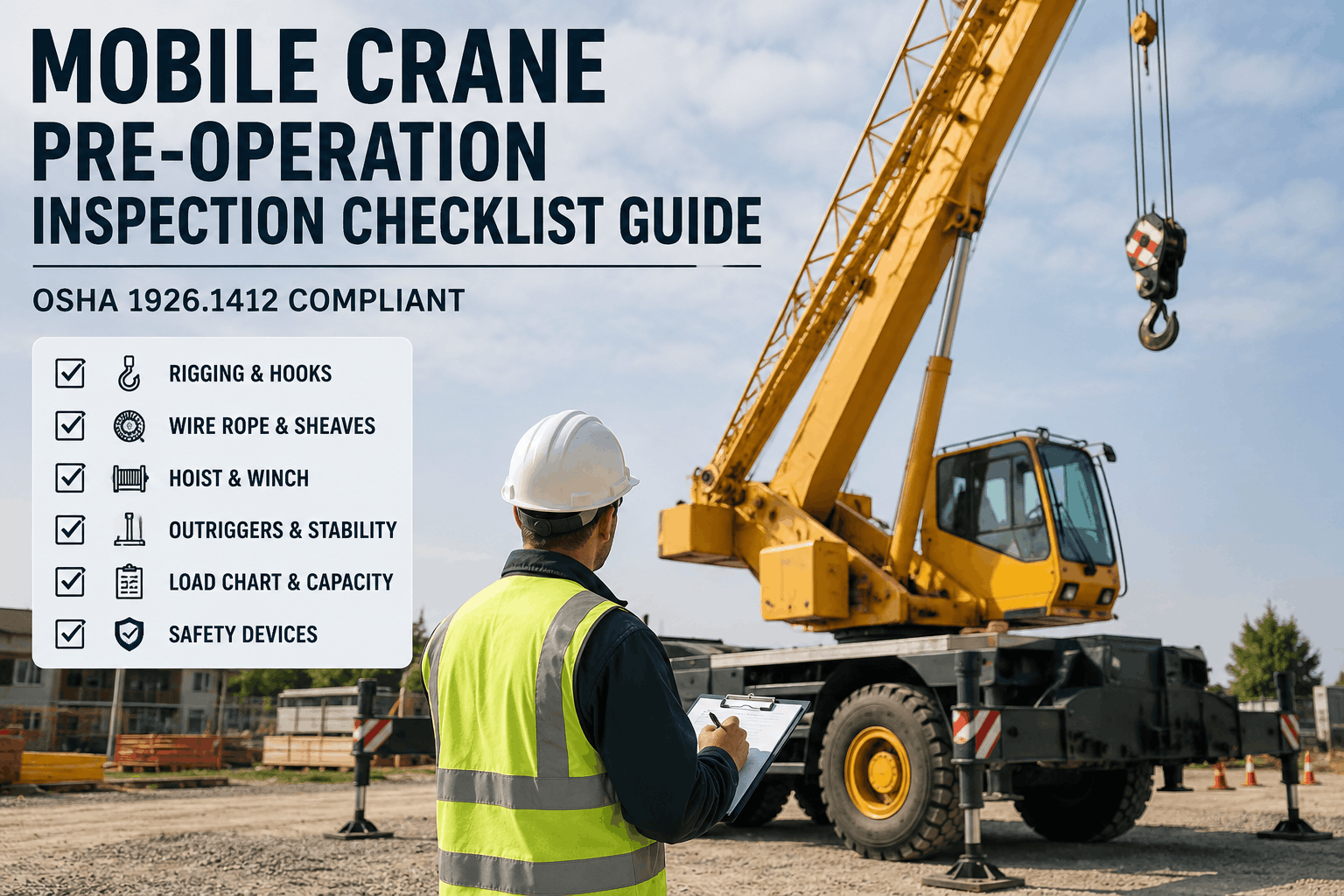
A mobile crane carries the highest daily inspection burden of any machine on a construction site — it moves between jobs, sets up on different ground every time, and suspends loads where a single failure is catastrophic. Crane-related fatalities average 42–44 per year in the United States, and the consequences of a weak inspection program reach far past fines: dropped loads, boom collapses, multi-million-dollar litigation, and project shutdowns. OSHA 29 CFR 1926.1412 is unambiguous about the cadence — a visual inspection by a competent person before each shift, a documented monthly inspection, and a comprehensive annual inspection by a qualified person — with ASME B30.5 incorporated by reference, making it legally enforceable. The shift inspection is also the most-skipped requirement on site, usually because it's rushed: a proper mobile-crane pre-op runs 30–60 minutes, and the items most often missed (wire rope broken-wire counts, brake-drift tests) are exactly the ones that need slow, deliberate observation. HVI's crane inspection and maintenance software turns the pre-op walkaround, the monthly and annual cadence, and every defect into one timestamped, photo-backed, audit-ready record. This guide walks the inspection in operating sequence, flags the setup hazards that cause the worst incidents, and shows how HVI keeps the documentation defensible. schedule a 30-minute walkthrough with our team to see it set up for your rough-terrain and all-terrain fleet.
The most-skipped inspection on site is the one suspending the load over your crew.
HVI puts the OSHA 1926.1412 pre-op walkaround on every operator's phone — structure, setup, wire rope, and function checks — logged with photos, plus monthly and annual inspections scheduled and flagged before they lapse.
The three inspection intervals OSHA requires
1926.1412 sets a layered cadence by frequency and depth. Knowing which interval applies — and who is qualified to perform it — is the foundation of a compliant crane program.
Pre-operation / shift inspection
A visual inspection before each shift by a competent person. For a mobile crane this runs 30–60 minutes. OSHA doesn't mandate written records for the construction shift check — but documenting it is the only way to prove it happened.
Who: competent personDocumented monthly inspection
A more detailed inspection focused on critical components — wire rope, hooks, and load-bearing parts. Documentation is required, and records must be retained for at least three months.
Who: competent personComprehensive annual inspection
A full evaluation of every load-sustaining structural component — boom, jib, turntable, outrigger beams, counterweight mounting, hook block, carrier frame — against manufacturer wear limits. Records retained 12+ months.
Who: qualified personASME B30.5 (mobile cranes) provides the detailed technical criteria OSHA incorporates by reference — so meeting B30.5 isn't optional best practice, it's legally enforceable. Operators must also hold NCCCO or equivalent certification per 1926.1427.
The pre-op inspection, in operating sequence
Work the crane the way you'll operate it — structure first, then setup, then the lifting system, then function. In HVI, each stage is a checklist section completed on a phone, with a photo required on any flagged item.
Structure & carrier
- Boom sections and pin connections for cracks, dents, deformation, missing pins
- Jib structural integrity and backstop condition (if equipped)
- Turntable and swing bearing — no loose bolts
- Tires for inflation and sidewall damage, or tracks/rollers on crawlers
- Engine fluids at level; no leaks; clean start, no abnormal smoke
Setup & ground
- Outriggers fully extended, pads seated on solid ground with adequate bearing
- Ground bearing capacity adequate — engineered mat plan when in doubt
- Setup level within the crane's tolerance; no settling or water accumulation
- Counterweight matches the load-chart configuration for the planned lift
- Adequate distance from edges and excavations
Hoist, rope & rigging
- Wire rope full travel — broken wires, kinks, birdcaging, corrosion, diameter loss
- Hoist drum spooling, rope-end attachment, minimum wraps on the drum
- Hook and latch — no cracks, deformation, or throat opening
- Slings and rigging hardware inspected; correct hitch and capacity
- Hydraulic lines and cylinder rods for leaks, scoring, or pitting
Function & safety systems
- Boom raise/lower, telescope, swing, hoist up/down — smooth, no drift
- Brakes hold the crane and the load; brake-drift test
- Load Moment Indicator (LMI) configured for current boom length and radius
- Anti-two-block, limit switches, horn, and alarms functional
- Load chart present, legible, and correct for the configuration
Wire-rope broken-wire counts and brake-drift tests are the most-missed items — precisely because they can't be rushed. sign up for a free HVI account and build a sequenced crane pre-op that forces the slow checks, or schedule a live demo to see a wire-rope defect routed straight to a work order before the first pick.
The setup hazards behind the worst incidents
The deadliest crane failures rarely start with a broken part — they start with how and where the crane is set up. These four are checked before any load leaves the ground.
Ground & outrigger failure — pads on soft or settling ground cause tip-overs; use engineered mats when bearing capacity is in doubt
Power line contact — maintain minimum approach distances per OSHA 1926.1408; plan, spot, and use taglines near energized lines
Overload / wrong config — capacity falls with radius and boom length; the LMI and load chart must match the actual setup
Swing-radius struck-by — barricade the swing radius and keep the area clear; confirm wind is within lift-chart limits
A defective crane is removed from service until repaired. In HVI, flagging any of these as critical automatically tags the crane out of service, creates a work order, and keeps it locked until the repair is documented and verified.
Wire rope: know the removal criteria
Wire rope is the most safety-critical wear item on a crane and has its own standard (1926.1413). Inspect the full length through travel — these are the conditions that take a rope out of service.
Broken wires
Count broken wires in a rope lay and at end connections against the standard's limits. Running ropes and standing ropes have different thresholds — this is the count that's most often rushed and missed.
Diameter & deformation
Measure for diameter reduction from wear or core damage, and watch for kinking, birdcaging, crushing, or unstranding — any structural deformation is a removal trigger.
Corrosion & heat
Inspect for corrosion, especially at end connections and where rope sits idle, plus any evidence of heat damage. Both degrade strength invisibly and warrant removal. sign up free and log wire-rope condition with photos every shift.
Paper records vs. HVI compliance tracking
Both run the same inspection. Only one produces the defensible documentation that protects your crew, your company, and your competent person when an incident or audit happens.
Paper records
- Shift inspection rushed — rope and brake checks skipped
- No proof the pre-op happened when OSHA investigates
- Monthly and annual inspections lapse unnoticed
- Wire-rope condition never trended pick to pick
- Records scattered, hard to retain for the required months
- A defect mentioned verbally, then forgotten before the lift
With HVI software
- Every pre-op stage time-stamped per operator and crane
- Audit-ready inspection history exports in seconds
- Monthly and annual inspections scheduled and flagged before they lapse
- Wire-rope and structural findings trended over time per machine
- Records retained automatically for the full required period
- A defect becomes a photo-backed work order that locks the crane out
crane-related deaths a year in the U.S. — from dropped loads, boom collapses, and tip-overs, with multi-million-dollar litigation and project shutdowns following. The shift inspection is the single most effective control and the most-skipped requirement on site. HVI makes sure it's done, slowly, logged, and provable on every crane, every shift.
Frequently asked questions
How often must a mobile crane be inspected under OSHA?
OSHA 29 CFR 1926.1412 requires three intervals. A visual pre-operation inspection by a competent person before each shift — for a mobile crane this takes 30–60 minutes. A documented monthly inspection focused on critical components like wire rope and hooks, with records retained at least three months. And a comprehensive annual inspection by a qualified person covering every load-sustaining structural component against manufacturer wear limits, with records kept 12+ months. ASME B30.5 provides the detailed technical criteria OSHA incorporates by reference. HVI schedules all three intervals per crane and flags monthly and annual inspections before they lapse, while retaining the full history.
Does OSHA require written documentation of the daily crane inspection?
Under 1926.1412(d), the each-shift inspection must be performed by a competent person, but OSHA does not strictly require written documentation of the daily check for construction cranes — only the monthly and annual inspections must be documented and retained. That said, documenting the shift inspection is strongly advised: after a dropped load or tip-over, the first thing an investigator or insurer asks is whether the pre-op was actually done, and a logged, timestamped record is the only way to prove it. HVI captures every shift inspection with photos, time, and operator so the proof exists whether or not it's strictly mandated.
What are the most important setup checks on a mobile crane?
The deadliest crane incidents usually start with setup, not a broken part. Four checks come before any load leaves the ground: ground and outrigger integrity — outriggers fully extended with pads on solid ground and engineered mats when bearing capacity is in doubt; power line clearance — minimum approach distances per OSHA 1926.1408, with planning and spotters; load configuration — counterweight, LMI, and load chart matching the actual boom length and radius, since capacity drops as radius increases; and swing-radius control — barricading the swing area and confirming wind is within lift-chart limits. All four are part of the HVI setup checklist section.
When should crane wire rope be removed from service?
Wire rope is the most safety-critical wear item and has its own standard, 1926.1413. Remove it for: broken wires exceeding the standard's limits within a rope lay or at end connections (running and standing ropes have different thresholds); diameter reduction from wear or core damage; structural deformation like kinking, birdcaging, crushing, or unstranding; and corrosion or heat damage, especially at end connections. The full rope length must be inspected through travel, slowly — broken-wire counts are among the most-missed items precisely because they can't be rushed. HVI lets operators log and photograph rope condition each shift so wear is trended rather than discovered too late.
How does HVI help with mobile crane inspection and compliance?
HVI turns the whole program into one provable system. Operators run the sequenced pre-op — structure, setup, hoist and rope, function — from a phone, with photos required on flagged items and the slow checks built in as required steps. Defects auto-create work orders and lock the crane out of service until a documented, verified repair is logged. Shift, monthly, and annual inspections are scheduled per crane and flagged before they lapse, and structural and wire-rope findings trend over time. The full inspection and service history exports in seconds for an OSHA audit, insurer, or incident investigation. It works the same across rough-terrain, all-terrain, truck-mounted, boom-truck, and crawler cranes. schedule a demo and we will set it up around your specific cranes and lift configurations on the call.
Make every crane pre-op slow, logged, and defensible.
HVI runs your sequenced shift inspection, monthly and annual cadence, wire-rope and structural tracking, and defect work orders in one platform built for construction crane fleets. Meet OSHA 1926.1412 and ASME B30.5 with documentation you can produce in seconds — and keep every load over your crew on a crane you can prove was safe. Sign up free today.
No credit card required · Live in under two weeks · Pre-op + monthly/annual cadence + wire-rope tracking + work orders in one platform