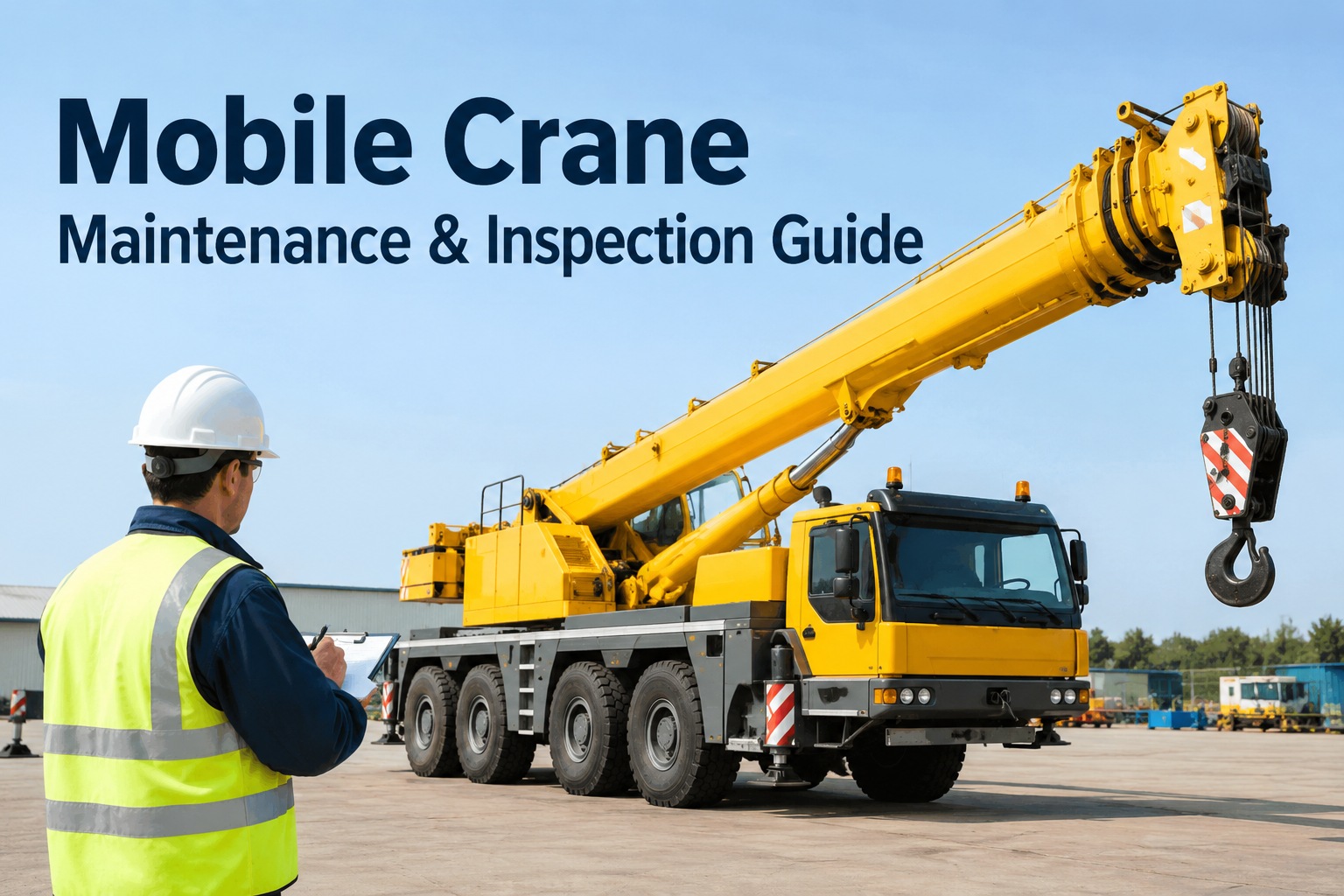
A crane's wire rope can look fine at a glance and still be one lift away from parting — which is exactly why mobile crane maintenance runs on stricter tiers than almost anything else in a mixed fleet. Below is what gets checked at each tier, the wire rope criteria that pull a rope from service immediately and how to keep a record that survives an audit instead of a lawsuit. See three tiers run per crane to see it run per crane.
Three Inspection Tiers, One Auditable Record Per Crane
Shift, monthly,and annual inspections scheduled automatically — with wire rope measurements logged against real removal criteria and every certificate stored on the asset. So the annual inspection is never where you find the surprise.
- Right inspector role & retention period on every tier
- Wire rope & hook measurements against OSHA thresholds
- Full inspection history pulls up in seconds, even offline
Three Tiers, One Chain: Miss a Level and the Whole System Breaks
Mobile crane maintenance and inspection isn't one checklist repeated on a calendar — it's three tiers of increasing scope and inspector qualification, each one assuming the level below it was actually done. OSHA's construction crane standard, 29 CFR 1926.1412, builds the requirement around a shift, monthly and annual structure, and the same logic (under different names) runs through CSA Z150 in Canada and AS 2550 in Australia.
Shift Inspection
Competent personA visual and functional check before every shift — controls, safety devices, wire rope, hydraulic lines, hooks, tires and ground conditions. Fifteen to sixty minutes of structured observation, not a form to rubber-stamp on the way to the first lift.
Monthly Inspection
Competent person, documentedEvery shift-level item plus a deeper structural and mechanical pass, written up with inspector name, date and findings, and retained on file. This is the tier most commonly missing when OSHA asks for records — and missing documentation is treated the same as a missed inspection.
Annual Inspection
Qualified personA comprehensive, often multi-day inspection by a qualified or third-party certified inspector — full structural review, non-destructive weld testing where warranted, load testing, and a complete wire rope evaluation covering sections hidden during routine checks. This is the certification decision.
Each tier folds into the next, which is exactly why a gap at the monthly level doesn't just sit quietly — it shows up as a surprise at the annual inspection, or worse, in the field. Book a demo to see all three tiers scheduled automatically per crane, with the right inspector role and retention period attached to each one.
Wire Rope: The One Component With Zero Margin for Judgment Calls
Every other item on a mobile crane inspection allows some degree of professional judgment about whether a wear pattern can wait. Wire rope doesn't. OSHA 1926.1413 and ASME B30.5 define specific, measurable removal criteria — hit any one of them and the rope comes out of service before the next lift, full stop.
Broken wires — more than six randomly distributed in one rope lay, or more than three in a single strand within one lay
Diameter reduction — wear or scrubbing exceeding roughly one-third of the original outer wire diameter
Core damage — kinking, crushing, birdcaging, or any visible core protrusion
Heat damage — any discoloration from torch contact or electrical arcing, regardless of severity
Corrosion pitting — visible pitting that measurably reduces rope diameter or strand strength
End attachment damage — cracked, deformed or worn end fittings, sockets or swaged terminations
The annual inspection is where these criteria matter most, because it's the one tier that requires examining the sections of rope normally hidden during shift and monthly checks — the portion running over sheaves, and any section subject to reverse bends. Book a demo to log wire rope measurements against these exact criteria at every tier, not just the annual one.
The Six Systems a Mobile Crane Maintenance Program Has to Cover
Wire rope gets most of the attention because the removal criteria are so specific, but a crane fails from more places than the rope. Here's what belongs on the schedule beyond it, and at what tier each one gets caught.
| System | What to check | Inspection tier |
|---|---|---|
| Hook & hook block | Throat opening (deformation), latch function, visible cracks or wear at the saddle | Shift + Monthly |
| Boom & structural members | Welds, cracks, bent or dented sections, pin and bushing wear | Monthly + Annual NDT |
| Outriggers & stabilizers | Pad condition, cylinder seals, locking pin engagement, ground-bearing capacity | Shift + Monthly |
| Hydraulic system | Hose condition, cylinder drift, fluid cleanliness, relief valve setting | Monthly |
| Load moment indicator (LMI) | Calibration accuracy, sensor connections, cutoff function under test load | Monthly + Annual |
| Anti-two-block system | Weight/switch function, alarm and cutoff response, wiring condition | Shift + Monthly |
A load moment indicator that's drifted out of calibration is one of the most dangerous failures on this list precisely because it doesn't look broken — it just reports the wrong number, quietly, until a lift goes past the crane's actual capacity.
The Pre-Lift Shift Checklist Every Operator Should Run
The annual inspection gets the certificate, but the shift check is what stops a bad lift today. Run this before the first pick of every shift — it maps to the shift-tier items in 1926.1412, and it's the fastest one to let slide when the site is running hot. Sign up free to use this checklist online in HVI so each item is tapped, timestamped and tied to the operator, instead of remembered.
Any item that fails is an immediate hold, not a "watch it this shift." Start free and build this into a recurring template for every crane in the fleet.
What's Actually at Stake in Mobile Crane Maintenance
The reason crane inspection tiers are stricter than almost any other equipment class isn't bureaucratic caution — it's the accident data. 42average crane-related deaths per year in the U.S., 2011–2017 (BLS) makes cranes one of the highest-consequence machines on any mixed fleet, and 50%+of fatal crane injuries involve a worker struck by a falling object or load (BLS) traces directly back to rigging, wire rope and load-control failures — the exact systems this maintenance structure exists to catch before they reach a live lift.
Missing or incomplete inspection records are consistently among the most-cited crane violations in OSHA audits, and they're also the fastest path from a routine citation to a willful-violation classification if an incident follows. A maintenance program that can't produce a clean, dated record for every tier isn't just a paperwork gap — in an investigation, it reads as a decision not to check. Book a demo to see how a full inspection history pulls up per crane in seconds, not a filing-cabinet search the week an auditor calls.
Keeping the Fleet Itself Inspection-Ready
A tiered inspection program only works if the crane is physically in a condition to pass it, which means the maintenance side of the program has to run ahead of the inspection side, not behind it. Wear items flagged at a shift or monthly check — a hydraulic seal starting to weep, a hook latch getting sluggish — need parts on hand and a repair scheduled before the next tier comes due, not after a rope or component has already crossed a rejection threshold. Book a demo to see parts and repair history tied directly to inspection findings, so a flagged item never sits unresolved until the next audit finds it again.
What an Equipment Manager Actually Catches at the Monthly Tier
The shift checks catch the obvious stuff — a leaking hose, a hook latch that's sticking. It's the monthly inspection that's actually saved us. We found a wire rope with corrosion pitting on a section that never came into view during a normal walk-around, only because the monthly process forces us to run it out and look at the hidden length. If that rope had gone another few months on rope-out-of-sight logic, it would have hit the annual inspection already past a rejection criterion.
The Takeaway
Mobile crane maintenance works when the three tiers actually build on each other — shift checks catching the obvious, monthly catching what the shift can't reach, annual catching what only disassembly and testing can find. Wire rope, hooks, outriggers, hydraulics and the load moment system all have specific, measurable failure points, and none of them are supposed to be judgment calls. The fleets that never get an ugly surprise at the annual inspection are the ones tracking all three tiers as one connected record instead of three separate habits. Sign up free and put every crane on its own tiered schedule this week.
Frequently Asked Questions
How often must a mobile crane be inspected under OSHA?
OSHA 29 CFR 1926.1412 requires construction mobile cranes to be inspected at three tiers: a shift inspection by a competent person before each shift, a documented monthly inspection by a competent person with findings retained for at least three months, and a comprehensive annual inspection by a qualified person with records retained for at least twelve months. If equipment has been idle for three months or more, a monthly-level inspection is also required before it returns to service.
What are OSHA's wire rope rejection criteria for cranes?
Under 1926.1413 and ASME B30.5, wire rope must be removed from service if it shows more than six randomly distributed broken wires in one rope lay (or more than three in a single strand), wear exceeding roughly one-third of the original wire diameter, kinking, crushing or birdcaging, any heat damage from torch contact or arcing, corrosion pitting that measurably reduces strength, or damage to end attachments and terminations. These are measurable thresholds, not judgment calls — any one of them takes the rope out of service immediately.
What's the difference between a competent person and a qualified person for crane inspections?
A competent person is someone capable of identifying hazardous conditions and has the authority to take corrective action — they perform shift and monthly inspections. A qualified person holds a recognized degree, certificate (such as NCCCO Crane Inspector certification), or extensive documented professional experience, and performs the annual comprehensive inspection, which can involve non-destructive testing and load testing beyond what a competent person is authorized to evaluate.
How often should crane hydraulics be serviced?
Hydraulic hoses, cylinders, fluid condition and relief valve settings should be checked at minimum during the monthly inspection tier, with fluid and filter changes following the manufacturer's hour-based service interval since hydraulics drive the boom, outriggers and load-handling functions on nearly every mobile crane. Any visible weeping at a fitting or cylinder should be treated as an immediate repair rather than logged for the next scheduled service, since a slow leak under load is how a controlled lowering becomes an uncontrolled one.
What happens if a crane fails an inspection?
A crane that fails any inspection item representing a safety hazard must be immediately removed from service and tagged "Do Not Operate" until the deficiency is corrected and re-inspected by a qualified person. Continuing to operate a crane with a known safety-critical deficiency is one of the fastest paths to a willful-violation citation if an incident occurs, and missing or incomplete inspection documentation is treated by OSHA with similar severity to a missed inspection outright.
Give Every Crane a Clean Shift, Monthly and Annual Record
HVI schedules every inspection tier automatically, captures wire rope and component measurements against real removal criteria, stores certificates and load-test history per asset, and sends alerts before a tier is due — in the yard or offline in the field.
No credit card · No hardware required · Live before your next annual inspection cycle