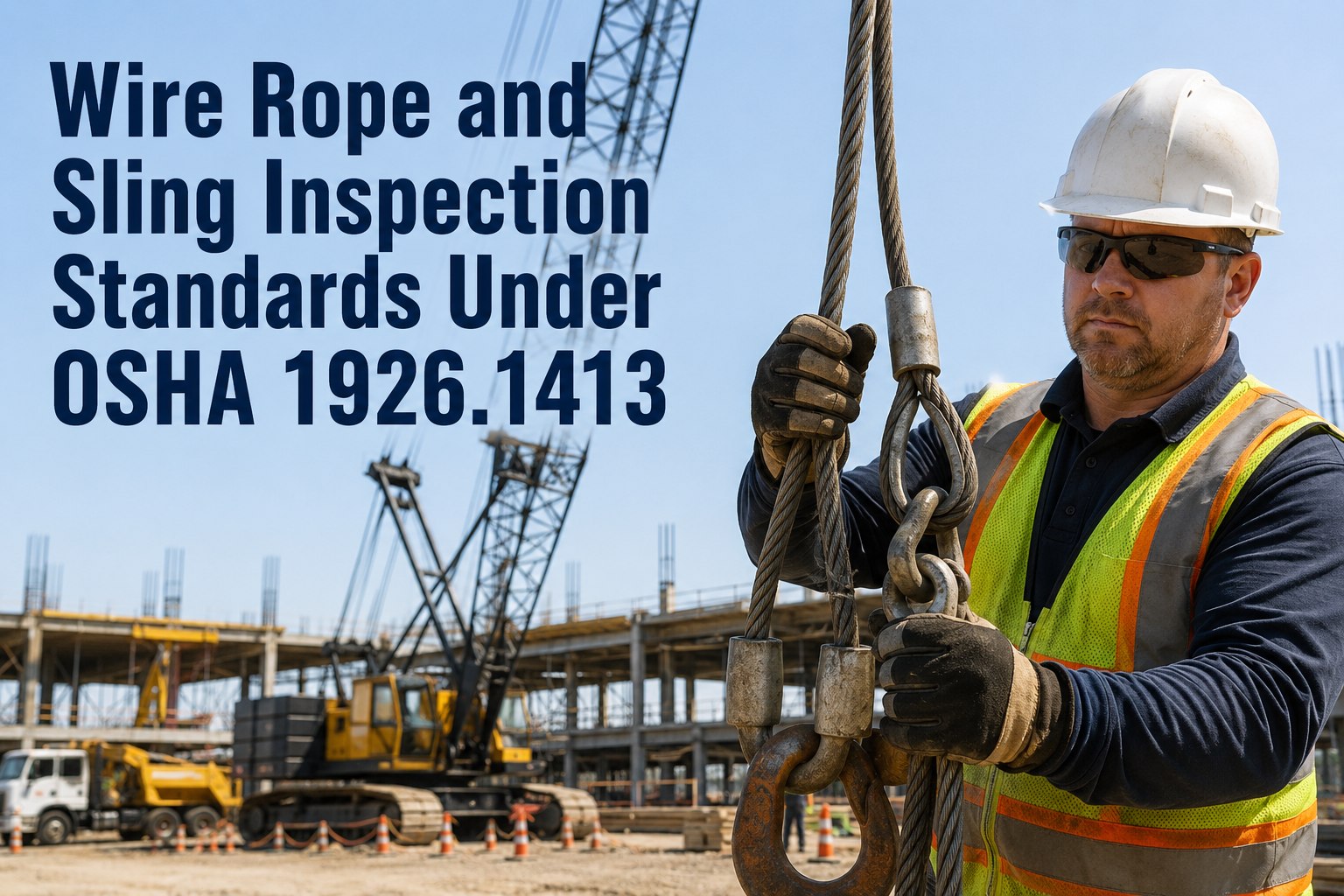
Wire rope is the single component on a crane that directly suspends every load — and unlike most failures, its failure mode offers no second chance. That's why systematic wire rope inspection under OSHA 29 CFR 1926.1413 is the most important individual inspection activity on any construction crane, and why wire rope deficiencies are the most commonly cited crane violation OSHA issues. The stakes are measured in lives: roughly 27% of crane fatalities trace to load drops from rigging and cable failure, against a backdrop of 42 to 44 crane-related deaths a year. What trips up many sites is that 1926.1413 doesn't use the simpler general-industry framework — inspectors trained under 29 CFR 1910.179 frequently misapply those criteria on construction sites, missing the entirely different three-category classification the construction standard demands. This article breaks down that framework: the Category I conditions an inspector must evaluate, the Category II thresholds that force immediate removal, the broken-wire counts by rope type, the shift/monthly/annual inspection tiers, and the tag-out rule. book a 30-minute walkthrough to see it set up for your cranes.
The rope that holds every load gives no second chance. 1926.1413 is how you catch it first.
HVI runs shift, monthly, and annual wire rope inspections from a phone — broken-wire counts, distortion, corrosion, end connections — applies the correct 1926.1413 thresholds, tags the hoist out of service when a rope must come off, and keeps the documented record OSHA requires.
Why wire rope inspection sits above the rest
Of every checkpoint on a crane, wire rope carries the most direct line to a fatality and the harshest citation history. The numbers explain the scrutiny.
The standard most sites apply wrong
A consistent pattern in OSHA citations: inspectors trained under the general-industry standard (29 CFR 1910.179) apply those criteria on construction sites — overlooking the entirely different deficiency framework in 1926.1413. The construction standard sorts wire rope deficiencies into three categories, each demanding a different response. Counting broken wires by the wrong standard is how a rope that should be off the crane stays on it.
The three-category framework
1926.1413 organizes every wire rope deficiency into one of three categories. Knowing which category a defect falls in tells you exactly what action the standard requires.
Evaluate for safety hazard
Significant distortion (kinking, crushing, unstranding, birdcaging, core protrusion), significant corrosion, electric-arc or heat damage, and improperly applied or corroded end connections. The inspector must determine whether each constitutes a hazard — and remove the rope if it does.
Remove at the threshold
Broken-wire counts and diameter reduction with specific numeric limits. Hit the threshold and the rope comes off — no judgment call. The exact numbers depend on whether the rope is running, rotation-resistant, or standing.
Critical-review conditions
Deficiencies in critical review items and at attachment points that demand prompt evaluation — the conditions where a competent person's judgment and documentation matter most.
The structural distortions in Category I — kinking, birdcaging, crushing, core protrusion — are removed from service immediately when found hazardous, with no threshold counting required. A kink doesn't get a wire count; it gets pulled. HVI's inspection flow routes each defect to the right category so the required action is never ambiguous.
Category II: the removal thresholds
These are the numeric limits that force a rope off the crane. They differ by rope type — and applying the wrong type's threshold is the classic 1926.1413 mistake.
A "rope lay" is the length along the rope in which one strand makes a complete revolution around it — the unit every broken-wire count is measured against, so getting the lay right is essential. One important exception: if the rope manufacturer has approved different criteria for broken wires or diameter reduction, those may be followed instead. HVI captures the rope type and counts against the correct threshold automatically.
The three inspection tiers
1926.1413 requires wire rope to be inspected on three intervals, each with its own scope and inspector. Each builds on the one below it.
Shift inspection
A competent person visually inspects running and standing ropes likely to be in use that shift, before or during it, for apparent deficiencies. Untwisting the rope or booming down isn't required at this level.
Monthly inspection
A documented inspection covering the same criteria in more depth, with a record kept on file. This is where the broken-wire counts and diameter measurements are formally logged.
Annual / comprehensive
A complete inspection by a qualified person, including sections normally hidden, with full documentation of items checked, results, inspector, and date retained for compliance.
Each tier produces a record, and missing or incomplete wire rope documentation is itself a common citation. sign up free and run all three tiers with the correct criteria built in, or book a demo to see crane wire rope templates.
When a rope must come off: tag it out
Finding a removal-condition defect isn't the end of the obligation — the standard dictates exactly what happens next, and skipping it is its own violation.
Remove or sever
When a rope meets a removal condition, it must be taken out of service — or, for a localized Category II defect, the defective part severed so the rope can't be used in that condition.
Tag out the hoist
Under 1926.1413(a)(3)(ii), the equipment or the hoist with that rope must be tagged out per 1926.1417(f)(1) until the rope is repaired or replaced — it can't simply be noted and left in use.
Document the action
The defect, the determination, and the removal are recorded — the trail that proves a competent person acted, which is what an OSHA review and any incident investigation will demand.
A removal condition found on paper and left in service is exactly the failure mode behind a load drop and a citation. sign up free and tag a hoist out of service the moment a rope fails inspection.
Paper checklists vs. HVI
Both technically record a rope inspection. Only one applies the correct 1926.1413 category and threshold, tags the hoist out of service, and keeps the documented record OSHA cites for when it's missing.
Paper / reactive
- General-industry criteria misapplied on construction
- Broken wires counted against the wrong rope type
- Kinking or birdcaging missed or under-evaluated
- A removal-condition rope left in service
- Tag-out skipped after a defect is found
- Monthly & annual records scattered or missing
With HVI software
- Correct 1926.1413 three-category framework built in
- Counts measured against the right rope-type threshold
- Distortion & corrosion captured with photo evidence
- A removal condition flags the rope for action
- The hoist tagged out of service until repaired
- Shift, monthly & annual records audit-ready
chance — so catch it first. Wire rope is the one crane component whose failure drops the load with no warning and no recovery, and it's the most-cited crane violation precisely because the criteria are detailed and easy to misapply. Running shift, monthly, and annual inspections against the correct 1926.1413 categories — and tagging out the moment a rope fails — is the whole defense. HVI makes that routine, correct, and documented on every crane.
Frequently asked questions
When must crane wire rope be removed from service under 1926.1413?
The construction standard sorts deficiencies into categories with different triggers. Category II sets specific numeric removal thresholds: for running ropes, six randomly distributed broken wires in one rope lay or three broken wires in one strand in one lay; for rotation-resistant ropes, two broken wires in six rope diameters or four in thirty diameters; for standing ropes like pendants and guys, more than two broken wires in one lay beyond end connections or more than one at a connection. A diameter reduction of more than 5% from nominal, or any broken strand, also forces removal. Separately, Category I structural distortions — kinking, crushing, unstranding, birdcaging, core protrusion — plus significant corrosion and heat or electric-arc damage must be evaluated by a competent person and the rope removed if found hazardous, with no wire count needed. One exception: a manufacturer may approve different broken-wire or diameter criteria. HVI's inspection and maintenance software applies the correct threshold by rope type automatically. sign up free and apply the right criteria every time.
What's the difference between Category I and Category II deficiencies?
They demand different responses. Category II deficiencies are objective, countable conditions with fixed numeric thresholds — broken wires per lay or per strand, diameter reduction over 5%, a broken strand. When a rope hits one of these limits, it comes off the crane; there's no judgment involved. Category I deficiencies are conditions that require a competent person to evaluate whether a safety hazard exists: significant distortion of the rope structure such as kinking, crushing, unstranding, birdcaging, or core protrusion; significant corrosion; electric-arc or heat damage; and improperly applied or corroded, cracked, bent, or worn end connections. For these, the inspector makes a determination, and if the condition is hazardous the rope is removed or the defective part severed. The practical point is that a structural distortion like a kink doesn't get a wire count — if it's hazardous, it's pulled immediately. HVI's inspection and maintenance software routes each defect to the correct category so the required action is clear. book a demo to see the category-based flow.
How often must crane wire rope be inspected?
1926.1413 requires three intervals. A shift inspection is performed by a competent person before or during each shift the equipment is used, consisting of a visual observation of running and standing ropes likely to be in use that shift for apparent deficiencies — untwisting the rope or booming down isn't required at this level. A monthly inspection covers the same criteria in more depth and must be documented, with the record kept on file; this is typically where formal broken-wire counts and diameter measurements are logged. And an annual or comprehensive inspection by a qualified person examines the rope more thoroughly, including normally hidden sections, with full documentation of items checked, results, inspector, and date. Missing or incomplete wire rope documentation at the monthly and annual levels is itself a common citation, so the record matters as much as the inspection. HVI's inspection and maintenance software runs all three tiers and retains the records. sign up free and never miss an interval.
Why do inspectors apply the wrong wire rope standard on construction sites?
It's a well-documented pattern in OSHA citations: inspectors and competent persons trained under the general-industry standard, 29 CFR 1910.179, carry those criteria onto construction sites — but construction cranes fall under Subpart CC and 29 CFR 1926.1413, which uses an entirely different three-category deficiency framework. The thresholds differ too. For example, some general-industry and ASME references for overhead cranes allow twelve broken wires in one lay, while the construction standard's running-rope threshold is six in one lay or three in one strand. Applying the more permissive number on a construction site can leave a rope in service that the governing standard requires off. The safe practice is to know which standard governs your equipment and, when in doubt, use the more conservative threshold. A system that's built around the correct construction criteria removes the chance of the mix-up. HVI's inspection and maintenance software applies the 1926.1413 framework directly. book a demo to see the construction-specific criteria.
How does HVI help with wire rope and sling inspection?
HVI is an inspection and maintenance software platform built to run the 1926.1413 wire rope program correctly and keep it documented. It provides shift, monthly, and annual inspection templates that follow the construction standard's three-category framework, captures the rope type so broken-wire counts are measured against the correct Category II threshold — running, rotation-resistant, or standing — and records Category I conditions like kinking, birdcaging, corrosion, and end-connection wear with photo evidence. When a rope meets a removal condition, the platform flags it for action and can tag the hoist out of service until it's repaired or replaced, in line with the tag-out obligation, and every defect auto-creates a tracked work order so nothing is left in service. It keeps timestamped records of every inspection — competent person, results, and date — so the monthly and annual documentation OSHA looks for is always audit-ready, and it works offline on the jobsite. book a demo and we'll map the software onto your cranes on the call.
The rope that holds every load deserves the inspection the standard actually requires.
HVI runs shift, monthly, and annual wire rope inspections against the correct 1926.1413 three-category framework, counts broken wires by rope type, captures distortion and corrosion with photos, tags the hoist out of service when a rope must come off, and keeps audit-ready records. Stop applying the wrong standard — and stop leaving a removal-condition rope on the crane.
No credit card required · Live in under two weeks · 1926.1413 criteria + shift/monthly/annual tiers + hoist tag-out + audit-ready records in one platform