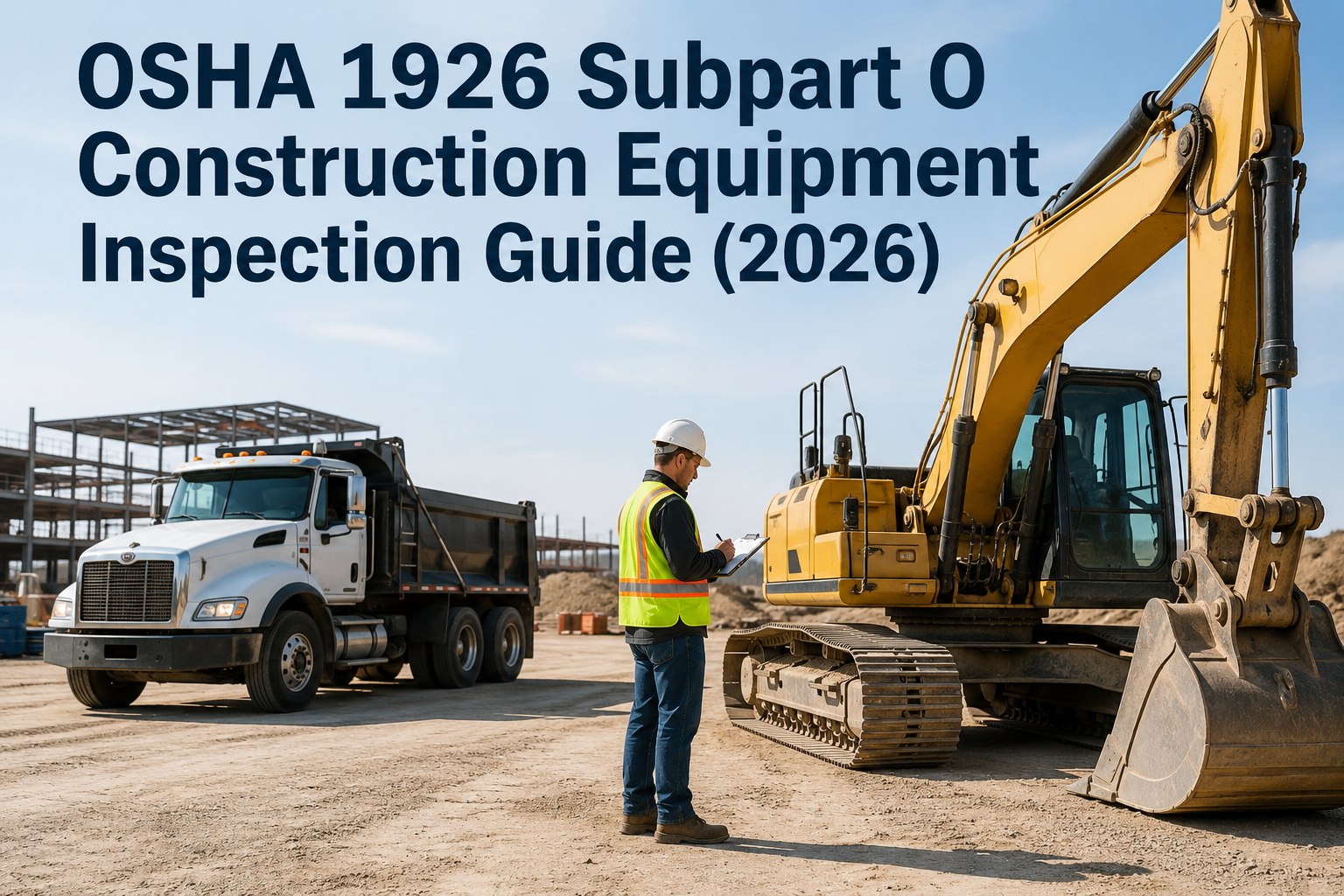
Construction equipment lives under a different rulebook than the trucks on the highway. A commercial motor vehicle answers to DOT and FMCSA; an excavator, loader, dozer, or off-highway haul truck working inside a jobsite answers to OSHA — specifically 29 CFR 1926 Subpart O, "Motor Vehicles, Mechanized Equipment, and Marine Operations." The stakes are not abstract: equipment failures cause roughly one in five construction fatalities, and about 90% of those failures are preventable with proper inspection. The cornerstone of Subpart O is one sentence in 1926.601(b)(14): all vehicles in use shall be checked at the beginning of each shift to assure that parts, equipment, and accessories are in safe operating condition and free of apparent damage that could cause failure. That single requirement — a documented pre-shift inspection by a competent person — anchors the whole compliance picture, and the penalty for ignoring it now reaches $16,550 per serious violation and $165,514 for willful or repeated ones. This guide breaks down what Subpart O covers, how its standards map to your equipment, what the pre-shift inspection must verify, and how to document it for an OSHA audit. book a 30-minute walkthrough to see it set up for your fleet.
Construction gear answers to OSHA, not DOT — and Subpart O starts every shift with an inspection.
HVI runs the 1926.601(b)(14) pre-shift inspection from a phone — brakes, lights, audible warning, ROPS, and safety systems — by a competent person, flags any defect, tags unsafe equipment out of service, and keeps the documented record an OSHA audit demands.
Why Subpart O compliance matters
The numbers behind the standard explain why OSHA treats pre-shift inspection as non-negotiable — and why the penalties for skipping it are steep.
The distinction that trips up many contractors: construction equipment that operates within an off-highway jobsite isn't governed by the DOT/FMCSA rules that cover highway trucks — it falls under OSHA's 29 CFR 1926, with different inspection requirements, documentation standards, and penalty structures. Applying a highway DVIR mindset to a jobsite excavator misses the OSHA-specific obligations entirely. Subpart O is the standard that actually governs the machine.
The cornerstone: 1926.601(b)(14)
One requirement anchors the entire standard. Everything else builds on this pre-shift mandate.
Checked every shift
All vehicles in use shall be checked at the beginning of each shift — not weekly, not when convenient. The inspection happens before the equipment works, every working day.
Safe operating condition
The check assures parts, equipment, and accessories are in safe operating condition and free of apparent damage that could cause failure while in use — a functional verification, not a glance.
Defects pull the machine
Findings must be communicated to the employer, and until any issue is fixed, the vehicle must not be operated. A defect is a stop-work condition, not a note for later.
The standard also requires, under 1926.20, that a competent person make frequent and regular inspections of the jobsite, materials, and equipment — so the pre-shift check has to be performed by someone qualified by training or experience, not just anyone with the keys. HVI structures the pre-shift inspection around exactly this requirement and records who performed it.
How Subpart O maps to your equipment
Subpart O isn't one rule — it's a set of standards, each governing a different class of equipment. Knowing which applies tells you what the inspection must cover.
Equipment (general)
General rules for all equipment: maintained in safe condition, and blades, buckets, and dump bodies lowered or substantially blocked and cribbed when not in use or being repaired.
Motor vehicles
Off-highway jobsite vehicles: service, emergency, and parking brakes; headlights, taillights, brake lights; audible warning device; seat belts per 49 CFR 571; cab shields; dump-body locks — plus the (b)(14) pre-shift check.
Material handling equipment
Earthmoving and lifting gear — scrapers, loaders, dozers, graders, off-highway trucks, lift trucks. ROPS, audible alarms on bidirectional machines, posted rated capacity, and industrial trucks per ANSI B56.1.
Competent-person duty
The umbrella requirement: an accident-prevention program with frequent and regular inspections by competent persons, and only trained, qualified employees operating equipment.
Cranes step outside Subpart O into the more detailed 1926.1412 regime — shift, monthly, and annual inspections — but every other machine on the site lives here. sign up free and run equipment-specific Subpart O inspections, or book a demo to see templates by equipment type.
What the pre-shift inspection must verify
Pulling the standards together, these are the safety-critical items 1926.601 and 1926.602 require to be in operable condition before a machine works. Each is a pass-or-pull check.
The dump-body support requirement is one operators forget: trucks with dump bodies must have a positive, permanently attached means of support that locks in position to prevent accidental lowering while maintenance or inspection is being done — a direct cause of crush fatalities when skipped. HVI builds the Subpart O safety items into each equipment template.
Documentation: what an audit demands
OSHA inspections require proof, and the proof is the record. Subpart O inspections are expected to be documented — and best practice is to document even where the letter of a standard doesn't compel it.
Who, what, when
A record showing the competent person who inspected, the machine, the date and shift, and what was found — the trail that proves the (b)(14) check actually happened.
Defect-to-repair chain
A found defect, the decision to remove the machine, and the verified repair — documented so the "fixed before operation" requirement is demonstrably met.
Exportable on demand
When an OSHA compliance officer asks, the inspection and repair history exports in minutes instead of a scramble through paper that may not exist.
Best practice is to document every inspection even when a specific standard doesn't explicitly require it — because an undocumented inspection is, to an auditor, an inspection that didn't happen. sign up free and keep an audit-ready Subpart O record on every machine.
Paper checklists vs. HVI
Both technically record a pre-shift check. Only one structures it around the Subpart O requirements, captures the competent person, tags unsafe equipment out of service, and produces the documented record an OSHA audit demands.
Paper / reactive
- DOT-style check that misses OSHA-specific items
- Pre-shift inspection skipped or rubber-stamped
- ROPS, alarms & dump-body locks not verified
- Defects noted on paper, machine run anyway
- No proof of the (b)(14) check for an audit
- $16,550–$165,514 exposure on a missed inspection
With HVI software
- Subpart O templates by equipment type
- Pre-shift check photo-verified, competent person logged
- ROPS, alarms, brakes & blocking all required items
- A failed item tags the machine out of service
- Every defect auto-creates a tracked work order
- Audit-ready records export in minutes
preventable — so prevent them. Equipment failures cause one in five construction fatalities, and roughly 90% are preventable with proper inspection. The pre-shift check required by 1926.601(b)(14) is the control that prevents them, and the documented record is what proves compliance and shields against the $16,550-to-$165,514 penalty exposure. HVI makes the Subpart O inspection routine, competent-person-verified, and audit-ready on every machine.
Frequently asked questions
What does OSHA 1926 Subpart O require for equipment inspection?
Subpart O — Motor Vehicles, Mechanized Equipment, and Marine Operations — governs construction equipment operating within an off-highway jobsite. Its cornerstone inspection requirement is 1926.601(b)(14): all vehicles in use must be checked at the beginning of each shift to assure that parts, equipment, and accessories are in safe operating condition and free of apparent damage that could cause failure while in use. Findings must be communicated to the employer, and the vehicle must not be operated until any issue is fixed. Layered on top, 1926.20 requires an accident-prevention program with frequent and regular inspections by competent persons, and only trained, qualified employees operating equipment. The specific equipment standards — 1926.600 for general equipment, 1926.601 for motor vehicles, and 1926.602 for material handling equipment — define the safety items that must be operable, from brakes and lights to ROPS and audible alarms. HVI's inspection and maintenance software runs the pre-shift check against these requirements and records the competent person. sign up free and run Subpart O inspections.
How is construction equipment inspection different from DOT truck inspection?
The jurisdiction is different, which changes everything downstream. Commercial motor vehicles operating on public highways are regulated by DOT and FMCSA, with the familiar pre-trip and DVIR requirements. Construction equipment that operates within an off-highway jobsite, not open to public traffic — excavators, loaders, dozers, graders, off-highway haul trucks — falls instead under OSHA's 29 CFR 1926, with different inspection requirements, documentation standards, and penalty structures. So a jobsite excavator isn't inspected to a DOT brake-adjustment standard; it's inspected to the Subpart O requirement that it be checked at the beginning of each shift and kept in safe operating condition by a competent person. Mixing the two up is a common compliance gap: applying a highway DVIR to a jobsite machine misses the OSHA-specific items like ROPS, audible alarms, and dump-body blocking, while a machine that also travels public roads may be subject to both regimes. HVI's inspection and maintenance software provides OSHA-construction templates distinct from DOT ones. book a demo to see construction-specific templates.
How often must construction equipment be inspected under OSHA?
For motor vehicles and mechanized equipment under Subpart O, the baseline is before each shift: 1926.601(b)(14) requires all vehicles in use to be checked at the beginning of each shift. Earthmoving and material handling equipment under 1926.602 and the general 1926.20 duty must receive frequent and regular inspections by competent persons, and powered industrial trucks follow ANSI B56.1. Cranes are the exception with the most detailed regime — under 1926.1412 they require shift inspections, monthly documented inspections, and annual comprehensive inspections. On top of these OSHA minimums, most manufacturers recommend additional weekly and monthly checks based on usage intensity, and following those keeps equipment reliable as well as compliant. The practical approach is a daily pre-shift inspection for every machine, with deeper periodic inspections layered on by equipment type. HVI's inspection and maintenance software automatically tracks all the required intervals for each equipment type. sign up free and never miss an interval.
What are the penalties for missing OSHA equipment inspections?
OSHA penalties are significant and rise each year with inflation adjustments. A serious violation can be fined up to $16,550, and a willful or repeated violation up to $165,514. But the direct fine is often the smallest cost. Equipment failures that cause injuries can lead to criminal liability, work stoppages costing tens of thousands of dollars per day, and insurance premium increases in the range of 30 to 50%. There's also the human cost the numbers represent: equipment failures cause about one in five construction fatalities, and roughly 90% of those failures are preventable with proper inspection. Because the pre-shift inspection required by 1926.601(b)(14) is inexpensive and fast, the cost-benefit is overwhelmingly in favor of doing it consistently and documenting it — an undocumented inspection offers little protection in an audit or investigation. HVI's inspection and maintenance software makes the inspection routine and keeps the documented proof. book a demo to see audit-ready records.
How does HVI help with OSHA 1926 Subpart O compliance?
HVI is an inspection and maintenance software platform built for construction fleets under OSHA jurisdiction. It provides equipment-specific pre-shift inspection templates aligned to the Subpart O standards — covering the brakes, lights, audible warning devices, ROPS, seat belts, and dump-body blocking that 1926.601 and 1926.602 require — that a competent person runs from a phone or tablet with mandatory photo capture on defects, and the platform records who performed each inspection to satisfy the competent-person requirement. A failed safety item can tag the machine out of service until it's repaired, meeting the "not operated until fixed" rule, and every defect auto-creates a tracked work order so it's actually corrected. It automatically tracks the required inspection intervals by equipment type — daily pre-shift for mechanized equipment, plus the shift, monthly, and annual regime for cranes under 1926.1412 — and keeps a timestamped record per machine that exports a full audit package in minutes. It works offline on the jobsite and syncs when back in range. book a demo and we'll map the software onto your fleet on the call.
Make the 1926.601(b)(14) pre-shift check routine, verified, and audit-ready.
HVI runs Subpart O pre-shift inspections from a phone — brakes, lights, audible warning, ROPS, seat belts, and dump-body blocking — by a competent person, tags unsafe equipment out of service, auto-creates a work order from every defect, tracks intervals by equipment type, and exports an OSHA-ready audit package in minutes. Prevent the failures that cause one in five construction fatalities.
No credit card required · Live in under two weeks · Subpart O pre-shift checks + competent-person logging + out-of-service tag-out + audit records in one platform


.png)