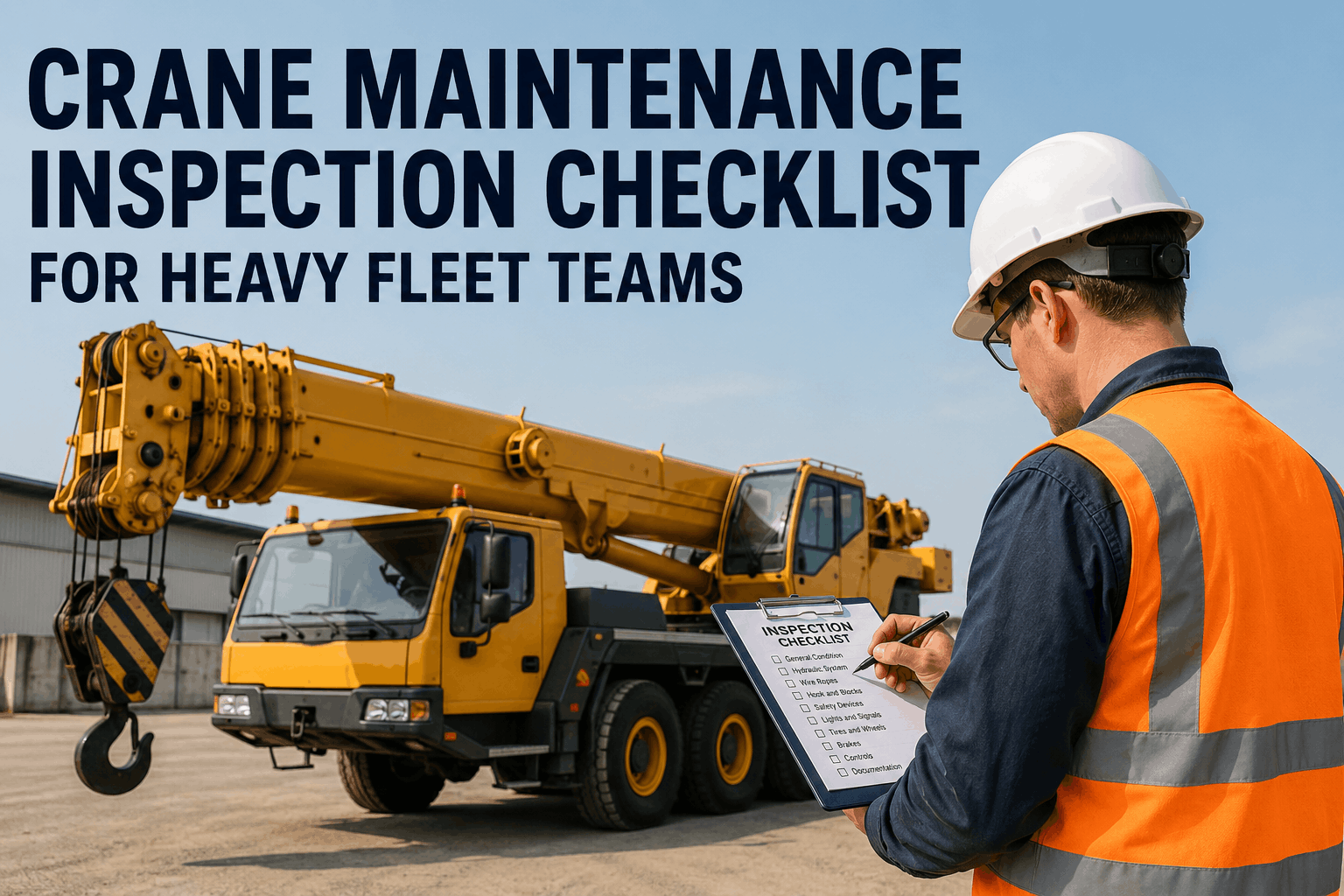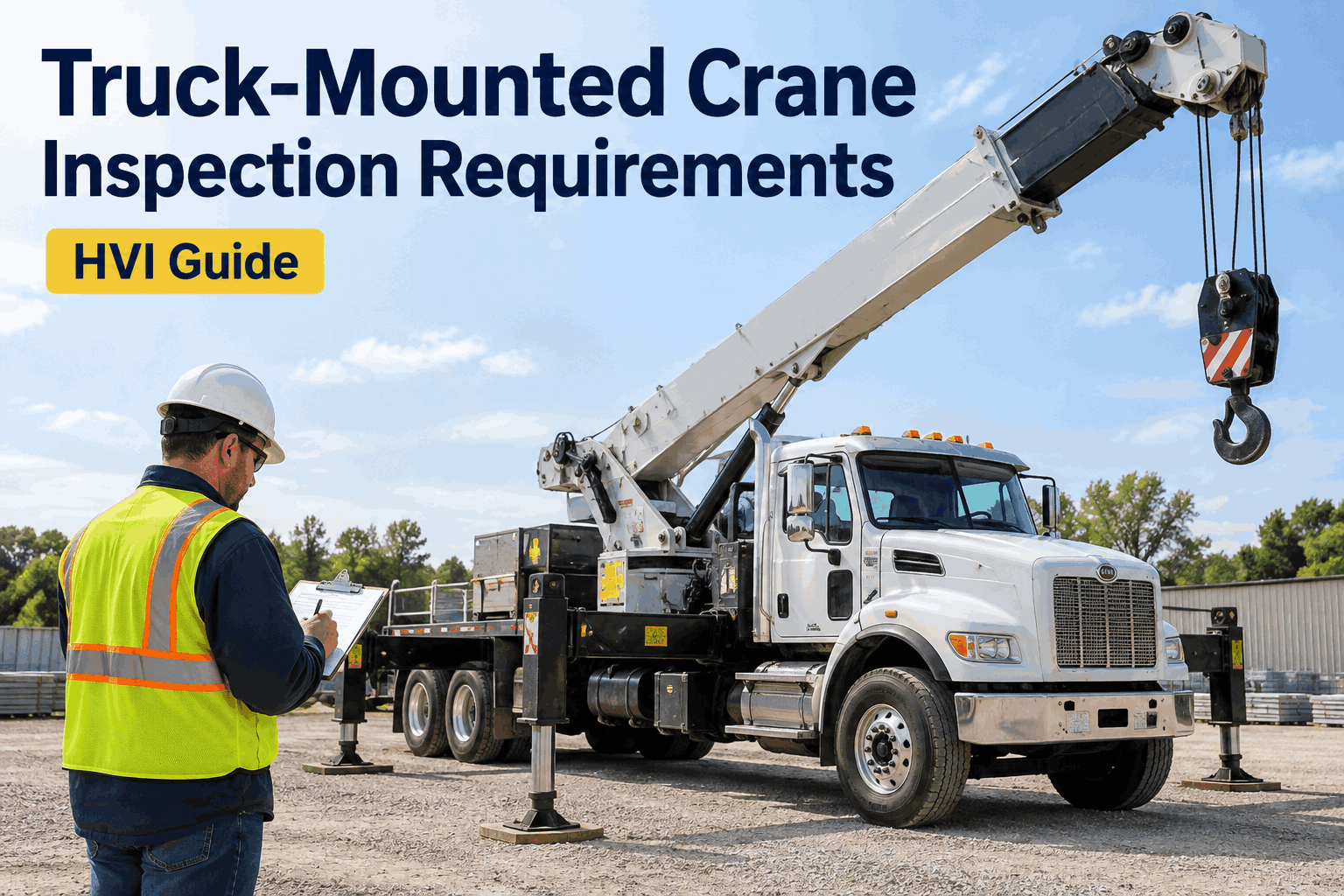
A truck-mounted crane is two machines sharing one chassis: a road vehicle and a piece of lifting equipment. That's why a truck mounted crane inspection isn't one check — it's three separate duties running in parallel, and passing one doesn't cover the others. The driver's daily pre-use check, the manufacturer's servicing, and the statutory thorough examination under LOLER each answer to a different rule and a different record. Treat a clean examination report as if it replaces the daily check and you've got a compliance gap — and a potentially catastrophic one. This guide lays out the three regimes and how to manage them against one asset. Book a demo to manage crane and vehicle checks on one asset.
Three Inspection Duties, No Substitutes
A loader crane answers to three separate regimes at once — the daily pre-use check, periodic servicing, and the LOLER thorough examination. Each has its own owner, interval, and record, and a pass on one is never a pass on another. Miss any layer and the crane is non-compliant, however good the others look.
The reason this matters isn't paperwork — it's that a neglected lorry-mounted crane is an accident waiting to happen, and each regime catches things the others don't. The daily check catches the fault that appeared this morning; servicing catches the wear building over months; the thorough examination catches the hidden structural and safety-device defects a competent person is trained to find. Drop one layer and something slips through.
The Three Regimes, Side by Side
Start by getting the three straight, because conflating them is the most common and most dangerous mistake. Each is a distinct legal and practical duty with its own owner, trigger, and output.
The killer detail: these don't substitute for each other. A current thorough examination report doesn't excuse a missing daily check, and a full service history doesn't count as a thorough examination. In Great Britain, loader cranes fall under LOLER 1998 in addition to PUWER, and both hold against the same asset — the same layered duty HVI already manages for MEWP and lifting equipment in a demo. Requirements vary by jurisdiction. Start free and hold each regime as its own record.
The Daily Pre-Use Check
The regime that starts every shift is the driver's, and it's the one enforcement asks about first after an incident. It's a function-and-safety check, not a deep inspection — but it has non-negotiable items.
Run the crane through its functions and confirm the controls respond correctly and return to neutral — a working function check before any load.
Confirm the overload protection system and the emergency stops are working properly — the two safety systems most likely to be the difference in an incident.
Look over the hydraulic hoses for damage and check for leaks — a sound hydraulic system, checked by eye, before the crane takes weight.
Any fault goes to the transport manager for action — and the check itself is documented, because if an incident happens, the authorities will want to see it.
The driver needs to know what they're looking for, which is why operator training matters — in the UK, ALLMI's lorry loader operator course covers exactly these pre-use checks. Undocumented, the check protects no one after the fact; documented, it's both a safety habit and the evidence trail enforcement expects. Book a demo to see the pre-use check captured on a device.
What the Examination Covers: Crane Anatomy
The thorough examination and the deeper inspections go component by component. A loader crane is a stack of load-bearing and safety-critical systems, and each has its own failure modes to check.
Boom & structure
Boom sections, slewing, mountings, and the crane structure for cracks, deformation, corrosion, and wear — the load path that carries everything.
Hoses, cylinders & connections
Hydraulic hoses, cylinders, rams, and connections for leaks, damage, chafing, and secure fittings — the muscle that moves and holds the load.
Outriggers, stabilizers & pads
Outriggers, stabilizer legs, and pads for operation, wear, and damage — the base that keeps the crane from tipping under load.
Hooks, latches & wire ropes
Hooks, safety latches, and any wire ropes fitted, for wear, distortion, broken wires, and correct latch function — the point where the load attaches.
Controls, e-stops & overload
Operator controls, emergency stops, and the overload protection and other safety devices — the systems that stop a lift going wrong.
Load chart & rated capacity
The load chart present and legible, and the rated capacity markings correct — because every safe lift depends on the operator reading the right number.
Beyond the components, the examination and pre-lift discipline extend to stability and ground conditions — the crane is only as safe as the surface it sets up on. Each of these areas has a pass/fail an examiner assesses, and each is worth photographing on the record so the condition is documented, not just noted. Start free and build a component-by-component crane template.
The 12-Month Interval — and When It Changes
The headline LOLER figure for a loader crane is a thorough examination at least every 12 months by a competent person. But "at least every 12 months" is a floor, not a fixed rule — several things shorten it or trigger an examination out of cycle.
A loader crane lifting loads is examined at least every 12 months by a competent person — usually a trained loader-crane examiner.
If the equipment is used to lift people, the interval drops — typically to 6-monthly — because the consequence of failure is a person, not a load.
A thorough examination is needed after substantial repair, damage, or relocation likely to affect safety — regardless of the calendar.
A competent person can draw up a written scheme setting intervals for the specific crane and its use — which may be more frequent than the default.
So the interval isn't one number to set and forget — it depends on the equipment, how it's used, and the scheme of examination for that machine. Getting it wrong is a legal exposure, not a paperwork slip, which is why the examination date has to be tracked and the reminder has to fire before it lapses. Book a demo to see examination dates tracked and reminded.
Reading the Report: Defect Categories
When the examination is done, the report categorises what it finds — and the category tells you how fast you have to act. Treating a report as pass/fail misses the urgency built into the grading.
Immediate danger
A defect presenting immediate danger. The equipment must not be used until it's rectified, and a Cat A finding is reported to the enforcing authority. This is a stop-now, no exceptions.
Timescaled repair
A defect that requires repair within a specified timescale. The crane can continue in use for now, but the clock is running and the fix has to happen inside the window given.
Worth observing
A defect worth observing — not yet a repair requirement, but a condition to monitor so it doesn't develop into a B or an A before the next examination.
The category dictates the corrective action and its deadline, so every finding needs to be routed and tracked to closure — a Cat A grounded until fixed, a Cat B on a countdown, a Cat C on the watch list. A report filed without acting on its categories is worse than useless: it's documented proof you knew about a defect and didn't address it. Start free and route examination defects by category.
How HVI Manages the Whole Crane Regime
The challenge with a truck-mounted crane is that its records live in two worlds — vehicle and lifting equipment — and things fall through the gap. Three capabilities bring it into one place.
Configurable crane templates
Build a pre-use check and a component-by-component inspection for your specific crane — boom, hydraulics, outriggers, hooks, safety devices, load chart — with photo evidence on every item, run on a phone in the field.
Recurring schedules & certificates
Schedule the servicing and the LOLER thorough examination with reminders before they lapse, and store the Report of Thorough Examination and certificates against the asset — so nothing runs out of date unseen.
Defect routing & asset history
Route a defect — by category where it's an examination finding — to a work order, and keep the full inspection, service, and examination history on the one asset that is both a vehicle and a crane.
The result is a truck-mounted crane whose vehicle side and lifting side are managed together, each regime on its own schedule but all on one record: pre-use captured, servicing scheduled, thorough examination tracked and certified, defects routed by category, and the whole history one tap away when it's asked for. Book a demo to see it on your crane fleet. Start free and put crane and vehicle on one asset.
From a transport manager who closed the vehicle-crane gap
Our trucks were maintained to the day and our loader cranes were an afterthought — the vehicle side and the lifting side were run by different people with different systems, and a thorough examination nearly lapsed on one crane because it lived in neither. Once the crane's pre-use check, servicing, and LOLER exam all sat on the same asset as the truck, nothing fell in the gap. The reminder fires, and the certificate's on file.
Frequently asked questions
What inspections does a truck-mounted crane need?
Three parallel regimes. First, a daily pre-use check by the driver before use — a function and safety check confirming the controls, overload protection, emergency stops, and hoses. Second, periodic servicing and maintenance to the manufacturer's schedule, including regular greasing. Third, a statutory thorough examination by a competent person under LOLER, at least every 12 months. These are separate duties with separate owners and records, and none substitutes for the others — a serviced crane still needs its thorough examination, and a current examination doesn't excuse a missing daily check. Requirements vary by jurisdiction.
What is a LOLER thorough examination for a loader crane?
Under the Lifting Operations and Lifting Equipment Regulations 1998 (LOLER) in Great Britain, a loader crane used for lifting must undergo a thorough examination by a competent person — usually a trained loader-crane examiner — at least every 12 months. It's a systematic examination of the crane's structure, hydraulics, outriggers, hooks and ropes, controls, and safety devices, resulting in a written Report of Thorough Examination under Schedule 1. It is separate from and additional to the driver's pre-use checks and the manufacturer's servicing, and it exists to detect defects a competent person is trained to find before they cause a failure.
How often does a truck-mounted crane need a thorough examination?
At least every 12 months for a loader crane lifting loads, under LOLER. The interval shortens — typically to 6-monthly — if the equipment is used to lift people. A thorough examination is also required out of cycle after substantial repair, damage, or relocation likely to affect safety. And a competent person can draw up a written scheme of examination setting intervals specific to the crane and its use, which may be more frequent than the 12-month default. The correct interval depends on the equipment, its use, and the applicable scheme, so it isn't a single fixed number.
What's the difference between a pre-use check and a thorough examination?
They're different regimes doing different jobs. A pre-use check is done by the driver before each use — a quick function and safety check of controls, overload protection, emergency stops, and hoses to confirm the crane is safe to operate today. A thorough examination is a periodic, systematic examination by an independent competent person under LOLER, at least annually, producing a formal written report that assesses structural and safety-critical condition. The pre-use check catches immediate faults; the thorough examination catches developing and hidden defects. One cannot replace the other, and both must be documented.
What do the defect categories A, B and C mean?
A thorough examination report grades defects by urgency. Category A is a defect presenting immediate danger — the equipment must not be used until it's rectified, and the finding is reported to the enforcing authority. Category B is a defect requiring repair within a specified timescale — the crane can be used for now, but the fix must happen inside the given window. Category C is a defect worth observing — monitor it so it doesn't worsen. The category sets the corrective action and its deadline, so every finding should be routed and tracked to closure, not just filed.
Manage the Vehicle and the Crane as One Compliant Asset
Run the pre-use check, servicing, and LOLER thorough examination against the same asset — configurable crane templates with photo evidence, recurring schedules and reminders, examination certificates on file, and defects routed by category. So all three regimes hold, nothing lapses in the gap, and the full history is ready when it's asked for. Live in under two weeks, trusted by 25,000+ users worldwide.
No credit card · No hardware · Crane inspection templates ready on day one