Meeting truck emergency equipment requirements sounds like a one-time job — buy an extinguisher, toss in some triangles, done. But the gear that keeps a stopped truck from becoming a highway pile-up only counts if it's actually there, charged and undamaged the day you need it. A discharged extinguisher or two triangles instead of three looks fine on the shelf and fails on the shoulder. Book a demo to see it tracked per truck.
The Three Items a Roadside Inspector Always Checks
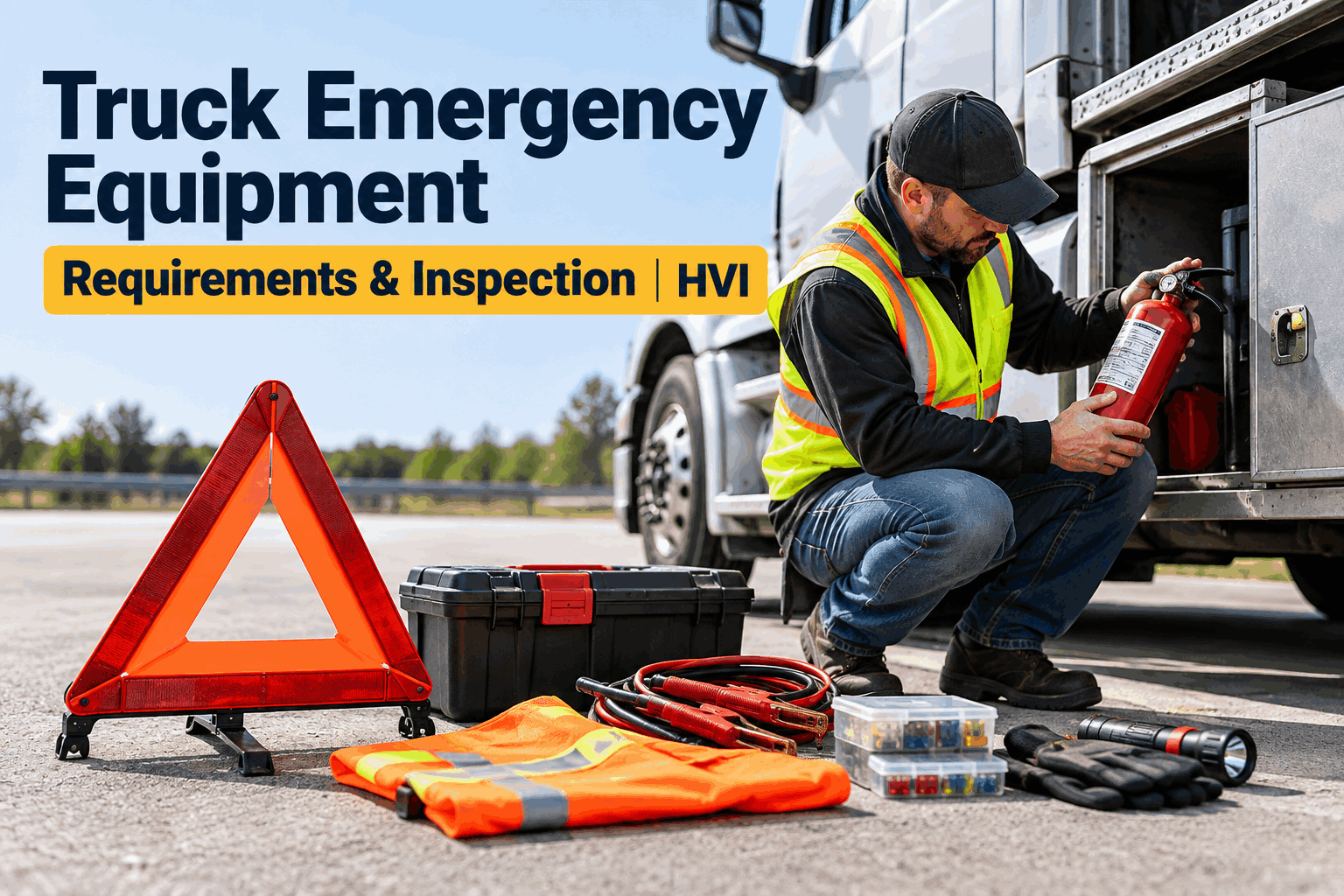
A fire extinguisher, three warning triangles, and spare fuses — the emergency equipment every commercial power unit must carry. Owning them isn't the check. Proving each is present and serviceable is.
Here's the full picture — exactly what the regulation requires, how to size the extinguisher, what "serviceable" means for each item, how stowage trips fleets up on the roadside, and how to keep every truck's kit inspected and audit-ready instead of a guess.
What the regulation actually requiresthe emergency equipment truck requirements in plain terms
The federal baseline lives in 49 CFR 393.95, which spells out the emergency equipment every commercial power unit must carry. It's short, but each line has a spec that trips people up when they eyeball it instead of reading it. Three things have to be aboard, in working order, before the truck rolls.
The trap is treating "we have some" as compliance. Two triangles isn't three. A fuse of the wrong amperage isn't a spare fuse. An extinguisher below its rated charge is a red tag waiting to happen. The regulation is specific for a reason, and a roadside inspector reads it the same way.
UL-rated, properly charged and securely mounted
Accessible to the driver, not buried in cargo
Rating depends on whether you haul hazmat
Three bidirectional reflective triangles (FMVSS 125)
Or six fusees / three liquid-burning flares as allowed
Undamaged and able to stand on the road
Required unless the truck uses only circuit breakers
Correct type and amperage for that vehicle
Enough for the electrical systems in use
Fuses are the item most fleets forget, because breaker-equipped trucks are exempt and people assume every truck qualifies. Confirm which of your units actually need spares, and note it on each one's record. Book a demo to see the 393.95 set built into a daily check
Sizing the fire extinguisher rightthe UL rating changes the moment you carry hazmat
The single most common truck fire extinguisher requirements mistake is carrying the wrong size for the load. The regulation ties the minimum UL rating to whether the vehicle transports hazardous materials that require placarding — and the jump is significant, so a truck that switches to hazmat runs needs a bigger unit.
5 B:C
One extinguisher rated 5 B:C or more — or two units each rated 4 B:C or more
10 B:C
One extinguisher rated 10 B:C or more, charged and readily accessible
The B:C rating matters because truck fires are usually fuel, oil or electrical — exactly what a B:C extinguisher is designed for. Whatever the rating, the gauge needle has to sit in the green and the pin and seal have to be intact, or the number on the label means nothing. HVI's own DOT fire extinguisher requirements guide breaks the sizing down further. Start free and log each extinguisher's rating and gauge state so a swap to hazmat never leaves you under-rated.
"Present" isn't the check — "serviceable" isthe condition checks a real emergency equipment inspection covers
The mistake that fails an otherwise well-equipped truck is checking that gear exists without checking that it works. An extinguisher can be mounted and dead. A triangle can be aboard and cracked. The point of an emergency equipment inspection is condition, not just presence — so each item gets a real pass/fail, not a glance.
- Gauge needle in the green charge zone
- Pin and tamper seal intact
- Securely in its bracket, not loose on the floor
- Inspection tag current, nozzle clear
- All three present, not one or two
- Reflective faces clean and undamaged
- Legs fold out and stand upright
- Stored where the driver can reach them fast
- Present for trucks that use fuses
- Correct amperage for the circuits
- Not already used to replace a blown one
- Stored dry, labeled, and findable
A good habit is to record the actual state — "extinguisher gauge green, seal intact, 3 triangles good" — rather than a bare tick. That way a slowly discharging extinguisher or a triangle that went missing shows up as a change, not a mystery. Book a demo to capture condition and a photo on every check
Stowage is where the roadside violation hideswhere the gear lives matters as much as whether it exists
Emergency equipment failures at roadside inspections often aren't about missing gear — they're about gear the driver can't get to. An extinguisher buried behind pallets, triangles locked in a toolbox with the key back at the yard, fuses in a bin nobody can find. If it isn't accessible in an emergency, it isn't really there.
Parts-and-accessories issues under Part 393 are consistently among the most-cited categories in roadside inspections, and emergency equipment sits right inside that group. Each one is avoidable with a check that asks not just "is it aboard?" but "can the driver reach it in ten seconds?" That's a stowage question, and it belongs on the inspection.
- Extinguisher buried under cargo
- Triangles in a locked box, no key aboard
- Fuses loose and unlabeled in a bin
- Gear that rattles free and gets damaged
- Extinguisher bracketed within the driver's reach
- Triangles in an open, labeled cab location
- Fuses in a marked holder by the panel
- Everything secured so it survives the miles
Set a standard stowage spot per truck type and inspect against it, so a new driver doesn't have to hunt. HVI's emergency kit bill of materials is a useful starting list to standardize from. Start free and set an equipment standard every truck is checked against.
Keep the whole kit audit-readyfrom a paper guess to a tracked record per truck
The reason emergency equipment slips is that it's easy to defer. It's not what breaks down the truck, so a missing triangle gets a mental note and never a fix. Multiply that across a fleet and you have units that pass a walkaround but would fail an audit — with no record of when the gear was last actually verified.
- A tick box that means "I glanced at it"
- No photo of the extinguisher gauge
- Missing item noted, then forgotten
- No way to prove the last real check
- Each item confirmed with condition and photo
- A gap becomes a routed defect instantly
- Extinguisher service dates on a schedule
- Full equipment history per unit for audits
The recurring-check piece matters most for the extinguisher, which needs periodic professional service on a calendar — exactly the kind of date a scheduling system remembers and a clipboard forgets. Book a demo to see extinguisher service scheduled per truck
From a fleet safety manager
We got dinged at a roadside for a discharged extinguisher — it was mounted, it looked fine, the gauge was in the red and nobody had looked closely in months. That one violation is what made me stop trusting a tick box. Now every truck's kit gets photographed on the daily check, and if an extinguisher drifts out of the green or a triangle goes missing, it's a defect before the truck leaves, not a story I hear from a scale house.
How HVI keeps emergency equipment trackedinspected per asset, defects routed, services scheduled
Emergency equipment compliance holds when it's on a record instead of in someone's memory. HVI's fleet inspection, defect routing and analytics turn the 393.95 kit into a check that captures condition, routes gaps, and schedules the recurring services no clipboard tracks.
Check each item per asset
Extinguisher, triangles and fuses as pass/fail items with condition and a gauge photo.
Route any gap as a defect
A missing or discharged item becomes a work order to the shop, timestamped to the unit.
Schedule recurring checks
Extinguisher service dates and equipment audits stay on a schedule, per truck, never overdue.
See how equipment checks, defects and service dates live on one screen inside HVI's fleet inspection. Line it up in a quick demo
Truck emergency equipment requirements: quick answers
What emergency equipment is required on a commercial truck?
Under 49 CFR 393.95, every commercial power unit must carry a properly charged and rated fire extinguisher, warning devices for a stopped vehicle (three bidirectional reflective triangles that meet FMVSS 125, or the allowed equivalent in flares/fusees), and spare fuses of the correct type and amperage — unless the vehicle uses only circuit breakers. All three must be present and serviceable, not just aboard.
What size fire extinguisher does a truck need?
It depends on the load. A truck not hauling placardable hazardous materials needs one extinguisher with a UL rating of at least 5 B:C, or two units each rated 4 B:C or more. A truck carrying hazmat that requires placarding needs one rated at least 10 B:C. Whatever the rating, it must be charged (gauge in the green), sealed, and securely mounted within the driver's reach.
How many warning triangles must a truck carry?
Three bidirectional emergency reflective triangles that conform to Federal Motor Vehicle Safety Standard No. 125. The regulation also allows equivalents such as at least six fusees or three liquid-burning flares, but reflective triangles are the standard choice because they don't burn out. All three triangles must be undamaged and able to stand upright on the road.
Do all trucks need spare fuses?
Only trucks whose electrical systems use fuses. A vehicle equipped entirely with circuit breakers is exempt from the spare-fuse requirement. For trucks that do use fuses, spares must match the correct type and amperage for the circuits, be present (not already used to replace a blown one), and be stored where they can be found. Confirm which of your units actually need spares and note it per truck.
How does HVI help manage emergency equipment inspections?
HVI turns the 393.95 kit into pass/fail inspection items per asset — extinguisher, triangles and fuses — each captured with condition and a photo. Any gap becomes a defect routed to the shop as a work order on that truck, and recurring extinguisher service dates and equipment audits stay on a schedule. Its analytics surface trucks that repeatedly come up short, so the kit stays audit-ready instead of a guess.
Stop finding out about a dead extinguisher at the scale house
HVI checks the extinguisher, triangles and fuses per truck, captures condition and a gauge photo, routes any gap as a work order, and keeps extinguisher service on a schedule. Emergency equipment stops being a shelf item and becomes a tracked, provable record.
No credit card · Emergency equipment checks ready on day one
- Extinguisher rating, gauge & seal
- Three triangles present & undamaged
- Spare fuses — type & amperage
- Stowage & accessibility check
- Recurring service dates per unit