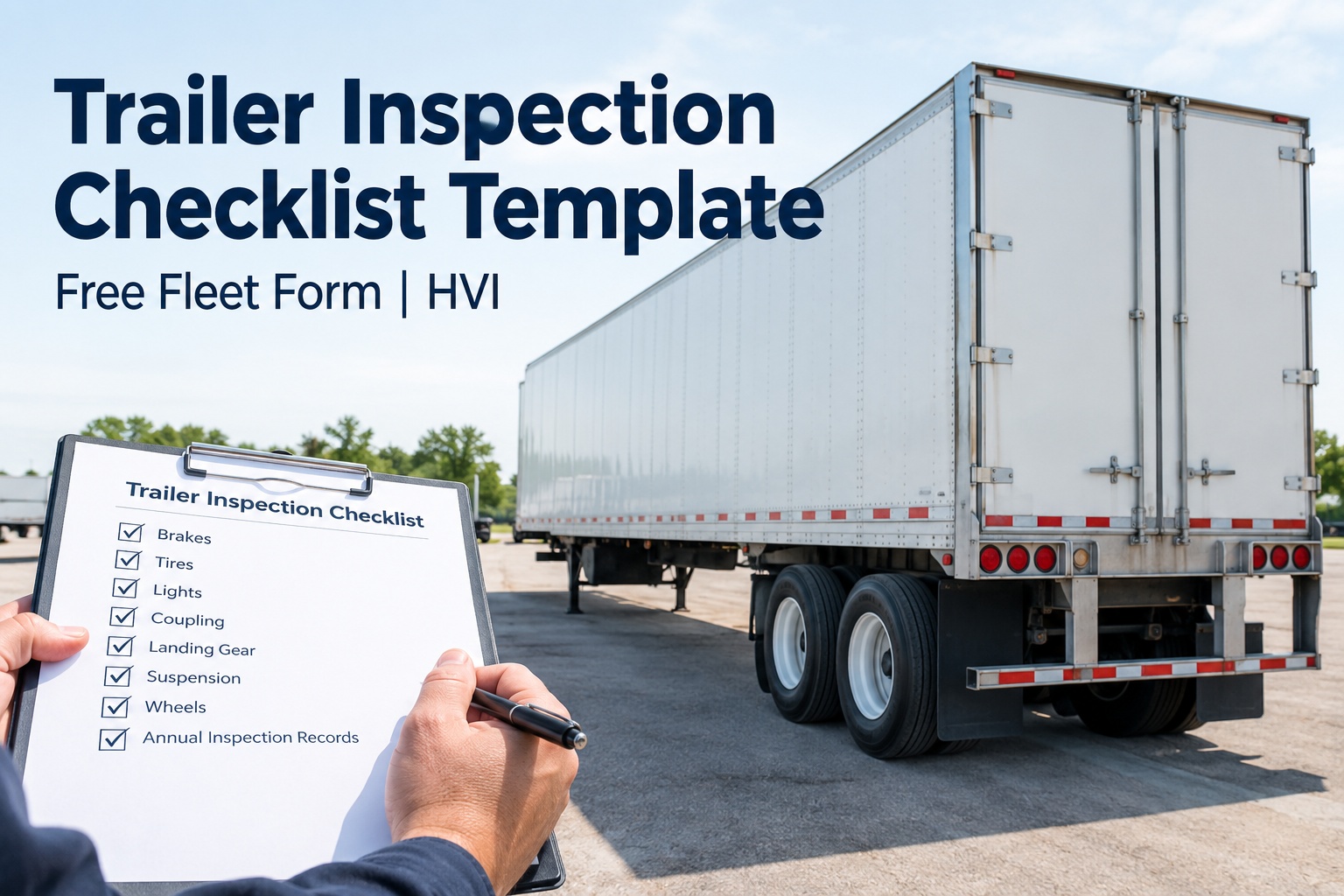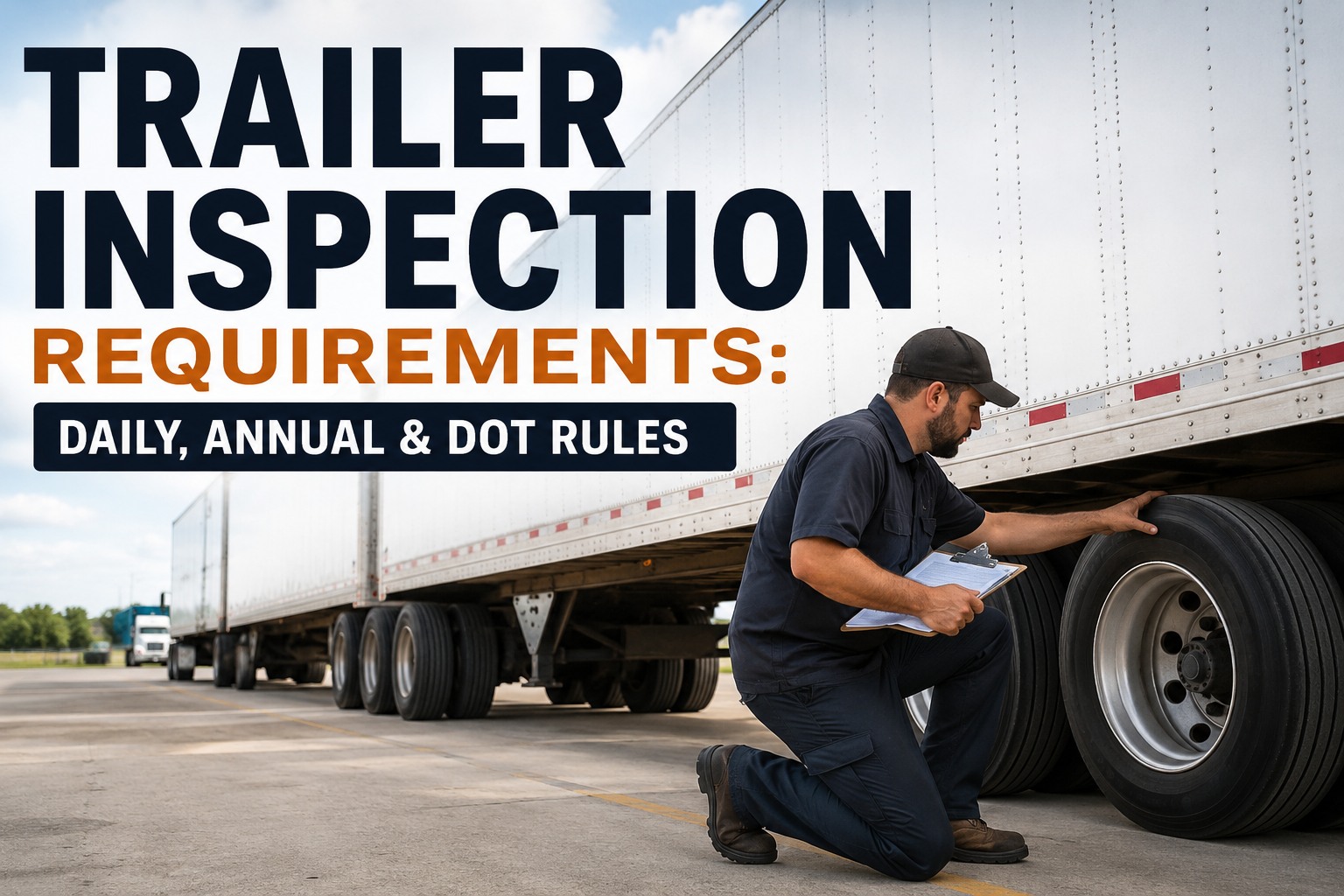
Trailer inspection requirements are where most fleets quietly bleed compliance. Trailers outnumber tractors 2-to-1 or 3-to-1. They sit parked at drop yards, customer sites, and rail ramps for weeks — without a driver to catch a defect and without an odometer to trigger the next PM. And the tractor's clean file creates a false sense that the trailer behind it is covered. It's not. Every trailer over 10,001 lbs GVWR is a separate CMV under 49 CFR 396.17. Book a demo
Your tractors have odometers. Your trailers have calendars. And nobody's watching the calendar.
~133,000 annual inspection citations get issued nationally every year. Second-most-common FMCSA violation. Most of them aren't failed inspections — they're missed dates on trailers sitting in yards where the mileage clock never ticks and the tractor's paperwork can't cover them.
Where trailers hide — and why the compliance clock keeps ticking anyway
The reason trailer compliance fails isn't the inspection itself. It's the tracking. Trailers move through 5 states of being during their compliance year and each one has its own visibility gap. The clock doesn't care where the trailer is or whether a driver's near it — annual inspection date is annual inspection date.
The fix isn't more diligence. It's calendar-based tracking that fires independent of driver activity, mileage, or trailer location. A trailer sitting in a drop yard should trigger the same 90-day advance alert as a trailer running the interstate. Book a demo to see calendar-based trailer compliance that doesn't need a driver in the seat
The two clocks every trailer runs — 12-month annual + daily DVIR
Trailer compliance under 49 CFR Part 396 runs on two overlapping clocks. Understanding what each one requires, who has to do it, and how long the paperwork lives is the difference between clean audits and paperwork citations.
Both clocks apply to every trailer independently of the tractor. A state inspection sticker doesn't satisfy the federal 396.17 requirement. A tractor's clean file doesn't cover the trailer behind it. Each unit stands or falls on its own paperwork. Start free and get both clocks tracked per trailer with 90-day and 60-day alerts
Where trailer defects cluster — and where OOS orders actually come from
CVSA's roadside inspection data is remarkably consistent year after year: trailer OOS violations concentrate in a handful of categories. Fleets that build DVIR templates around the actual defect distribution catch the highest-risk items before roadside inspectors do.
- 41% Brake system & adjustment
- 22% Tires & wheels (flat, tread, ply exposed)
- 16% Lighting & electrical (7-way plug)
- 12% Coupling devices & king pin
- 9% Frame, suspension, wheel end
Top 3 categories = 79% of trailer OOS. Brakes alone are 41% of vehicle OOS violations per CVSA 2026 data. A DVIR template that hits these three hard catches most of what puts a trailer on the shoulder.
The pattern is the fix. A pre-trip that spends time on brakes, tires, and lights — and captures each with a photo — catches roughly 4 out of every 5 OOS-risk defects before the vehicle moves. Book a demo to see the defect-frequency-tuned DVIR template running on trailers
The 90/60/30-day alert workflow — how to never miss an annual inspection again
Trailer annual inspections don't fail from inspection difficulty. They fail from calendar visibility. A trailer whose annual is due next month is invisible to dispatch, to maintenance, and to the driver — until it's expired. A three-stage alert workflow, running per trailer regardless of location, removes the failure mode entirely.
Executed consistently across a mixed fleet, this workflow turns "annual inspection compliance" from a recurring near-miss problem into a background process. The alerts do the tracking; the fleet does the work. Start free and configure 90/60/30 alerts on every trailer this week
From a compliance manager running 340 dry vans across 6 drop yards
We had 340 trailers spread across 6 drop yards and 40+ regular customer sites. Our previous system was a spreadsheet in the compliance office and a wall calendar in the maintenance shop. On paper we knew when every annual was due. In practice, we missed 12-15 trailers a year on inspection dates because a trailer would sit at a customer for 6 weeks and just fall off everyone's radar. Twice in 2024 we had drivers pulled at scales with expired stickers — $2,800 in fines each time, plus the OOS load that had to be re-covered by another driver.
Moving the whole trailer inventory into HVI with 90/60/30-day alerts on every unit changed everything. Every trailer, wherever it's sitting, is now visible in one dashboard with days-to-annual, last DVIR date, and any open defects. Compliance now catches every expiring annual six weeks out regardless of whether the trailer's on the road or parked at a receiver. Twelve months in: zero missed annuals, zero roadside sticker-expired citations, and the FMCSA compliance review last spring took two days instead of the two weeks it took the previous cycle. Same fleet, same trailers, no more paper on the wall.
Frequently asked questions
What are the DOT trailer inspection requirements under FMCSA?
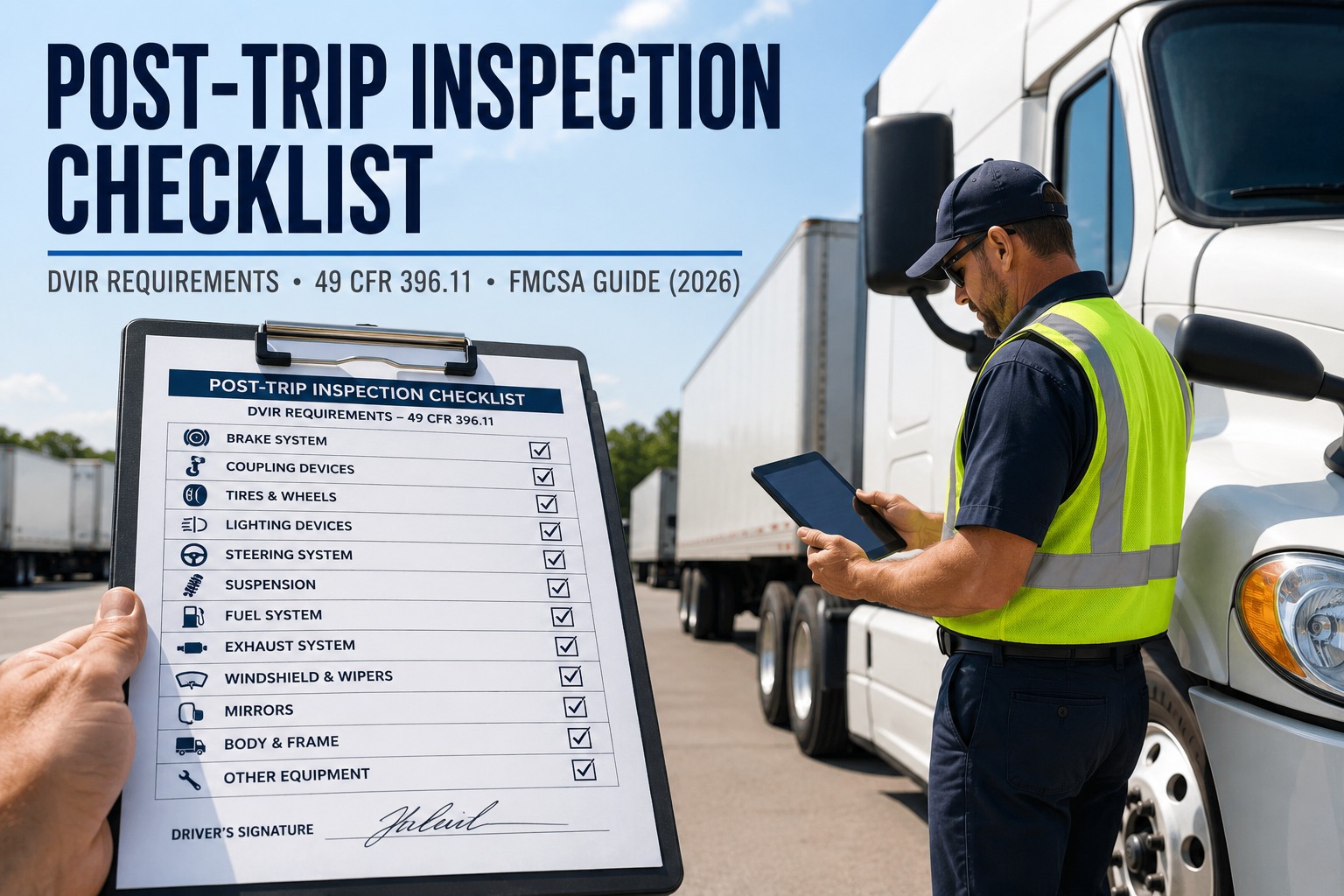
Every commercial trailer or semi-trailer with a gross vehicle weight rating over 10,001 lbs is subject to two overlapping FMCSA inspection requirements. The annual periodic inspection under 49 CFR 396.17 requires each trailer to pass a comprehensive inspection at least once every 12 months against the 15 component categories defined in Appendix A to Part 396 (formerly Appendix G). The inspection must be performed by a person qualified under 49 CFR 396.19, and the report must be retained by the motor carrier for 14 months from the inspection date. Proof of the inspection — either a decal on the trailer or a copy of the inspection report — must be accessible when a roadside inspector asks. The driver vehicle inspection report under 49 CFR 396.11 is the daily side of the same compliance system: at the end of each workday, the driver must complete a written inspection report on each trailer operated, noting any defects that affect safety or would result in mechanical breakdown. Defect reports and the associated repair certification must be retained for 3 months. Each trailer in a combination counts as a separate commercial motor vehicle for compliance purposes — a tractor with a semitrailer and full trailer requires three separate annual inspections. State inspection stickers do not automatically satisfy the federal 396.17 requirement; the federal periodic inspection is its own standalone obligation.
How often does a trailer need a DOT inspection?
The 49 CFR 396.17 annual periodic inspection is required at least once every 12 months for every commercial trailer over 10,001 lbs GVWR. That's the minimum federal frequency. Many well-run fleets perform additional voluntary inspections at 6-month intervals for high-utilization trailers or specific high-risk equipment (refrigerated units, tank trailers, heavy-haul lowboys), but 12 months is the enforceable federal floor. On top of the annual inspection, the daily driver vehicle inspection report under 49 CFR 396.11 must be completed each workday the trailer is operated. This produces two distinct cadences that both apply: an annual comprehensive inspection producing a signed report and (typically) a sticker on the trailer, and a daily driver-completed report noting any defects observed during operation. The two documents serve different purposes and cannot substitute for each other. A trailer with a current annual inspection sticker but no DVIR history for a period it was operated is not compliant. A trailer with a clean DVIR history but an expired annual inspection is not compliant either. Both clocks must be running on every trailer, whether it's on the road daily or sitting in a drop yard between assignments.
What happens if a trailer's annual inspection expires?
A trailer operating with an expired or missing 49 CFR 396.17 annual inspection is subject to being placed out of service at any roadside inspection, and the citation goes on the motor carrier's CSA Vehicle Maintenance BASIC score with implications for insurance rates, freight eligibility, and future audit selection. Annual inspection violations rank as the second-most-common FMCSA violation category, with approximately 133,000 citations issued nationally each year and per-violation fines that typically run in the $1,000 to $4,000 range. The bigger risk sits in what follows: a trailer with an unrepaired safety defect discovered during the enforcement stop can trigger a civil penalty of approximately $15,420 (2026 figure) for dispatching a vehicle with unresolved defects. The out-of-service order itself typically holds the trailer until repaired and re-inspected, meaning the load doesn't move, another asset has to be dispatched to recover it, and the carrier absorbs the recovery cost on top of the fine. In practical operational terms, one missed annual inspection can produce a $3,000-$5,000 total exposure event once the fine, load recovery, and downtime are added up. The prevention side is calendar-based tracking that fires alerts 90 and 60 days ahead of the due date so the inspection is booked, defects are pre-cleared, and the sticker is renewed before it lapses.
How long do I have to keep trailer inspection records?
Two different retention clocks apply to the two different inspection types under 49 CFR Part 396. The annual periodic inspection report under 396.17 must be kept for 14 months from the inspection date. It must be maintained where the vehicle is normally garaged or where the carrier keeps its vehicle maintenance records, and must be available for FMCSA inspection on demand. The driver vehicle inspection report under 396.11, when it notes a defect, must be retained by the motor carrier for 3 months along with the certification of repair that must accompany it. Reports noting no defects don't have a mandatory retention period under federal rules, though most compliance-focused fleets retain all DVIRs for at least 3 months regardless. Beyond the federal minimums, many carriers retain both types of records for a full 12 months or longer to support their CSA data disputes, insurance underwriting, litigation defense, and internal maintenance trending. Digital record-keeping automates the retention automatically — every inspection archives with its date, the retention clock runs in the background, and audit-ready evidence packs can be exported by trailer, by date range, or by inspection type at any time. The February 2026 eDVIR Final Rule from FMCSA formally recognizes electronic DVIR records as a preferred compliance method, and industry trend continues strongly toward digital replacing paper for all Part 396 records.
How does HVI help fleets manage trailer inspection requirements?
HVI's trailer compliance module runs both required clocks on every trailer in the fleet regardless of trailer location or utilization pattern. The 49 CFR 396.17 annual inspection tracker fires 90-day, 60-day, and 30-day advance alerts to compliance manager, maintenance scheduler, and fleet manager. When a trailer's annual approaches, the system flags it in dispatch and can auto-hold from long-haul assignments if the inspection isn't yet booked. Reports upload signed by a 396.19-qualified inspector and archive with automatic 14-month retention. Daily DVIRs under 49 CFR 396.11 run in the mobile app tied to specific trailer number, with a template weighted toward the highest-frequency OOS categories (brakes, tires, lights, coupling). Any defect noted on DVIR flows straight to a work order with repair certification required before the trailer can be re-dispatched. All records archive per trailer, searchable by unit, driver, date, or defect type, with the required 3-month retention on defect DVIRs running automatically. For compliance managers like Susan R. running 340 trailers across 6 drop yards, the typical result is zero missed annuals, zero roadside sticker-expired citations, and FMCSA compliance reviews closed in days rather than weeks. Book a demo to see the trailer compliance workflow running live.
Every trailer, every drop yard, every date. One dashboard that doesn't care where the trailer is sitting.
HVI keeps 49 CFR 396.17 annual inspections, 396.11 daily DVIRs, and defect-to-work-order tracking running on every trailer in the fleet — hooked or parked. Alerts fire before dates expire. Records archive automatically. Compliance reviews close in days. Live in under two weeks; typical result is zero missed annuals and clean audits.