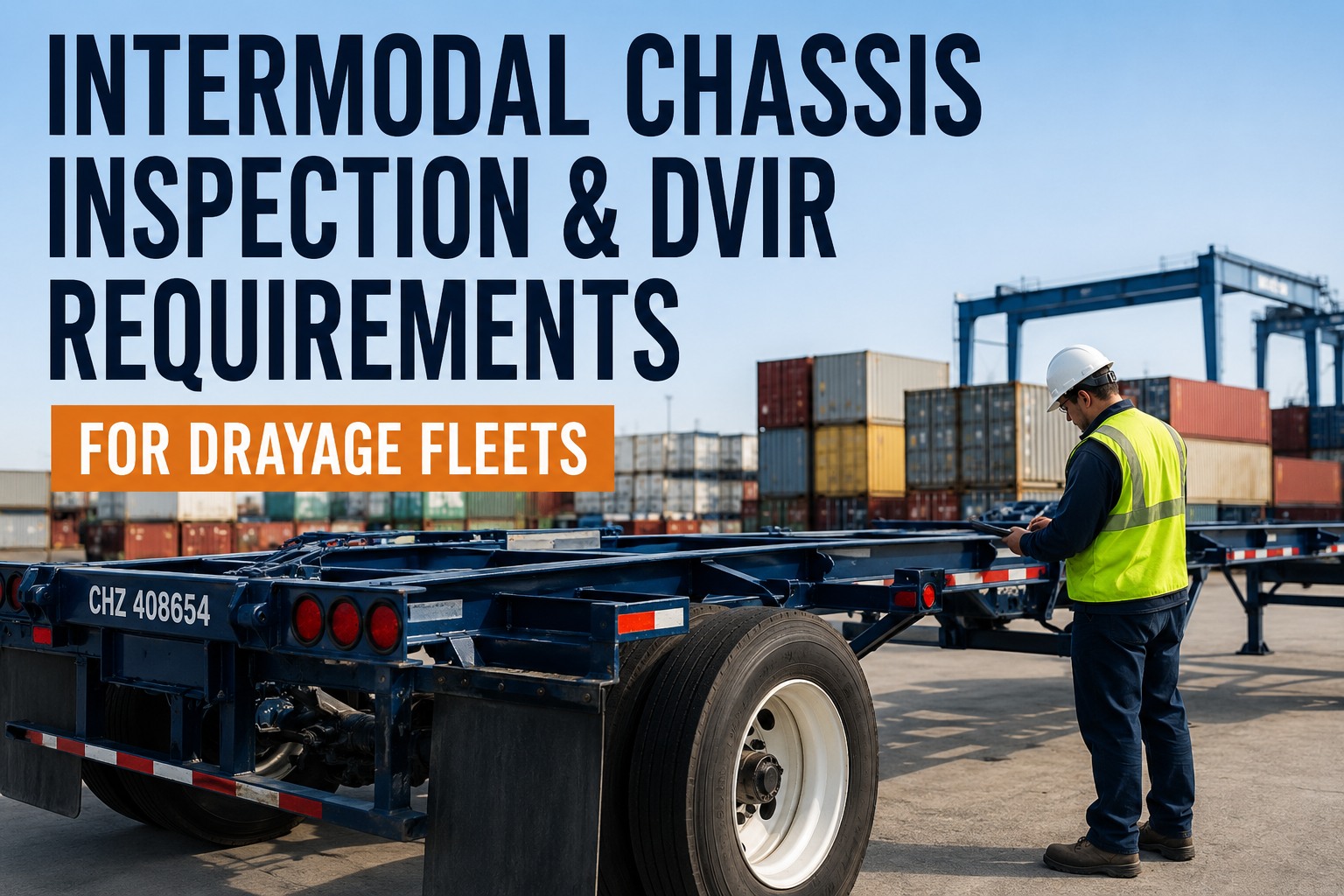
An intermodal chassis changes hands more than any other piece of equipment on the road — owned by an IEP, dispatched to a motor carrier, driven by a drayage driver. When a defect turns up at roadside, "whose responsibility is that?" has a specific federal answer under 49 CFR 390.40–42 — and getting it wrong is how carriers absorb costs that legally belong to the IEP. This guide walks the driver pre-trip required by 392.7, the IEP duties under 390.40, and the defect reporting workflow. Book a demo .
Who Owns Which Chassis Inspection Duty?
Intermodal is the only equipment category where three federally-defined parties share responsibility. Miss the boundaries and you carry costs that legally belong to another party.
The 2012 FMCSA rule change is the most-misunderstood piece of chassis compliance. Before 2012, drivers had to submit a DVIR for every intermodal equipment inspection regardless of whether defects were found — no-defect DVIRs generated massive paperwork with limited safety value. FMCSA removed the no-defect DVIR requirement; drivers only need to file a DVIR when a defect is found or reported. The pre-trip inspection itself is still required every time under 49 CFR 392.7 — but the paperwork trigger is defect-driven. Fleets still using pre-2012 no-defect DVIR workflows are burning driver time on unnecessary documentation; fleets that skip pre-trip inspection because "no DVIR is required" are courting roadside violations. Both patterns come from misreading the same rule.
The 8 component categories the driver must inspectDirect from 49 CFR 392.7(b) — the driver's federal pre-trip list
These 8 categories are the driver's federal obligation. The rule specifies "as thorough a visual inspection as possible without physically going under the vehicle" — underside items that require crawling under the chassis are IEP responsibility, not driver. Book a demo to see the 8-category template configured in HVI
Service brake components (visible only)
Brake chambers, slack adjusters, air lines — whatever can be seen without going under. Trailer brake connections (glad hands, gladhand seals). Audible check when charging air system.
Lighting devices, lamps & conspicuity
Marker lights, brake lights, turn signals, backup lamps, license plate lamp, DOT reflective conspicuity tape intact. Test with tractor connected and engine running.
Wheels, rims, lugs, tires
Tire tread minimum 2/32" per 49 CFR 393.75, no sidewall damage, no exposed cord, proper inflation. Wheel lug nuts all present and tight. Rim condition — no cracks, no missing pieces.
King pin & upper coupler assembly
King pin condition, upper coupler plate free of cracks or damage, locking mechanism engagement. This is where the tractor connects — failure here = separation.
Rails & support frames
Main rails, cross members visible from ground level. Cracks, dents, deformation, or corrosion that reduces structural integrity. Weld failures at joints.
Tie-down bolsters
Front and rear container bolsters intact, no deformation. Container corner casting seats undamaged. Bolster is what the container weight actually rides on.
Locking pins, clevises, clamps, hooks
All four twist locks (or pin locks) fully engaged into container corner castings. Locking levers in locked position. This is the single most-checked item at roadside.
Sliders & sliding-frame locks (extendable chassis)
On extendable chassis (40–53 ft convertible): slider position matches container length, all locking pins fully engaged in both rails. Extending mid-trip = catastrophic.
Even without the no-defect DVIR paperwork, the inspection itself needs to be documented internally — that's how you prove it happened when a roadside officer asks or when settlement disputes a defect charge. Book a demo to see internal-inspection logging that satisfies both federal and UIIA scopes
The defect reporting workflow — who does what, in orderFrom driver-found defect to IEP acknowledgment and repair
When a driver finds a defect at pre-trip, federal rules define the exact sequence of events that follows. Skipping steps is how defects get charged to the wrong party at settlement. Start a free trial to explore the defect-routing workflow.
Driver finds defect at pre-trip
Chassis at interchange or in yard. Driver runs the 8-category pre-trip. A defect is identified — missing marker light, tire below 2/32", damaged twist lock, cracked bolster, whatever the finding.
Defect documented with photo evidence
Photo of the defect + date, time, chassis ID, and driver name captured. On paper this is a note; digitally it's a timestamped record with GPS coordinates and photo hash that can't be edited after the fact.
Defect reported to IEP per 49 CFR 390.42(b)
Driver must notify IEP of the defect. Reporting method varies by IEP (phone, portal, EDI); requirement is the same — IEP has to be told and given an opportunity to remedy.
IEP acknowledges and dispatches repair OR replaces chassis
IEP has physical repair responsibility. They either send a mobile M&R vendor to the interchange point or swap the chassis for a compliant unit. This is where IEPs get evaluated on responsiveness.
Repair confirmed, DVIR closed, chassis dispatched
Carrier DVIR filed for the defect and the repair; chassis returns to service or the swap chassis gets its own pre-trip. Every step timestamped and photo-documented for the audit trail.
Federal vs UIIA vs carrier best practice — know which layer appliesAll three exist; only one carries federal enforcement teeth
Chassis inspection has three overlapping standards. Federal rules (49 CFR) are enforceable at roadside and by FMCSA. UIIA (Uniform Intermodal Interchange and Facilities Agreement) is a contractual agreement between IEPs and motor carriers that goes beyond federal in some areas. Individual carrier best practices sit on top. Confusing them — especially treating UIIA items as federal-enforceable — produces disputes at settlement.
49 CFR Part 390 subpart C, 392.7, 396.3, 396.11
Driver pre-trip on 8 categories, defect reporting to IEP, IEP systematic maintenance, DVIR when defect found. Violations = citations + CSA points + OOS orders at roadside.
Uniform Intermodal Interchange Agreement (Exhibit A)
Contractual inspection checklist between IEPs and carriers. Includes items federal rules don't require: landing legs, sand shoes, crank handles, mud flaps, rear underride guard, license plate, hazmat placards. Enforceable through contract, not FMCSA.
Additional inspection items and photo requirements
Photo per twist lock, photo per tire, GPS-stamped inspection location, driver signature. Not federally required, not UIIA-required, but standard on any drayage fleet that has faced a chassis-related liability claim.
Layers 1 and 2 belong together in one inspection workflow — not two separate checklists. Book a demo to see federal + UIIA scopes merged in a single template
From a drayage fleet manager after standardizing chassis inspections
We run 84 tractors doing container drayage out of two port terminals. For years we ate chassis defect costs we shouldn't have — drivers would find a bad tire or bad brake at pre-trip, verbally tell dispatch, dispatch would tell the IEP, and if it wasn't documented properly the IEP would push back at settlement. On average we were absorbing $60–80K a year in chassis costs that legally belonged to the IEP.
We put the 8-category pre-trip into a digital DVIR template, required photo per defect, timestamped and geo-tagged. When a driver finds a defect now, it goes to the IEP with a photo and a record; IEP acknowledges or disputes with an actual counter-record instead of a phone opinion. Our chassis cost absorption dropped to under $8K last year. That's what documented inspection actually earns.
Frequently asked questions
What should a driver inspect on an intermodal chassis before transporting a container?
Per 49 CFR 392.7(b), before operating an intermodal chassis on the road, the driver must inspect 8 component categories and be satisfied they are in good working order: (1) service brake components readily visible without going under the chassis, and trailer brake connections; (2) lighting devices, lamps, markers, and conspicuity material; (3) wheels, rims, lugs, and tires; (4) king pin and upper coupler assembly; (5) rails and support frames; (6) tie-down bolsters; (7) locking pins, clevises, clamps, and hooks; and (8) sliders and sliding-frame locks (on extendable chassis). The rule specifies "as thorough a visual inspection as possible without physically going under the vehicle" — components requiring the driver to crawl under are IEP responsibility. If a defect is found, the driver must report it to the IEP per 49 CFR 390.42(b) and cannot operate the equipment until the defect is remedied.
Is a no-defect DVIR required for intermodal chassis?
No. Since the FMCSA final rule effective June 12, 2012, drivers operating intermodal equipment (IME) are no longer required to submit no-defect DVIRs, and IEPs are no longer required to retain them. The pre-trip inspection itself under 49 CFR 392.7 is still required every time a driver operates an intermodal chassis — the change was purely to the paperwork trigger. A DVIR is required only when the driver finds a defect or is made aware of one. This is one of the most-misunderstood pieces of intermodal compliance. Fleets still filing no-defect DVIRs are burning driver time on unnecessary documentation; fleets that skip the pre-trip inspection because "no DVIR is required" are courting roadside violations. Both patterns come from misreading the 2012 rule.
Who is responsible for chassis maintenance under FMCSA rules — the IEP, the motor carrier, or the driver?
All three parties have federally-defined responsibilities. The Intermodal Equipment Provider (IEP) under 49 CFR 390.40 has the systematic inspection, repair, and maintenance responsibility — including maintaining records and providing adequate inspection space at interchange points. The motor carrier under 49 CFR 396.3 and 396.11 is jointly responsible for operating the equipment in safe condition and for filing DVIRs when defects are reported. The driver under 49 CFR 392.7 must perform the pre-trip inspection and be satisfied the equipment is in good working order before operating, and must report any defect to the IEP under 49 CFR 390.42(b). When a defect is found at roadside, both the motor carrier and the IEP can receive violations depending on the defect nature and who was in a position to detect it — documented pre-trip inspection is what keeps liability aligned with actual responsibility.
Does HVI support intermodal chassis-specific DVIR templates?
Yes. HVI supports configurable digital fleet inspections and DVIRs that can be built for intermodal chassis with the 8-category federal pre-trip structure, per-category photo evidence requirements, defect documentation with severity flags, defect routing so IEP-responsibility items and carrier-responsibility items go to the correct party, and searchable inspection history at the chassis level. UIIA-additional items (landing legs, mud flaps, placards, license plate) can be added as separate template sections so both federal and contractual inspection scopes are covered in one workflow. All records are timestamped and can include GPS-stamped inspection location for defensibility. When roadside inspection or a settlement dispute asks "who inspected this and when?" the answer is a document pull with photos, not a paper hunt.
What's the difference between federal chassis inspection rules and UIIA requirements?
Federal rules (49 CFR Part 390 subpart C, 392.7, 396.3, 396.11) define the minimum inspection standard enforceable at roadside and by FMCSA. Violations carry citations, CSA score impact, and potential out-of-service orders. UIIA (Uniform Intermodal Interchange and Facilities Agreement) is a contractual agreement between IEPs and motor carriers that adds inspection items beyond the federal minimum — landing legs, sand shoes, crank handles, mud flaps, rear underride guard, license plate, hazmat placards, and displayed FHWA stickers among them. UIIA items are enforceable through contract at settlement, not by federal authorities at roadside. Both matter for drayage fleets: federal items protect against citations and OOS orders; UIIA items protect against per-diem disputes and chassis-return chargebacks. Digital DVIR templates should typically cover both scopes together so drivers do one inspection, not two.
Give drivers, carriers, and IEPs a shared source of truth
HVI supports digital fleet inspections and DVIRs configured for intermodal chassis with the 8-category federal pre-trip, UIIA-additional items, per-category photo evidence, defect routing by responsibility, and searchable inspection history. The federal rules, the contractual layer, and the operational record all live in one workflow — not scattered across a paper pre-trip, a phone call to dispatch, and a portal message to the IEP.
No credit card · No hardware · Chassis templates ready on day one