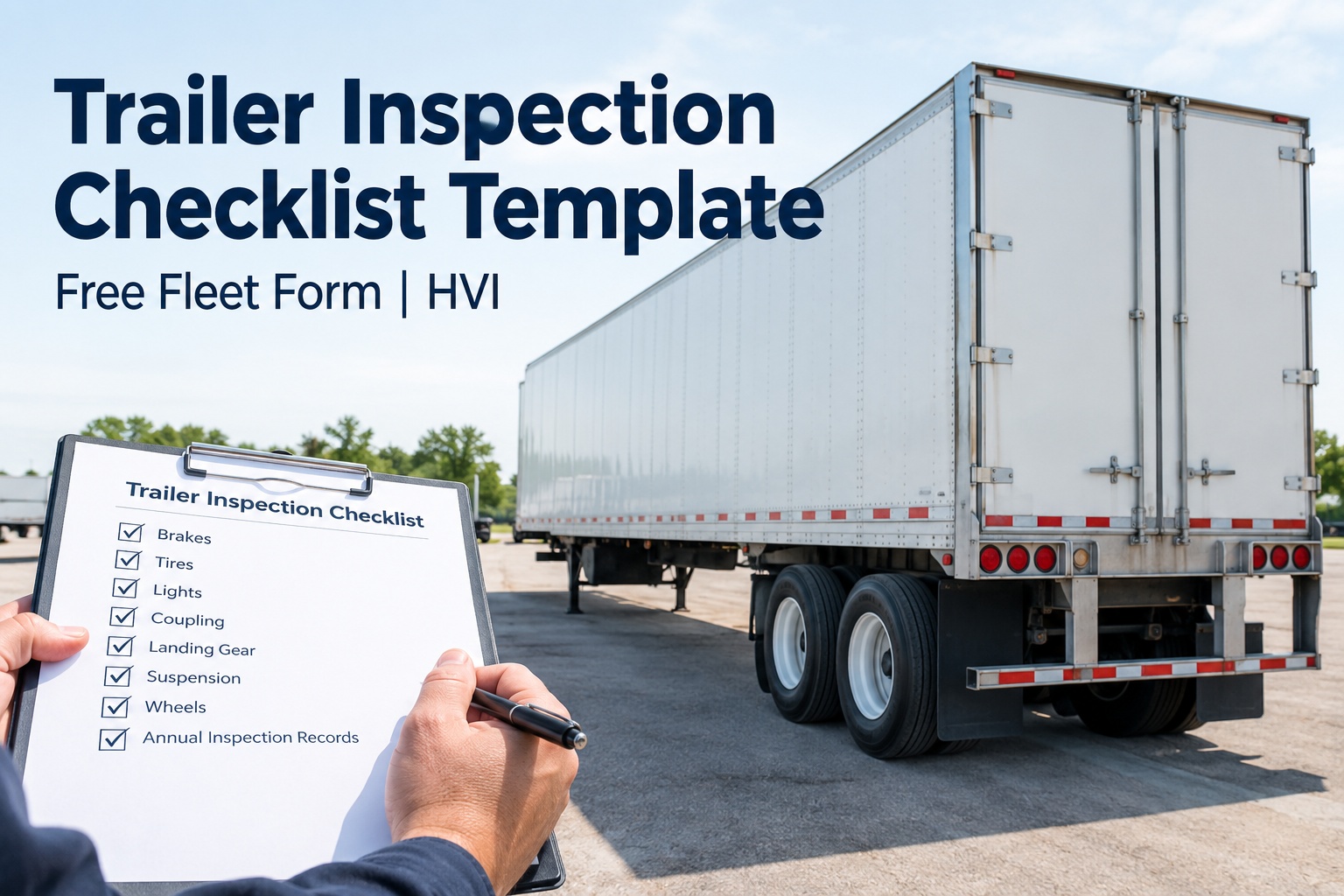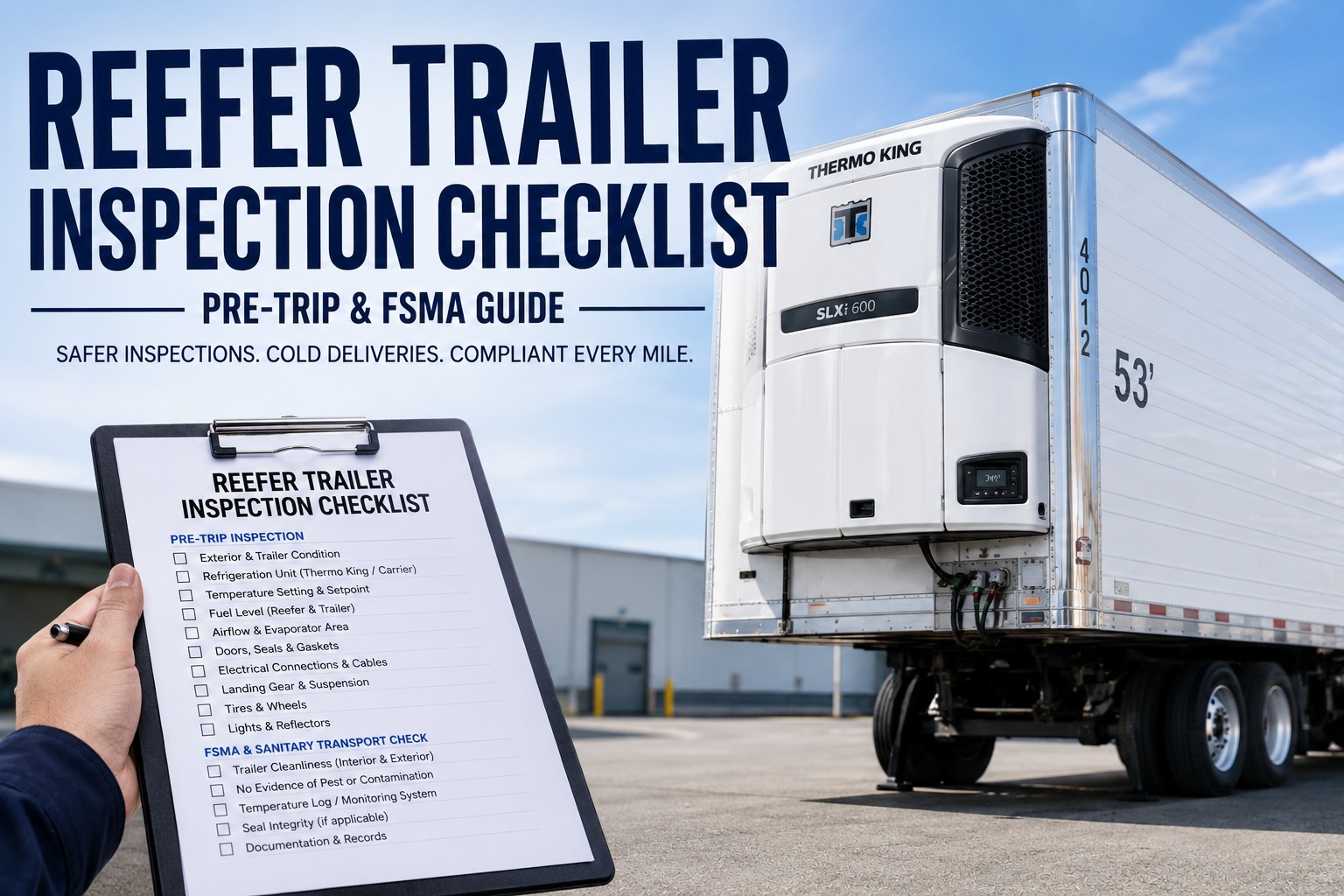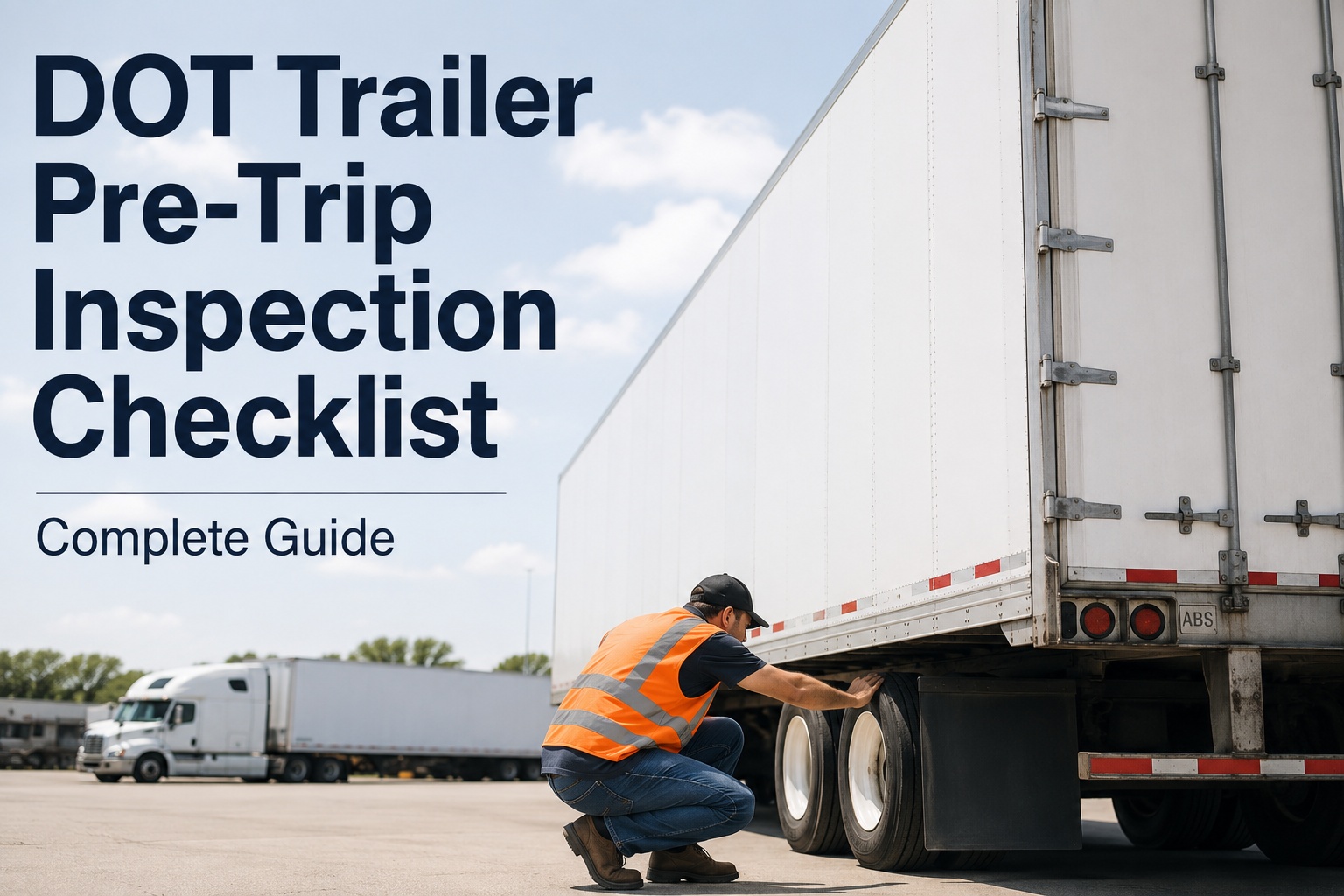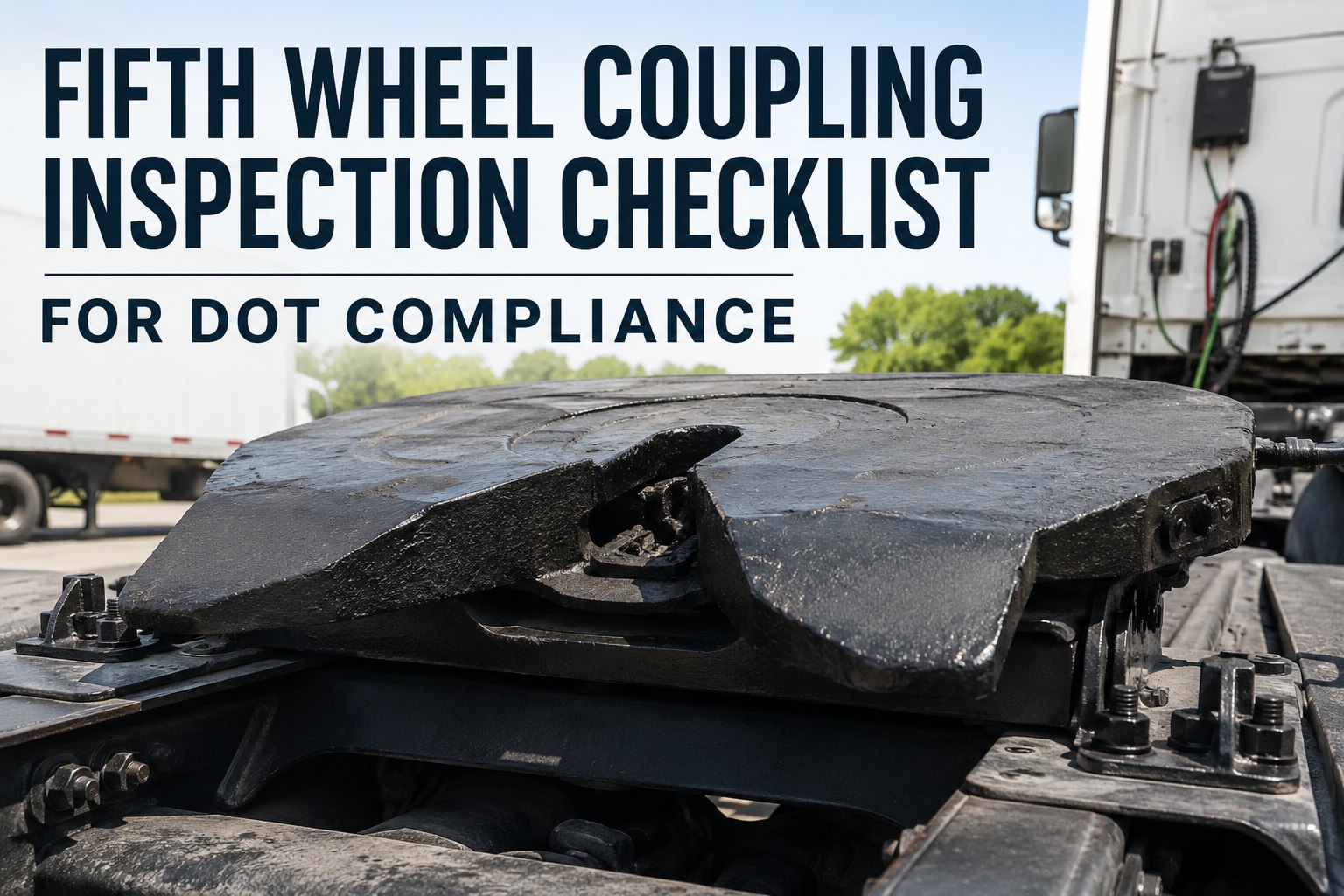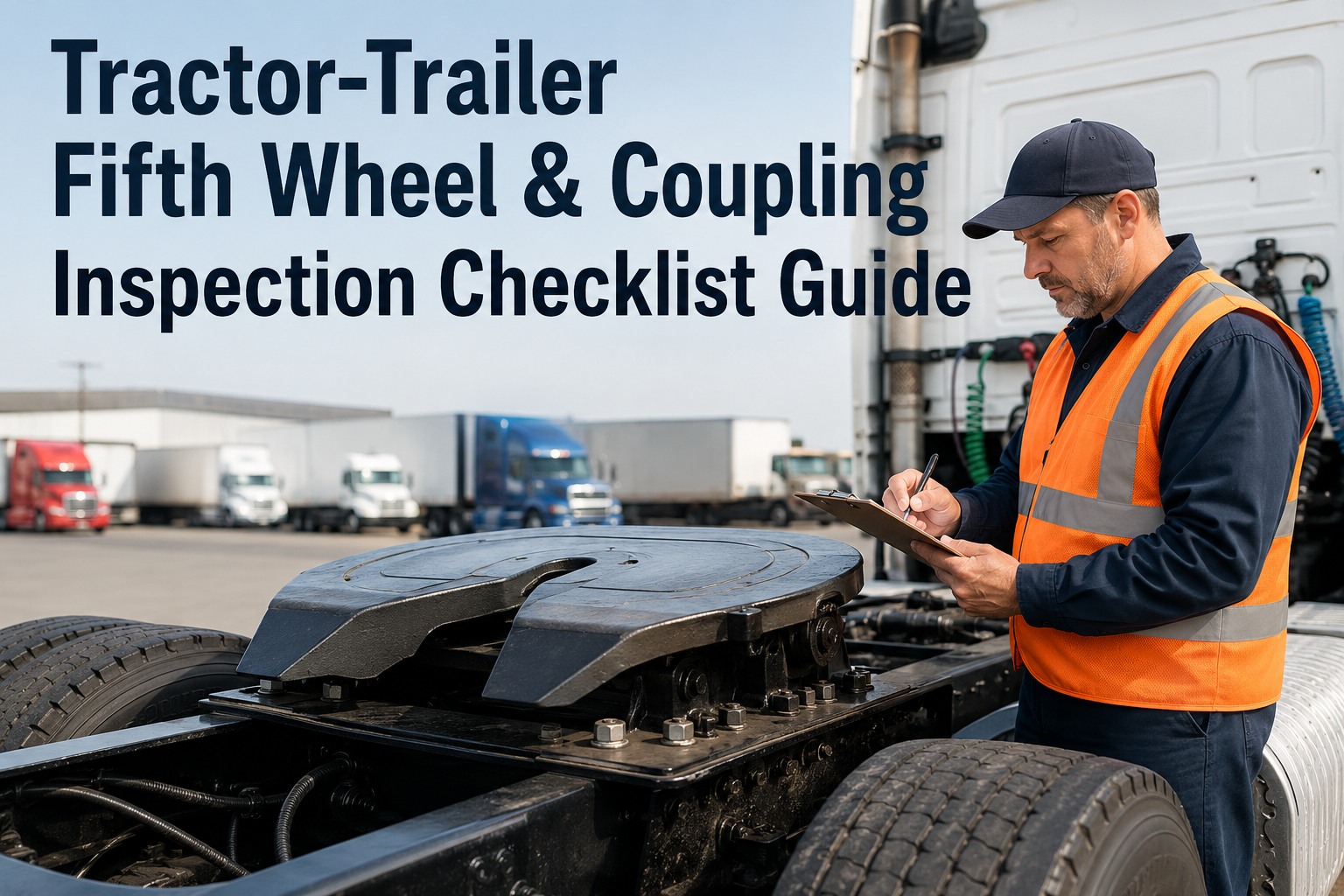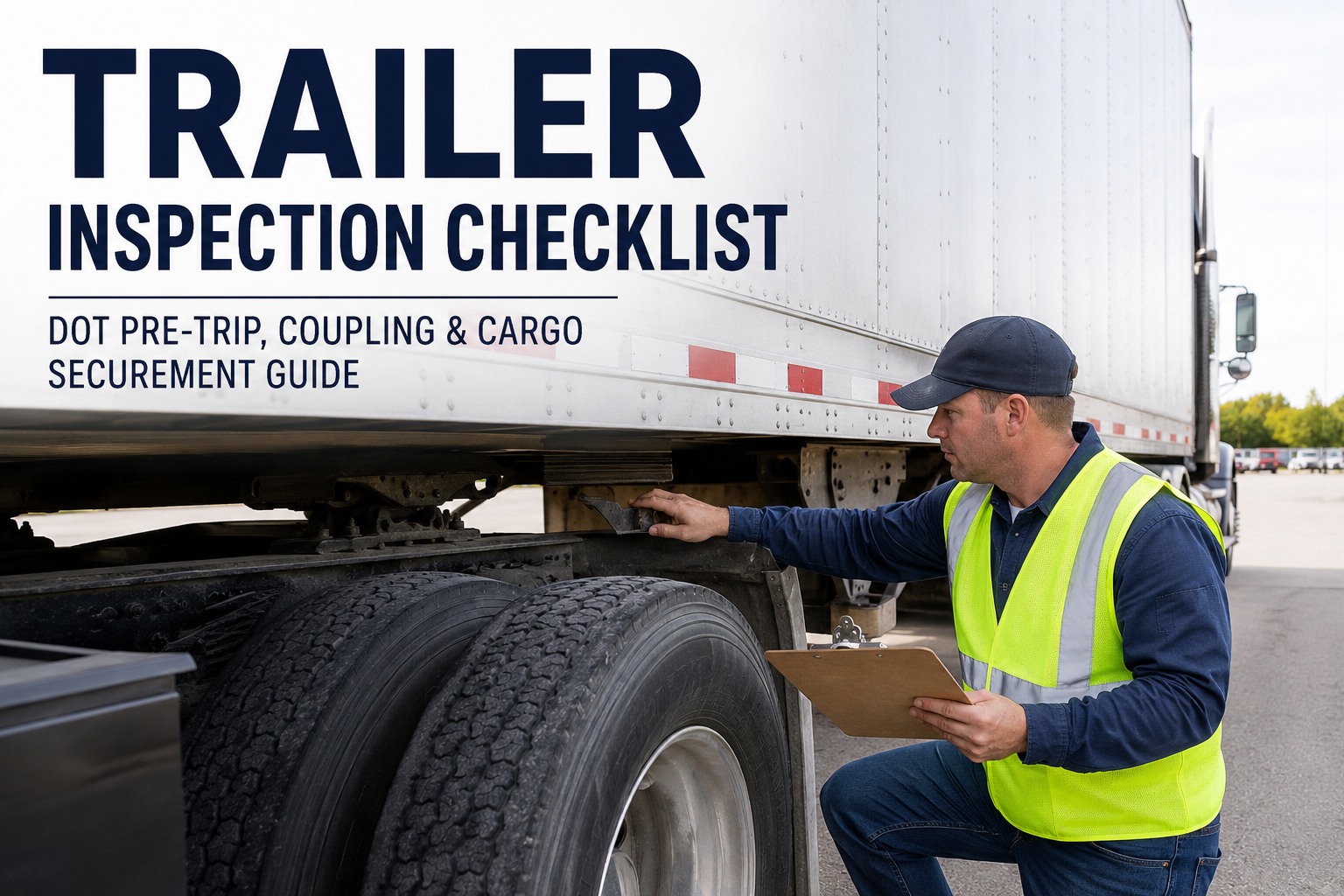
The tractor gets the attention, but the trailer is where the violations hide. Brakes out of adjustment, a lighting circuit gone dark, a kingpin worn past its limit — roughly one in five trailers pulled in for a roadside inspection gets placed out of service, almost always for a defect a proper walkaround would have caught. This complete trailer inspection checklist walks the whole unit the way an inspector does — coupling, brakes, tires, lights, suspension, landing gear, and cargo securement — with the exact conditions that trigger an out-of-service order. Book a 30-minute walkthrough to see it run digitally on your own trailers.
The Complete Trailer Inspection Checklist
Every system a DOT-compliant trailer walkaround has to cover — fifth wheel and kingpin, brakes, tires, lights, suspension, landing gear, and cargo securement — with the out-of-service thresholds an CVSA inspector uses.
- 1Coupling & fifth wheel
- 2Brake system
- 3Tires, wheels & rims
- 4Lights & reflectors
- 5Suspension
- 6Landing gear
- 7Frame & body
- 8Cargo securement
-
1 in 5
commercial trailers placed out of service at roadside inspections in 2026
roadside inspection data -
41%
of all vehicle out-of-service orders are brake-related — the top cause
2025 CVSA Roadcheck -
#2
tires are the second most-cited trailer out-of-service violation
CVSA inspection data -
14 mo
how long the annual trailer inspection report must be retained
49 CFR 396.21
Why the trailer fails more than the truck
A trailer is held to the same federal inspection standards as the power unit pulling it — but it's the part drivers rush. It sits low, it's dirty, its lights and brakes run off connections that get yanked apart and slammed back together every hookup, and it spends nights in a yard where nobody's looking at it. That's exactly why so many roadside out-of-service orders trace to the trailer, not the tractor. The good news: nearly every one of those defects is visible on a proper walkaround. Work the trailer in zones, know the threshold that fails each system, and you catch the problem in the yard instead of at a scale house. See how HVI guides the trailer walkaround
Zone 1: Coupling & fifth wheel — the catastrophic one
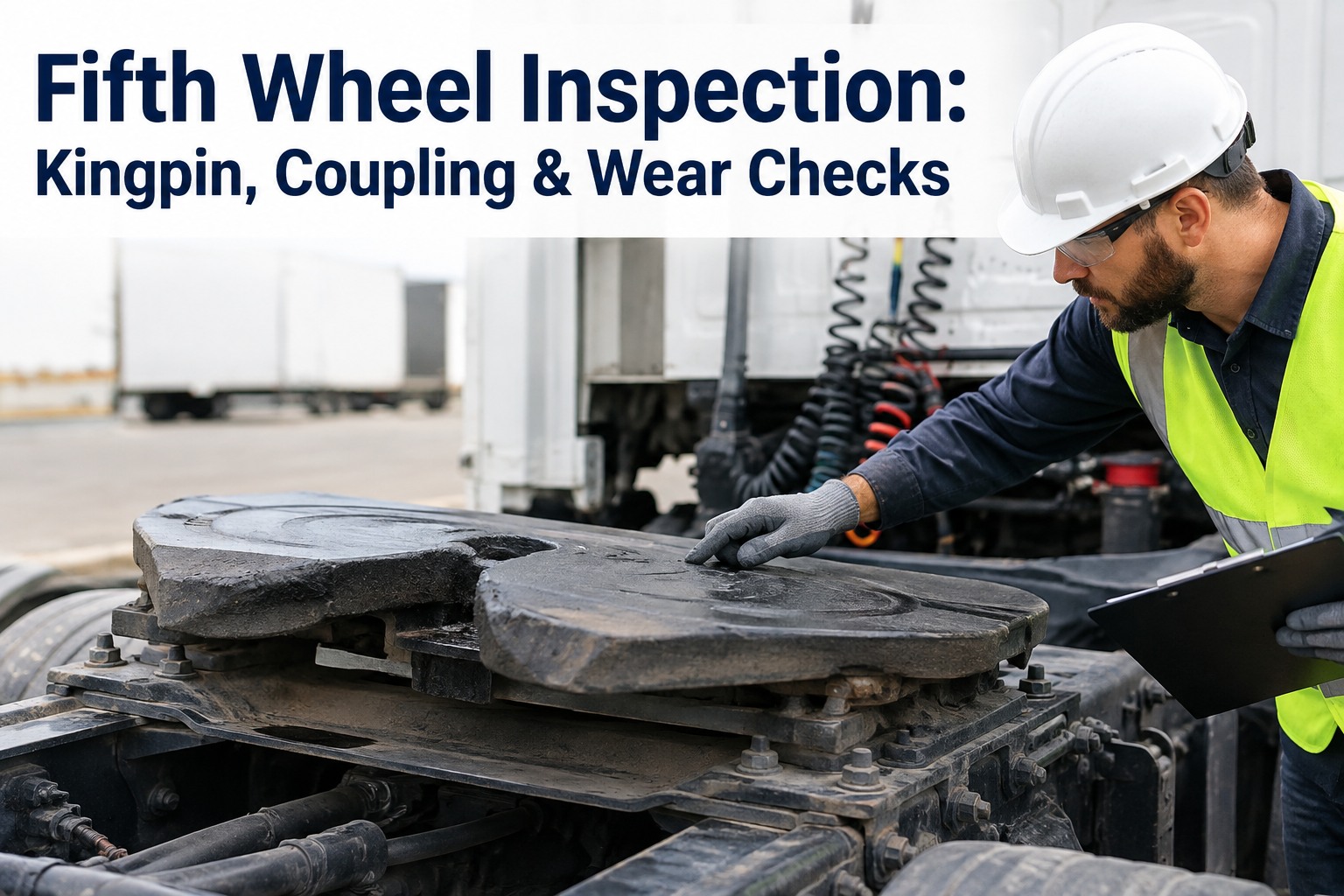
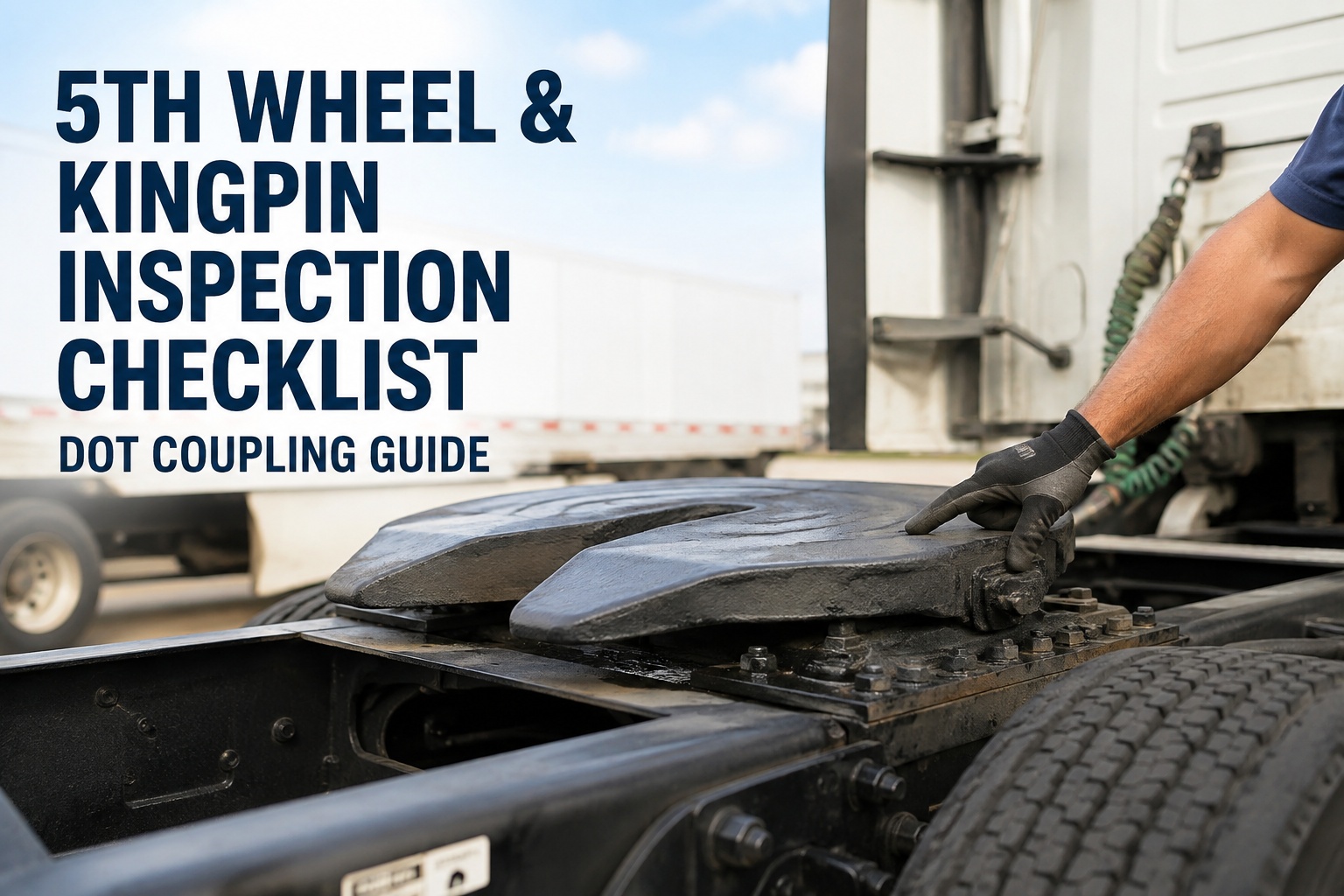
Start here, because this is the one failure that kills people. A trailer that separates from the tractor at speed is a worst-case event, and it's almost entirely preventable at the coupling. Inspect it at every hookup, not just once a day.
Coupling & fifth wheel
Every hookup- Kingpin not worn beyond limit (reject beyond ~2" diameter), no cracks or deformation
- Fifth wheel jaws fully closed and locked around the kingpin
- Release handle seated in the locked position
- Fifth wheel plate greased; apron sits flat with no gap
- Mounting bolts tight — no loose or missing fasteners
- Glad hands sealed, air lines and electrical pigtail secure with no leaks
- Safety chains or devices connected where required
- Perform a tug test to confirm the coupling holds
Out of service if: fifth wheel jaws not locked, kingpin not properly engaged, a missing or disconnected safety device, an air line not connected or leaking, or any component that allows separation risk.
A calibrated kingpin gauge and a photo at each inspection let you track wear over time and replace before it fails — strong evidence of due diligence in an audit, too. Log kingpin measurements on every hookup
Zone 2: Brake system — the #1 out-of-service cause
Brakes are the single largest source of out-of-service orders, and on a combination they're evaluated across every axle. One weak wheel end can fail the whole unit, so this is where measurement beats eyeballing.
Air brake system
Measured, per axle- Trailer brakes apply when the supply line is pulled; deceleration at both sides of every axle
- Pushrod stroke within limits (measured at 90–100 psi) — standard chamber max ~1.75", long-stroke ~2"–2.5"
- Brake lining above minimum thickness (~1/4")
- Drums free of cracks, deep scoring, or heat damage
- Hoses and tubing not cut, chafed, bulging, or leaking; secured and not rubbing
- Spring (parking) brakes hold; relay and ABS modulator valves function
- ABS indicator lamp completes its self-test and goes out
Out of service if: 20% or more of the brakes on the combination are defective or inoperative, air loss exceeds the allowed rate, an audible leak at a brake chamber, lining below minimum, or a brake hose with damage through the outer casing.
Zones 3–7: the rest of the walkaround
The remaining structural and visibility zones are quicker but no less citable. Each has its own out-of-service threshold — a checkmark isn't enough if the measurement is out of spec.
-
3
Tires, wheels & rims
- Tread at least 2/32" on trailer axles; no exposed belt or ply
- Proper inflation, no cuts, bulges, or sidewall damage
- No flat and no audible or felt air leak
- Wheels/rims free of cracks; lug nuts not loose or missing
- Tandem slider pins fully engaged both sides
-
4
Lights & reflectors
- Tail, brake, and turn signals all functional
- Clearance and marker lamps present and working
- Side reflectors and reflective tape intact
- Electrical connector pins clean and undamaged
-
5
Suspension
- Springs and leaves not cracked, broken, or shifted
- Air bags inflated, not leaking or missing
- U-bolts, hangers, and bushings tight, not worn
- Shock absorbers secure with no fluid leaks
-
6
Landing gear
- Cranks up and down smoothly
- Fully raised and secured before departure
- No bent legs, stripped gears, or missing handle
- Pads and mounting hardware intact
-
7
Frame & body
- Frame rails and crossmembers free of cracks or breaks
- Floor and decking sound; no holes compromising cargo
- Welds and mounting points not failing
- Mud flaps present and secured
-
i
Documentation
- Annual inspection sticker current
- Registration and permits valid
- Prior DVIR reviewed and defects certified
- Records producible on request
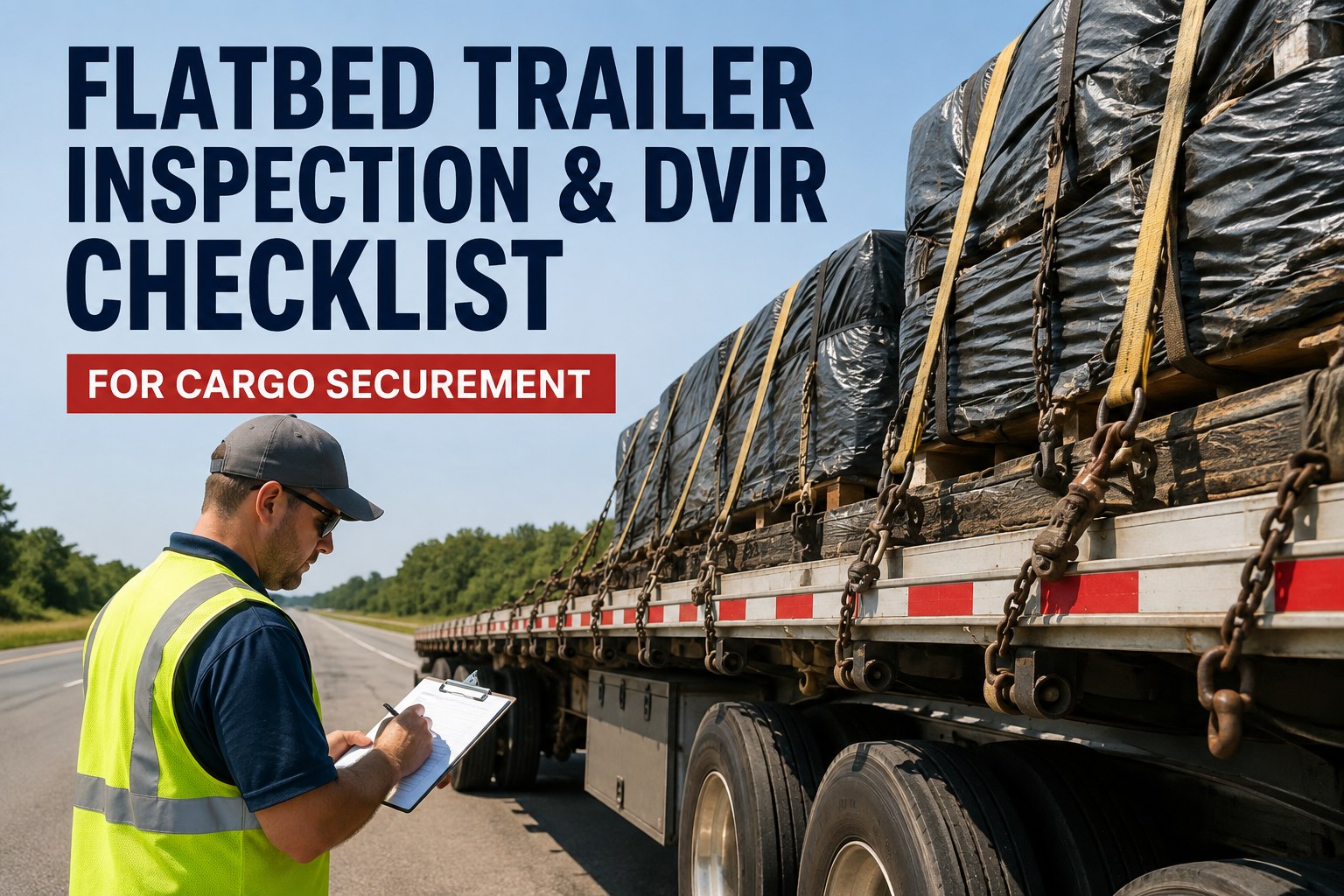
Zone 8: Cargo securement — the load itself
Securement is its own inspection, and a growing share of out-of-service orders. It doesn't matter how sound the trailer is if the load can shift, fall, or leak. The rules live in FMCSA 393.100–136.
Cargo securement
FMCSA 393.100–136- Aggregate working load limit of tiedowns at least half the weight of the cargo
- Correct number of tiedowns for cargo length and weight
- Tiedowns, chains, and straps not cut, frayed, or worn
- Edge protectors used where devices contact sharp cargo
- Blocking and bracing prevent forward, rearward, and side movement
- Re-check securement within the first 50 miles, then periodically
Out of service if: insufficient tiedowns for the load, damaged or defective securement devices, or any condition where the load can shift, fall, or spill.
Photograph the secured load before departure and you've documented that it left the yard right. Book a demo to see securement captured with photos
Where trailers actually get cited
If you want to raise your pass rate, prep where the violations cluster. A handful of systems drive most trailer out-of-service orders — and all of them are visible before dispatch.
-
Brakes
~41%
of vehicle OOS
Brake defects
Out-of-adjustment pushrods, worn linings, cracked drums. Evaluated per axle across the combination.
-
Tires
#2
trailer OOS
Tire & tread
Under-tread, exposed belt material, and flats — quick to catch on a walkaround, quick to fail if missed.
-
Cargo
~11%
of vehicle OOS
Securement
Too few tiedowns, worn straps, loads that can shift. A named CVSA focus and a rising share of citations.
-
Coupling
Fatal
if it fails
Fifth wheel
Lower frequency, highest stakes. A separation event is catastrophic — which is why the tug test is non-negotiable.
Expert view
With drop-and-hook, a driver grabs a trailer he's never seen, that's been sitting in the yard for who knows how long. The tractor gets a good pre-trip, but the trailer used to get a glance and a tug test — and that's where our roadside violations came from. Lights out, a brake out of adjustment, a strap nobody re-checked.
Making the trailer walkaround its own guided checklist changed that. The driver can't skip the coupling photo or the light check, and if something's flagged it routes to the shop before the trailer's cleared. Our trailer OOS rate dropped hard, and the yard actually moves faster because there's no guessing.
— Rob C., Terminal Manager, drop-and-hook fleet
Paper trailer form vs. HVI digital checklist
The walkaround is the same either way. What changes is whether the measurements get recorded, the defects get routed, and the records are there when an inspector asks.
Paper trailer form
- A checkmark with no kingpin or stroke measurement behind it
- Easy to skip the coupling or a light circuit and still "complete" it
- No photo of the defect or the secured load
- Defect handoff to the shop relies on a note or a call
- Forms lost between the yard and the office
HVI digital checklist
- Measurement fields for kingpin wear, pushrod stroke, and tread
- Pass/fail gates that block skipping a zone
- Mandatory photos on coupling, brakes, and cargo
- Defects auto-route to a work order before dispatch
- Cloud-stored DVIRs, produced in seconds for an auditor
Since the 2026 eDVIR rule made electronic reports explicitly compliant under 49 CFR 396.11, moving the trailer walkaround digital is a clean win — the inspection is the same, the record is bulletproof. Sign up free and load the trailer checklist on every phone
Frequently asked questions
What should a trailer inspection checklist cover?
A complete trailer inspection covers the coupling system (fifth wheel, kingpin, glad hands, air and electrical lines, safety chains), the brake system (pushrod stroke, lining thickness, drums, hoses, spring brakes, ABS), tires and wheels (tread, inflation, condition, lug nuts, slider pins), lights and reflectors, suspension (springs, air bags, U-bolts, shocks), landing gear, the frame and body, and cargo securement. A trailer is held to the same federal inspection standards as the power unit, and many of the most common roadside violations — brakes, lighting, and tires — occur on the trailer rather than the tractor, so none of these zones should be skipped.
How do you inspect the fifth wheel and kingpin?
Check that the fifth wheel jaws are fully closed and locked around the kingpin, the release handle is seated in the locked position, and the mounting bolts securing the fifth wheel to the frame are tight with none loose or missing. The plate should be greased and the trailer apron should sit flat with no gap. Examine the kingpin for wear, mushrooming, cracks, or deformation — a calibrated kingpin gauge measures wear, with replacement generally required beyond about a 2-inch diameter. Confirm the glad hands are sealed with no air leaks and the electrical pigtail is connected, then finish with a tug test to verify the coupling holds. A fifth wheel not locked, a kingpin not properly engaged, or any component allowing separation risk is an out-of-service condition.
What are the most common trailer out-of-service violations?
Brake defects lead by a wide margin — brake-related violations account for roughly 41% of all vehicle out-of-service orders, evaluated across every axle of the combination. Tires are the second most-cited trailer violation, typically for under-tread or exposed belt material. Cargo securement makes up a significant and rising share, around 11% of vehicle out-of-service orders. Lighting failures and coupling defects round out the list. The important point is that nearly all of these are visible during a pre-dispatch walkaround, which is why roughly one in five trailers pulled in for a roadside inspection is placed out of service for something that could have been caught in the yard.
How are trailer brakes measured during an inspection?
Trailer brakes are measured, not judged by eye. Pushrod (slack adjuster) stroke is checked with the brakes applied at roughly 90–100 psi — a standard chamber allows a maximum stroke of about 1.75 inches, while long-stroke chambers allow about 2 to 2.5 inches depending on size. Brake lining thickness should be above the minimum of about 1/4 inch, and air loss should not exceed the allowed rate (roughly 4 psi per minute on a combination). Drums are checked for cracks, scoring, or heat damage, and hoses for cuts, chafing, or leaks. If 20% or more of the brakes on the combination are defective or inoperative, the vehicle is placed out of service.
How long do trailer inspection records need to be kept?
The annual periodic inspection report for a trailer must be retained for 14 months under 49 CFR 396.21, and either the report or a decal must be kept on the trailer. Daily Driver Vehicle Inspection Reports (DVIRs) must be retained for at least three months at the terminal where the trailer operates, and the records must show both the defects identified and certification that repairs were completed before the trailer returned to service. A trailer that fails inspection must be removed from service until a qualified mechanic completes and certifies the repairs. Digital records make producing this history on demand far easier and are fully compliant under FMCSA rules.
Put the full trailer walkaround on every driver's phone
HVI runs the complete eight-zone trailer inspection as guided pass/fail gates — measurement fields for kingpin wear, pushrod stroke, and tread, mandatory photos on coupling and cargo, instant defect routing to maintenance, and cloud-stored DVIRs. Catch the defect in the yard before it becomes an out-of-service order at the scale.
No credit card · No hardware · Live on your fleet in under two weeks