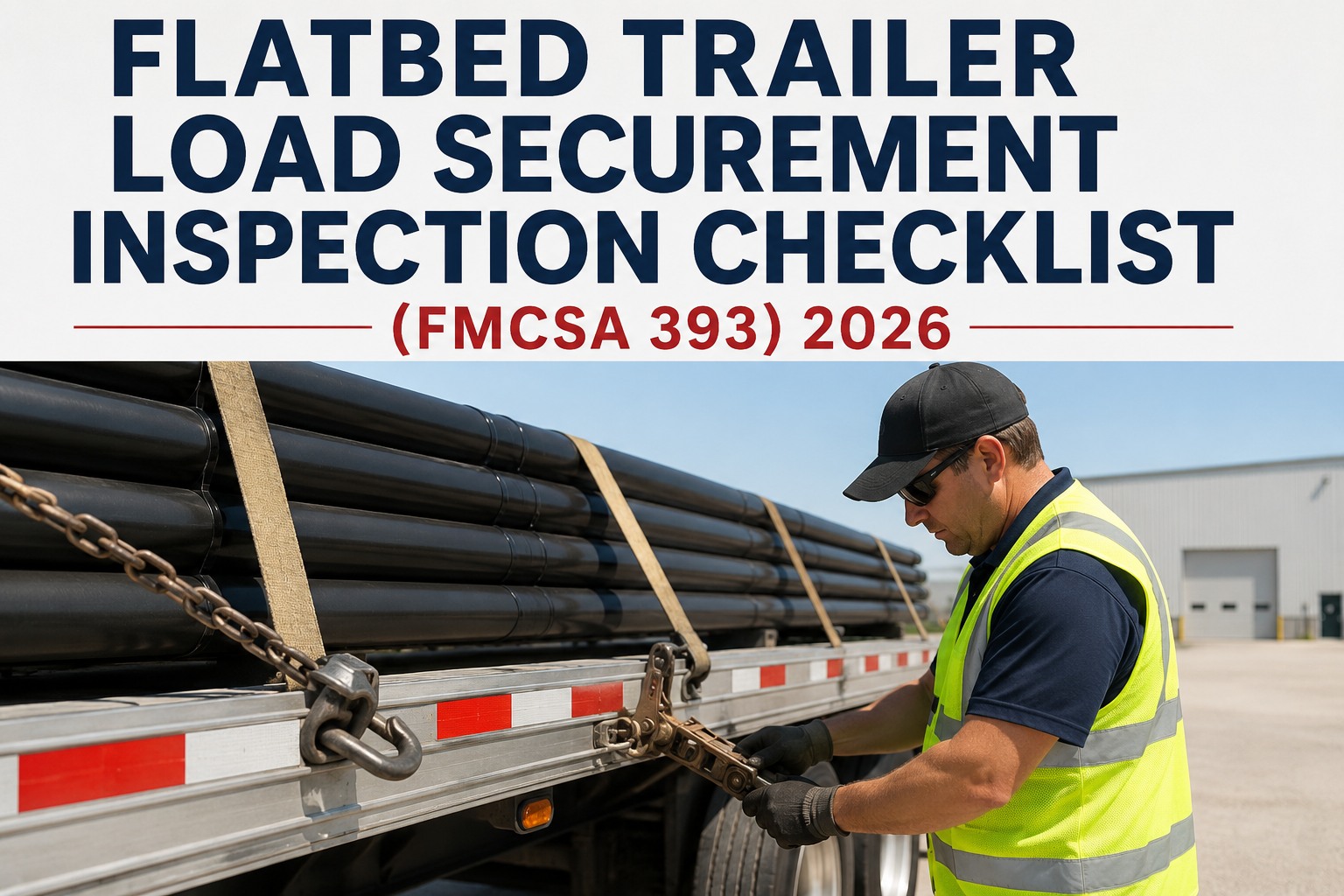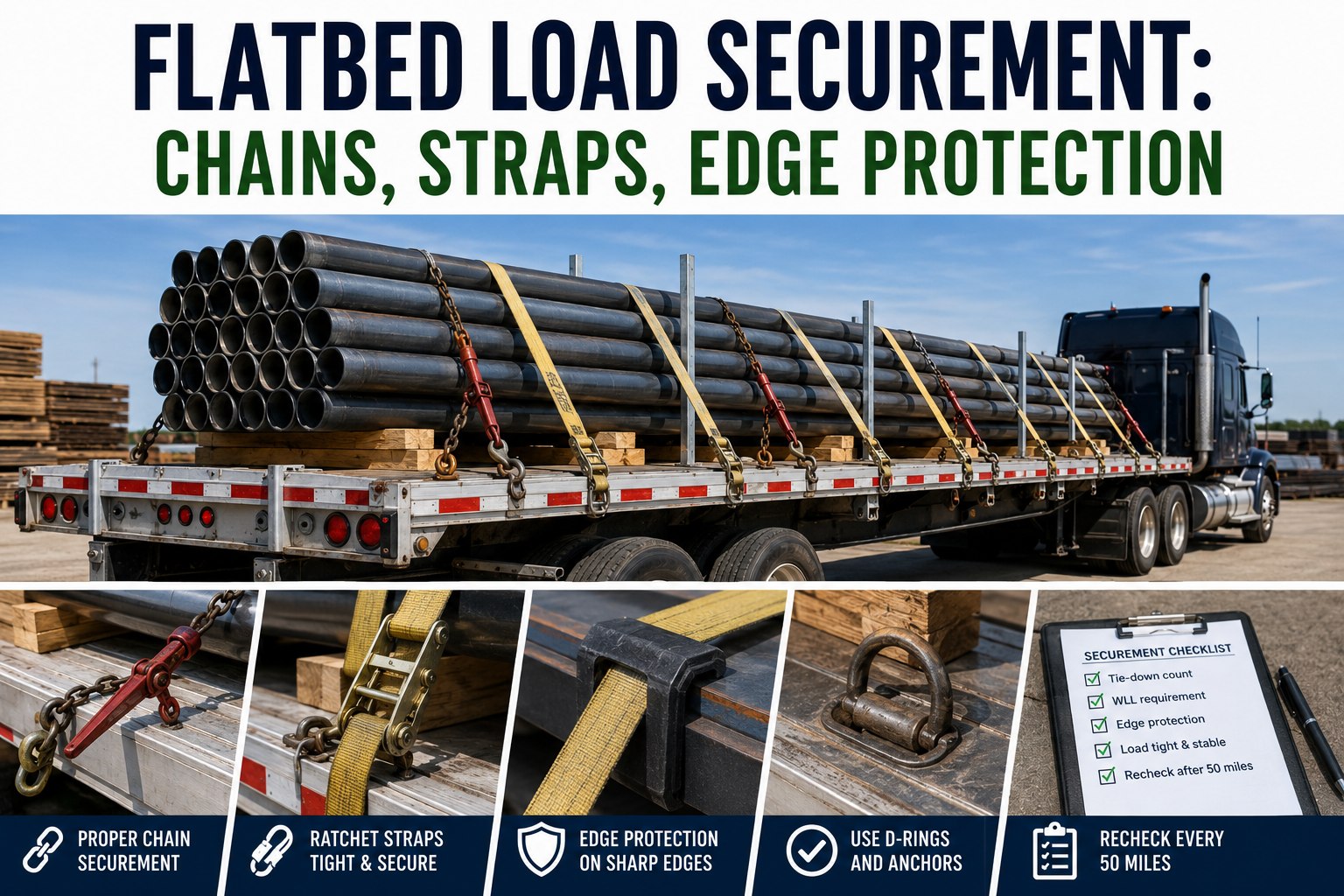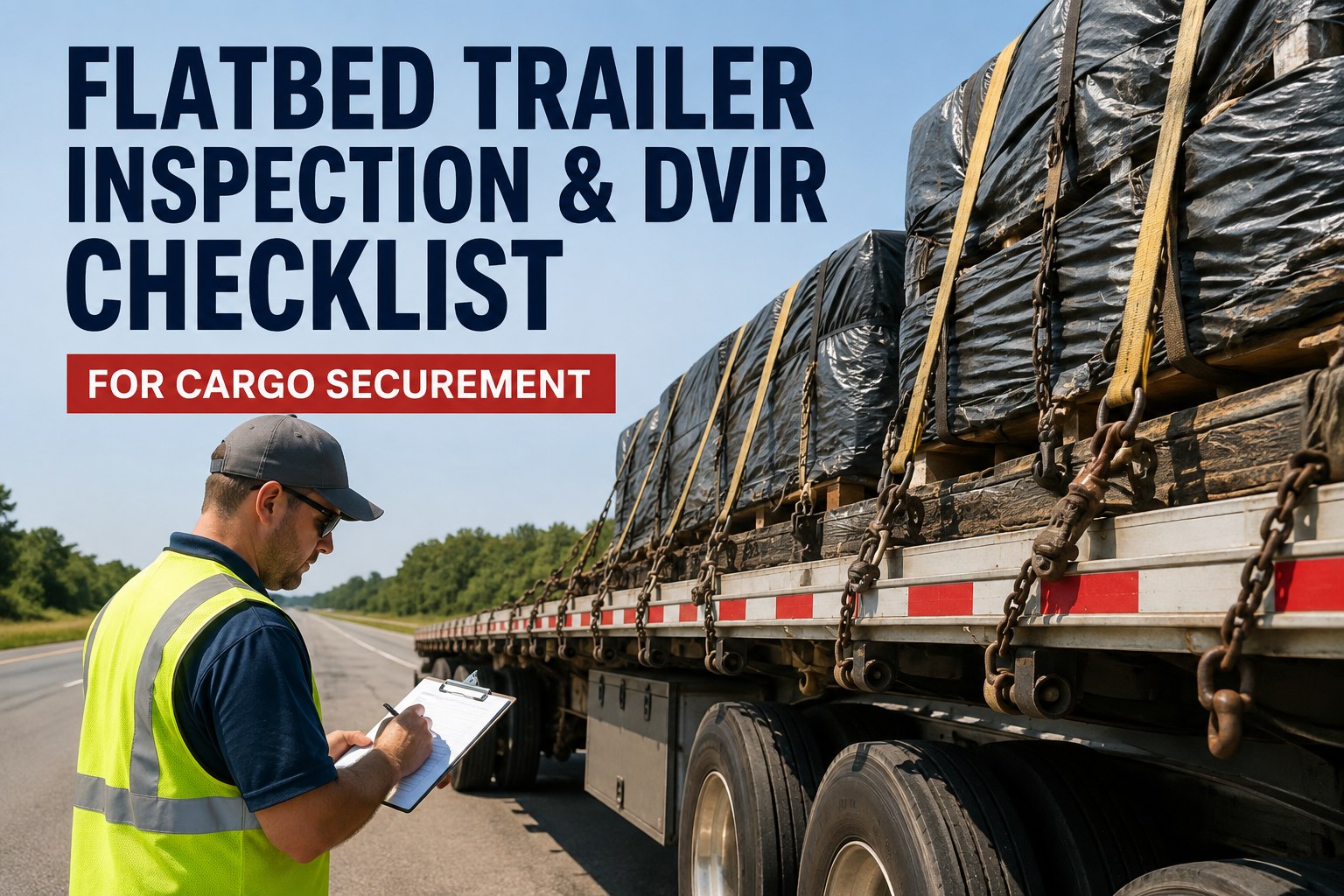
A flatbed load with the wrong tie-down count or an aggregate Working Load Limit under 50% of cargo weight is not "close to compliant." It's a $18K-per-violation ticket, an out-of-service order, and — if the load fails on the road — the cargo becoming a projectile behind you. 49 CFR 393 Subpart I sets the math with no gray area: minimum tie-down count based on length and weight, aggregate WLL at least 50% of cargo weight, no shift greater than ½" in any direction. This guide walks the trailer checks, the securement math, and the digital DVIR workflow. Book a demo .
The Flatbed Securement Math — Worked in Full
Every legal flatbed load passes two independent tests: enough tie-downs by count, and enough aggregate WLL by weight. Both. Not either. Here's the arithmetic on a real load.
Cargo securement violations ranked among the top-5 vehicle out-of-service categories during the 2025 CVSA International Roadcheck, producing over 1,500 OOS orders and more than 18,000 additional citations. A single violation can be $18K per event before insurance premium impact or CSA score damage. The math itself is not complicated — two tests, both must pass. What causes violations is running the calculation once when the load is first configured, then treating it as done, and skipping the trailer inspection that would catch the chain gouge or binder failure that turns a compliant load into a released load.
The 6-zone flatbed trailer inspection — before you even touch the loadTrailer inspection and cargo securement are two disciplines that happen in sequence
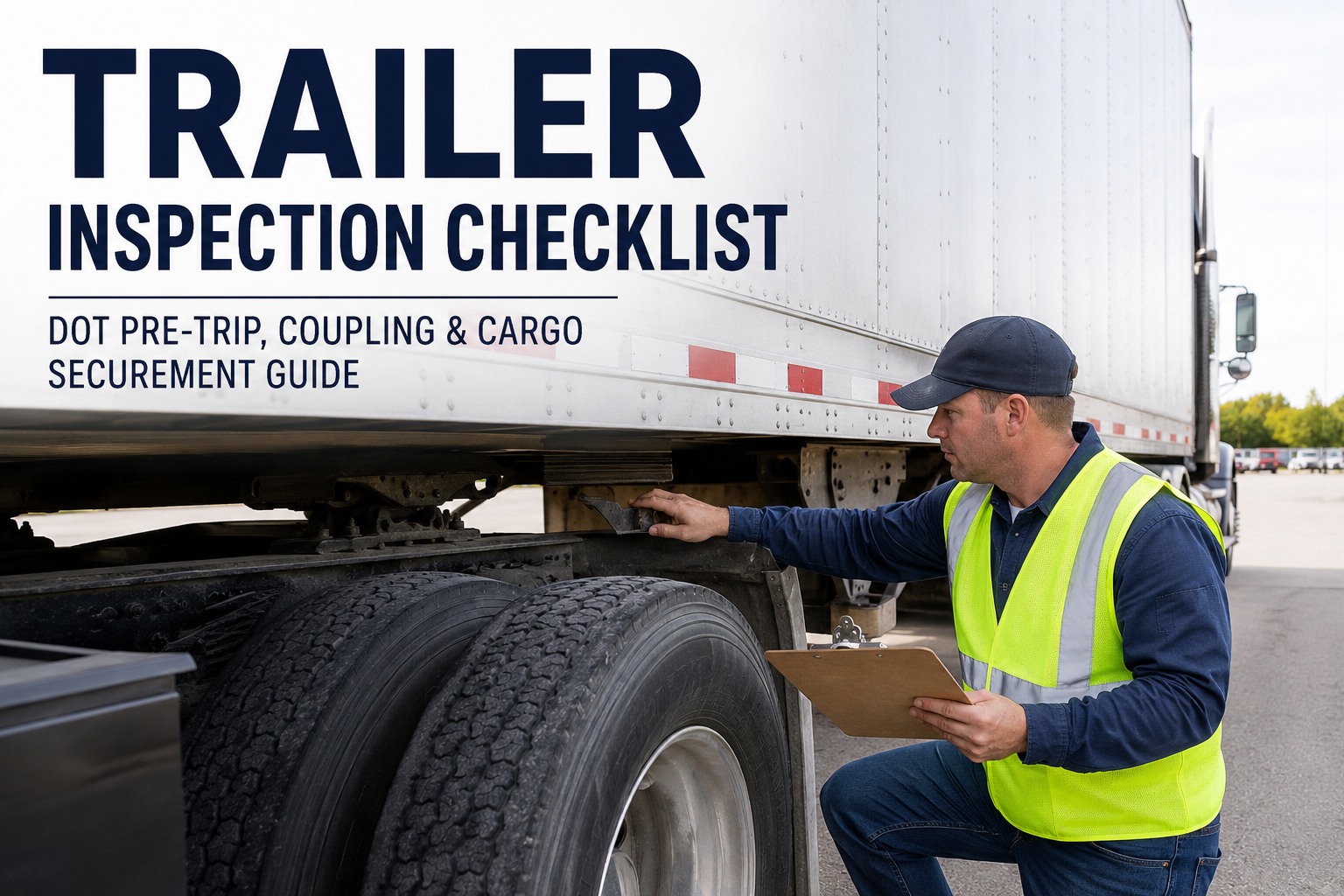
Trailer inspection is empty-trailer work. Cargo securement inspection happens loaded. Both are required, and skipping either is how DVIRs fail an audit. Below are the 6 zones every flatbed pre-trip covers before the load goes on. Book a demo to see the 6-zone template in HVI
Deck surface & boards
Wood deck: cracks, rot, splintering, missing boards, protruding nails. Steel deck: gouges, rust-through, weld cracks. Load-bearing zones get closer look than edges.
Stake pockets, rub rails & anchor points
Every stake pocket clear and undamaged, rub rails intact end-to-end, D-rings and chain anchors free of deformation. The tie-down attaches here — if the anchor is compromised, the tie-down doesn't matter.
Headboard / front-end structure
Per 49 CFR 393.114, front-end structure must resist forward load movement. Check for bends, tears, weld failure, missing bracing. If the headboard is questionable, load restraint is questionable.
Axles, tires, brakes
Standard 49 CFR 393 trailer checks: tire tread ≥ 2/32" per 393.75, no audible air leaks at brake chambers, axle alignment visual check, wheel-end signs of overheating.
Lighting & conspicuity
All marker lights, brake lights, turn signals, backup, and reflective conspicuity tape intact. Flatbeds show more chassis than enclosed trailers — conspicuity matters more.
Tarp system & equipment box
If load will be tarped: tarp condition, no tears or missing grommets, spare rings, straps, corner protection. Equipment box contents verified before dispatch, not at the roadside.
Tie-down count — the length-and-weight tableDirect from 49 CFR 393.106 and 393.110 — commit this to memory
The tie-down count rule is one of the most-cited FMCSA sections and one of the most-misapplied. It's not complicated — but it is exact, and roadside inspectors will apply it exactly. Here's the count logic as a lookup.
The 6 defects that trigger cargo securement OOS at roadsideWhat the CVSA inspector is looking for — and what puts you out of service
Roadside inspectors don't recalculate every load's WLL from scratch. They look for visible failure patterns that indicate the securement wasn't done correctly. Six patterns cover the vast majority of cargo securement OOS orders. Start a free trial and configure a template that captures each of these before dispatch.
Tie-down count below the length-and-weight minimum
Inspector counts tie-downs, measures cargo length, notes cargo type. If count is short, OOS. No math required — it's a lookup.
Aggregate WLL below 50% of cargo weight
Inspector reads WLL from each tie-down (stamped on hardware), sums, compares to bill of lading cargo weight. Under 50% = OOS. Missing WLL markings on hardware = OOS on the hardware itself.
Damaged tie-downs (cuts, knots, twisted webbing, worn chain links)
Straps with cuts of any depth, knots (which reduce WLL to unknown), or twisted webbing. Chains with deformed, cracked, or worn links. All OOS — damaged tie-downs have unpredictable WLL.
Missing edge protection where chains contact sharp edges
Chain crossing a sharp cargo edge without corner protector will fail progressively. Inspector flags this as securement inadequate. Corner protectors are cheap and required.
Wrong chain grade for the load
Grade 43 (transport chain) where Grade 70 (binding chain) is required, or Grade 70 where Grade 80/100 is required. Chain grade is stamped on links; inspector will look. Wrong grade = OOS even if count is right.
Load shift greater than ½" in any direction
Per 49 CFR 393.100, cargo cannot shift more than ½" longitudinally or laterally under normal driving forces. Visible shift at inspection = securement inadequate = OOS.
From a fleet safety manager after switching flatbed DVIRs to digital
Two of our flatbeds got hit with cargo securement OOS orders in one week last spring — both drivers had done the securement correctly by count but neither could show the aggregate WLL math on paper. Roadside officer had every right to question it. That cost us $9K in fines and 48 hours of downtime on both units.
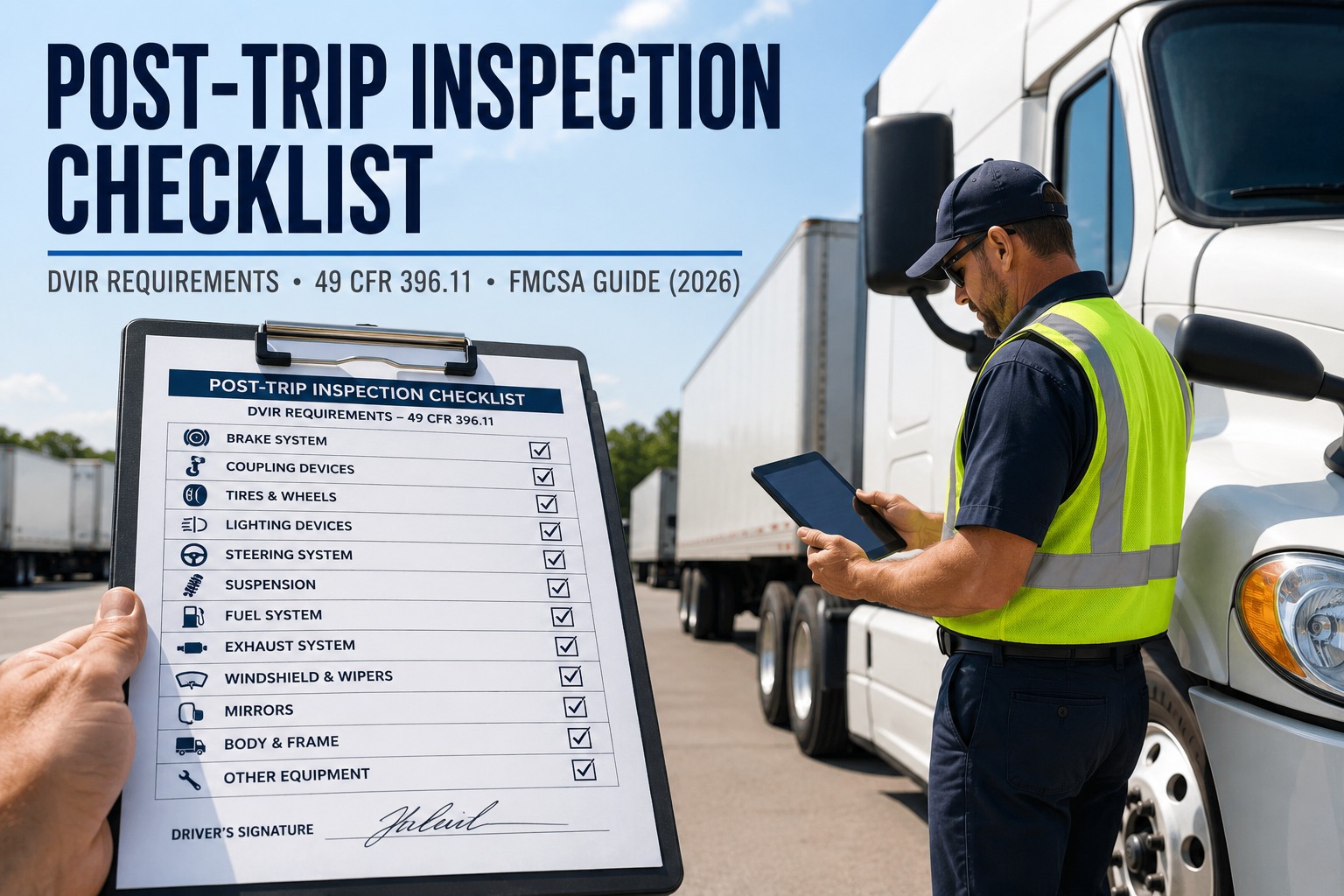
We rebuilt our flatbed DVIR digitally with a securement worksheet drivers fill in on the tablet before dispatch: cargo weight, tie-down count, WLL per tie-down, aggregate WLL calculated automatically, photos of every tie-down and edge protection point. Roadside officer asks how the load was calculated, driver hands over the phone with the record. Zero cargo securement OOS in 14 months since. That's what defensible DVIR looks like.
Frequently asked questions
What should you inspect on a flatbed trailer before hauling a load?
A flatbed pre-trip inspection covers two disciplines in sequence: the empty-trailer inspection (6 zones) and the loaded-trailer securement inspection. Trailer zones: (1) deck surface and boards for cracks, rot, or gouges; (2) stake pockets, rub rails, and anchor points for damage or deformation; (3) headboard/front-end structure per 49 CFR 393.114; (4) axles, tires per 393.75 (min 2/32" tread), and brakes; (5) lighting and conspicuity tape; (6) tarp system and equipment box. Once loaded: verify tie-down count matches 49 CFR 393.106/393.130 for cargo length and weight (min 4 for heavy equipment >10K lb); verify aggregate WLL is at least 50% of cargo weight per 49 CFR 393.102; verify edge protection where chains contact sharp cargo edges; and re-check the load within the first 50 miles per 49 CFR 392.9. Every step is a documentable DVIR event.
How many tie-downs does a flatbed load need under FMCSA rules?
Under 49 CFR 393.106 and 393.110: loads 5 ft or shorter and 1,100 lb or lighter require 1 tie-down; loads 5 ft or shorter but heavier than 1,100 lb require 2; loads over 5 ft up to 10 ft require 2; loads over 10 ft require 2 for the first 10 ft plus 1 additional tie-down for every 10 ft (or fraction thereof) beyond that — so 15 ft = 3, 20 ft = 3, 25 ft = 4, 40 ft = 5. Separately, per 49 CFR 393.130, heavy vehicles and equipment weighing more than 10,000 lb require a minimum of 4 direct tie-downs regardless of length. And separately again, per 49 CFR 393.102, the aggregate Working Load Limit of all tie-downs must be at least 50% of the cargo weight. All three tests must pass independently.
What is the aggregate Working Load Limit rule and how do you calculate it?
Per 49 CFR 393.102, the aggregate Working Load Limit (WLL) of all tie-downs used to secure a load must equal at least 50% of the cargo weight. Calculation: sum the WLL of every tie-down being used to secure the cargo, then verify that sum is at or above half the cargo weight. Each tie-down's WLL is stamped on the hardware (chain link tag, strap tag, binder tag) — use the marked value, not an estimate. Example: 22,000 lb excavator requires aggregate WLL of at least 11,000 lb. Four 3/8" Grade 70 chains at 6,600 lb WLL each = 26,400 lb aggregate, which passes comfortably. Common mistakes: mixing chain grades and using the highest rating, forgetting that binder WLL applies to the binder even if the chain is stronger, and using strap systems where the strap WLL and hardware WLL differ (always use the lower of the two).
Does HVI support flatbed-specific DVIR and cargo securement templates?
Yes. HVI supports configurable digital inspection checklists and DVIRs that can be built for flatbed trailers with per-zone photo evidence requirements, cargo securement inspection templates that capture cargo weight, tie-down count, WLL per tie-down, edge protection photos, and post-departure re-check documentation. Defects flagged during either the trailer inspection or the securement inspection carry severity flags (out-of-service vs flag-and-repair) and can generate maintenance work orders automatically. All records are tied to the specific trailer asset and are searchable by date, driver, defect type, or load.
What are the top cargo securement violations at roadside inspection?
Six failure patterns account for the vast majority of cargo securement OOS orders at roadside. First: tie-down count below the length-and-weight minimum in 49 CFR 393.106/393.130 — a simple count. Second: aggregate WLL under 50% of cargo weight per 49 CFR 393.102, checked by reading WLL stamps on hardware and comparing to bill of lading. Third: damaged tie-downs (cuts, knots, twisted webbing, worn or deformed chain links) which have unpredictable WLL. Fourth: missing edge protection where chains contact sharp cargo edges. Fifth: wrong chain grade for the load (Grade 43 where Grade 70 is required, etc.). Sixth: load shift greater than ½" in any direction per 49 CFR 393.100. Cargo securement was among the top-5 vehicle OOS categories during the 2025 CVSA International Roadcheck.
Build defensible flatbed DVIRs your drivers actually complete
HVI supports digital fleet inspections, DVIR configured for flatbed trailers, cargo securement inspection templates with WLL calculation capture, per-tie-down photo evidence, defect documentation with severity flags, and maintenance work orders from defects. The 6-zone trailer routine, the securement math, the loaded-load photos — all in one record. Not paper. Not scattered.
No credit card · No hardware · Flatbed templates ready on day one