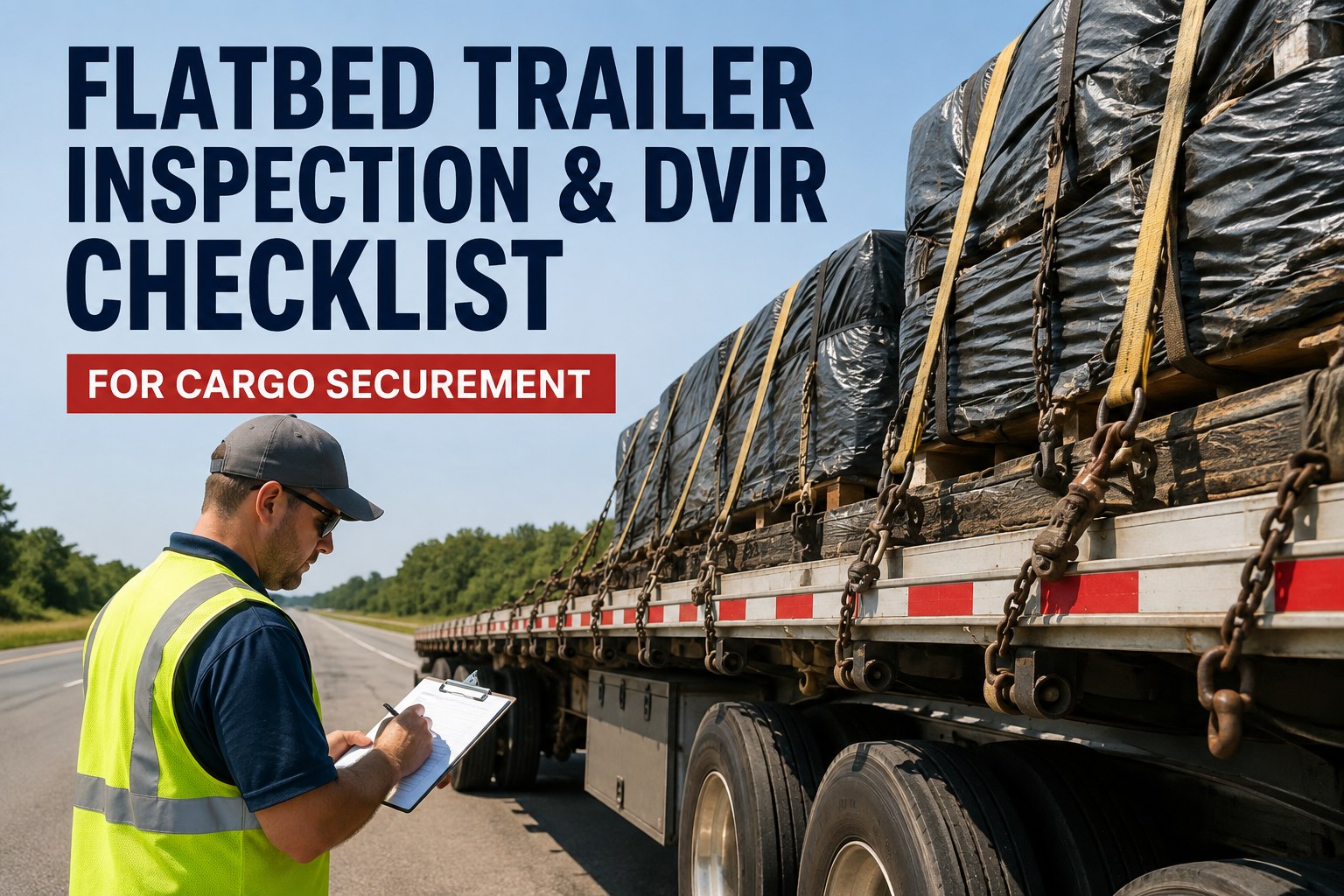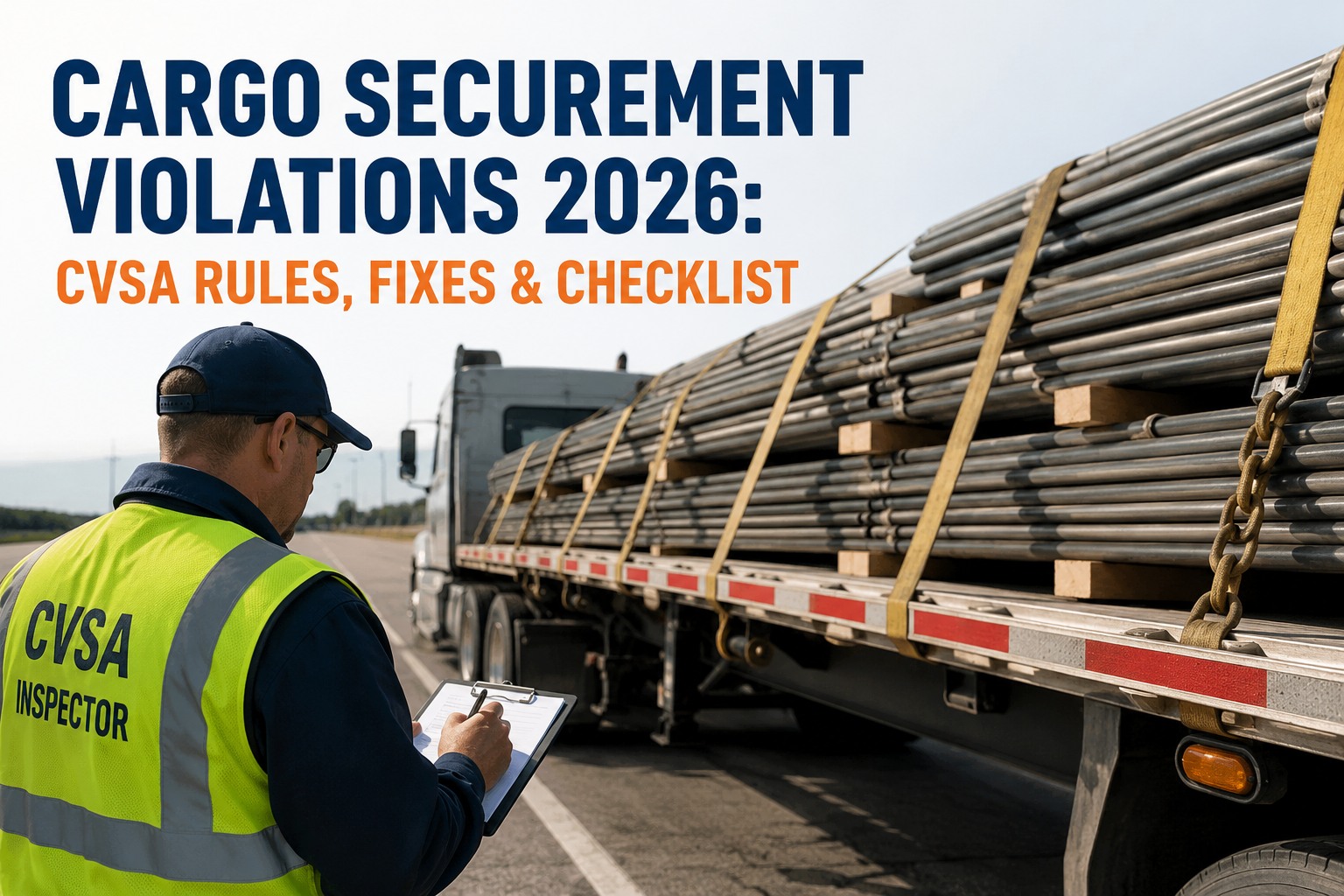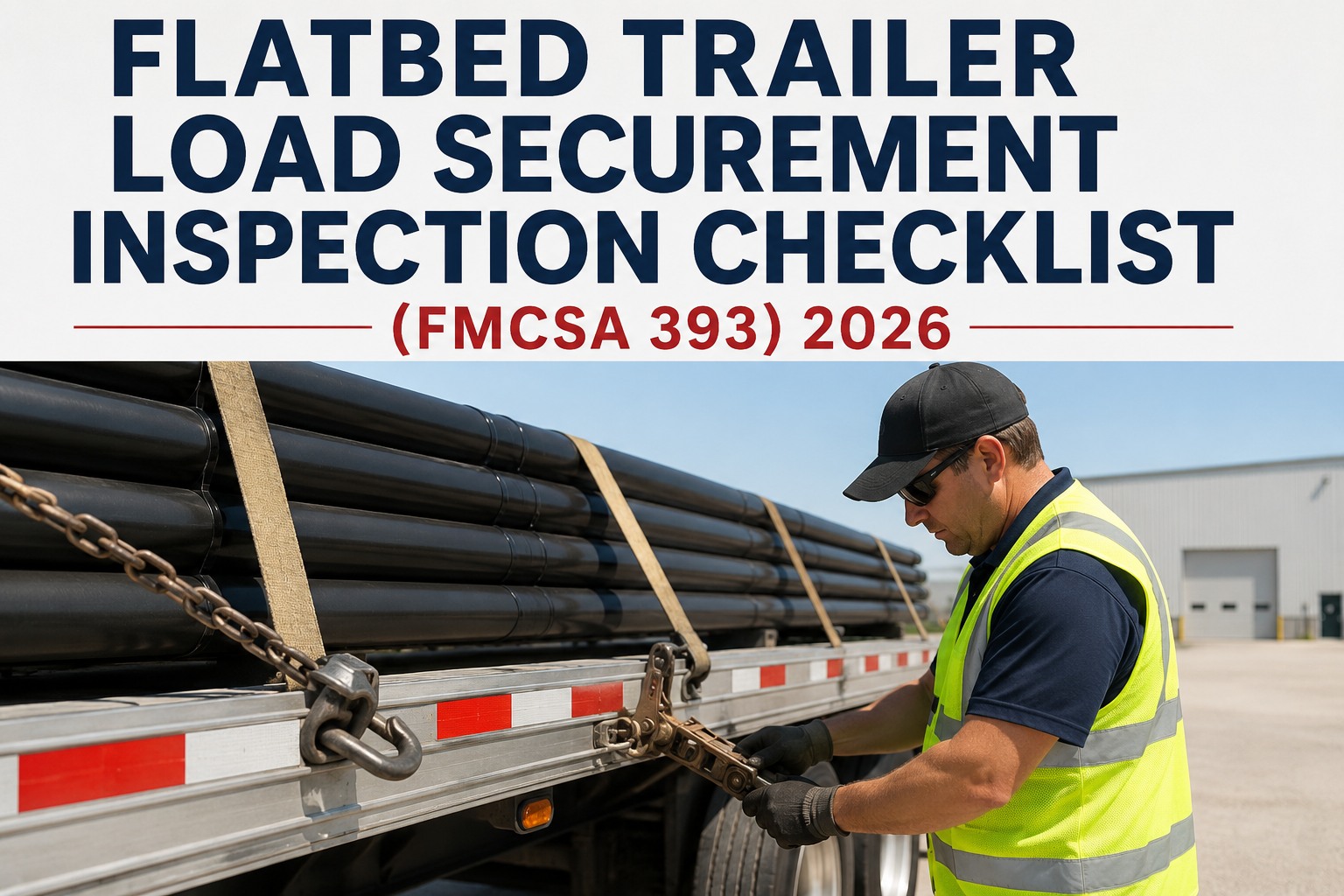
Cargo securement violations ranked among the top five vehicle out-of-service categories during the 2025 CVSA International Roadcheck, producing over 1,500 OOS orders and more than 18,000 additional citations. Most of those violations are preventable with a single tool: a standardized pre-trip load securement inspection. FMCSA 49 CFR Part 393 Subpart I is clear — cargo cannot shift more than half an inch in any direction, and the aggregate working load limit of all tiedowns must equal at least 50% of the cargo weight. This is the complete flatbed load securement inspection checklist for 2026. Book a demo to digitize your securement inspections.
Flatbed Load Securement Inspection: 5 Zones Between You and an OOS Order
Every flatbed load starts with these five zones. Miss one, and the next scale house decides your day.
A flatbed load that looks secure in the yard can shift, loosen, or fail 30 miles down the highway. FMCSA requires an in-transit inspection within the first 50 miles and every 150 miles thereafter — but the pre-trip inspection is where most violations are prevented. Below is the zone-by-zone checklist that keeps your loads legal, your drivers safe, and your CSA score clean.
The Numbers That MatterFMCSA rules every flatbed driver must know cold
These three numbers are the foundation of every securement decision. A 40,000-pound load needs at least 20,000 pounds of aggregate WLL across all tiedowns. A 25-foot piece of cargo needs at least 4 tiedowns (2 base plus 1 per additional 10 feet, rounded up). And when the inspector checks, the load cannot have shifted more than half an inch from where it was loaded. Every item on this checklist traces back to one of these three requirements. Book a demo to see WLL tracking built into HVI digital inspections
Zone 1: Tiedown Deviceschains, straps, wire rope, and binders
Every tiedown device on the flatbed must be inspected before the load leaves the yard. A single defective chain, frayed strap, or improperly seated binder can cause a load shift that cascades into a catastrophic failure — and an immediate OOS order at the next inspection point.
Zone 2: Working Load Limit Verificationthe 50% rule that determines pass or fail
The single most common securement violation is insufficient aggregate WLL. The math is straightforward but must be verified on every load: add up the WLL of every tiedown device, and confirm the total equals at least 50% of the cargo weight.
Zone 3: Edge Protectionthe detail that cuts straps and costs loads
Zone 4: Deck, Blocking, and Frictionthe foundation the load sits on
Zone 5: In-Transit Inspectionsthe FMCSA requirement most drivers skip
FMCSA requires drivers to inspect cargo securement within the first 50 miles after loading and every 150 miles or every 3 hours (whichever comes first) thereafter. This isn't a suggestion — it's a federal requirement, and inspectors can ask for documentation.
Stop, walk the load, retighten every tiedown. New loads settle during the first miles. Straps stretch. Chains find slack. This is the highest-risk window.
Full walkaround: check tension, inspect tiedown condition, verify edge protectors haven't shifted, confirm blocking hasn't moved. Document each check.
Hard braking, rough roads, weather change, or a driver change all require a fresh securement check. Don't assume the load is still tight after hitting construction zones or mountain grades.
Record time, location, and findings at each in-transit inspection. Digital timestamps in HVI provide audit-ready proof. Book a demo
From a flatbed fleet safety manager running 45 drivers
We had three OOS orders for securement in one quarter — two for insufficient WLL and one for a frayed strap the driver didn't catch. Each one cost us a day of revenue plus the CSA points. The problem wasn't that our drivers didn't know the rules; it was that the paper checklist didn't force them to actually walk the load and count tiedowns.
Since we moved to a digital inspection with required photos at each strap and chain, our securement violations went to zero for 14 months straight. The in-transit recheck feature was the real game-changer — drivers log a 50-mile check with GPS and timestamp, which gives us documentation we never had before.
Frequently asked questions
What is the minimum number of tiedowns required on a flatbed load?
FMCSA requires a minimum of 2 tiedowns for any cargo, regardless of length or weight. For cargo longer than 10 feet, add 1 additional tiedown for every 10 feet of cargo length or fraction thereof. For example, a 25-foot load requires at least 4 tiedowns (2 base plus 1 for the second 10 feet and 1 for the remaining 5 feet). For heavy equipment weighing over 5,000 pounds, a minimum of 4 independent tiedowns is required regardless of the load's length. Loads exceeding 10,000 pounds also require a minimum of 4 tiedowns. These are federal minimums — many experienced flatbed drivers use more tiedowns than the minimum for added safety margin.
What is the working load limit (WLL) requirement for flatbed cargo?
The aggregate working load limit of all tiedowns securing a piece of cargo must equal at least 50% of the cargo's total weight. For example, a 40,000-pound load requires tiedowns with a combined WLL of at least 20,000 pounds. The WLL of any tiedown assembly is limited by its weakest component — if a 5,400 lb WLL strap is attached to a 4,700 lb hook, the assembly's WLL is 4,700 pounds. While FMCSA does not require tiedown devices to be marked with their WLL, drivers must know the ratings of their equipment and be able to demonstrate compliance during an inspection. Using tiedowns with missing or unreadable WLL labels creates a practical compliance problem even though labeling isn't technically required.
How often must flatbed drivers check their load during a trip?
FMCSA requires drivers to inspect cargo and securement devices within the first 50 miles after beginning a trip or after the cargo has been loaded, and then at intervals not exceeding 150 miles or 3 hours of driving, whichever comes first. These in-transit inspections require a physical walkaround of the load to check tiedown tension, verify edge protectors are in place, confirm blocking hasn't shifted, and identify any signs of cargo movement. Each check should be documented with time and location. In-transit inspections are also required whenever there's a change of driver, after the vehicle has been involved in any incident, or after driving through conditions that could affect load stability such as hard braking events, rough roads, or severe weather.
What are the most common flatbed cargo securement violations?
The most common cargo securement violations on flatbed trailers include insufficient aggregate working load limit (total tiedown WLL below 50% of cargo weight), too few tiedowns for the load length and weight, damaged or defective tiedown devices (frayed straps, cracked chain links, malfunctioning binders), missing edge protection where tiedowns contact sharp cargo edges, and loose tiedowns that have lost tension during transport. During the 2025 CVSA International Roadcheck, cargo securement produced over 1,500 out-of-service orders and over 18,000 additional violations in the United States, making it one of the top five vehicle violation categories. Each violation impacts the carrier's CSA score and can result in immediate out-of-service orders that strand the load.
Can I digitize flatbed load securement inspections?
Yes. A platform like HVI (Heavy Vehicle Inspection) lets flatbed carriers build custom securement checklists by load type (steel, lumber, equipment, pipe, coils), require photos at every tiedown and edge protector, log WLL calculations per load, capture in-transit rechecks with GPS timestamps, and auto-generate defect reports when a driver flags a damaged tiedown or insufficient WLL. Every inspection is signed digitally, stored with GPS location and timestamp, and retrievable in seconds during a DOT roadside inspection or CSA audit. Digital inspections ensure drivers physically walk the load rather than checking boxes from the cab, which is the primary failure mode of paper checklists.
Every flatbed load: inspected at the yard, rechecked on the road, documented for DOT
Build securement checklists by cargo type. Require photos at tiedowns and edges. Log WLL calculations. Capture in-transit checks with timestamps. Pull any inspection in seconds for roadside or audit. Live in under two weeks.
No credit card · No hardware · Works on any phone or tablet