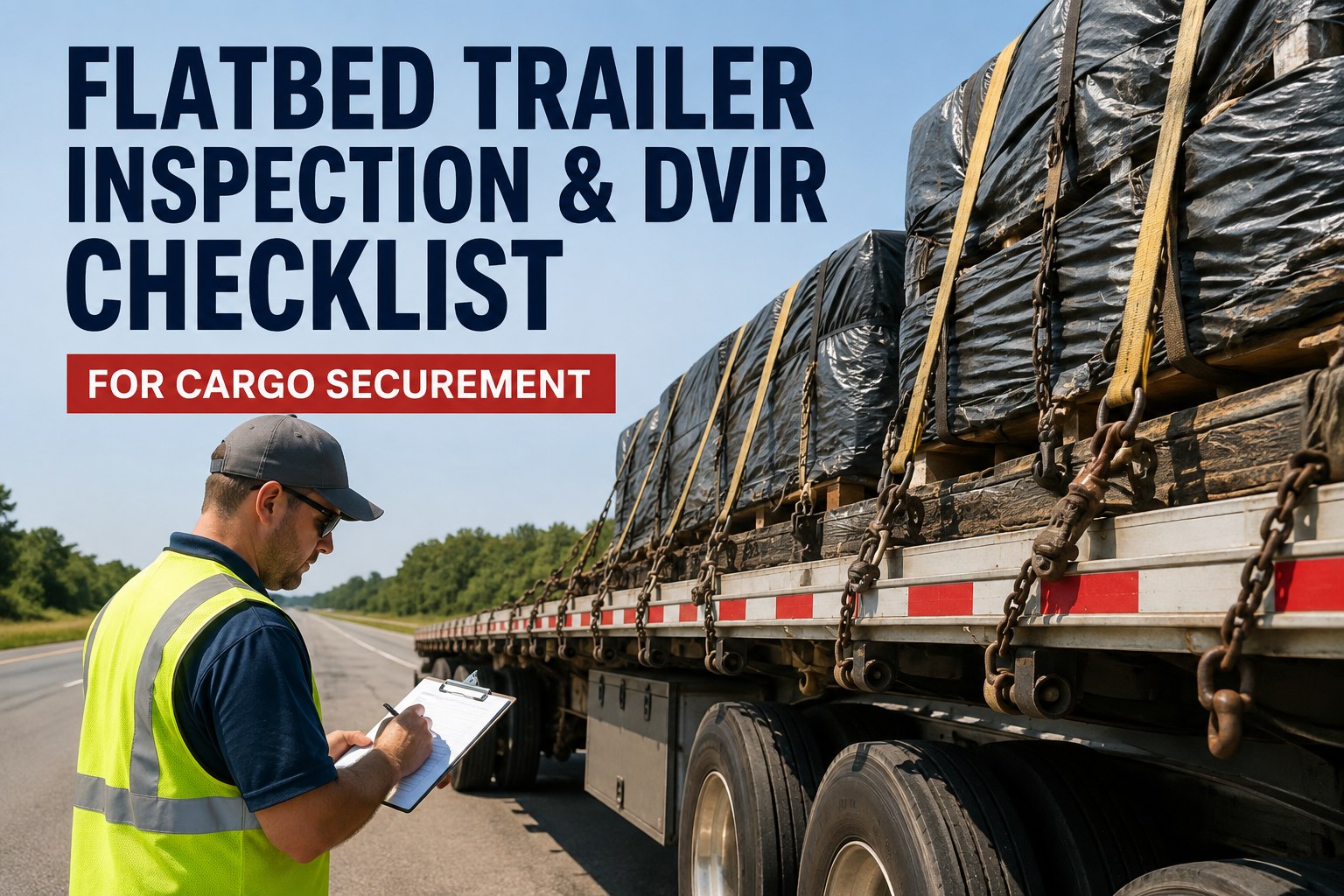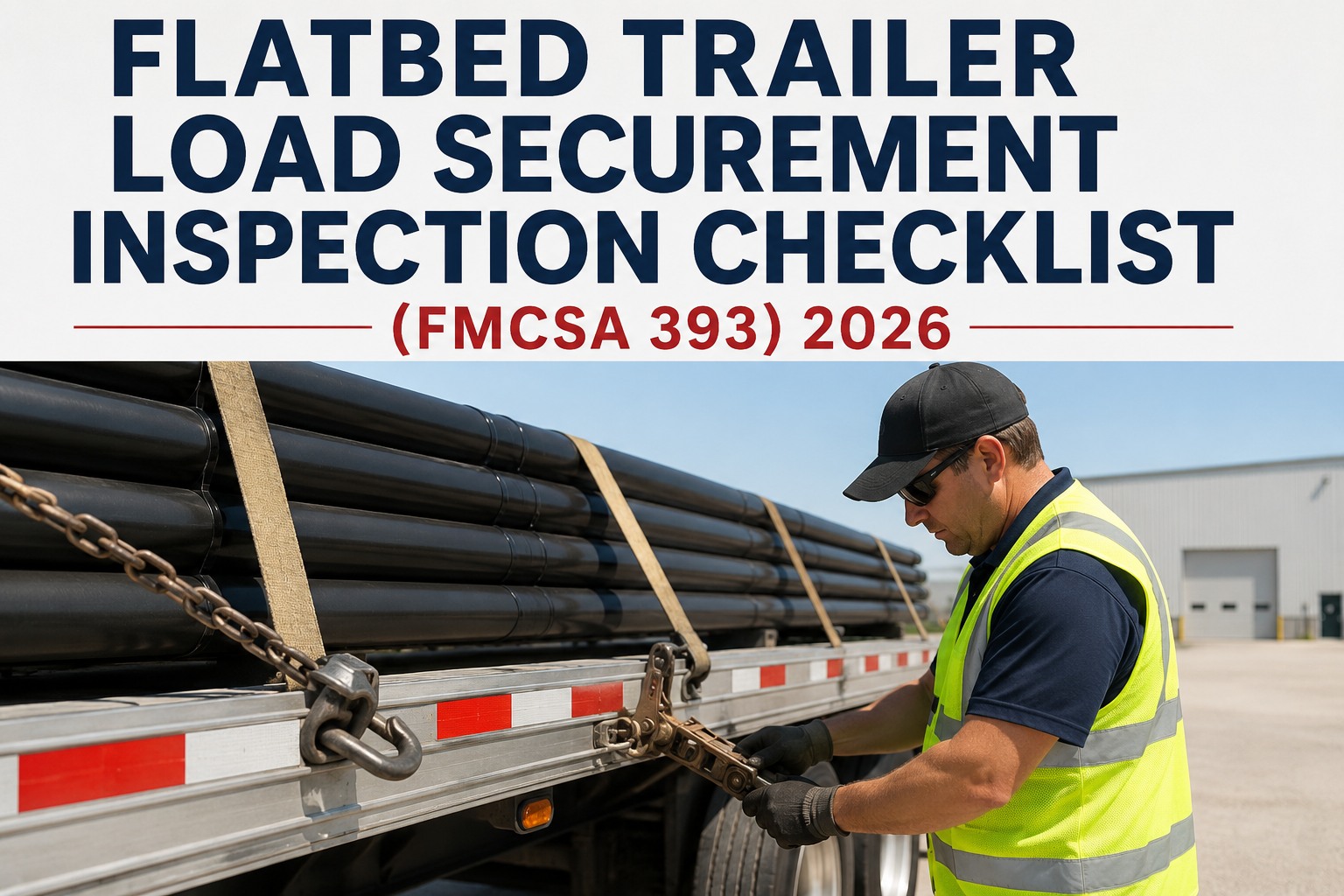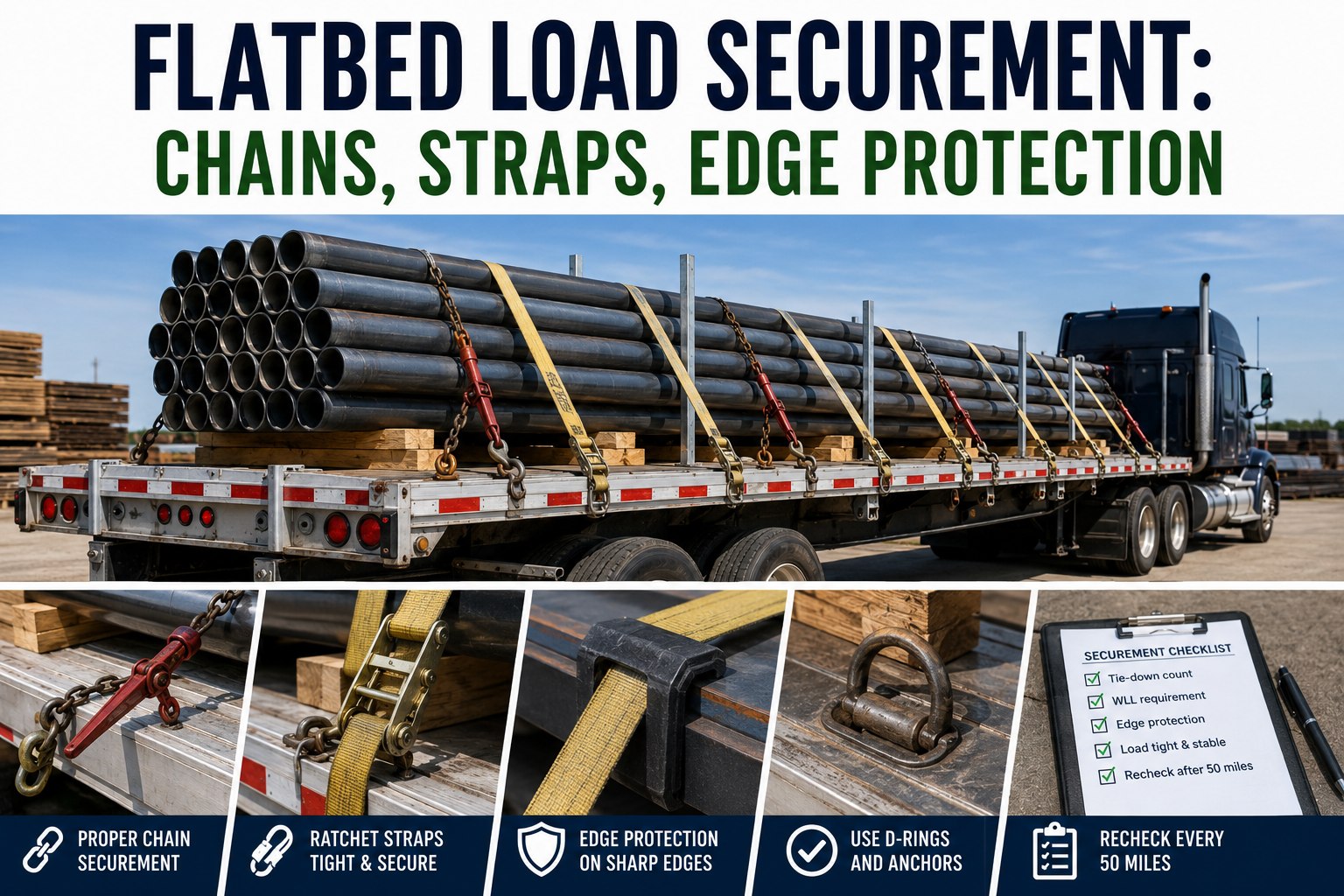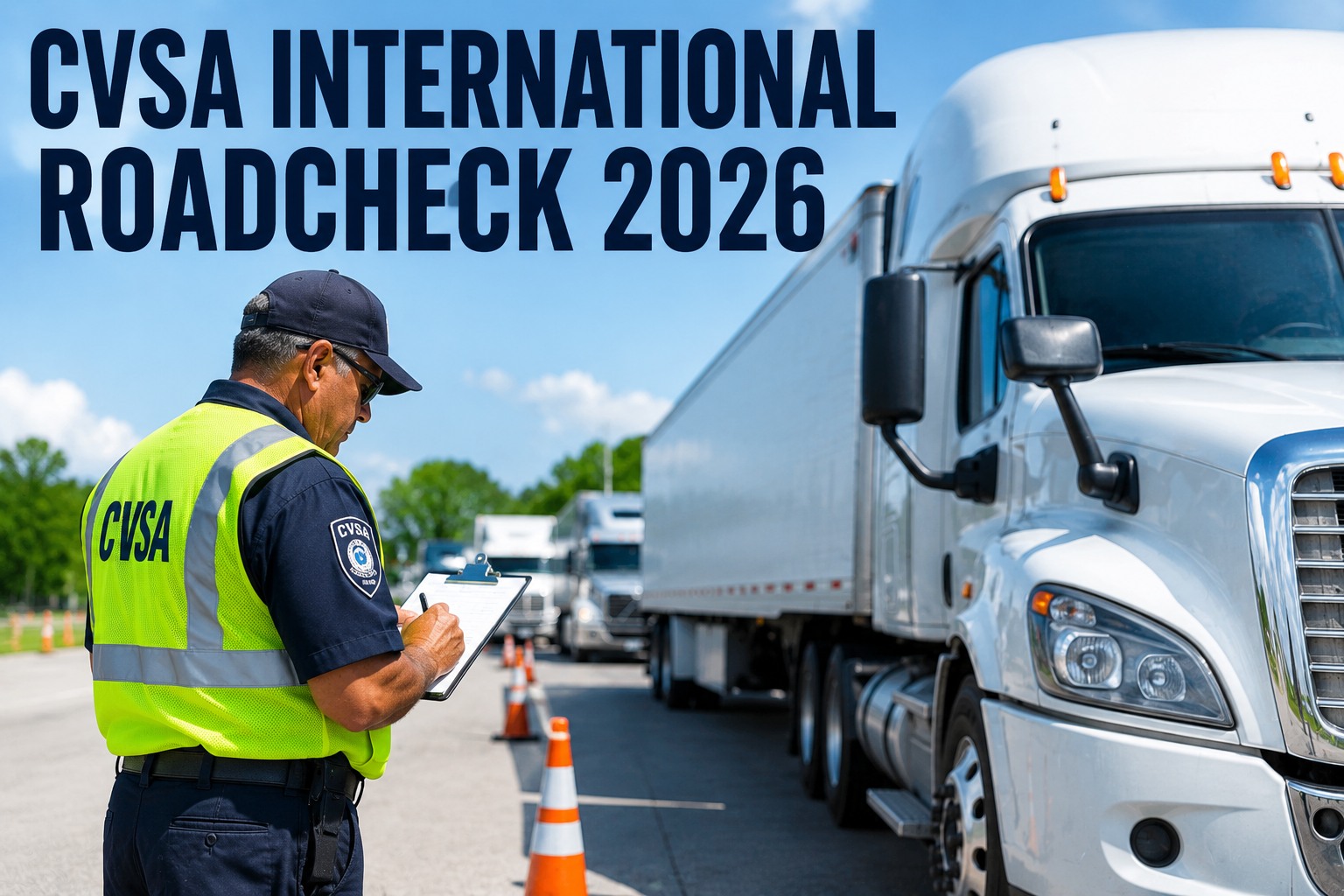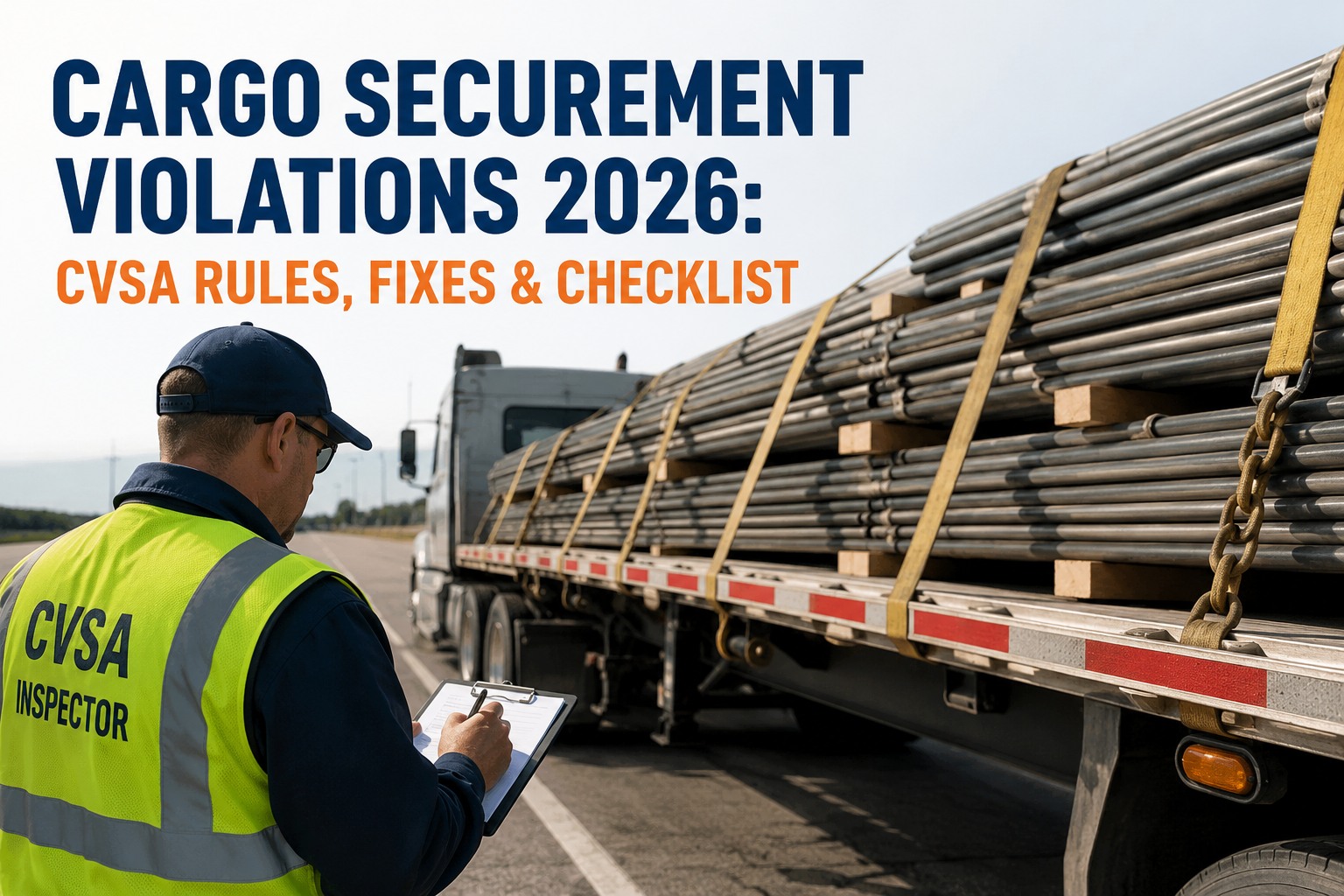
CVSA logged 18,108 violations in 2025 for cargo not secured to prevent leaking, spilling, blowing, or falling — plus another 16,054 for unsecured vehicle components and dunnage. That's 34,000+ securement citations in a single year, and it's the reason cargo securement was named the 2026 Roadcheck vehicle focus area. This cargo securement violations 2026 playbook breaks down the 49 CFR Part 393 math inspectors are actually enforcing — the 50% aggregate working load limit rule, the 0.8g / 0.5g force standard, the length-based tiedown count formula — and the six roadside violation patterns that keep fleets on the OOS scoreboard. Book a demo to see HVI's digital cargo securement audit in action.
The Cargo Securement Math That Failed 34,000 Loads Last Year
The rules are physics. The violations are patterns. And the audit trail is the difference between defending a citation and getting a Conditional rating.
Cargo securement violations are Part 393 enforcement findings on how a commercial load is anchored to a vehicle — and they've climbed the CVSA vehicle-out-of-service list for three consecutive years running. The 2025 numbers tell the whole story: 18,108 citations for cargo that leaked, spilled, blew, or fell in transit, plus 16,054 citations for dunnage, chains, straps, tarps, or components that were themselves not secured to the vehicle. Both categories trace to the same three fundamentals under 49 CFR Part 393 Subpart I: the 50% aggregate working load limit, the force-vector retention standard, and the length-based tiedown count formula. Every violation is a failure of one of the three.
The 50% Rule: The Math That Governs Every Load
The foundational cargo securement requirement is deceptively simple, and it's also the most commonly miscalculated one in the field: the aggregate working load limit of all tiedowns must be at least half the weight of the cargo being secured. Not appearance. Not strap count. Not "looks tight." Math. Book a demo to see aggregate WLL calculated automatically per load in HVI.
The Three Force Vectors Your Securement Has to Hold
The 50% rule isn't the only physics test. Under 49 CFR 393.102, the securement system must also prevent cargo movement against three specific force scenarios — the ones that emergency braking, evasive maneuvering, and hard cornering actually generate on the road.
The Tiedown Count Formula (49 CFR 393.106)
Beyond the WLL math, Part 393 sets a minimum tiedown count based on cargo dimensions. This is where visual inspection meets rule enforcement — and where fleets that "eyeball it" get cited most often.
The Six Roadside Violation Patterns
Every one of the 34,000+ 2025 securement citations traces to one of six patterns. Knowing what inspectors are looking for is the first control layer.
The 50 / 150 Inspection Rhythm
Cargo securement compliance isn't a one-time check at loading. Part 393.106 requires a specific rhythm of driver-executed re-checks — and a missed re-check is a citation even when nothing shifted.
Roadside Inspection Checklist — What Inspectors Verify
The North American Standard Level I inspection includes a full cargo securement examination. Every item on the inspector's checklist is a potential citation.
How HVI Turns Securement Compliance Into a System
Paper securement records get lost, misfiled, or backfilled after the fact — and none of those hold up in a compliance review. Digital securement compliance is the operational fix.
Frequently Asked Questions
What is the 50% aggregate WLL rule under 49 CFR Part 393?
Under 49 CFR 393.106, the aggregate working load limit of all tiedowns securing a load must be at least 50% of the total weight of the cargo being secured. WLL is the manufacturer's stamped rating on the strap, chain, or binder — not the breaking strength, and not the visual "looks tight" test. A 40,000 lb load requires aggregate WLL of at least 20,000 lb across the securement system, and damaged, unrated, or missing-tag devices contribute zero to that calculation. Aggregate WLL is the single most-cited securement failure at roadside — primarily because crews add straps by feel rather than calculating against the actual cargo weight.
How many tiedowns do I need for my cargo?
The baseline formula under 49 CFR 393.106: articles under 5 feet AND under 1,100 lb need one tiedown; articles under 5 feet but over 1,100 lb need two; articles from 5 to 10 feet need two regardless of weight; articles over 10 feet need two plus one additional tiedown for every 10 feet of length beyond that. A 22-foot beam requires four tiedowns (2 baseline + 1 for the 11-20 ft segment + 1 for the 21+ ft segment). Length-based count is enforced independently of the aggregate WLL calculation — hitting the WLL total doesn't excuse a count shortfall. Commodity-specific rules in 49 CFR 393.116 through 393.136 (logs, metal coils, paper rolls, concrete pipe, automobiles, heavy machinery) may require more than the baseline; always apply the stricter rule.
How often do I need to re-check cargo securement in transit?
Under 49 CFR 393.106, the driver must inspect the securement within the first 50 miles of the trip and then at either 150 miles of travel, 3 hours, or every change of duty status — whichever comes first. The 50-mile check is the critical one: tiedowns nearly always require re-tensioning after initial road settling, and a missed 50-mile check that generates a shift-related citation is a preventable violation. The 150-mile or 3-hour rhythm continues for the remainder of the trip. Missing an interval is itself a citation, even if the load hasn't visibly shifted.
What are the fines for cargo securement violations in 2026?
Cargo securement citations are civil penalties under the FMCSA schedule, and combined state and federal exposure per incident regularly exceeds $8,000 — with severe or repeated violations reaching well higher. More consequentially, every citation feeds into the Cargo-Related BASIC of FMCSA's CSA scoring, where the 2026 SMS overhaul increased the weighting of cargo violations. Pattern violations trigger Warning Letters, Offsite Investigations, or full Compliance Reviews. The financial impact extends into insurance premium exposure at renewal (elevated Cargo BASIC percentile is a documented rate-driver), broker qualification (major shippers filter by CSA percentile), and Conditional safety rating risk for repeat offenders.
When is edge protection required and what counts as compliant?
Under 49 CFR Part 393, edge protection is required whenever a tiedown makes contact with a cargo edge that has a radius of less than one-half inch. The concept is straightforward: a sharp edge cuts into the strap or chain at the contact point, reducing its effective WLL and eventually leading to failure. Compliant edge protection places a resistant material (V-board, rubber sleeve, corner protector) between the tiedown and the edge such that the strap or chain isn't in direct contact with the sharp radius. Missing edge protection where required is treated the same as a damaged securement device under 49 CFR 393.104 — the tiedown counts as zero WLL, potentially dropping the aggregate below 50% and triggering an OOS finding. Try HVI free to see edge protection documented in the trip record.
Close the Gap Between the Load Plan and the Roadside Inspection
HVI runs the 50% WLL math per load, captures photo evidence at every 50 / 150 re-check, and archives the full securement record for the CSA-scoreable window — the audit trail that turns a possible OOS into a defended citation. Live in under two weeks. No hardware. No IT project.
No credit card · No hardware · Digital cargo BASIC ready on day one