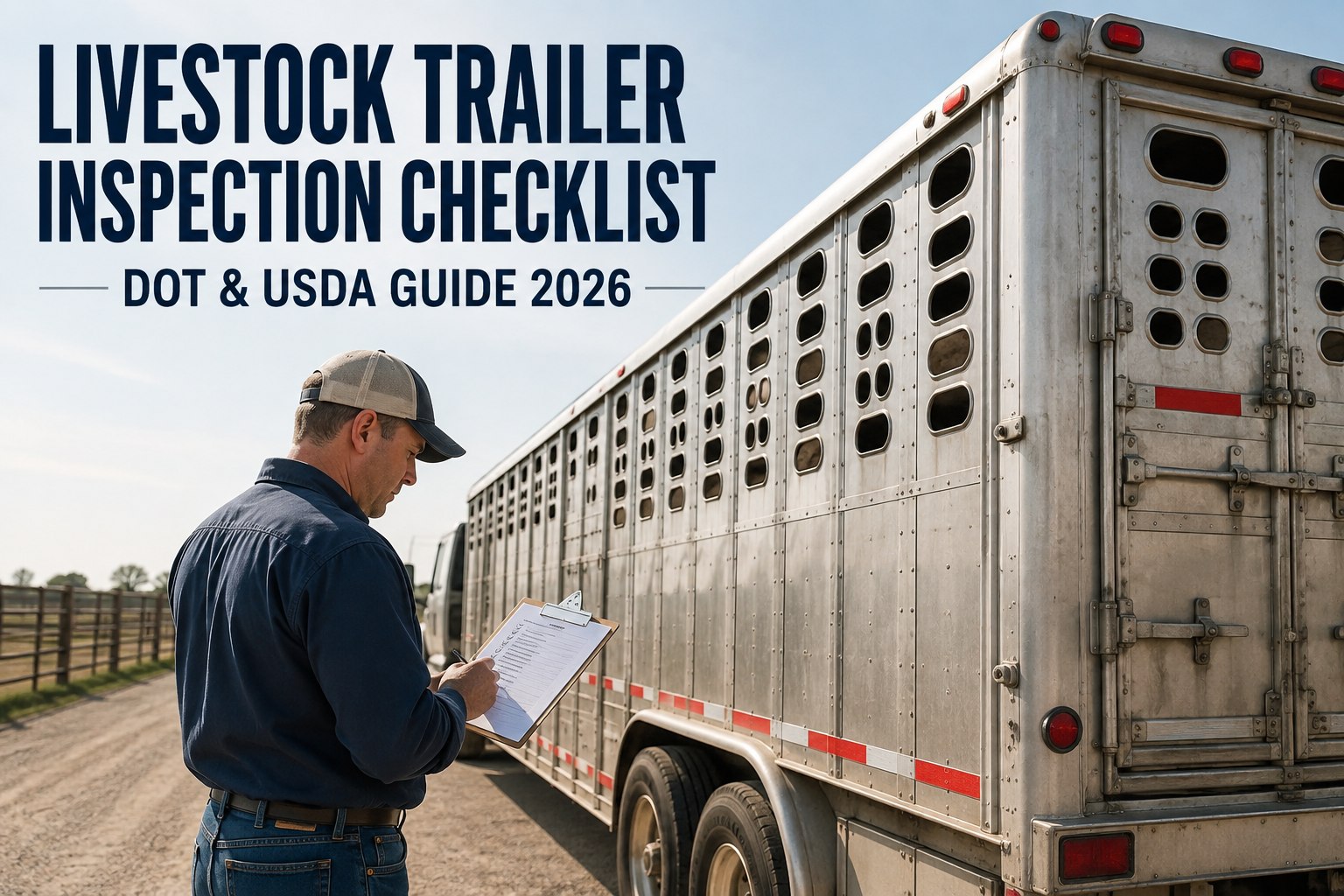
A livestock trailer is a moving barn with brakes. Every trip carries live animals whose safety depends on the same walkaround that keeps the rig legal — and misses the things that matter most for the cargo. Rotted floorboards. Blocked roof vents. A worn ramp cleat. A divider latch that pops on a sharp turn. This livestock trailer inspection checklist covers the five hotspots on every cattle, hog, sheep, and goat hauler, plus the USDA and state requirements a DOT walkaround misses. Book a demo
Two loads share every trailer — the freight and the living cargo. One inspection has to protect both.
DOT covers brakes, lights, tires. USDA / APHIS and state agencies cover flooring, ventilation, ramps, and biosecurity. A generic pre-trip catches half. A species-aware DVIR catches both — and prevents the downer animal, the overheating incident, and the disease-vector claim before they happen.
The 5 livestock-specific hotspots — where the generic pre-trip misses
Standard DOT walkarounds check the tractor and trailer as a truck. A livestock inspection walks the same trailer as an animal-carrying enclosure. Below are the five zones every cattle hauler DVIR should cover, in order of impact on the animals inside.
The five zones are the animal-safety half of the pre-trip. The tractor DOT walkaround handles the mechanical half. Both live in one workflow on a livestock-aware DVIR, and both matter equally — a citation and a dead animal come from opposite ends of the same missed inspection. Book a demo to see the 5-zone livestock DVIR template running photo-verified
Species density — how many head fit, legally and safely
Overcrowding is the most common welfare violation in commercial livestock transport, and it's the easiest one to prevent with a quick per-species calculation before loading. USDA and industry guidelines set floor-space minimums by animal class and weight. Below is the working table every livestock hauler should keep in the cab.
| Species & class | Typical weight | Min space per head | Head in 48' pot |
|---|---|---|---|
| Cattle — feederYoung, growing | 600-800 lbs | 10-12 sq ft | ~55-65 |
| Cattle — finishedMarket-ready steers | 1,200-1,400 lbs | 14-16 sq ft | ~40-45 |
| Cattle — adult cow / bullBreeding stock | 1,400+ lbs | 18-25 sq ft | ~28-35 |
| Hogs — marketSlaughter weight | 240-280 lbs | 4.0-4.5 sq ft | ~180-200 |
| Sheep — adultEwes / market lambs | 120-180 lbs | 2.5-4.0 sq ft | ~180-260 |
| Goats — adultMeat / dairy breeds | 100-160 lbs | 2.0-3.5 sq ft | ~200-300 |
Space rules are the easiest welfare requirement to satisfy and the hardest to defend after the fact. Photograph the load configuration at dispatch; the head count and space math become the record. Start free and get species-density validation built into the load record
Biosecurity wash-down — the 4-stage cycle between every load
The livestock trailer floor that a hoof stood on at the origin farm can spread hoof-and-mouth, PRRS, PEDv, or a dozen other pathogens to the next farm unless the trailer is cleaned between loads. USDA/APHIS treats the trailer as a disease vector, and receiving farms increasingly refuse to unload trailers without documented wash-down. The four-stage cycle below is the industry standard.
-
01Dry clean-out ~15 min
Remove all bedding, manure, feed, and debris. Sweep or shovel out completely. Dry material into approved disposal.
-
02Pressure wash ~25 min
Full high-pressure wash of floor, walls, dividers, gates, and ramp. All organic material gone before disinfectant is applied — disinfectant on manure is chemistry with no result.
-
03Disinfectant application ~15 min + dwell
USDA-approved disinfectant applied per label rate. Minimum dwell time observed (typically 10-15 min per product spec). No shortcuts — contact time is what kills pathogens.
-
04Dry, log, and photograph ~30 min
Allow trailer to dry. Log the wash: date, time, location, disinfectant used, initials. Photograph interior. Timestamped record travels with the next load.
The wash-down is the biosecurity insurance policy every livestock hauler carries whether they document it or not. Documenting it is what turns "I washed" into evidence at the receiving farm gate and in any traceback investigation after a disease event. Book a demo to see wash-down logs auto-tied to the trailer's next load record
From a cattle hauler running 4 pots between Nebraska feedlots and Iowa packers
I've been hauling cattle for 22 years and until three years ago every pre-trip was paper and memory. Floor looked fine, roof vents were open, ramp cleats felt right. Most of the time that was true. The one time it wasn't — a soft spot in the floor over the rear axle I hadn't spotted in three weeks — I lost a fat steer through the boards on I-80 outside Grand Island. The steer was a total loss. The trailer was OOS. And the packer had questions about the load count on delivery that I didn't have paperwork to answer.
The 5-zone livestock DVIR with photos every trip changed how I think about the walkaround. Every load starts with a floor photo from underneath, a ventilation check with the vents visible, a ramp cleat close-up, gate latches tested and shown, drainage confirmed clear. Species-density check on the head count matches what's on the bill of lading. Wash-down log stays attached to the trailer file. In three years I haven't had a welfare complaint, haven't had an OOS on the trailer, and when the receiving vet at a feedlot asks about biosecurity between loads I hand her my phone. Same walkaround as before — just witnessed and remembered.
Frequently asked questions
What does a complete livestock trailer inspection checklist cover?
A complete livestock trailer inspection covers two layers: the standard DOT walkaround (brakes, lights, tires, suspension, coupling, driveline) and the livestock-specific five-zone check that a generic pre-trip doesn't touch. The livestock zones: floor integrity and non-slip surface (wood floors checked for rot, aluminum for corrosion, steel cross-members for rust, cleats and mats in place); ventilation (every side slat, roof vent, and adjustable louver clear and functional); rear ramp and loading gate (deploys smoothly, cleats present, hinge pins seated, latches engage); interior gates, dividers, and latches (every latch tested under hand pressure, no sharp edges, no bent posts); and drainage plus wash-down readiness (drain holes clear, watertight floor-to-wall seal, no standing fluid). On top of the trailer walkaround, the livestock pre-trip also verifies species-appropriate stocking density (head count against per-species floor space rules), bedding stocked appropriately for species and trip length, biosecurity wash-down completed and logged since last load, and interior photograph captured before loading. Every zone corresponds to either a welfare-violation risk under USDA/state rules or an insurance-claim vector on cargo damage — and a photo-verified DVIR captures both in one workflow.
What are the USDA space requirements for cattle in a livestock trailer?
USDA and industry guidelines set minimum floor space per head based on species, animal class, and body weight. For cattle: feeder animals (600-800 lbs) require 10-12 sq ft per head, finished market cattle (1,200-1,400 lbs) require 14-16 sq ft, and adult cows or bulls (1,400+ lbs) require 18-25 sq ft. In a standard 48-foot livestock pot, this typically works out to 55-65 feeder cattle, 40-45 finished cattle, or 28-35 adult breeding stock. For hogs, market-weight animals (240-280 lbs) require 4.0-4.5 sq ft each, allowing roughly 180-200 hogs per pot. Sheep and goats require 2.0-4.0 sq ft depending on class and weight, allowing 180-300 head per pot. Industry audits consistently show that roughly one in three livestock hauls violates space rules, and overcrowding is documented to increase injury rates by approximately 60% while driving heat-stress risk during summer months. Overcrowding also creates the exact conditions that turn a straightforward run into a downer-animal cargo claim and a welfare citation, with federal welfare fines running up to $2,500 per infraction. A 30-second head-count against known trailer square footage before loading prevents all of it.
Is biosecurity wash-down between livestock loads legally required?
Federal law does not mandate a specific wash-down procedure between all livestock loads, but the framework surrounding it is dense enough that documented wash-down is effectively required in commercial livestock hauling. USDA/APHIS treats livestock trailers as potential disease vectors in traceback investigations, and receiving farms and packers increasingly refuse to unload trailers without documented wash-down since a single missed cleaning can introduce PRRS, PEDv, foot-and-mouth (in a hypothetical outbreak), or other pathogens to a clean operation. Many state departments of agriculture, packing plants, and integrator contracts specify wash-down requirements, and the National Pork Board's Transport Quality Assurance program and the Beef Quality Assurance Transportation program both require documented cleaning between loads for certified haulers. The industry-standard cycle is four stages: dry clean-out (remove all bedding, manure, feed, debris); pressure wash (full high-pressure wash of floor, walls, dividers, gates, ramp before disinfectant); disinfectant application (USDA-approved product per label rate with minimum dwell time observed, typically 10-15 minutes); and dry, log, and photograph (allow drying, log date-time-location-disinfectant-initials, photograph interior, timestamp record). Total cycle runs roughly 90 minutes for a standard 48-foot pot. The log is the evidence that answers the question at every farm gate and every audit.
What are the most common livestock trailer inspection failures at roadside?
Roadside inspection failures on livestock trailers cluster in a few predictable categories. Ventilation obstruction — roof vents blocked with debris, side slats packed with dried manure, adjustable louvers stuck — is the most common warm-weather welfare finding and can trigger both DOT and state-level welfare citations. Floor integrity failures — soft spots in wood floors, corrosion in aluminum cross-members, rust-through in steel decking — are the most serious structural finding and typically result in immediate out-of-service orders regardless of whether animals are on board. Ramp and cleat wear on the rear loading ramp, particularly worn traction strips, is the leading cause of loading-time injuries and shows up in downer-animal claims almost as often as overcrowding. Divider latch failure — a compartment latch that can be popped by hand pressure — leads to animals piling during braking and turning, which is preventable with a 30-second latch test at pre-trip. Overcrowding beyond the per-species space rules is the most cited welfare violation, running as high as one in three hauls per industry audit data. And missing or falsified DVIR is the paperwork failure that turns a mechanical or welfare finding into a compounded citation. All of these are catchable during a structured 5-zone livestock walkaround; none are catchable during a generic pre-trip that treats the trailer as freight cargo.
How does HVI's livestock DVIR support cattle, hog, sheep, and goat haulers?
HVI's livestock trailer DVIR template is built for the species-aware pre-trip. The five-zone walkaround runs in the mobile app with prompted photo capture at every critical point: floor integrity from above and underside, ventilation (roof vents, side slats, louvers), rear ramp and cleats, interior gates and divider latches (with latch-test confirmation), and drainage plus wash-down status. Species-density validation is built into the load record: enter species, animal class, and head count, and the app validates against per-species floor-space rules (10-25 sq ft for cattle by class, 4-4.5 for market hogs, 2.5-4.0 for sheep and goats) with a green/red pass indicator before dispatch. Biosecurity wash-down logs capture the 4-stage cycle (dry clean-out, pressure wash, disinfectant application with dwell time, dry-log-photo) tied to the trailer file so the wash record travels with the next load automatically. Every completed DVIR generates a signed PDF stored in the inspection archive, searchable by load ID, trailer, driver, date, or receiving facility — the DOT record, the welfare compliance record, the biosecurity record, and the cargo-claim defense in one workflow. For owner-operators like Jesse W. running 4 pots on regular cattle routes, the typical result is zero welfare complaints, zero trailer OOS, and clean biosecurity documentation at every farm gate. Book a demo to see the livestock trailer DVIR template running live.
A livestock trailer is a moving barn. The pre-trip has to protect the animals, the compliance record, and the next load.
HVI's livestock trailer DVIR walks the five animal-safety hotspots with prompted photo capture, validates species-specific stocking density before dispatch, logs the 4-stage biosecurity wash between loads, and stores every load record signed and timestamped. Live in under two weeks; every trip has the evidence, not just the memory.