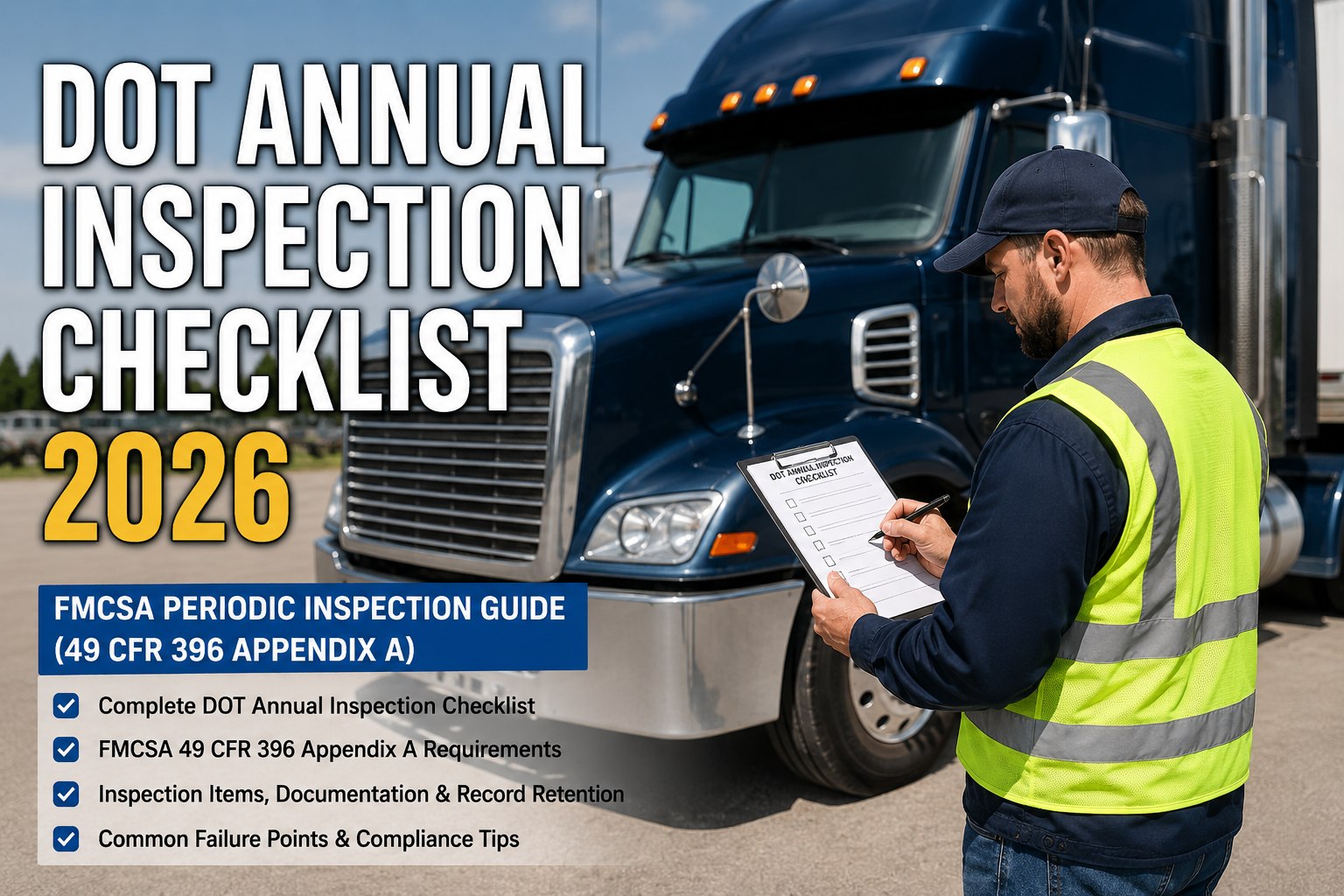
A truck that runs fine all day is still out of service if it has no current annual inspection on file. Roughly 133,000 vehicles are cited every year for exactly that — a paperwork gap, not a mechanical one. This is the complete DOT annual inspection checklist built straight from 49 CFR 396 Appendix A: every system a qualified inspector must check, the pass/fail criteria, the measurement specs that trip people up and how long to keep the record. Start free with HVI to run the whole thing digitally.
DOT Annual Inspection Checklist & 49 CFR 396 Appendix A Guide
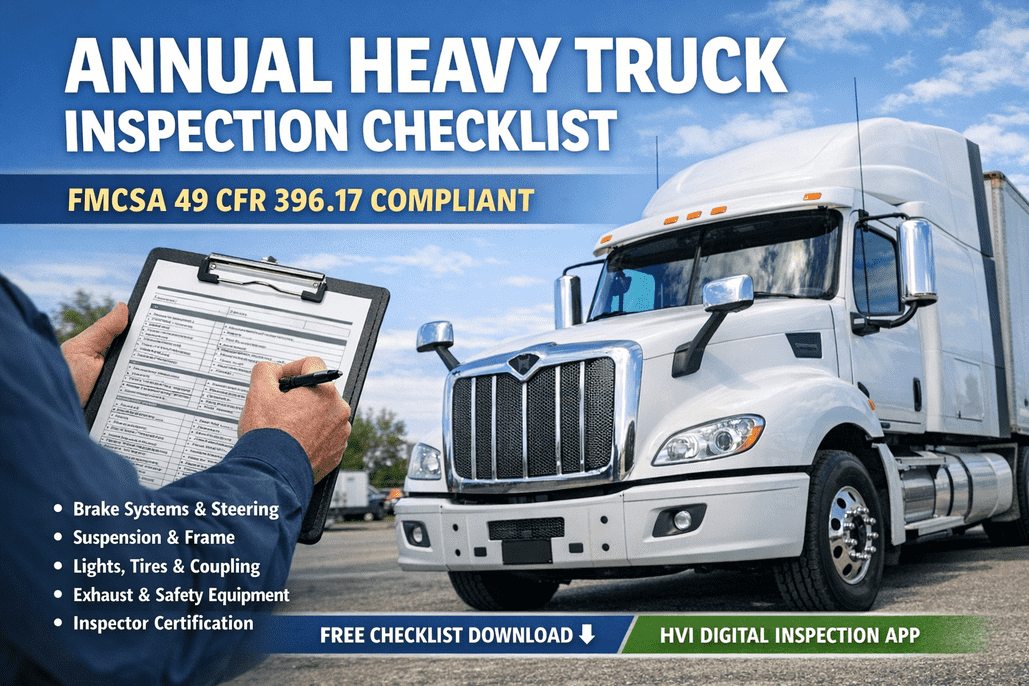
Every system the annual periodic inspection requires, with the exact rejection criteria and measurement specs a qualified inspector under FMCSA §396.19 uses. One skipped system means no valid certificate — this checklist makes sure none get missed.
- Inspected
- Expires17 May 2027
- SystemsAll 12 passed
- ResultCertified
-
~41%
of roadside out-of-service orders are brake-related — the #1 inspection failure
2025 CVSA Roadcheck data -
133,000
vehicles cited a year for operating without a current annual inspection
FMCSA CSA violation data -
12 mo
inspection interval — each unit in a combination inspected separately
49 CFR 396.17 -
14 mo
how long the signed inspection report must be retained on file
49 CFR 396.21
What the DOT annual inspection actually is
Under 49 CFR 396.17, every commercial motor vehicle must be inspected at least once every 12 months against the minimum standards in Appendix A. It isn't the daily DVIR and it isn't a roadside check — it's a comprehensive, system-by-system inspection by a qualified inspector, documented on a signed report, with a decal or the report kept on the vehicle. Each unit in a combination counts on its own: a tractor, its semitrailer, and any dolly each need their own inspection. And there's no such thing as a partial annual inspection — a vehicle with a dozen systems passed and one skipped does not have a valid certificate. Every Appendix A system has to be covered, and any single rejection criterion met puts the vehicle out of service until it's fixed and re-verified. Book a demo to see the digital workflow enforce that automatically.
The Appendix A inspection systems
Appendix A lays out the systems every annual inspection must cover, each with its own rejection criteria. Brakes carry the most risk by far — get them right and you've eliminated the single biggest cause of failure.
-
Highest risk
- Brake system~41% of all OOS orders
- Steering mechanism
- Tires
- Wheels & rims
The contact and control systems
-
Structural
- Frame & frame members
- Suspension
- Coupling devices
- Fuel system
- Exhaust system
-
Visibility & body
- Lighting devices
- Windshield & glazing
- Wipers
- Rear-vision mirrors
- Windshield washers, horn
Brake violations are the largest share of both annual inspection failures and roadside out-of-service orders. On a 5-axle tractor-trailer that means brakes evaluated on every axle, individually. See how HVI captures each brake position with measurements and photos.
The full pass/fail checklist
Here's what a qualified inspector checks in each system and the condition that rejects the vehicle. The red blocks are the highest-risk systems — where most failures happen and where measurement, not eyeballing, is required.
-
1
Brake system
The #1 failure category — measure every brake on every axle. Visual estimation isn't acceptable under Appendix A.
- Pushrod stroke within the readjustment limit (measured at 80–90 psi, brakes applied)
- Lining thickness above minimum — 1/4" air drum non-steer, 1/8" air disc
- No absence of braking action on any axle required to have brakes
- No missing or broken shoes, linings, pads, springs, or air-chamber bolts
- Drums/rotors free of cracks that open under application
- Air builds to cut-out; leak-down within limits; low-air warning works
- Parking brake holds on actuation
-
2
Steering & suspension
- Steering wheel free play within limits for the box type
- No worn, cracked, or repair-welded steering components
- Power steering hoses, pumps, and belts sound
- Springs, leaves, and hangers not cracked, broken, or shifted
- U-bolts, torque rods, and bushings not worn or loose
- No missing or damaged axle positioning parts
-
3
Tires, wheels & rims
- Steer-axle tread at least 4/32" in every major groove; 2/32" other axles
- No body ply or belt material exposed through tread or sidewall
- Not flat, and no audible or felt air leak
- No steer tire marked "Not for Highway Use" or regrooved (with exceptions)
- Wheels and rims free of cracks; no bias/radial mix on an axle
- Fasteners not loose, missing, broken, cracked, or stripped
-
4
Coupling devices
- Fifth wheel mounting and pivot not cracked, loose, or missing fasteners
- Locking mechanism engages and holds the kingpin
- Pintle hooks, drawbars, and safety devices intact
- Saddle-mounts and tow-bar connections secure
-
5
Frame, fuel & exhaust
- Frame rails and cross-members free of cracks, breaks, or sag
- Fuel tank securely mounted; no leaks; cap in place
- Exhaust not leaking beneath the cab or sleeper
- No exhaust component in contact with fuel or wiring
-
6
Lighting, glazing & visibility
- All required lamps and reflectors present and working
- Windshield free of damage in the driver's critical viewing area
- Wipers and washers operate correctly
- Mirrors present, secure, and undamaged; horn works
The measurement specs that fail people
Most annual inspection failures aren't dramatic — they're a lining a hair under minimum or a steer tire a groove short. Under Appendix A these are measured with a gauge, not judged by eye, and the gap between "looks fine" and "below spec" is often a thirty-second of an inch.
- Brake lining — air drum, non-steer axle Reject below 1/4"
- Brake lining — air disc Reject below 1/8"
- Brake lining — hydraulic/electric drum Reject at 1/16" or less
- Pushrod stroke Over readjustment limit at 80–90 psi
- Air leak-down — single vehicle More than ~3 psi/min
- Air leak-down — combination More than ~4 psi/min
- Low-air warning Must activate above 60 psi
- Tire tread — steer axle Reject below 4/32"
- Tire tread — all other axles Reject below 2/32"
These are measured, not estimated. Signing off a lining "close enough" by eye is exactly how a certified vehicle ends up out of service at a roadside check two weeks later. HVI's digital inspection checklist gives each of these its own measurement field, recorded per position and per axle.
Sample inspection record timeline
This is what a machine's inspection and defect history looks like when it's logged properly — newest first. One glance and any inspector, auditor, or buyer knows the whole story.
-
Annual dueAnnualPass
Periodic inspection — all 12 systems
Full Appendix A inspection. Brake stroke and lining measured at every wheel position; steer tread 6/32". Certified, decal applied.
Systems: 12 · Inspector: qualified §396.19 · Report retained 14 mo -
Pre-inspectionCorrectiveFixed
Steer tire replaced ahead of inspection
Left steer tread at 5/32" flagged on a driver DVIR — replaced before the annual to avoid a same-day failure.
Trigger: driver DVIR · Verified before certification -
RoadsideRoadsideClean
Level II roadside inspection
No violations. Report retained — a Level I within 12 months can substitute for the periodic inspection under §396.23.
Level: II · No OOS · Report on file -
DefectDefectRepaired
Brake chamber bolt replaced
Loose air-chamber mounting bolt found on a PM. Replaced and torqued; pushrod stroke re-measured within limit.
Trigger: PM check · Repair photo on file
One screen, the whole inspection story. Book a 30-minute demo to see live inspection timelines with driver DVIRs feeding the annual.
Where inspections actually fail
If you want to raise your pass rate, spend your prep time where the failures cluster. A few systems account for the overwhelming majority of both annual rejections and roadside out-of-service orders.
-
Brakes
~41%
of OOS orders
Brake violations
Worn linings, out-of-adjustment pushrods, cracked drums. Evaluated per axle, so one weak wheel end fails the whole vehicle.
-
Tires
4/32"
steer minimum
Tire & tread
Under-tread steer tires and exposed belt material are quick, common rejections — and the easiest to catch on a walkaround.
-
Lights
Fast
easy to miss
Lighting defects
Inoperative lamps and reflectors fail instantly and are trivially preventable with a daily check before inspection day.
-
Lapse
133k
cited a year
Expired certificate
The most avoidable failure isn't mechanical — it's a 12-month inspection that quietly lapsed. An expiry alert fixes it.
Pass rate: reactive vs. always-ready fleet
Fleets that prep only on inspection morning fail far more often than fleets that feed daily driver findings into the shop. Here's the difference in outcomes.
-
Always-ready fleet
First-time pass 90%Fail 10%
Driver DVIRs feed the shop, defects fixed weeks early, tread and lining tracked between inspections. Certification is a formality.
-
Inspection-morning fleet
Pass 55%Fail / rework 45%
Defects discovered on inspection day, same-day scramble to source parts, units sitting idle waiting to re-certify. Costly and avoidable.
The failures are predictable and mostly visible weeks ahead if someone's tracking them. That's the case for feeding daily driver findings into the maintenance queue. Book a HVI demo to see DVIRs flow into the annual workflow.
Who can inspect, how often, and the paperwork
The inspection itself is only half of it. Get the inspector qualification, the interval, and the documentation right, or a technically-passing vehicle still isn't compliant.
-
Who can inspect
A qualified inspector under 49 CFR 396.19 — someone who understands Part 393 and Appendix A and can identify defects, with documented training or 1+ year of experience. In-house mechanics, third-party shops, and state-certified stations all qualify. Keep qualification evidence on file while the inspector is active, plus one year after.
-
How often
At least once every 12 months per vehicle — and each unit in a combination separately. A CVSA Level I roadside inspection within the last 12 months covering all Appendix A items can substitute for the periodic inspection under 396.23, if the vehicle passed and the report is retained.
-
The documentation
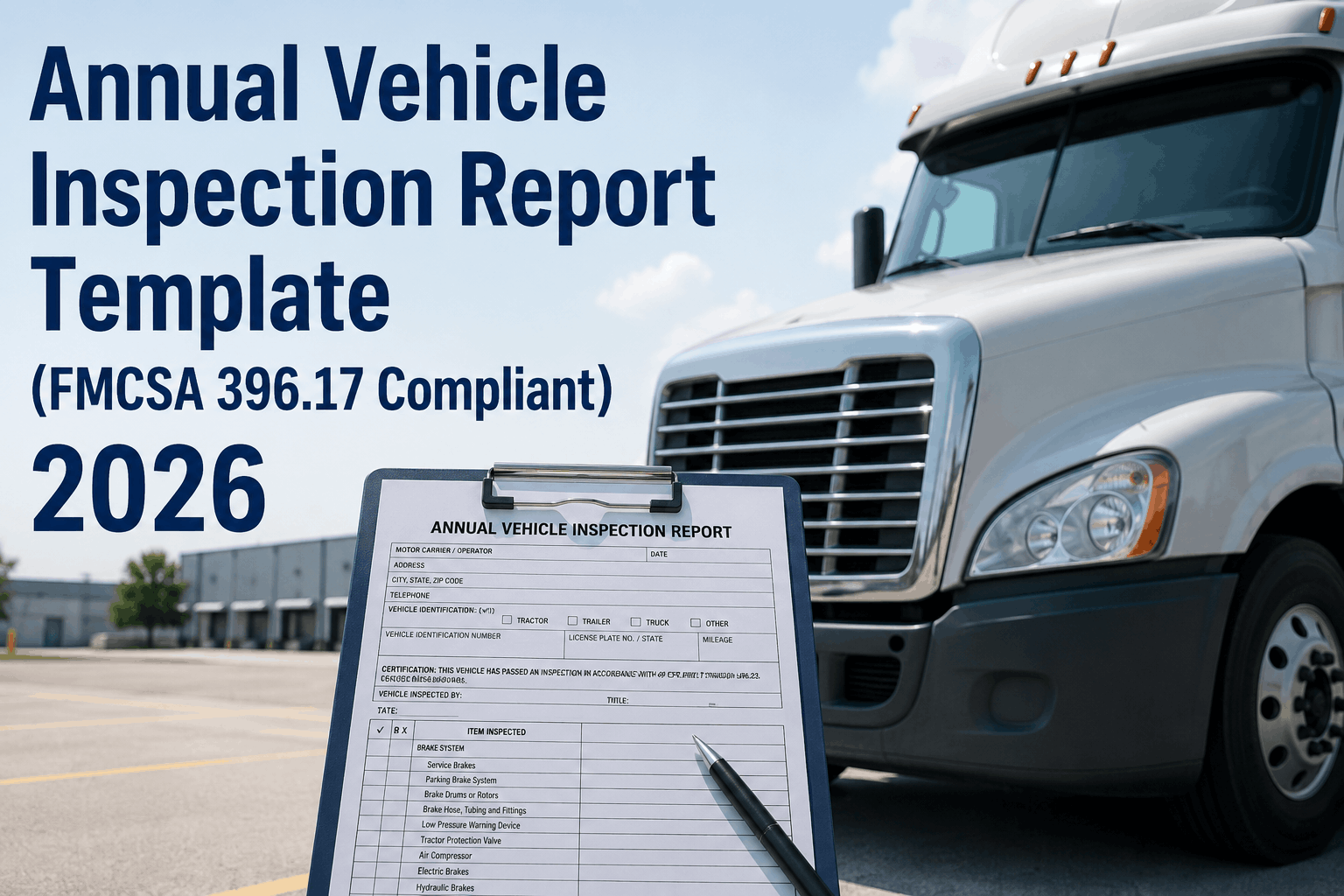
A signed report per 396.21 — inspector name and qualification, carrier, vehicle ID, date, items inspected, defects found. Keep it 14 months, and carry the report or a decal on the vehicle. Any defect must be corrected and re-verified before the inspector signs.
Expert view from the shop floor
The failures I see aren't blown-out brakes — they're a lining a thirty-second under, a steer tire one groove short, a pushrod barely past the limit. On paper the tech "inspected" it, but nobody wrote the number down.
So when it's out of service at a scale house two weeks later, there's nothing to show the measurement was ever taken. Record the number at every position and that argument disappears — and the tech can't skip a system because the app won't let them sign until it's done.
— Dave R., Shop Foreman & certified inspector, regional flatbed carrier
Paper inspection form vs. HVI digital checklist
Paper inspection form
- A checkmark with no measurement behind it
- Easy to skip a system and still "complete" the form
- No photo of the defect that was found and fixed
- Certificate lost to the shop, the cab, or the rain
- No alert before the 12-month expiry lapses
HVI digital checklist
- A measurement field per position — stroke, tread depth
- Pass/fail gates that block a partial inspection
- Mandatory defect photos and auto work orders
- Compliant AVIR report generated as a PDF
- 90/60/30/7-day alerts before each unit expires
One 2026 reason to go digital: electronic DVIRs were authorized under 49 CFR 396.11 and 396.13 effective March 23, 2026, so driver-reported defects flow straight into your maintenance queue and surface on the next inspection. Sign up free with HVI and load the Appendix A checklist onto every inspector's phone.
Frequently asked questions
What is required for a DOT annual inspection?
A DOT annual inspection must cover every system in 49 CFR 396 Appendix A — brakes, steering, suspension, tires, wheels and rims, coupling devices, frame, fuel and exhaust, lighting, windshield and glazing, wipers, mirrors, and horn — against the specific rejection criteria for each. There's no partial inspection: if one system is skipped, the vehicle doesn't have a valid certificate. Several items are measured rather than eyeballed, including brake lining thickness, pushrod stroke, and tire tread depth. It must be performed by a qualified inspector under 396.19, documented on a signed report per 396.21, and any defect corrected and re-verified before certification.
How often is a DOT annual inspection required?
At least once every 12 months for every commercial motor vehicle, under 49 CFR 396.17. Each unit in a combination is inspected separately — a tractor, its semitrailer, and any converter dolly each need their own annual inspection. A CVSA Level I roadside inspection performed within the last 12 months can substitute for the periodic inspection under 396.23, provided the vehicle passed, all Appendix A items were covered, and the report is retained. Some states impose stricter intervals, so carriers running across jurisdictions should track both federal and state requirements per vehicle.
Who can perform a DOT annual inspection?
A qualified inspector under 49 CFR 396.19. FMCSA doesn't require a single specific certification, but the inspector must understand Part 393 and Appendix A, be able to identify defective components, and have documented qualification — completion of a state or federal training program, a qualifying certificate, or at least one year of combined training or experience as a mechanic or inspector. Qualified in-house mechanics, third-party commercial garages, and state-certified inspection stations can all perform it. The carrier must keep evidence of the inspector's qualification on file while they're active and for one year after they stop performing inspections.
What happens if a truck fails a DOT annual inspection?
Any Appendix A rejection criterion that's met puts the vehicle out of service — it can't be certified until the defect is corrected. The inspector must document the correction (what was repaired, by whom, when, and with which parts) and re-verify it before signing the certification. Signing off a vehicle with uncorrected defects is itself a violation of 396.17 and 396.21. Operating without a current annual inspection is one of the most common vehicle maintenance violations — roughly 133,000 citations a year — and carries out-of-service exposure, CSA points under the 2026 scoring system, and civil penalties.
How long should annual inspection records be kept?
The signed annual inspection report must be retained for 14 months from the report date under 49 CFR 396.21, and either the report or a decal must be kept on or in the vehicle. The report has to identify the inspector and their qualification, the carrier, the vehicle, the date, the items inspected, and any defects found. That's separate from general maintenance records under 396.3, which are kept for one year while the vehicle is in service plus six months after it leaves the fleet. Digital records are fully acceptable under FMCSA rules and make producing a 14-month history on demand far easier.
Put the full Appendix A checklist on every inspector's phone
HVI runs the complete 49 CFR 396 Appendix A inspection as guided pass/fail gates — measurement fields for every brake and tire position, mandatory defect photos, auto-generated AVIR reports, and expiry alerts before each unit lapses. Stop letting a missing number or a lapsed date turn a good truck into an out-of-service order.
No credit card · No hardware · Live on your fleet in under two weeks