Every commercial motor vehicle in the United States must pass a comprehensive annual periodic inspection at least once every 12 months under 49 CFR 396.17 — and the documentation proving it must be retained for 14 months from the inspection date, with a copy (or compliant decal) on the vehicle at all times. Approximately 133,000 vehicles are cited annually for operating without a current annual inspection report, making it the second most common Vehicle Maintenance violation in the FMCSA CSA system. Recordkeeping civil penalties exceed $15,000 per violation, and falsification can trigger criminal prosecution. This guide gives fleet managers a complete FMCSA 396.17-compliant Annual Vehicle Inspection Report (AVIR) template — the seven required report fields under 396.21, the 15 Appendix A inspection categories every vehicle must cover, inspector-qualification rules under 396.19, the three valid inspection paths, retention rules (including electronic-storage compliance), and the most common mistakes that turn a routine inspection into an audit finding. HVI's inspection and maintenance software automates the AVIR workflow end-to-end — guided digital inspections per Appendix A category, photo capture, pass/fail gates, auto-generated 396.21-compliant reports, and 14-month digital retention built in. Start your free HVI trial to deploy a digital AVIR template across your fleet in under an hour, or book a demo to see how HVI inspection and maintenance software replaces paper AVIRs with audit-ready digital records.
The 7 required AVIR fields under 49 CFR 396.21
Every Annual Vehicle Inspection Report must contain these seven fields without exception. Missing any one of them invalidates the report — and during a roadside or audit review, an incomplete AVIR has the same compliance status as no AVIR at all.
Full legal name of the qualified inspector who performed the inspection. Inspector must meet 49 CFR 396.19 qualifications.
Legal carrier name as registered with FMCSA (USDOT number holder). Must match the carrier responsible for the vehicle.
The date the inspection was completed. The 12-month validity runs from the last day of the month in which it was performed.
VIN, company unit number, or both. Each vehicle in a combination (tractor, trailer, dolly) gets its own AVIR — no shared inspections.
Every one of the 15 Appendix A categories must appear with pass/fail or defective/satisfactory result. Blank lines = incomplete report.
Specific description of each defect found, with correction documentation: what was repaired, by whom, when, and what parts were used.
Signed statement certifying the report is accurate and complete, and that the vehicle meets requirements at the time of inspection.
The 15 Appendix A inspection categories
Appendix A to 49 CFR Part 396 defines 15 component categories that every annual inspection must cover. Each category has detailed sub-component criteria — the inspector must verify each one and document the result on the AVIR.
Service brakes, parking brake, brake drums/rotors, hoses, slack adjusters, ABS, audible warnings
Fifth wheel, pintle hooks, drawbar/towbar, safety chains, kingpin wear
No leaks forward of cab, secure mounting, no escape into operator's compartment
No leaks, secure mounting, fuel tank cap, fuel lines, all required protection
All required lamps and reflectors per 393.11 (headlights, tails, brake, turn, marker, ID, reflectors)
Cargo securement, weight distribution compliance, no protruding cargo
Steering wheel free play, column, gearbox, tie rods, ball joints, drag link, no leaks
Springs, leaves, U-bolts, shock absorbers, air bags, hangers, no cracks or misalignment
No cracks, breaks, broken welds, or loose fasteners on main frame and crossmembers
Tread depth (4/32" steer / 2/32" drive), no sidewall damage, proper load rating, no recap on steer
No cracks, missing lugs, elongated holes, severe rust, or signs of slipping
No cracks in driver's swept area, no obstructions, no discoloration impacting vision
Functional, blades intact, proper coverage of swept area, both sides operating
Both required mirrors present, securely mounted, undamaged, properly adjustable
Fire extinguisher charged, 3 reflective triangles, spare fuses (if non-LED circuits)
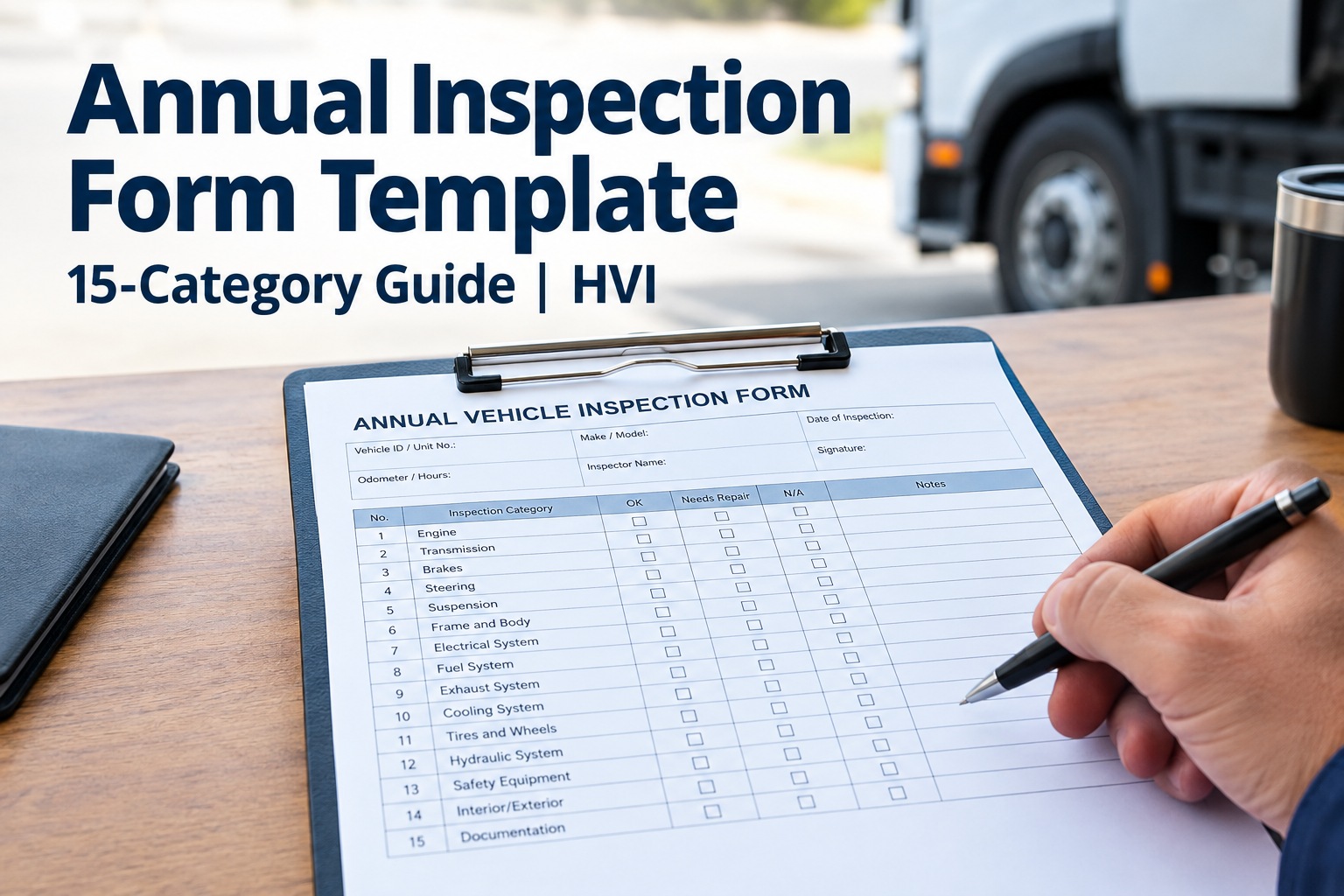
Sample AVIR template structure
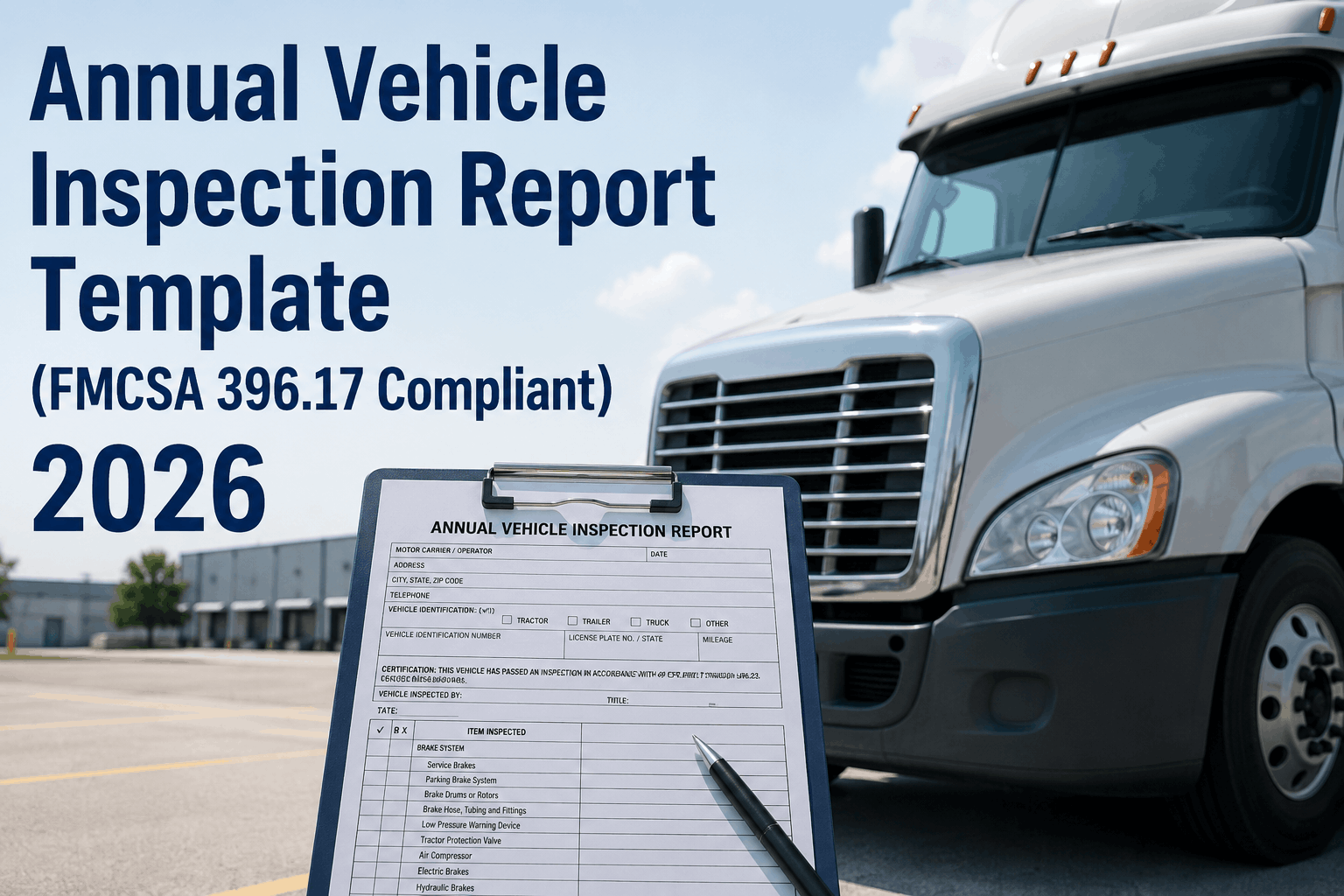
This is the standard structure of a 396.17-compliant Annual Vehicle Inspection Report. Whether on paper, Excel, or digital, the layout follows the same regulatory anatomy: header (carrier + vehicle + inspector), inspection grid (15 categories × pass/fail), defects section, and certification block.
Inspector qualifications under 49 CFR 396.19
Not just anyone can sign an AVIR. The inspector who performs the annual inspection must meet specific federal qualification standards — and FMCSA explicitly requests inspector qualification records during audits, including for third-party inspectors at commercial garages working on the carrier's behalf. Missing inspector qualification records = automatic audit violation.
Must demonstrate understanding of all parts and accessories in 49 CFR Part 393 and Appendix A to Part 396 — the regulations defining what each component must look like to pass.
Familiar with the methods, procedures, and tools necessary to perform each Appendix A inspection — pushrod-stroke gauges, brake lining gauges, tread depth gauges, torque wrenches, etc.
Able to spot defective, missing, or unsafe components by sight, measurement, or operational test — and document each one in compliance with 396.21 requirements.
Carrier retains evidence of each inspector's training and qualifications while active plus 1 year after. Includes training certificates, employer documentation, and continuing education.
Three valid inspection paths
FMCSA recognizes three ways to satisfy the annual inspection requirement. All three produce a 396.17-compliant AVIR — the choice depends on your in-house capability, geography, and operating jurisdiction.
Carrier employs technicians who meet 396.19 qualifications. Inspections performed at carrier facilities. Full control over scheduling and quality — but the carrier carries 100% of compliance responsibility, including inspector qualification documentation.
Performed by commercial garages, fleet leasing companies, or truck stops under 49 CFR 396.17(e). Carrier still must retain copies of inspector qualifications — FMCSA audits third-party qualifications during compliance reviews.
If the vehicle is subject to a state mandatory inspection program FMCSA has determined "as effective as 396.17" (under 396.23), that program satisfies the federal requirement. List of approved states is maintained by FMCSA.
Retention rules & vehicle documentation
The retention rules under 396.17 and 396.21 are specific, strict, and frequently misunderstood. Three separate requirements apply — the original report, the proof on the vehicle, and the inspector qualification records.
The original Annual Vehicle Inspection Report must be retained for 14 months from the inspection date. Reports may be kept at the principal place of business or wherever vehicle records are stored. Electronic storage is acceptable if records remain legible, retrievable, and complete.
A copy of the most recent inspection report — or a compliant inspection decal — must be on the vehicle at all times. Roadside inspectors will request this immediately. The decal must include the inspection date, name and address of the inspecting facility, and confirmation that the vehicle passed.
Evidence of each inspector's qualifications under 396.19 must be retained for as long as the inspector is performing inspections on the carrier's behalf — plus one additional year after. Third-party inspector qualifications are the carrier's responsibility to obtain and retain.
A tractor-semitrailer-full trailer combination requires three separate annual inspections — one per vehicle. The tractor's inspection does NOT cover the trailer behind it. Converter dollies count as separate vehicles. This is the most common audit finding.
Electronic storage — what makes digital AVIRs FMCSA-acceptable
FMCSA explicitly permits electronic storage of annual inspection records — but the records must meet specific quality and accessibility standards. Digital storage isn't automatic compliance; the records have to be legitimately auditable.
Digital records must be fully readable when displayed or printed. Scanned PDFs with cut-off margins, low-resolution images, or missing pages fail the legibility test — and an unreadable record is treated as a missing record.
Auditors typically give 48-hour notice. Records must be exportable and reviewable within that window. A digital system that requires IT involvement, vendor calls, or batch retrieval to produce records fails this requirement.
Electronic records must show modification history if edits occur. Original timestamps, inspector identity, and content changes need to be auditable. Editable Excel files without version control don't meet this standard.
Records organized so the auditor can find specific vehicles by VIN/unit number and specific time periods. A folder of 5,000 untagged PDFs technically meets retention but functionally fails the retrieval test.
14-month retention isn't optional when a hard drive fails or a vendor changes platforms. Acceptable digital storage has off-site backups and migration plans — paper-grade reliability with digital convenience.
Electronic signatures are accepted when they authenticate the inspector and bind them to the record. Plain-text typed names without authentication don't meet the inspector-certification requirement — there must be evidence the inspector actually signed.
Top 6 mistakes fleets make on annual inspections
These six errors cause the bulk of the 133,000 annual inspection citations issued each year. Each one is easy to prevent with disciplined process and the right software.
Only inspections under state programs FMCSA has approved as "equivalent" under 396.23 satisfy the federal rule. A generic state safety sticker does NOT — unless the state is on FMCSA's approved-equivalency list.
Each unit in a combination — tractor, semi-trailer, full trailer, converter dolly — needs its own AVIR. A "tractor-trailer was inspected together" defense doesn't hold up at audit.
Even when the inspection itself is perfect, the absence of inspector qualification documentation (especially for third-party inspectors) is an automatic FMCSA finding. Track training certificates and continuing education.
FMCSA revised the guidance and removed the option to satisfy the annual requirement through a violation-free roadside inspection. You need a periodic inspection report — full stop.
"Defective" items must be corrected before the vehicle can be certified — and the correction documented: what was repaired, by whom, when, what parts were used. Skipping this is a common audit finding.
Paper AVIRs go missing in filing cabinets, get coffee-stained, or disappear in office moves. The 14-month clock is unforgiving — a missing 8-month-old AVIR is identical to never having performed the inspection in the regulator's eyes.
HVI inspection & maintenance software — built for FMCSA 396.17 compliance
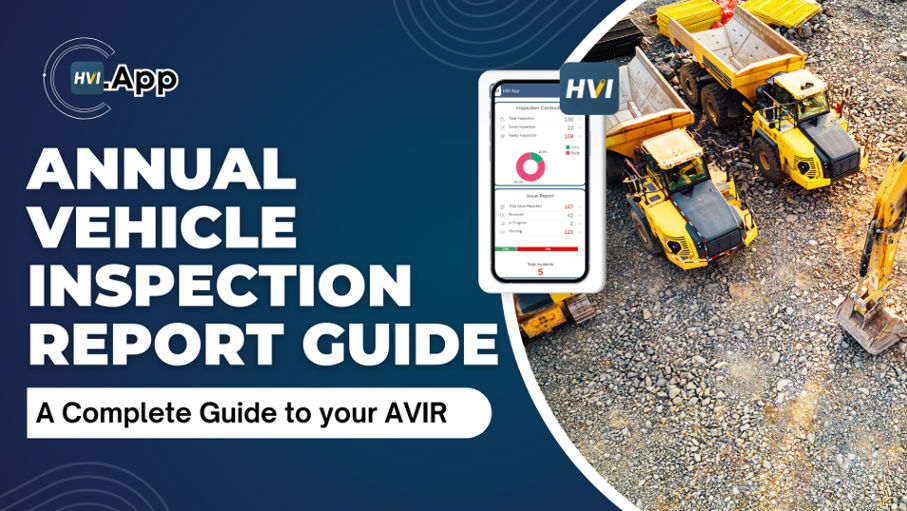
HVI is purpose-built inspection and maintenance software for commercial and heavy equipment fleets, with the FMCSA 396.17 annual inspection workflow built into the platform. Guided digital inspections per Appendix A category, photo capture, pass/fail gates, auto-generated 396.21-compliant reports, and 14-month digital retention — eliminating the documentation gaps that turn routine inspections into audit findings.
All 15 Appendix A categories built into a guided mobile inspection — pass/fail gates per category, measurement fields, required photo capture on flagged defects. The inspector can't skip a category.
Inspector name, carrier, date, VIN, all 15 categories with results, defects with corrections, signature — auto-populated into a 396.21-compliant report at submission. No missing-field violations.
HVI tracks inspection due dates per VIN and fires reminders 60 days before the 12-month window expires. Eliminates the "we forgot to inspect that one" violation — the most common audit finding.
Each inspector's 396.19 qualification documentation logged per individual — training certificates, continuing education, employer status. Third-party inspectors covered too. Qualifications retained through active period plus 1 year.
Every AVIR stored in tamper-evident digital archive indexed by VIN and date. Retrievable in under a minute when an FMCSA auditor requests records — meets the legibility, retrievability, and signature-equivalency standards.
Any "Defective" mark on the AVIR auto-creates a maintenance work order with photo and parts list. The vehicle cannot be certified until every Appendix A deficiency is corrected — and the correction is documented per 396.21.
A 396.17-compliant AVIR isn't a paperwork exercise — it's a defensible operational system. Start your free HVI trial to put digital AVIRs on every vehicle in your fleet, or schedule a 30-minute walkthrough to see how HVI inspection and maintenance software automates the entire annual inspection workflow.
Frequently asked questions
Q: How long must an Annual Vehicle Inspection Report be retained?
Q: What are the 7 required fields on an AVIR?
Q: What are the 15 Appendix A inspection categories?
Q: Who can perform an annual vehicle inspection?
Q: Does a tractor's annual inspection cover the trailer?
Q: Can I store AVIRs electronically instead of on paper?
Q: What's the penalty for a missing or invalid AVIR?
One annual inspection per vehicle. 14 months of retention. 15 categories per AVIR. The paper system fails at scale — purpose-built software doesn't.
HVI is inspection and maintenance software built for FMCSA 396.17 compliance. Digital Appendix A templates, auto-generated 396.21 reports, due-date scheduling per VIN, inspector qualification records, and 14-month tamper-evident retention. Audit-ready by design.
No credit card required · FMCSA 396.17 & Appendix A compliant · 14-month digital retention from day one