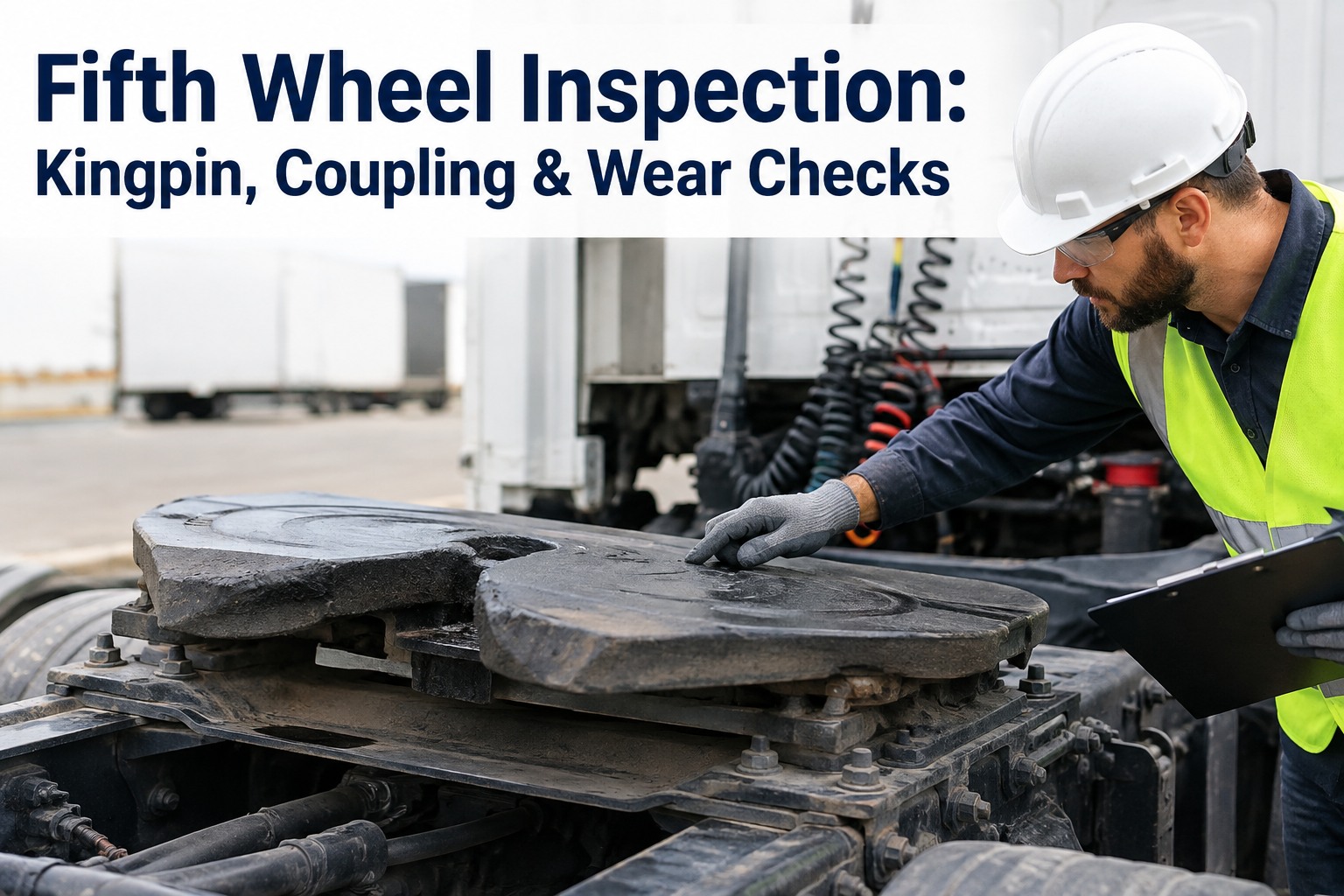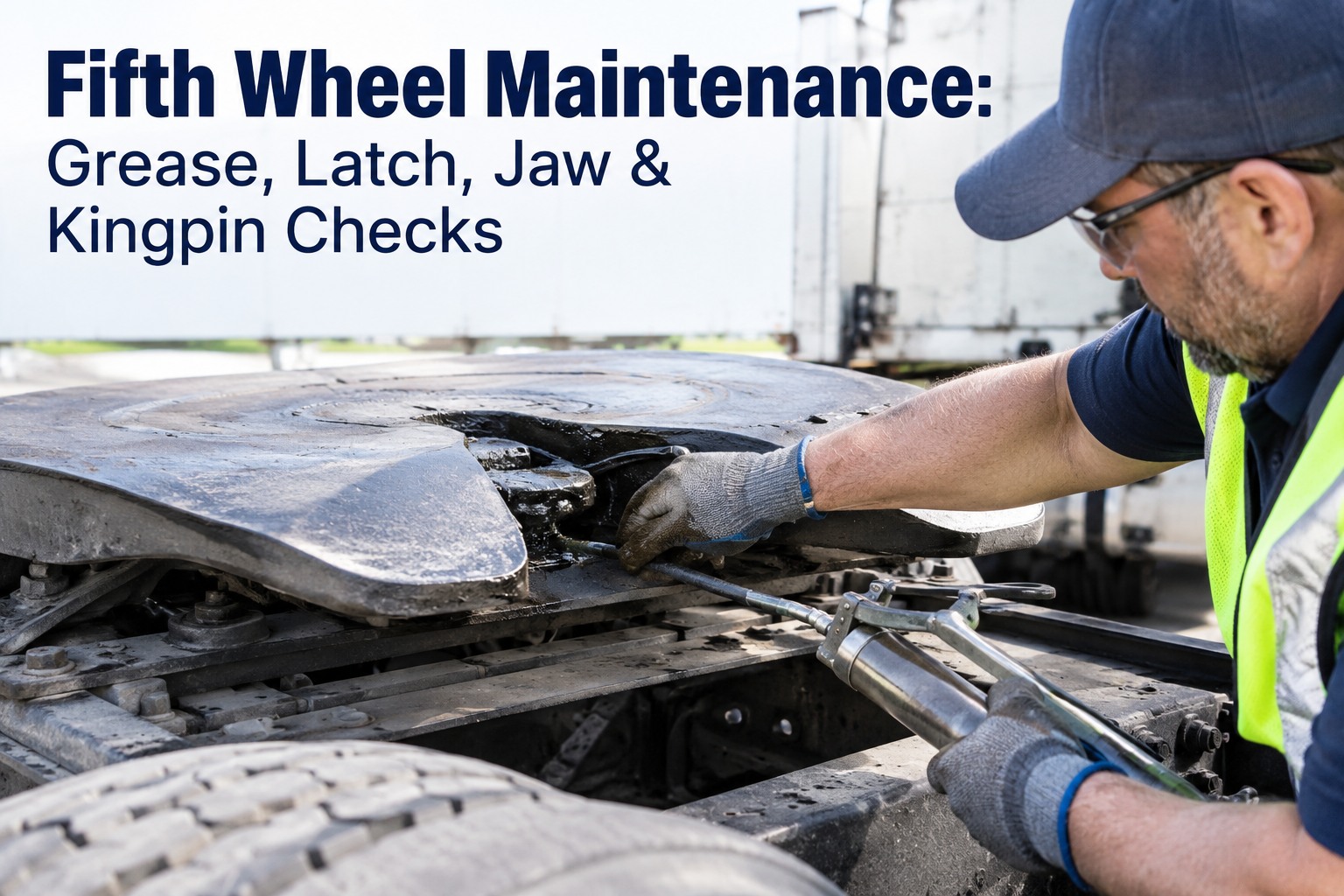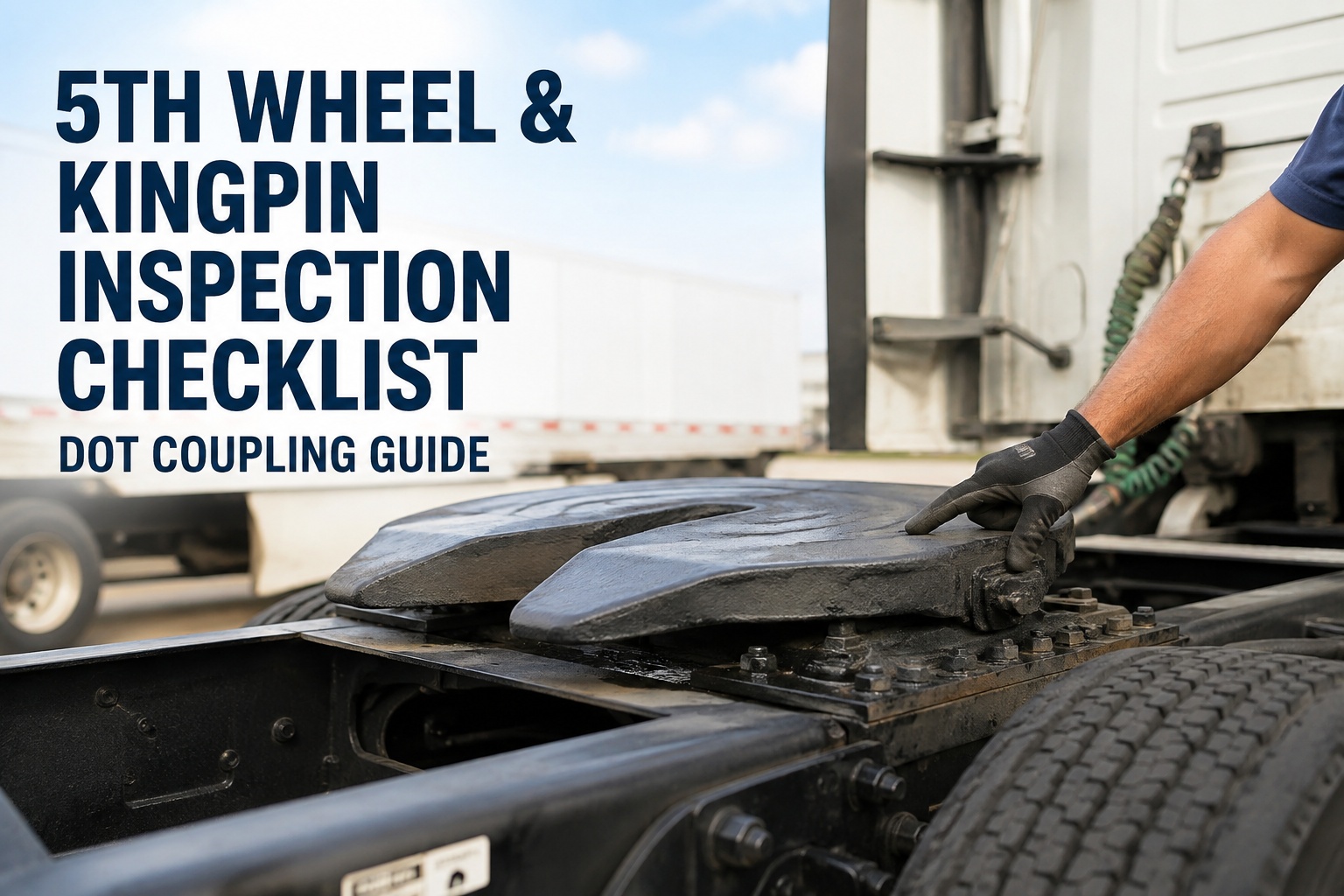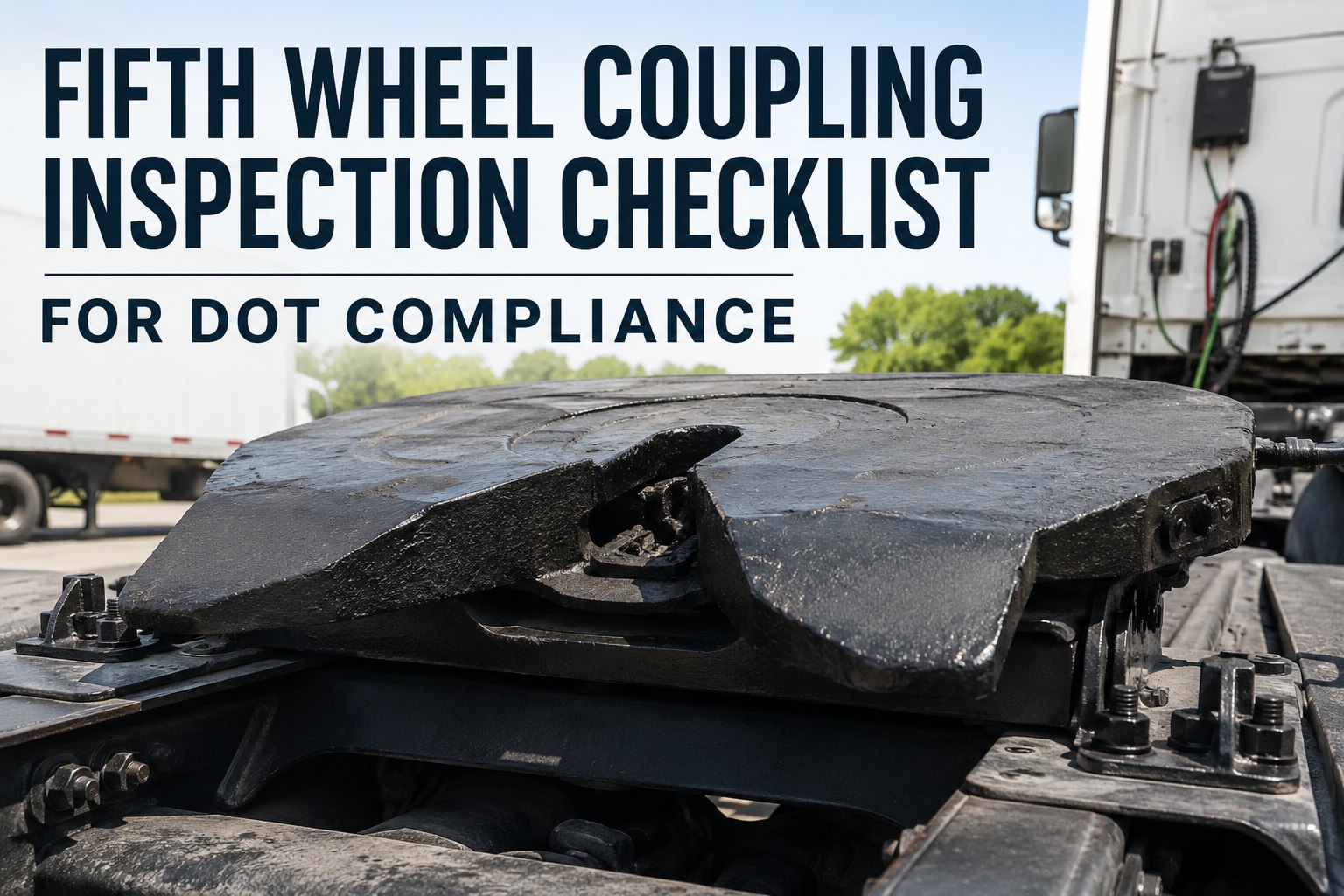
The fifth wheel coupling is the single most safety-critical mechanical joint on any tractor-trailer combination. Every 80,000-pound rig on the highway depends on a coupling assembly the size of a large pizza to hold the trailer to the tractor through braking, cornering, road impact, and driver input. Fifth wheel failure isn't a downtime event — it's a catastrophic separation event, and every DOT inspector knows it, which is why fifth wheel-related violations account for a meaningful share of vehicle out-of-service placements every year despite being physically one small component. This guide walks through the complete fifth wheel coupling inspection checklist: the six inspection zones, the specific pass and defect criteria per zone, the DOT and CVSA out-of-service triggers, lubrication best practice, and the early-warning wear patterns that separate a fleet catching problems on the DVIR from a fleet finding out about them at a roadside stop or worse. Book a demo when you want to see the fifth wheel checklist configured in your DVIR.
The 6 zones your fifth wheel inspection must cover
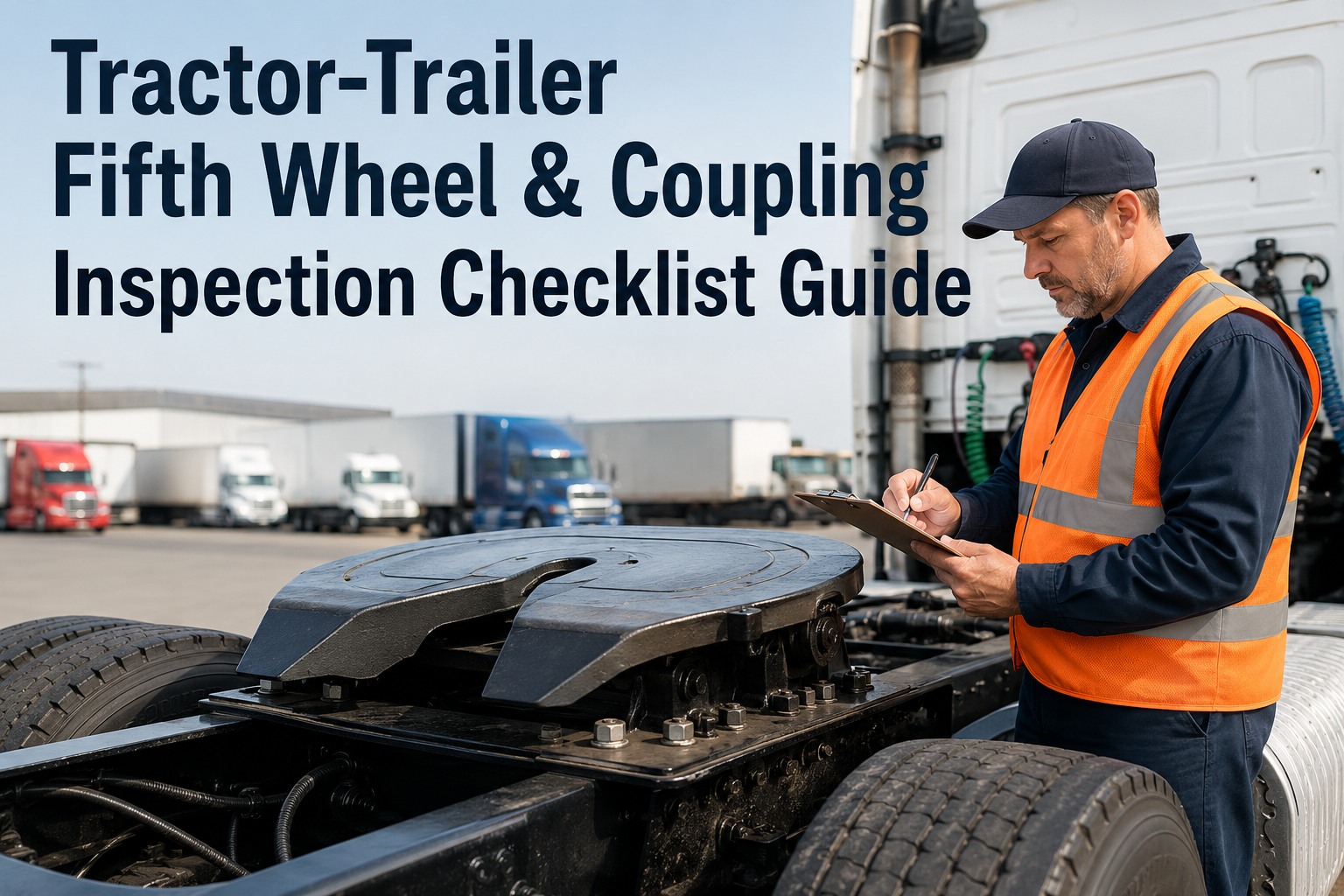
Top-down view of the coupling · every numbered marker is a mandatory inspection point
Why the fifth wheel deserves its own inspection checklist
Every DVIR includes "fifth wheel" as one of dozens of line items, usually resolved with a single pass/fail check. That level of scrutiny is inadequate for the mechanical joint that holds an 80,000-pound combination together. A proper fifth wheel inspection has six distinct zones, each with its own pass criteria and defect conditions. Miss any one zone and you can pass the DVIR while operating a truck that would fail a roadside inspection instantly.
Every zone has a distinct failure mode and a distinct inspection technique. A "fifth wheel: pass" line item on a paper DVIR gets you nowhere near this level of scrutiny. Book a demo to see all six zones structured into your DVIR
Zone-by-zone inspection criteria: pass vs defect
Each zone has a specific pass condition and specific defect conditions that trigger a work order or, in some cases, an immediate out-of-service placement. Here's what to look for in each of the six zones.
Top plate surface
- Flat surface with no visible warpage
- Uniform wear pattern across the plate
- No cracks radiating from any bolt hole or edge
- Wear plate insert (if fitted) secure & within thickness spec
- Any hairline crack visible on inspection
- Warpage causing uneven trailer contact
- Deep gouges or scoring beyond wear spec
- Missing or displaced wear insert
Locking jaws
- Both jaws close fully around king pin gauge
- Jaw wear surface uniform, no flat spots or gouges
- Return spring functional — jaws snap closed decisively
- No visible cracks on jaw body or pivot pin area
- Gap between king pin gauge and jaws > 1/2 inch
- Any crack in jaw body or pivot mount
- Sticky or partial closure — jaw not decisively engaging
- Visible wear ridges or flat spots on jaw contact surface
King pin bore
- Bore clean, free of debris and packed grease
- No damage to bore walls or entry chamfer
- King pin (on trailer side) within diameter spec
- Full engagement verified with tug test after coupling
- Gap > 2 inches between trailer plate and fifth wheel
- King pin visibly bent, cracked, or worn below spec
- Debris blocking full king pin insertion
- Any indication of high-hitch (jaw closed above king pin)
Release handle & secondary lock
- Handle in locked position (fully seated against stop)
- Secondary safety lock (if fitted) engaged
- Release operates smoothly without excessive force
- Return spring pulls handle back to locked position
- Handle bent, broken, or in mid-position
- Secondary lock inoperative or missing
- Release mechanism stuck or requiring excessive force
- Any binding or grinding in operation
Mounting bolts & hardware
- All mounting bolts present and torqued to spec
- No visible movement between fifth wheel and mounting bracket
- Mounting bracket welds intact, no cracks
- Frame mounting points solid, no fatigue cracks
- Any missing mounting bolt (immediate OOS)
- Any visibly loose or turnable bolt (immediate OOS)
- Cracked mounting bracket or frame attachment
- Visible movement between fifth wheel and mount under load
Grease grooves & lubrication
- Grease grooves visible, not packed with debris
- Fresh grease film on top plate (unless dry-lube system)
- No excessive grease buildup at plate edges
- Grease type matches manufacturer specification
- Dry plate on greased-type fifth wheel (accelerates wear)
- Grooves packed solid with old grease + debris
- Wrong grease type (contamination risk)
- Grease weeping past plate edges under load
Zones 2 and 5 carry the highest OOS exposure — jaw defects and mounting bolt issues are common inspector targets during roadside stops. Zone 6 rarely triggers OOS on its own but is the most common cause of accelerated wear in the other zones. Book a demo to see the 6-zone template configured on your DVIR
DOT / CVSA out-of-service criteria for fifth wheel
Under CVSA's North American Standard Out-of-Service Criteria (updated annually every April 1) and FMCSA regulations under 49 CFR 393.70, the following fifth wheel conditions result in immediate out-of-service placement. Any one of them and the truck stops on the shoulder until repaired.
Fifth wheel violations are one of the least-negotiable OOS categories on any inspection. Inspectors do not extend courtesy on coupling integrity — if it's a defect condition, the truck is placed OOS on the spot. Regular DVIR discipline is the only realistic way to prevent these placements. Book a demo to see the OOS-triggering conditions built into your DVIR
Fifth wheel lubrication: doing it right
Lubrication is the single most common source of accelerated fifth wheel wear — too much grease, wrong grease, no grease at all, or grease packed with debris. Every fleet needs a documented lubrication practice. Here's what works.
- Grease the top plate at every PM cycle (typically 10,000–15,000 miles or monthly, whichever comes first)
- Use lithium-complex grease with a NLGI grade meeting manufacturer spec — usually NLGI #2
- Clean debris and old grease from grooves before applying fresh
- Apply an even film across the top plate, not just in the grooves
- Grease the release mechanism pivot and locking jaw pivot separately
- Document each lubrication event in the machine service history
- Over-grease — excess grease weeps past the plate edges, attracts debris, and doesn't help lubrication
- Mix incompatible grease types (lithium and calcium bases separate, calcium and moly can react)
- Apply grease without cleaning the previous cycle's residue first
- Skip lubrication because "the truck feels fine" — wear accelerates silently until jaw failure
- Use general-purpose chassis grease unless manufacturer explicitly permits
- Rely on operator memory — put lubrication on the digital PM schedule with alerts
Some fleets have moved to dry-lube fifth wheel systems (polymer-coated top plates or replaceable lube plates) to eliminate the greasing task entirely. The trade-off is upfront cost and periodic plate replacement, offset by cleaner coupling operation and no manual lubrication labor. Start a free trial to configure fifth wheel lubrication tracking with automated PM alerts.
Common fifth wheel failure patterns to watch for
Fifth wheel failures rarely happen without warning — there's almost always an early wear signal that a good DVIR catches weeks or months before the catastrophic event. Here are the four failure patterns every fleet should train drivers and mechanics to recognize.
All four patterns give weeks of warning — if the inspection routine is actually catching them. That's what the difference between "fifth wheel: pass" and a proper 6-zone inspection buys you: months of lead time on failures that would otherwise be catastrophic. Start a free trial with the fifth wheel checklist pre-loaded on every truck in your fleet.
From a safety supervisor who found 3 mounting bolts loose on a random check
We had a driver report the trailer felt "loose" during a lane change on I-70. He pulled over at the next scale and reported it. Our safety supervisor drove out with a torque wrench and found three of the mounting bolts on that fifth wheel could be turned by hand. Not loose — hand-turn loose. That truck had passed a paper DVIR that morning.
Post-incident review showed the driver had been marking fifth wheel as "PASS" on the DVIR for months without actually checking the mounting. Once we moved to a digital DVIR with mandatory photo capture of the mounting bolts, that whole class of near-miss disappeared. Because you can't fake a photo of loose bolts — you either take the picture and the bolts are tight, or you take the picture and the defect is documented.
The bottom line on fifth wheel coupling inspection
The fifth wheel is the single joint on a tractor-trailer that cannot afford to fail. Every DOT inspector knows it, every roadside enforcement action treats it as immediate out-of-service exposure, and every catastrophic tractor-trailer separation traces back to a defect that a proper inspection should have caught. The 6-zone framework — top plate, locking jaws, king pin bore, release handle, mounting bolts, and grease grooves — is what turns "fifth wheel: pass" into an actual, defensible, documented inspection. The DOT and CVSA out-of-service criteria are non-negotiable, and the failure patterns almost always give weeks of warning through wear signals that a disciplined DVIR would catch. Move the fifth wheel inspection off paper and onto a digital DVIR with photo capture per zone, and you eliminate an entire class of both compliance exposure and catastrophic failure risk — typically for less than the cost of a single OOS event's total downstream impact.
Frequently asked questions
What are the DOT out-of-service criteria for a fifth wheel?
Under 49 CFR 393.70 and CVSA's North American Standard Out-of-Service Criteria, the following fifth wheel conditions result in immediate out-of-service placement: any part of the mounting missing, cracked, or ineffective (including frame welds, mounting brackets, and mounting bolts); any loose mounting bolt or nut that can be turned with hand or normal wrench pressure; a gap greater than 1/2 inch between the king pin gauge and the locking jaws when the jaws are fully closed; the locking mechanism is ineffective (won't lock, won't unlock, or partial engagement); a gap greater than 2 inches between the trailer plate and the fifth wheel indicating a high-hitch condition; any crack in the fifth wheel plate or throat area, including hairline cracks; and any visible damage, bending, or wear beyond specification on the king pin itself as measured by a standard king pin gauge. Fifth wheel OOS violations are non-negotiable in enforcement — inspectors do not extend courtesy on coupling integrity because of the catastrophic failure risk.
How often should a fifth wheel be inspected?
The fifth wheel is subject to multiple overlapping inspection cycles. First, the pre-trip DVIR before every shift — a visual check for obvious defects, proper locking, and any signs of loose mounting. This is required by 49 CFR 396.11 for every commercial vehicle every day. Second, a detailed monthly PM inspection covering all six zones (top plate, locking jaws, king pin bore, release handle, mounting bolts, grease grooves) with specific pass and defect criteria per zone. Third, an annual DOT inspection that includes a comprehensive fifth wheel assessment including torque check on all mounting bolts, measurement of jaw wear against manufacturer specification, and inspection of the mounting bracket welds. Fleets operating in corrosive environments (salt, coastal) should add a semi-annual inspection specifically for corrosion under the mounting plate. Every inspection cycle should be documented in a digital service history — paper records don't provide the audit trail needed if a coupling-related incident occurs.
What type of grease should be used on a fifth wheel?
Most fifth wheel manufacturers specify a lithium-complex grease with an NLGI grade of #2, though some applications call for #1 in cold climates for better cold-flow characteristics. The specific grease type depends on the fifth wheel manufacturer — SAF-Holland, Fontaine, and Jost all publish their own recommended lubricants and interval guidance. Critical points on grease selection: (1) never mix incompatible grease bases — lithium and calcium separate, lithium and moly can react — so if switching grease types you must fully clean the plate first; (2) general-purpose chassis grease is often not adequate because it doesn't withstand the pressure and temperature at the coupling surface; (3) some newer applications use dry-film lubricants (polymer-coated plates or replaceable lube plates) that eliminate greasing entirely. Whatever type is used, document it in your PM records so future service events use the same product and avoid contamination. Photo-verified digital DVIRs are the cleanest way to track grease application over time.
How do you check if a fifth wheel is properly coupled?
Every coupling must be verified with a documented four-step check: (1) Visual inspection — look under the trailer to confirm the trailer plate is flat against the fifth wheel with no visible gap (a gap greater than 2 inches indicates a high-hitch condition and is immediate out-of-service). (2) Jaw engagement check — the locking jaws must be fully closed around the king pin, verifiable by looking at the release handle position (fully locked, not in a mid-position) and any visual indicator the manufacturer provides. (3) Secondary lock check — if the fifth wheel is equipped with a secondary safety lock, verify it is engaged. (4) Tug test — with the trailer brakes set and the tractor in low gear, gently attempt to pull forward. The trailer must move with the tractor as a single unit; if any relative motion is observed between tractor and trailer, the coupling is incomplete. Skip any of these four steps and you're operating on assumption rather than verification. Digital DVIRs can enforce all four checks as mandatory pass/fail responses before dispatch is authorized.
Can a fifth wheel be repaired or does it need to be replaced?
Some fifth wheel defects can be repaired; others require complete replacement. Repair-eligible items generally include: locking jaw replacement (jaws are typically a serviceable part on major manufacturers); release mechanism spring or handle replacement; wear plate insert replacement (if the design uses one); grease groove cleaning and re-machining in limited cases; and mounting hardware replacement. Replacement-required items generally include: any crack in the fifth wheel plate, throat, or mounting bracket (welding cracks on a fifth wheel is not permitted by any manufacturer); any warpage of the top plate; frame mounting cracks that extend into the truck frame; and any indication of fatigue failure. The general rule: if the crack or damage is in a stress-bearing structural element, the fifth wheel is replaced. If the damage is in a serviceable component that can be swapped out with OEM-approved parts, repair is appropriate. Never let a shop weld a cracked fifth wheel — the metallurgy of the coupling is designed as a heat-treated single unit and welding introduces failure risk.
Turn fifth wheel inspection into a documented, defensible discipline
HVI's fifth wheel coupling checklist covers all six zones with mandatory pass/defect criteria, photo capture on any defect, auto-generated work orders, and a searchable service history for every truck in your fleet. Live in under two weeks — typical fleets eliminate fifth wheel OOS exposure entirely inside the first quarter.
No credit card · DOT / CVSA-ready templates · Works alongside any ELD provider