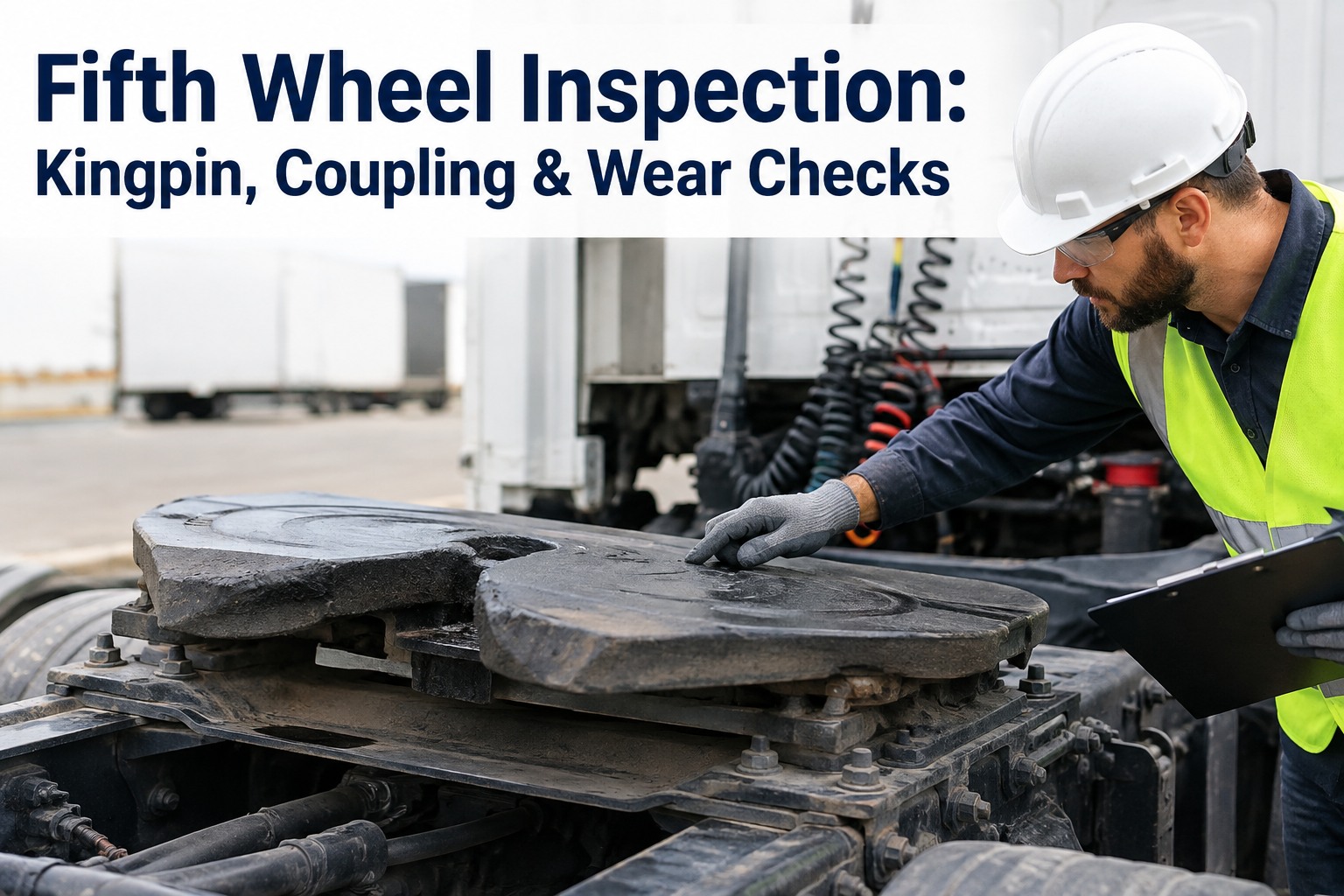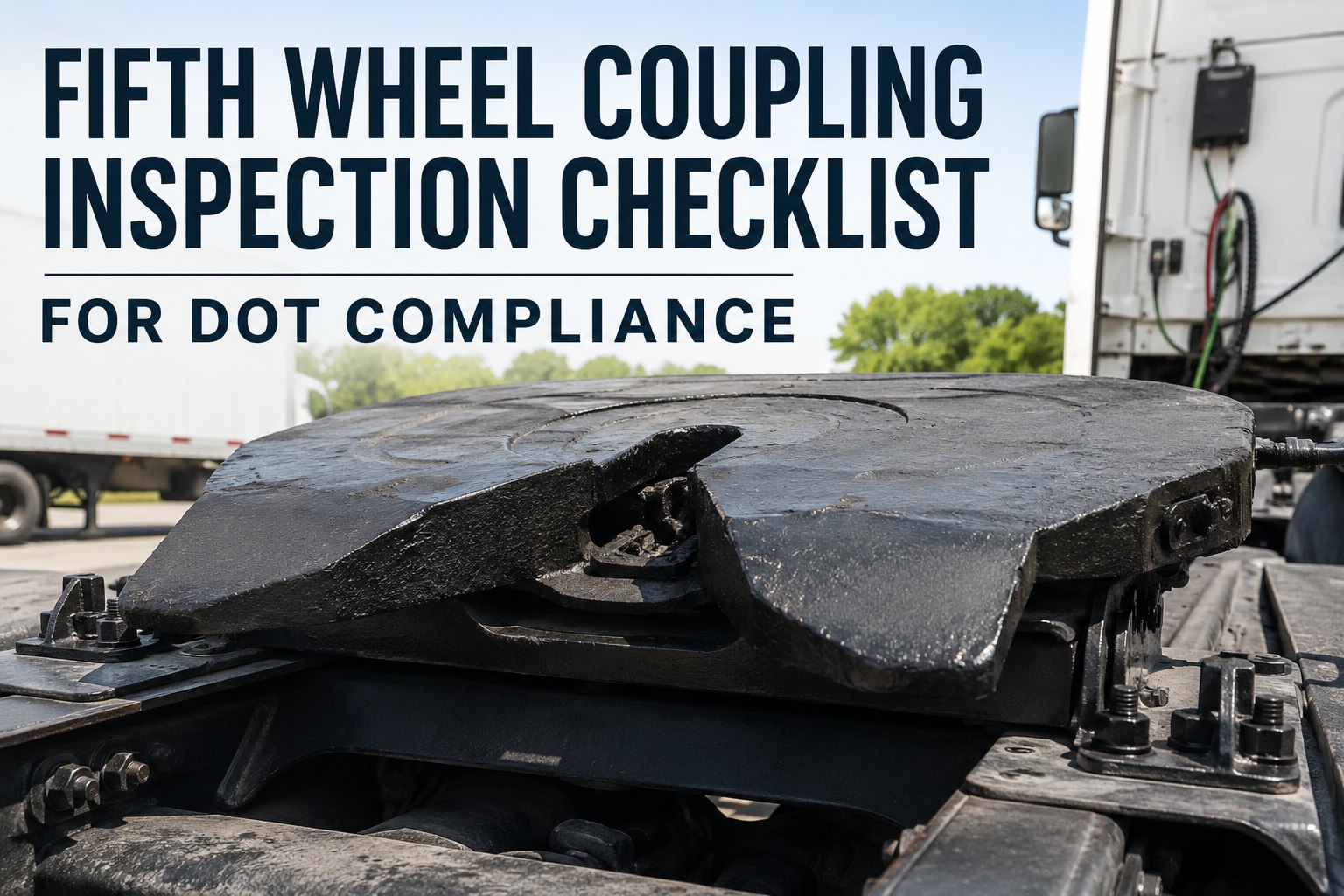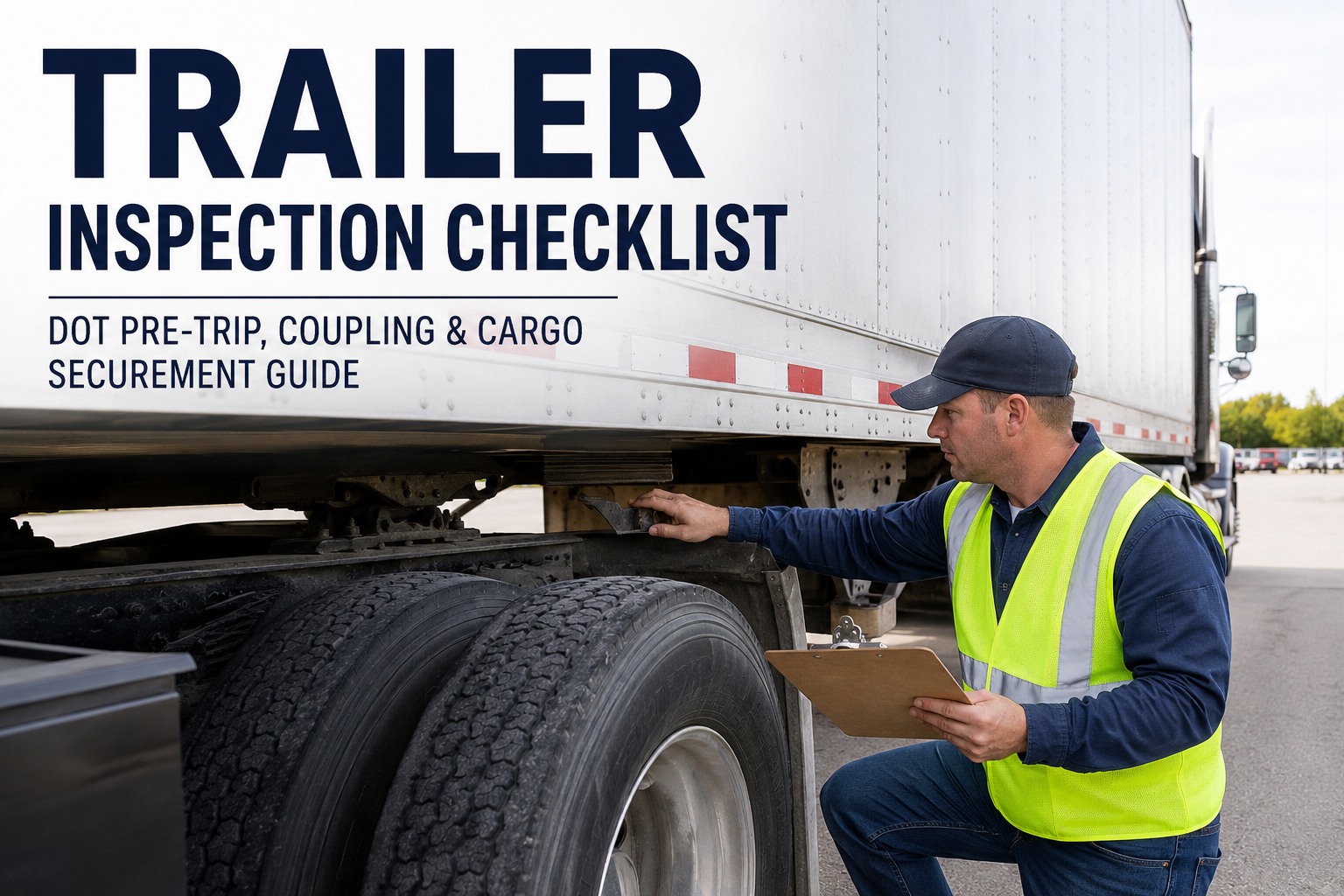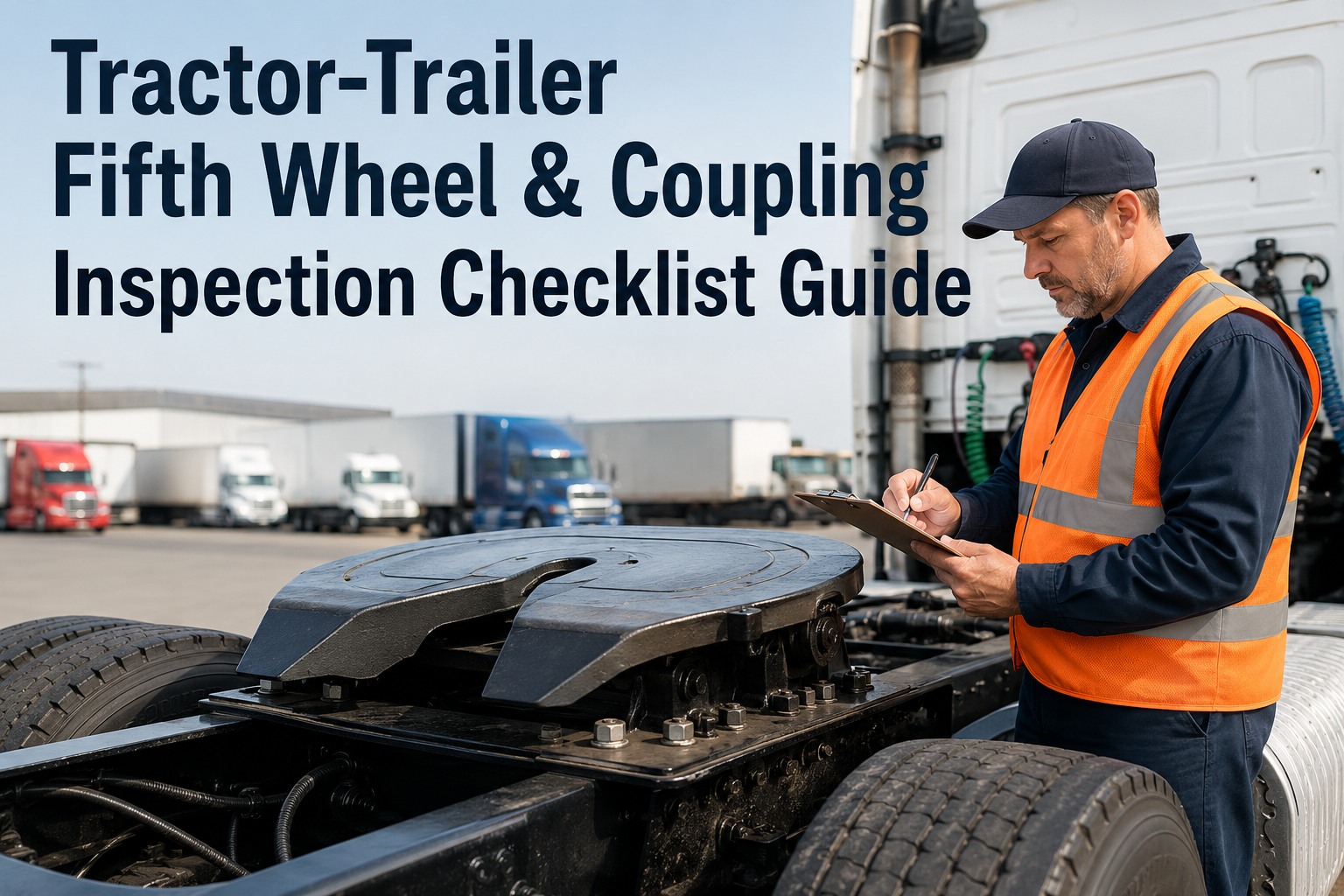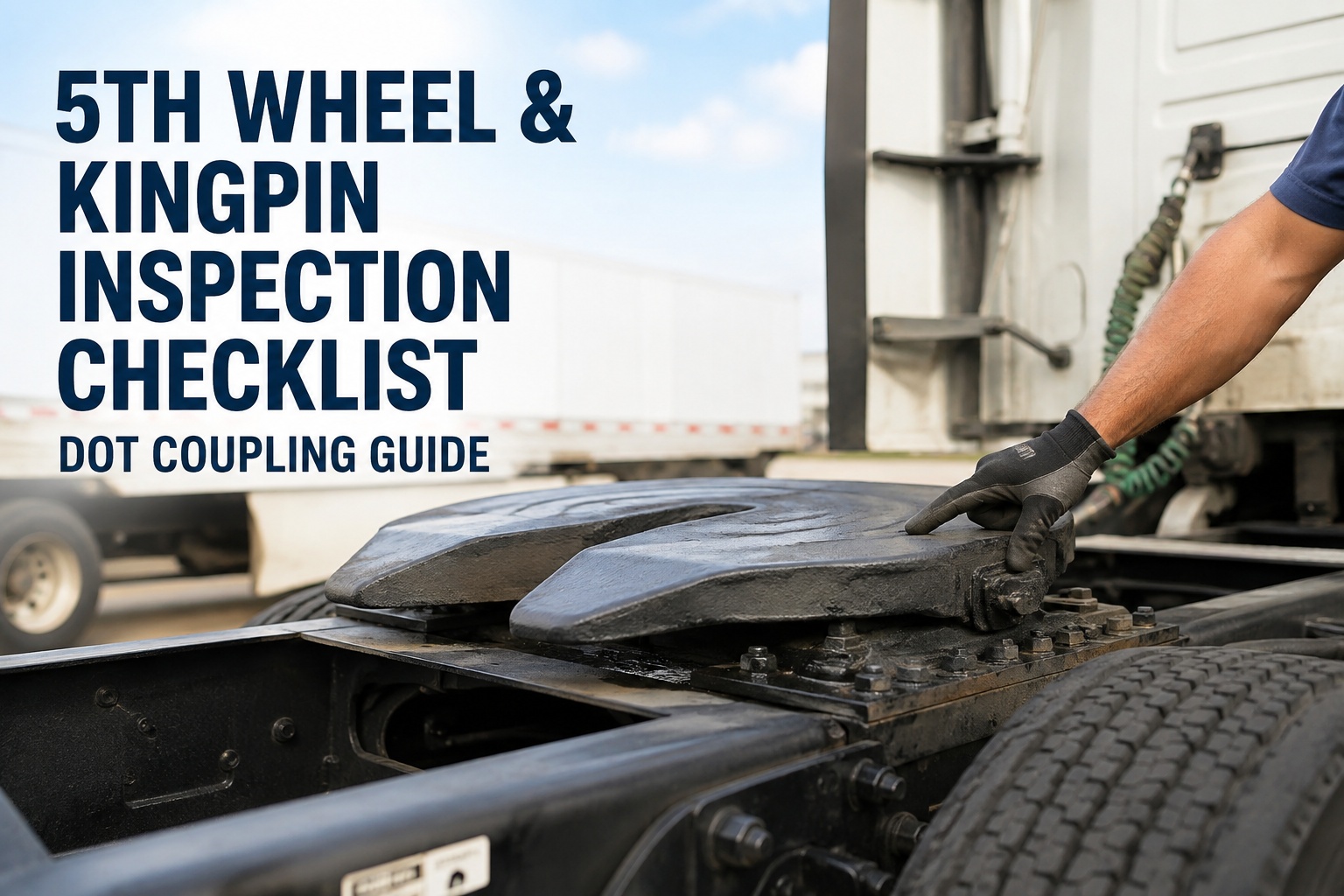
A kingpin that has worn one-eighth of an inch on the 2-inch diameter looks perfect. The surface is smooth, the head is intact, and nothing about a visual walkaround will flag it. But the fifth-wheel jaws can no longer grip it under load, and one hard braking event separates a normal shift from a runaway trailer on the interstate. The 5th wheel kingpin inspection isn't a look-and-move discipline — it's a measurement discipline. This guide walks the four tolerance limits, coupling anatomy, and pull-test workflow that catches wear a visual check misses. Book a demo
The three components that keep a trailer attached to a tractor
Kingpin, primary jaws, secondary latch. Three layers of retention. All three must be in-spec for the coupling to be legal.
Trailer separation is one of the most severe mechanical failure modes in commercial trucking. When the coupling releases at speed, the trailer becomes a 40,000-pound unguided projectile. FMCSA and CVSA treat coupling defects as immediate out-of-service violations for that reason — there's no repair-later option, no next-inspection window, no benefit of the doubt at the roadside. The coupling either meets specification or the vehicle doesn't move.
The four numbers that decide whether the coupling is legal
Coupling compliance is decided by four specific measurements. All four have to hold for the coupling to remain in service. Any one exceeded — even with the other three perfect — and the vehicle is placed out of service until the failing component is replaced.
Maximum allowable wear on either the 2″ or 2-7/8″ kingpin diameter, in any direction. Beyond this and the jaws can't grip securely. Requires a kingpin gauge — visual check will not catch uniform wear.
Maximum allowable kingpin bend from true vertical. A bent kingpin doesn't seat correctly in the jaws even when it looks straight. Straightening not permitted — heat treatment cannot be restored.
Maximum wear on the horn section of the fifth-wheel plate when coupled. Beyond 20% reduction from original section = immediate OOS. Wear is visual but requires trained inspector eye.
Cracks extending through 20% or more of the original weld or parent metal on the fifth-wheel plate = immediate OOS. Any crack in the kingpin itself = immediate OOS, regardless of length.
Three of the four measurements need physical tools or trained inspector judgment — a kingpin gauge for diameter wear, a level or straight-edge for bend, and calibrated eyes for horn wear and cracks. Only weld/plate cracks are commonly caught in casual walkaround. That's the trap: a visual pre-trip that skips the gauge measurement is trading paper compliance for actual coupling reliability. Book a demo to see kingpin gauge measurements captured with photo evidence per inspection
The 6-station coupling walkaround — visual + functional
A proper coupling inspection isn't one step. It's six — four visual, one measurement, one functional. Cadence: every 90 days or 30,000 miles per SAF-Holland guidance, plus every pre-trip coupling event. Runs about 8 minutes when done thoroughly.
Station 2 — the gauge measurement — is what separates real coupling inspection from paper compliance. Every fleet mechanic should have a kingpin gauge in their toolbox; every over-the-road driver should know how to run one on the trailer they're picking up. Every pre-trip walkaround should include the gauge check on the trailer's kingpin. And station 6 — the pull test — is what verifies stations 1 through 5 actually held together in a real coupling event. Both take under two minutes combined, and both save careers. Book a demo to see the 6-station workflow with photo capture required per station
CVSA out-of-service criteria — the eight conditions that ground the vehicle immediately
These are the specific coupling conditions CVSA inspectors look for during Level I roadside and terminal inspections. Any one of them = immediate out-of-service order. No repair-then-proceed, no next-inspection window. The vehicle stays parked until the condition is fixed by a qualified technician.
Fifth-wheel jaws not fully closed
Jaws not fully engaged around kingpin during coupling. Incomplete coupling = separation risk under any load.
Kingpin movable by hand (uncoupled)
If the kingpin moves in any direction when handled by an inspector, it's loose in the upper coupler mounting. Immediate OOS.
Kingpin not properly engaged
Kingpin visible but not seated correctly in the fifth-wheel jaws when coupled. Verified by physical inspection.
Any crack in kingpin
Any visible crack in the kingpin itself, regardless of length or location. Kingpins cannot be repaired. Replacement only.
Horn section >20% worn
Fifth-wheel horn section reduced more than 20% from original by wear when coupled. Visual inspection by trained eye.
Plate cracks ≥20%
Cracks extending through 20% or more of original weld or parent metal on fifth-wheel plate.
Missing / ineffective mounting bolts
Upper coupler attachment bolts missing or ineffective per TTMA TB-110 requirements. Loose fifth-wheel mount = coupling risk.
Missing/disconnected safety devices
Safety chain, breakaway system, or air lines missing or disconnected. Applies to trailers with drawbar hitches and to fifth-wheel-coupled tractors.
What ties all eight together: none can be "fixed at the next stop." Each is a physical grounding at the roadside. A driver who understands the criteria and runs the 6-station walkaround catches these before dispatch instead of at the scale house. Cargo, delivery windows, and customer relationships all move in the driver's favor with 8 minutes of upfront work. Book a demo to see CVSA OOS criteria surfaced live per inspection Start free and get CVSA coupling criteria built into pre-trip templates on day one
From a Safety Manager who runs 34 tractors on long-haul freight
We had a driver report "coupling slap" — that thump you hear when reversing under load if the kingpin-to-jaw clearance is out of tolerance. He'd noticed it for a couple weeks but hadn't flagged it because the coupling still looked and felt locked. When we finally gauged the kingpin, it was 3/16-inch wide on the 2-inch diameter — almost 50% past the CVSA limit. That trailer had been in service like that for six weeks.
What changed after that scare was mandating kingpin gauge measurements at every trailer pickup, photo-documented in the digital inspection. We haven't had a coupling defect surprise us in 14 months. The gauges are $30 each. We gave every driver one and trained the workflow. On 34 tractors and 60 trailers in rotation, the cost of one prevented separation event covers the whole program for a decade.
Frequently asked questions
What does a 5th wheel kingpin inspection cover?
A proper 5th wheel kingpin inspection is a six-station discipline covering both the tractor's fifth-wheel assembly and the trailer's kingpin, run every 90 days or 30,000 miles per SAF-Holland maintenance guidance, plus at every coupling event during pre-trip walkarounds. Station 1: kingpin visual inspection — cracks anywhere on the kingpin, abnormal wear or friction marks, bent or leaning position, and any weld repairs (welds on kingpins are prohibited and count as OOS). Station 2: kingpin gauge measurement — using a purpose-built kingpin gauge to check the 2-inch and 2-7/8-inch diameters against SAE J2228 tolerance of 1/8-inch maximum wear, plus a bend check against a straight-edge and a hand-move test when uncoupled. Station 3: fifth-wheel plate and throat — plate cracks or deformation, throat cracks or bending, adequate grease film (not dry and not hardened), and check for metal shavings which indicate accelerated wear. Station 4: locking mechanism — jaws fully close and lock, handle stays in locked position, secondary safety latch engaged, and horn section wear check. Station 5: mounting and slider — mounting bolts present and torqued, bracket welds intact per TTMA TB-110, slider pins engaged if slider-type fifth-wheel, and slider release functional. Station 6: pull test after coupling — trailer brakes applied, low-gear forward tug against locked brakes, no forward movement of trailer, and visual re-check of jaw engagement. The whole workflow takes approximately 8 minutes when done thoroughly.
What are the kingpin wear limits?
The primary kingpin wear tolerance is 1/8-inch (0.125") maximum wear on either the 2-inch or 2-7/8-inch kingpin diameter, in any direction, per SAE J2228 — the industry standard used by SAF-Holland and other major kingpin manufacturers. Beyond this tolerance, the fifth-wheel jaws cannot grip the kingpin securely enough to prevent movement under dynamic load, and the kingpin must be replaced. Critical measurement note: kingpin wear is often uniform, meaning the pin still looks smooth and undamaged on visual inspection even when it's significantly past tolerance. A purpose-built kingpin gauge is required to verify the two diameter measurements against spec — a visual pass without a gauge measurement is not a legitimate inspection. Beyond diameter wear, three other kingpin conditions matter: the kingpin cannot exceed 1 degree of bend from true vertical (bent kingpins don't seat correctly in the jaws); any crack in the kingpin, regardless of length or location, is an immediate OOS condition; and no weld repair is ever permitted on kingpins because welding destroys the quenched-and-tempered heat treatment, creating a brittle failure point that can fracture catastrophically under load. Kingpins are quenched and tempered alloy steel, and their strength depends entirely on that heat treatment being intact. When any of these conditions is found, kingpin replacement is the only remedy — there is no straightening, welding, or field repair option under any circumstance.
What are the CVSA out-of-service criteria for fifth-wheel and coupling?
CVSA identifies eight specific coupling conditions that trigger immediate out-of-service orders during Level I roadside and terminal inspections. (1) Fifth-wheel jaws not fully closed around the kingpin when coupled — incomplete coupling means separation risk under any load. (2) Kingpin movable by hand when uncoupled — if the kingpin can be moved in any direction by an inspector's hand, it's loose in the upper coupler mounting. (3) Kingpin not properly engaged — kingpin visible but not seated correctly in the fifth-wheel jaws, verified by physical inspection. (4) Any crack in the kingpin, regardless of length or location, since kingpins cannot be repaired. (5) Fifth-wheel horn section reduced more than 20% from original by wear when coupled — visual inspection by trained inspector eye. (6) Plate cracks extending through 20% or more of original weld or parent metal on the fifth-wheel plate. (7) Upper coupler attachment bolts missing or ineffective per TTMA TB-110 requirements. (8) Safety devices — safety chain, breakaway system, or air lines missing or disconnected. None of these can be "fixed at the next stop" or resolved by driver correction at the scale house — each is a physical grounding until a qualified technician performs the repair. The regulatory basis is 49 CFR 393.70 for coupling device requirements, with CVSA Level I inspection procedures defining the specific enforcement thresholds. Roadside coupling violations produce some of the most severe CSA-scoring impacts because trailer separation is one of the highest-consequence commercial vehicle failure modes.
How often should a 5th wheel and kingpin be inspected?
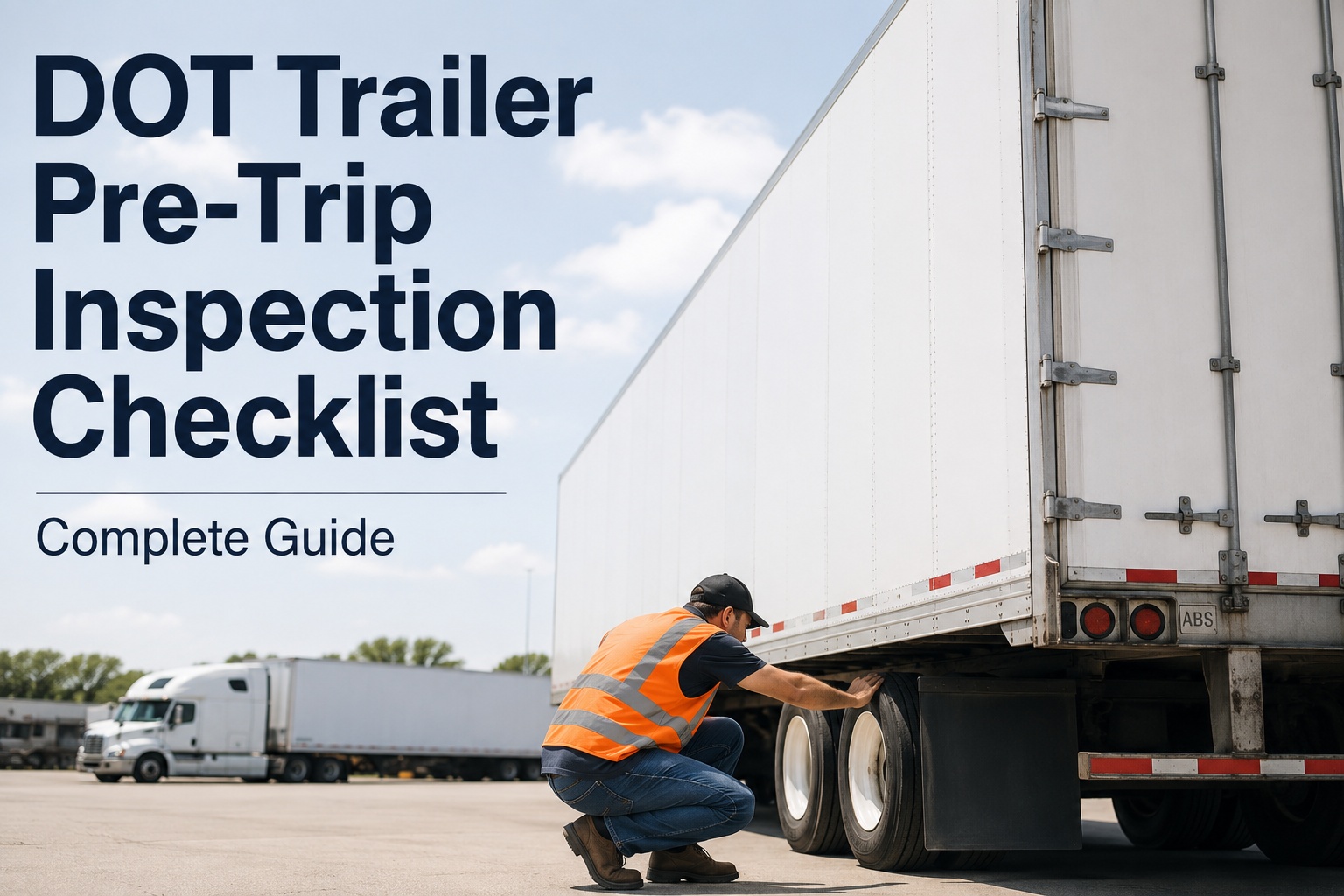
Cadence is layered, with three separate inspection intervals working together. Every coupling event: driver pre-trip walkaround covers all six stations before dispatch, with special attention to the pull test after coupling and the visual verification of jaw engagement and secondary latch. This is required under FMCSA pre-trip rules for the 11 required inspection items, of which coupling is one. Every 90 days or 30,000 miles: full mechanic inspection per SAF-Holland recommended interval, including kingpin gauge measurement on the 2-inch and 2-7/8-inch diameters, bend check against straight-edge, and physical verification of fifth-wheel plate condition, throat, mounting bolts, and lubrication. This interval is what catches the wear that visual pre-trips miss. Annual periodic inspection: 49 CFR 396.17 Appendix A requires coupling devices inspection as part of the annual DOT inspection, covering locking mechanism (parts not missing, broken, or deformed; kingpin securely held when locked; locking jaws fully closed around kingpin), pintle hook if applicable, mounting hardware, safety chains, slider pins, and air and electrical connections. The three intervals work together: the pre-trip is the daily gatekeeper, the 90-day gauge measurement catches wear trends, and the annual inspection is the regulatory checkpoint that produces the certification sticker. Missing any one creates a gap. A fleet running all three, with digital records and photo evidence at each measurement, has both the operational safety and the audit-ready compliance trail.
How does HVI support coupling inspection and CSA compliance?
HVI ships pre-built coupling inspection templates covering the full 6-station workflow — kingpin visual, kingpin gauge measurement (both 2" and 2-7/8" diameters), fifth-wheel plate and throat, locking mechanism and secondary latch, mounting and slider, and pull-test verification. Photo evidence required at each station, so measurement records include visual documentation of what was inspected and where the wear was noted. Kingpin gauge measurements are recorded numerically per trailer per inspection, creating a wear-trend history that lets fleet mechanics predict when a kingpin will hit the 1/8-inch replacement threshold before it gets flagged at a roadside inspection or fails in service. Every inspection is tied to the specific vehicle, trailer, driver, and location with GPS verification and timestamp, meeting FMCSA pre-trip documentation requirements at 49 CFR 396.11 and CVSA Level I audit expectations. Annual periodic inspection templates align with 49 CFR 396.17 Appendix A coupling requirements. Repeat defects at the same coupling assembly surface automatically — the pattern that lets fleet safety managers identify units where wear rates are accelerating faster than the fleet average. For safety managers like Jason T., the ability to document photo evidence of every kingpin gauge measurement is what turns a "we inspected it" argument into a defensible record after any incident. Published customer data shows fleets on HVI report approximately 25% lower annual maintenance cost with typical payback around 3 months.
Coupling defects are the failure mode with no repair-later option. Turn every pre-trip into a measured inspection.
HVI runs 6-station coupling templates with kingpin gauge measurement, photo evidence per station, and full audit trail. Live in under two weeks. One prevented separation event covers years of software cost.
No credit card · Coupling templates ready on day one