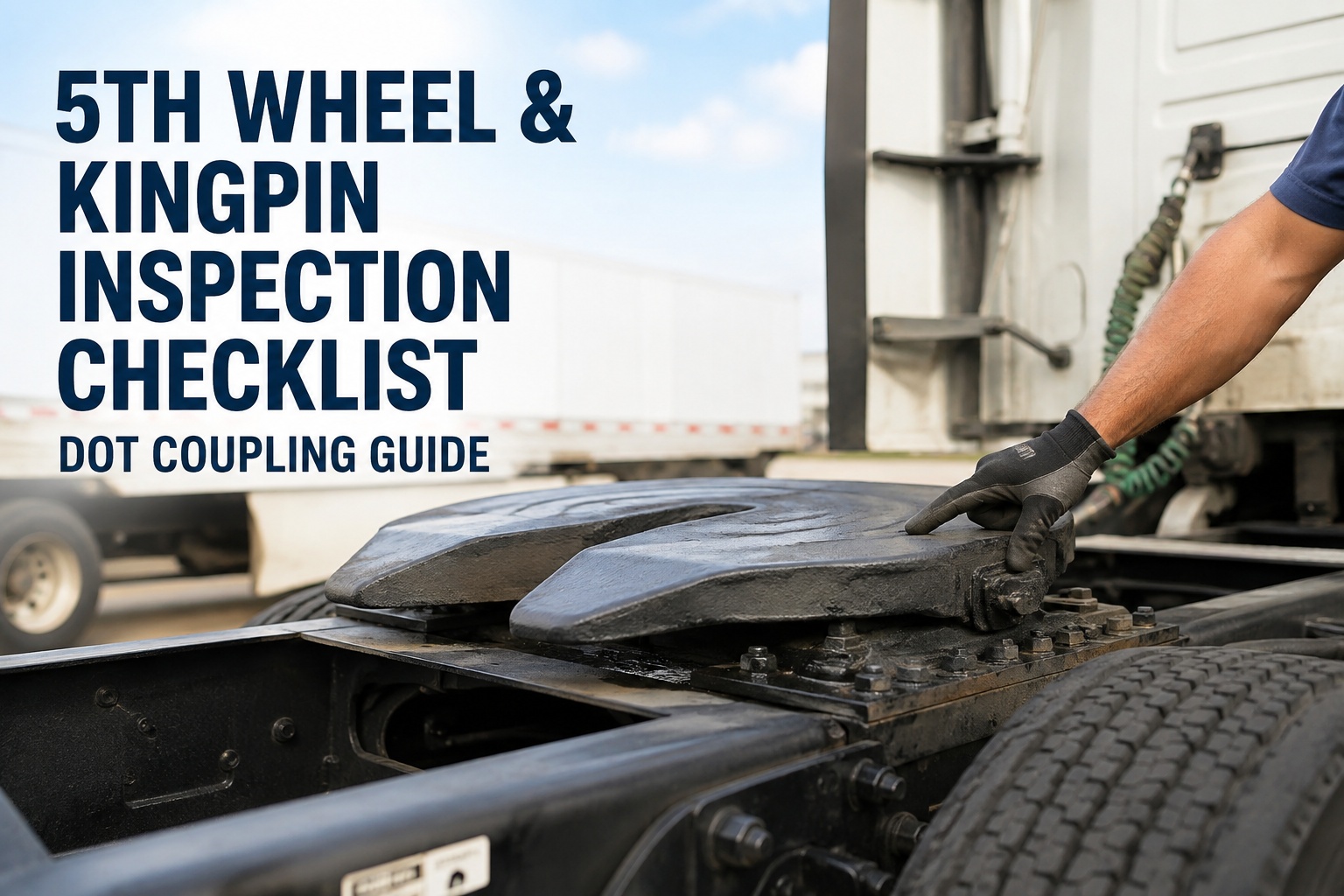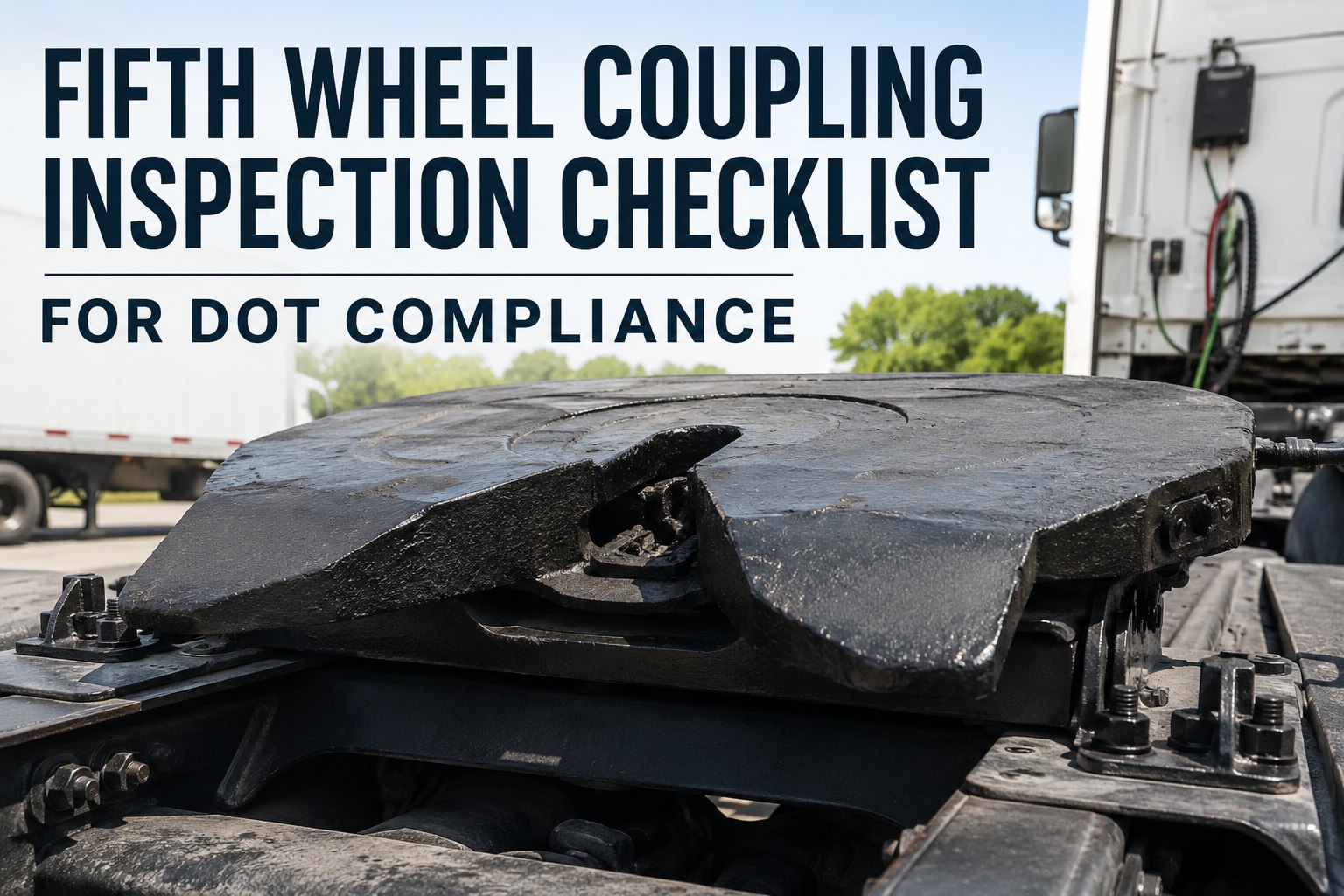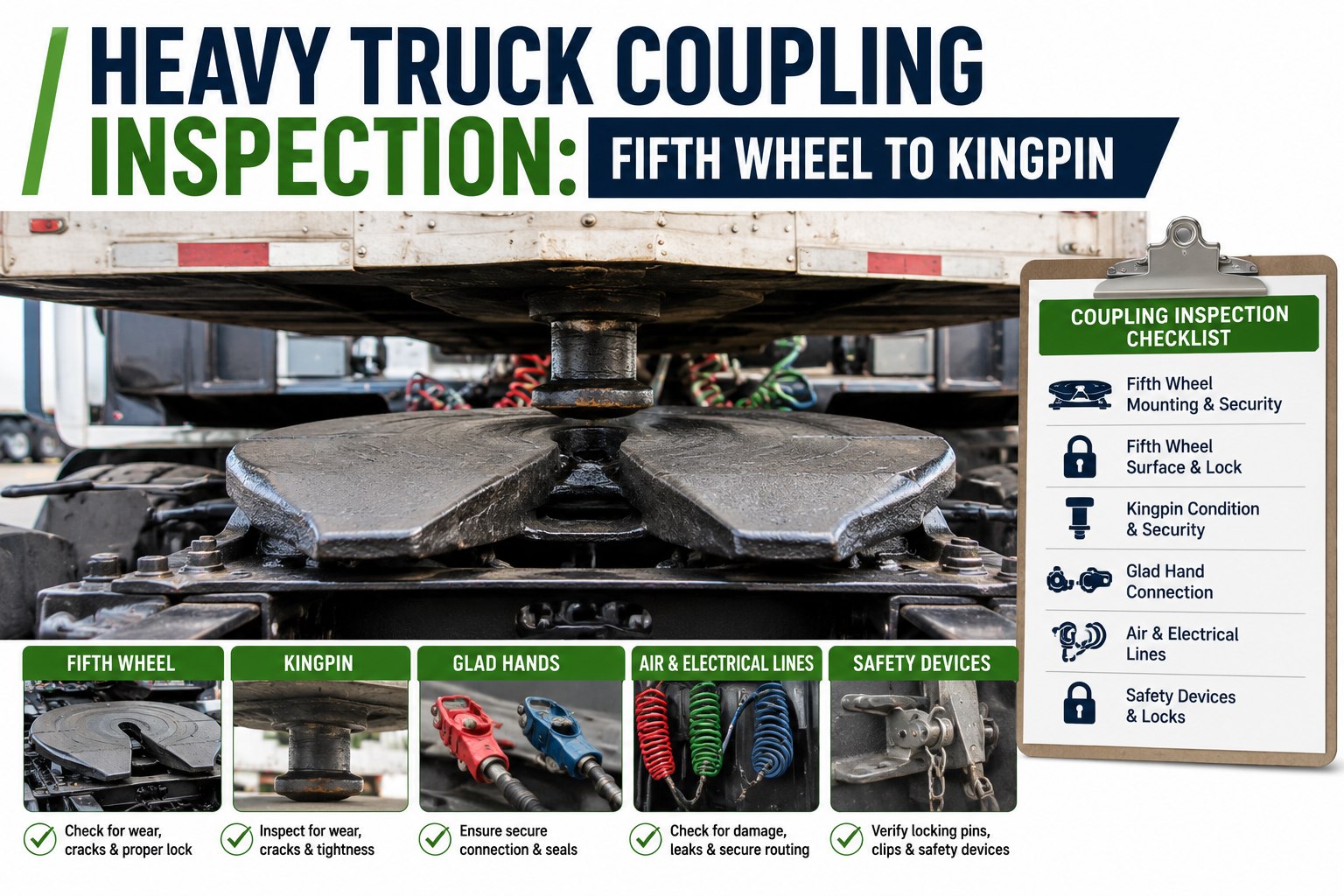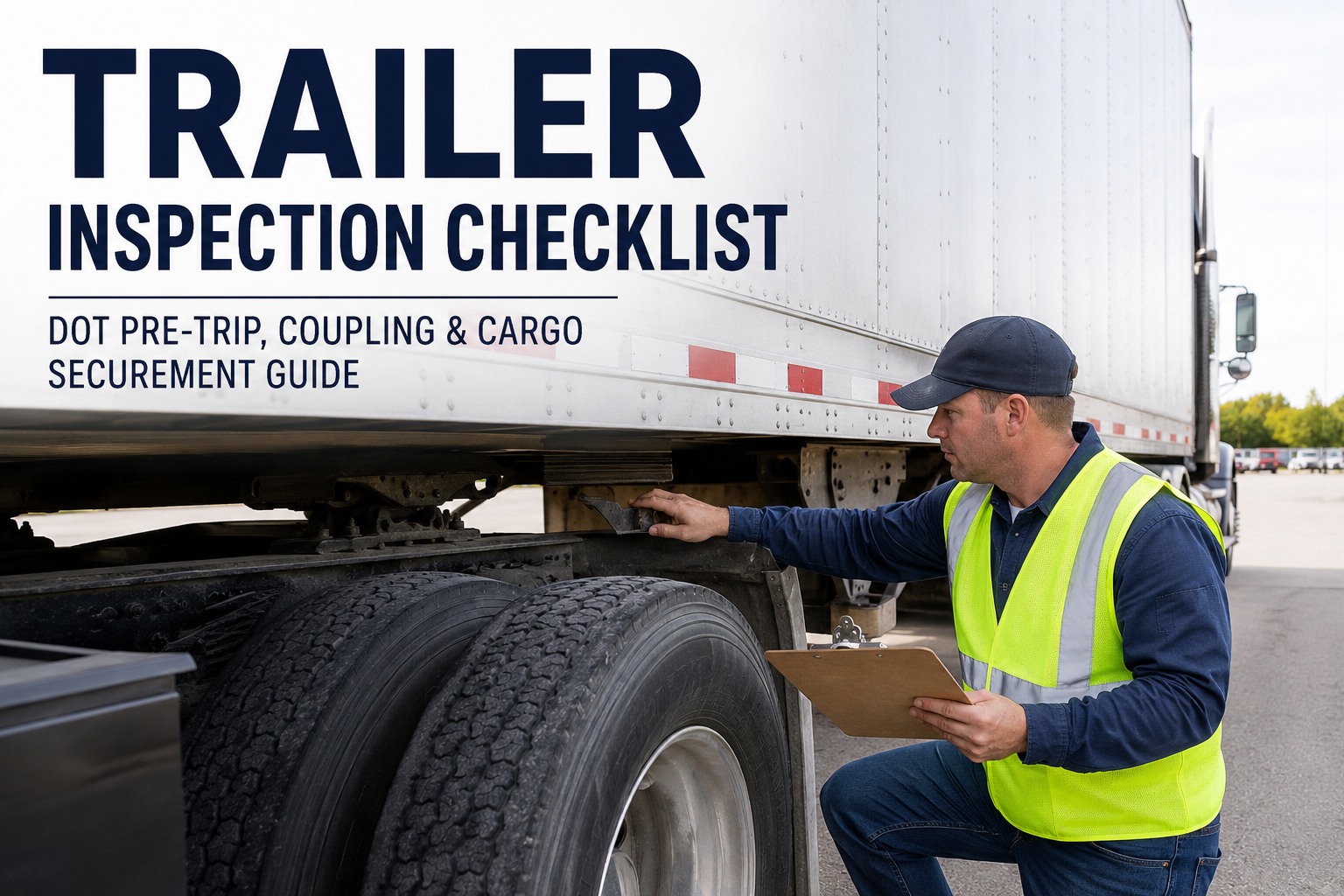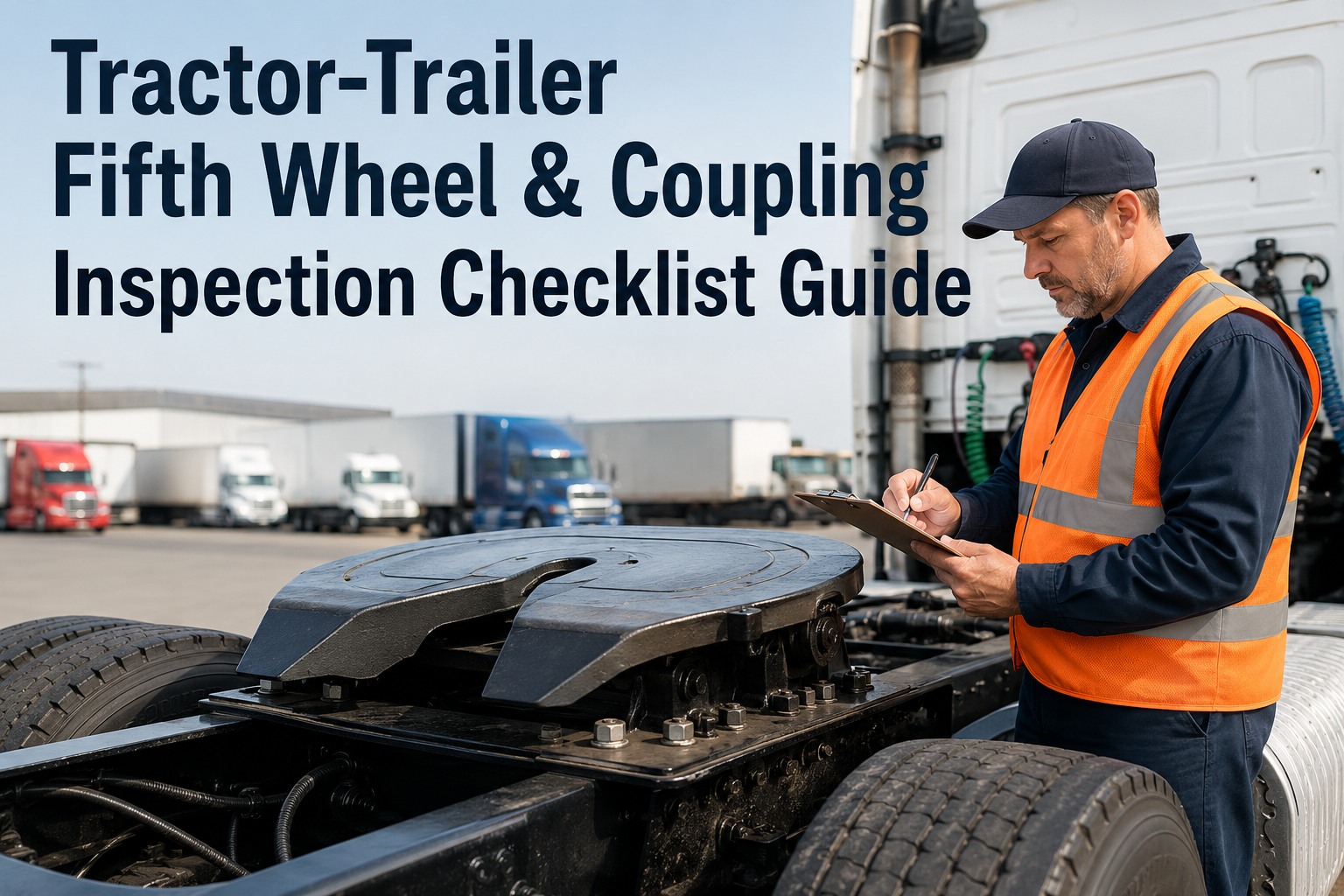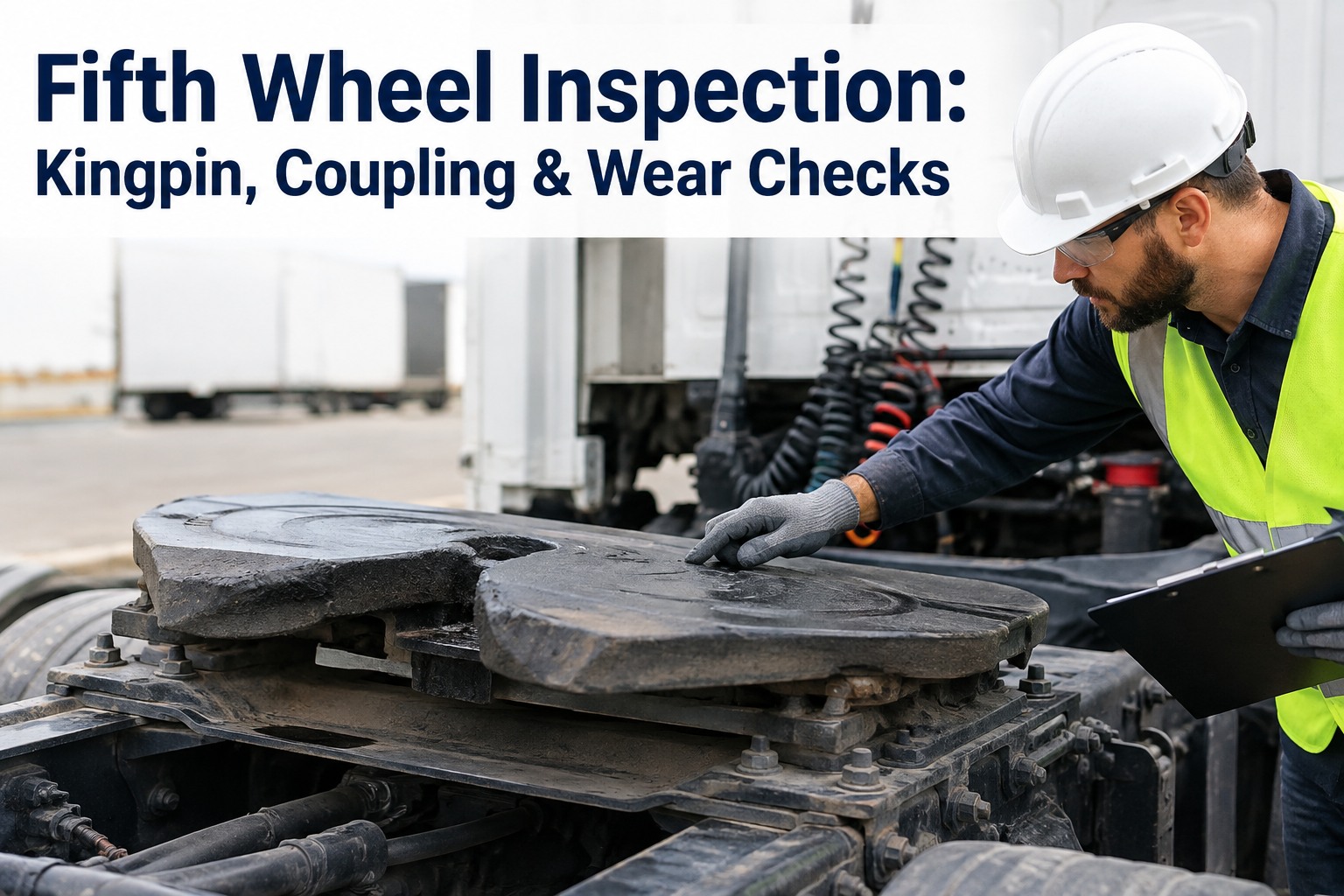
Fifth wheel inspection is not a pass-fail check — it's a measurement against a wear spectrum defined by SAE J2228 (0.125" max kingpin wear) and CVSA out-of-service thresholds. A kingpin at 0.100" wear passes visual and passes the tug test but is 30 days from OOS at 30,000-mile duty cycles. This guide walks the measurement spectrum, the gauge-based inspection that catches wear before OOS, and why the tug test alone doesn't verify a coupling — book a demo to digitise fifth wheel inspections in HVI.
Kingpin Wear Progression — Where Your Coupling Sits Today
Kingpin wear happens on a measurable spectrum, not a binary pass/fail. Four stages, four inspection outcomes — and the gauge measurement that tells you exactly where you are before the roadside inspector does.
Every fifth wheel inspection maps a kingpin to one of these four stages. The number decides service life — not a visual "looks fine" or a passing tug test.
The rest of this page walks the gauge-based measurement protocol, the CVSA out-of-service criteria that mirror the wear progression, the four other measurements that matter besides kingpin wear (jaw wear, horn reduction, plate condition, mounting bolt integrity), and why the tug test alone does not verify a coupling — even in Fontaine's own installation manual. Book a 30-minute demo to see gauge measurements captured per unit in HVI.
The kingpin gauge measurement — the only inspection that gives you a number
A visual inspection of a kingpin tells the technician whether it looks worn, cracked, or damaged. A kingpin gauge tells the technician whether wear has crossed the 0.125" SAE J2228 limit — the difference between "we think it's OK" and "we have a measured baseline on record for the next inspection." Every serious fleet fifth wheel programme is built around gauge measurement, not visual judgement.
Uncouple & clean
Trailer uncoupled, kingpin exposed. Wire brush surface to remove grease, dirt, and metal shavings. Any shavings recovered from around the kingpin base indicate accelerated wear and warrant deeper inspection of both kingpin and fifth wheel jaws.
Seat the gauge
Fontaine, SAF-Holland, and JOST all publish gauges designed for SAE J700 kingpins. The gauge fits over the 2" and 2-7/8" diameters. If the gauge seats fully on both surfaces, wear is within limits. If the gauge does not seat, wear exceeds 0.125" and the kingpin is OOS.
Check bend, cracks, defects
Straight-edge along the kingpin shaft to verify no bend beyond 1°. Visual check for cracks, burrs, or gouges: any nick >0.12" deep in throat or jaw contact area = replace; any crack anywhere = replace. Never weld or grind a kingpin (heat destroys the heat-treatment).
Move-by-hand test
With trailer uncoupled, attempt to move the kingpin by hand in any direction. A kingpin that moves is loose in the upper coupler weld and is immediate OOS — regardless of what the gauge reading showed. Loose upper coupler is a separate failure mode from surface wear.
Record every measurement per trailer per inspection date. The gauge reading, bend check, and move-by-hand result together produce a trend line that shows how fast a kingpin is wearing on a specific trailer — and predicts when replacement will be needed 60-90 days in advance rather than at the roadside inspection. Book a demo to see per-trailer kingpin measurements trended over time in HVI.
CVSA out-of-service criteria — the eight conditions that end the day at the scale house
CVSA Level I inspections apply specific out-of-service criteria to fifth wheels and kingpins under 49 CFR 393.70. Any one of these puts the tractor-trailer combination immediately out of service on the roadside — no exceptions, no "fix it at the next stop." Fleet-side inspection programmes should be built to catch each of these before the truck leaves the yard.
| OOS condition | What triggers it | Fleet-side catch method |
|---|---|---|
| Kingpin movable by hand | Upper coupler weld failure or worn kingpin bore | Move-by-hand test at every uncoupled inspection |
| Kingpin wear >0.125" | Surface wear beyond SAE J2228 limit | Kingpin gauge at 90-day / 30,000-mi cadence |
| Kingpin crack (any) | Fatigue, impact damage, or heat damage | Visual after cleaning; dye penetrant if suspect |
| Jaws not fully closed around kingpin | Worn jaws, bent locking mechanism, obstruction | Visual after coupling; lock indicator check |
| Horn section reduced >20% by wear | Chronic under-greasing or extreme duty cycle | Horn measurement per manufacturer procedure |
| Fifth wheel plate crack through >20% weld | Fatigue crack in plate or mounting weld | Visual after plate cleaning; annual weld inspection |
| Mounting bolts missing / ineffective (TTMA TB-110) | Bolt shear, vibration loosening, missed torque | Torque check at annual PM; visual pre-trip |
| Fifth wheel not securely attached to frame | Mount bracket crack, bolt failure, frame damage | Visual inspection with plate removed at annual |
Every one of these conditions produces observable wear signals for weeks before it becomes an OOS finding. A kingpin that moves by hand today was 0.100" worn last month and 0.080" worn two months ago. Coupling slap under load was reported six weeks before the jaws failed. Mounting bolts show rust streaks from micro-movement long before they shear. The gap between a well-run inspection programme and a roadside OOS event is measured in whether those signals get captured, logged, and acted on. Book a demo to see CVSA OOS criteria pre-loaded in fifth wheel inspection templates in HVI.
Why the tug test alone doesn't verify a coupling — per Fontaine's own manual
The tug test is the driver's coupling verification: after hooking to a trailer, the driver moves the tractor forward against the locked trailer to confirm the coupling held. It's the correct first check, and it catches gross coupling failures — but it is not sufficient by itself. Fontaine's own installation and operating manual states plainly: "improper couplings can pass a tug test and sound is not reliable to verify proper coupling. The coupling procedure is not complete without a visual inspection. It is necessary to get out of the tractor and look."
Complete the tug test
Trailer brakes set, low gear, gentle throttle against the coupling. Tractor should not separate. This catches: jaws not engaged at all, release handle open, kingpin missed the throat entirely. Necessary but not sufficient.
Visual: no gap between plates
Exit the cab. Look at the fifth wheel plate under the trailer's upper coupler. There should be no visible gap between the fifth wheel top plate and the underside of the trailer. Any gap means the trailer is riding on the jaws only — failure mode within miles.
Visual: jaws closed around kingpin
Look through the throat of the fifth wheel. Confirm both jaws are fully closed and locked around the kingpin. Lock indicator (if fitted) shows locked. Release handle in fully locked position. Secondary safety latch engaged if the wheel is equipped.
Air & electrical connections
Both air lines connected, glad hands sealed. Electrical connector seated. Landing gear fully raised. Wheel chocks removed. Trailer brakes released. Every step in the procedure completes before the tractor leaves.
The visual step is where drivers who cut corners get in trouble. A coupling that passed the tug test but has a gap between plates, or has one jaw engaged and one not fully closed, will separate on the first sharp turn or heavy stop. Fontaine's manual is unambiguous: the procedure is not complete without a visual inspection. Fleet DVIR templates should require photo evidence of the visual step, not just a driver checkmark. Start a free HVI trial to require photo evidence on every coupling visual check.
A fleet technician on catching a kingpin at 0.115" before it hit 0.125"
I've been in fleet maintenance 22 years, mostly dry van and reefer. What changed most in the last five years isn't the mechanical work — it's what gets recorded. We used to run a kingpin gauge, get a pass or fail, and write "OK" on the sheet. If the kingpin failed, we replaced it and moved on. No trend, no baseline, no early warning.
Started measuring and logging every kingpin at 90-day inspection about three years ago. Trailer 4471 went from 0.045" wear at year-baseline, to 0.078" at 6 months, to 0.115" at 9 months. That trend told us we had 30-45 days before OOS. Scheduled the replacement, no roadside surprise. Compare that to trailer 3928 — same fleet, same age, same duty cycle, kingpin worn from 0.020" to 0.180" between two inspections because it was coupling with one specific tractor that had worn jaws. That tractor was chewing kingpins on every trailer it pulled. Wouldn't have caught that pattern without the trend data on both sides.
Frequently asked questions
What is the wear limit for a truck kingpin?
SAE J2228 sets the wear limit at 0.125" (1/8") on both the 2" and 2-7/8" diameters of a standard SAE J700 kingpin. Wear beyond that limit places the kingpin out of service under CVSA criteria and 49 CFR 393.70. The measurement is taken with a purpose-built kingpin gauge (SAF-Holland, Fontaine, and JOST each publish their own gauges compatible with SAE J700 kingpins). If the gauge seats fully on both diameters, wear is within limits. If the gauge does not seat, wear exceeds 0.125" and the kingpin must be replaced. Wear does not happen linearly across all kingpins — duty cycle (highway vs urban stop-and-go), trailer loading, lubrication cadence, and the condition of the fifth wheel jaws the trailer couples with all affect wear rate. A trailer that consistently couples with a fleet's worst-worn fifth wheel can chew through 0.100" of wear in months, while another trailer on the same fleet may stay under 0.050" wear for years. This is why per-trailer measurement logging and trending matters — the 0.125" limit is the same for all, but the rate at which a specific trailer approaches it varies dramatically. Never attempt to weld or grind a kingpin: quenched-and-tempered alloy steel loses its heat treatment when welded and creates a brittle failure point. Kingpins that reach the wear limit are replaced, not repaired.
How often should a fifth wheel be inspected?
Multiple inspection cadences apply. Driver pre-trip DVIR under 49 CFR 396.11: every workday, driver verifies coupling security via visual check and tug test, defects reported. Every-coupling visual: any time the trailer is coupled or uncoupled, driver performs the coupling verification (tug test + visual gap check + jaw engagement + lock indicator) before the tractor departs. Manufacturer-recommended detailed inspection: SAF-Holland recommends every 3 months or 30,000 miles for kingpin gauge measurement, plate lubrication check, and jaw wear inspection. Annual DOT inspection under 49 CFR 396.17: comprehensive coupling assessment including torque check on all mounting bolts, measurement of jaw wear against manufacturer specification, and inspection of mounting bracket welds per TTMA TB-110. Fleets operating in corrosive environments (coastal, road-salt regions) should add a semi-annual inspection specifically for corrosion under the mounting plate, which can hide behind a healthy-looking top surface. Each cadence produces records that should be retained per the fleet's documented policy. The single most common fleet inspection failure is skipping the 90-day / 30,000-mile detailed inspection because it sits between the daily DVIR and the annual PM — and it's where kingpin wear trends actually get measured.
Does the tug test verify a fifth wheel coupling?
No — not by itself. The tug test verifies that the coupling has some engagement (the tractor does not separate under gentle forward pressure with trailer brakes set), which catches gross coupling failures like jaws not engaged at all, release handle open, or kingpin missing the throat entirely. It does not verify: no gap between the fifth wheel plate and trailer upper coupler (a trailer riding on the jaws only will pass a tug test but separate on the first sharp turn), both jaws fully closed around the kingpin (one jaw partially engaged still passes a tug test), lock indicator showing locked, secondary safety latch engaged, air and electrical connections properly seated. Fontaine's own installation and operating manual is explicit on this point: "improper couplings can pass a tug test and sound is not reliable to verify proper coupling. The coupling procedure is not complete without a visual inspection. It is necessary to get out of the tractor and look." The complete coupling verification is: tug test first, then exit the cab and visually confirm no gap between plates, both jaws closed around kingpin, lock indicator locked, release handle in position, air lines connected, electrical seated, and landing gear fully raised. Every step required. Fleet DVIR templates should capture photo evidence of the visual step, not just a driver checkbox.
What are the CVSA out-of-service criteria for fifth wheels?
Eight conditions place a fifth wheel or kingpin immediately out of service on CVSA Level I roadside inspection under 49 CFR 393.70. Kingpin movable by hand in any direction when uncoupled (indicates loose upper coupler weld). Kingpin wear exceeding 0.125" on either the 2" or 2-7/8" diameter per SAE J2228. Any crack in the kingpin (fatigue, impact, or heat damage — kingpins cannot be field-repaired). Fifth wheel jaws not fully closed around the kingpin when coupled. Fifth wheel horn section reduced more than 20% by wear when coupled. Any crack extending through more than 20% of original weld or parent metal on the fifth wheel plate. Upper coupler attachment bolts missing or ineffective per TTMA TB-110 requirements. Fifth wheel not securely attached to the tractor frame (mount bracket crack, bolt failure, or frame damage). Each condition is an immediate roadside grounding. All eight produce observable wear signals for weeks before reaching OOS threshold, which is why fleet-side inspection programmes built on gauge measurement, torque checks, and photo-documented visual inspection catch them before dispatch rather than at the scale house. Roadside enforcement records fifth wheel OOS as a CSA violation, which affects insurance premiums, contract eligibility, and driver record.
What grease should be used on a fifth wheel?
Most fifth wheel manufacturers specify a lithium-complex grease with an NLGI grade of #2 for standard operations, with some cold-climate applications calling for NLGI #1 for better cold-flow characteristics. SAF-Holland, Fontaine, and JOST each publish specific lubricant recommendations for their fifth wheels and slider units, and using a manufacturer-approved lubricant is important because grease specification affects wear rate directly. Under-greased fifth wheels wear at 3-5x the rate of properly lubricated units — and the wear pattern accelerates because worn surfaces hold less grease, which increases friction, which accelerates wear further. Grease application: distribute along the full length of the jaw mating surfaces on the top plate, cycle the fifth wheel open and closed several times to distribute grease into the jaw pockets, top up the kingpin grease groove at the same interval. Inspect grease condition at every DVIR: dry, hardened, or contaminated grease is as much a wear risk as no grease at all. Corrective action for hardened grease is to remove old grease with a wire brush and appropriate solvent, then re-apply per manufacturer spec. Metal shavings visible in the grease indicate accelerated wear on either the kingpin or the fifth wheel jaws and warrant a full gauge measurement and jaw inspection before continuing service.
Catch kingpin wear at 0.100" — not at the roadside inspection.
HVI captures fifth wheel and kingpin measurements as numeric fields per trailer per inspection, trends them over time to predict replacement 60-90 days ahead, pre-loads CVSA OOS criteria and SAE J2228 wear limits into templates, requires photo evidence on every defect, schedules 90-day / 30,000-mile inspections automatically, and produces audit-ready records for 49 CFR 393.70 compliance. Live in under two weeks. No hardware. No credit card.
Trusted by fleets running structured coupling inspections across USA, Canada, UK & Australia · Ready on day one