A driver reports the wheel feels "loose" before it turns. An inspector grabs the rim and starts turning it by hand, eyeballing how far it moves before the tires respond. That guess is exactly what a steering play measurement truck procedure is supposed to replace.
What's the Steering Play Limit on This Truck?
Pick the steering wheel diameter and system type. See the maximum allowable lash before it is a citable defect.
Steering play measurement truck inspections exist because "loose" is a feeling, and feelings don't hold up when a defect gets challenged. A number, measured the same way every time, does.
Steering defects are also unusually well suited to documentation. Every source of play below can be measured, photographed, and logged against a specific truck instead of described from memory after the fact.
Why Free Play Measurement Beats an Impression
Under 49 CFR §393.209(b), steering wheel lash is checked with the engine running for power-assisted systems and the wheels straight ahead. Turn the steering wheel in one direction until a front wheel visibly starts to move — the distance the rim traveled before that happens is the lash.
That distance gets compared against the table for the truck's actual wheel diameter, not a rounded-off guess of "a couple inches." An 18-inch wheel and a 22-inch wheel have different limits for a reason.
Two inspectors doing this by feel can reasonably disagree about whether a truck is close to the line. Two inspectors doing it with a tape measure against a documented limit generally can't. See the lash measurement logged against this exact table
Component Inspection: Where Steering Play Actually Comes From
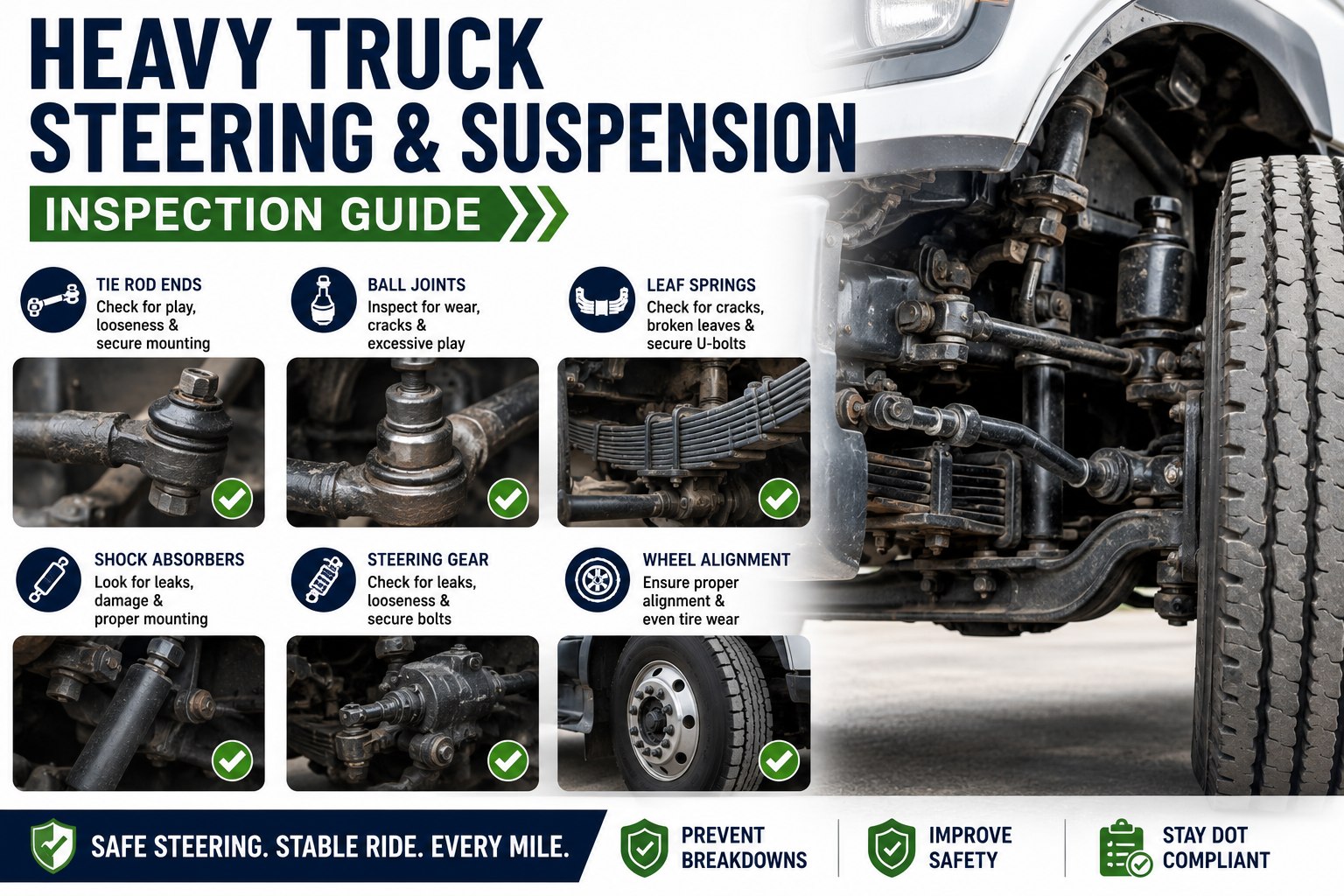
Total lash at the wheel is rarely one part failing — it's usually several joints each contributing a small amount that adds up past the limit. That's why a component-by-component check matters more than a single overall wheel-rock test: a truck can pass a quick rim check and still have one joint quietly approaching failure.
Tie Rod Ends
Check for vertical and horizontal movement at each end while a second person rocks the steering wheel.
Drag Link
Inspect both ends for looseness. Any perceptible movement here shows up directly as wheel lash.
Pitman Arm
The arm on the gear output shaft must not be loose. A loose pitman arm is a direct, citable finding on its own.
Idler Arm
Supports the linkage on the opposite side from the gear box. Wear here is easy to miss without a dedicated check.
This check needs two people: one moving the steering wheel back and forth in short strokes, one watching and feeling each joint for movement that shouldn't be there. A single inspector working alone tends to catch the obvious failures and miss the small ones that only show up while the wheel is actively being worked. See a two-person steering check captured in one digital record
Kingpin and Knuckle Play
Kingpin and steering knuckle wear behaves differently from linkage wear — it shows up as play in the vertical axis the truck steers around, not just side to side.
With the front axle raised and the wheel loaded against a dial indicator or pry bar, vertical movement beyond the manufacturer's tolerance indicates kingpin or bushing wear that linkage inspection alone won't catch. Left unaddressed, this play tends to worsen quickly under load, since the same worn surface is taking every steering input on that axle. This is separate from the coupling-side kingpin — see HVI's fifth-wheel kingpin and coupling inspection for the trailer-side wear limits.
Steering Box Condition
The gear box itself carries three separate failure points, and a quick glance at the housing exterior only catches one of them. Mounting bolts must be present and tight — a gear box shifting slightly under load is transmitting that movement straight into the wheel lash measurement.
Output shaft play at the pitman arm connection adds to total lash the same way a worn tie rod end does, just closer to the source. Leakage at the housing seals is a maintenance flag on its own, and often an early warning that internal wear is already changing how the box responds to input. See steering box findings tied to the same vehicle record
Power Steering System Checks
Power steering failures compound steering play problems instead of causing them directly, which is exactly why they get missed during a lash-focused check.
Low or contaminated fluid
Reduces assist response and can mask developing play until the system is under real load.
Pump function
A failing pump changes steering effort gradually, which drivers often describe as the truck feeling "different" rather than clearly wrong.
Hose condition and fittings
Cracking, chafing, or a loose fitting near a moving component is a defect before it's ever a visible leak.
Active fluid leaks
A leak is a steering defect and a fire risk at once when fluid contacts a hot exhaust component nearby.
That last point is worth repeating on its own: a power steering leak found during a routine check is never a "note it and move on" item. HVI's digital inspection routes a leak finding straight to a severity-flagged defect instead of a line in a paper form.
The Steering Play Inspection Checklist
Every source of play on this page comes down to a short set of measured, hands-on checks. Keep this in the bay so the inspection produces a number and a per-joint result, not just "steering felt fine."
- Wheel lash measured at the rim, under the diameter limit
- Tie rod ends and drag link checked for movement
- Pitman arm tight on the output shaft
- Idler arm and kingpin/knuckle play within tolerance
- Gear box mounting bolts present and tight, no cracks
- Power steering fluid level and condition OK
- Hoses and fittings sound; no active leak near hot parts
- Any out-of-limit finding photographed and logged
Eight checks that turn a "feels loose" complaint into a measured record. Use this steering inspection checklist online free, with the lash number and a photo on every finding.
Diagnosing a Wander Complaint
A driver complaint of "the truck wanders" rarely points to one single component. It's a symptom that several of the checks above can each explain — total wheel lash near the upper limit is the first thing to rule out, since it directly affects how much correction a driver has to make to hold a line.
Uneven tire pressure, alignment drift, and worn suspension bushings can produce a similar complaint without any steering-specific defect present at all. Working through the steering measurement first, before assuming an alignment or tire cause, keeps a real steering defect from getting diagnosed as something else and sent back out on the road.
Documenting which causes were ruled out, and in what order, also protects the shop if the same complaint comes back. A repeat complaint with no record of what was checked looks very different from one with a clear trail behind it.
Why Steering Defects Are Worth Trending Per Truck
A single steering measurement tells you today's condition. A history of measurements on the same unit tells you how fast it's getting there — a truck whose lash climbed from 1½ inches to 2¼ inches over three inspection cycles is telling a very different story than one steady at 1¾ inches for a year.
That trend line only exists if every prior measurement was captured the same way, tied to the same vehicle, and easy to pull back up months later. Photo evidence attached to each finding adds a second layer: a worn tie rod end photographed at each inspection shows an inspector, auditor, or insurer exactly what "worn" meant at that point in time.
That combination — a measured number plus a photo — holds up far better under scrutiny than a technician's memory of a truck they serviced four months ago. See photo evidence attached directly to a steering finding
From a safety manager who standardized this check fleet-wide
We used to get three different answers from three different techs about whether a truck's steering was "fine" or "getting soft." Nobody was wrong exactly, they just weren't measuring the same thing.
Once the inspection asked for an actual number against the diameter table, the disagreement mostly disappeared. Either it's under the limit or it isn't.
Steering Play Measurement Truck Checks Turn a Feeling Into a Fact
Steering defects are unusual in vehicle inspection: they're genuinely safety-critical and genuinely easy to measure, at the same time. A proper steering play measurement truck procedure replaces "feels a little loose" with a number checked against a real limit, backed by a photo and a record tied to that specific unit.
That combination is what turns steering from the inspection item people argue about into the one nobody has to. Start free and standardize the measurement across every truck in the fleet.
Frequently Asked Questions
How is steering wheel play measured on a truck?
With the engine running for power-assisted systems and the wheels straight ahead, the steering wheel is turned in one direction until a front wheel visibly begins to move. The distance the rim travels before that happens is the free play, or lash. That measurement is then compared against the allowable limit for the truck's specific steering wheel diameter under 49 CFR §393.209(b), since the limit is not the same across every wheel size.
What is the steering play limit for a truck's steering wheel?
Limits vary by wheel diameter and system type. For a 16-inch wheel the limit is 2 inches on a manual system and 4¼ inches on a power system, rising to 2¾ inches and 5¾ inches on a 22-inch wheel. For diameters not listed in the regulation's table, the limit is expressed as 14 degrees of angular rotation for manual systems and 30 degrees for power steering systems.
Which components contribute to steering play besides the steering box?
Tie rod ends, the drag link, the pitman arm, and the idler arm can each contribute a small amount of play that adds up at the steering wheel. Kingpin and steering knuckle wear can add play in a different axis entirely. A thorough check inspects each of these individually, typically with a second person moving the steering wheel while joints are observed for movement.
Is a power steering fluid leak an out-of-service condition?
A power steering leak is a defect in its own right and carries an added risk when the fluid can contact hot components such as an exhaust manifold, creating a fire hazard alongside the steering concern. Fluid level, pump function, and hose or fitting condition should all be checked together, since a developing leak often shows up as chafing or a loose fitting before fluid is visibly dripping.
Why does a truck wander even when no single steering defect is found?
A wander complaint can stem from several causes beyond steering play, including uneven tire pressure, alignment drift, or worn suspension bushings, any of which can produce a similar feel behind the wheel. Measuring steering wheel lash first rules out the most safety-critical cause before investigating tire and alignment factors, so a genuine steering defect isn't mistaken for a lower-severity issue.