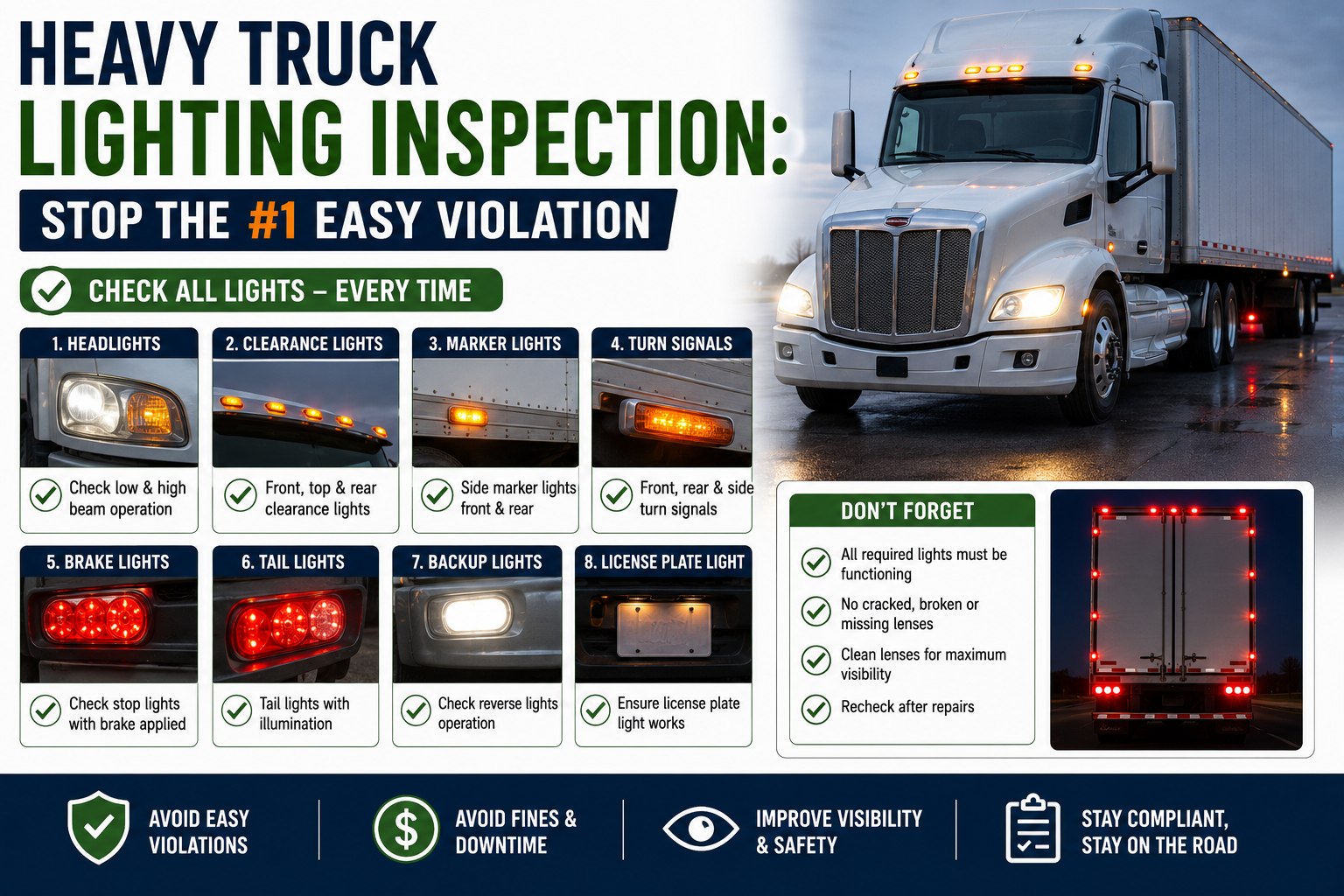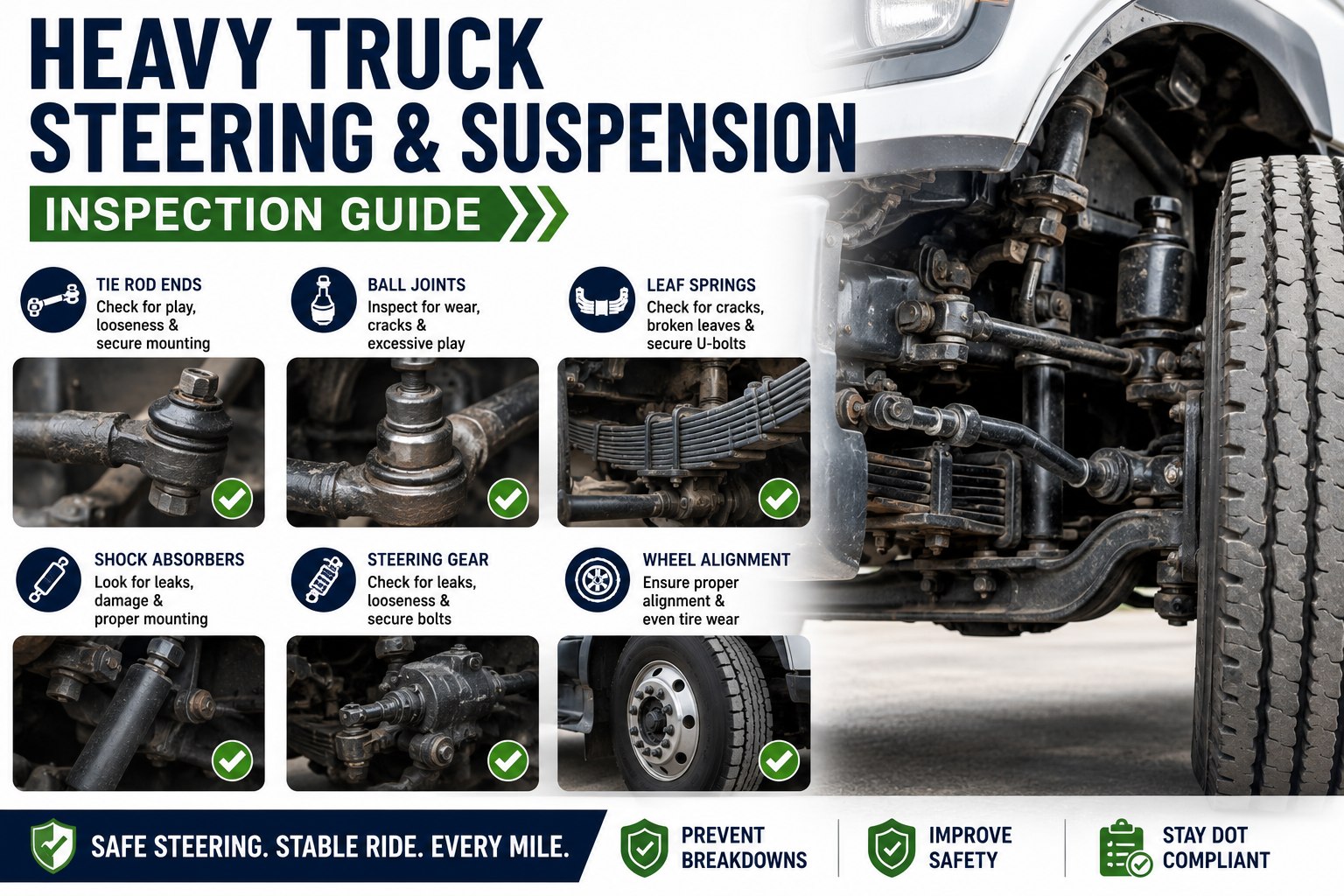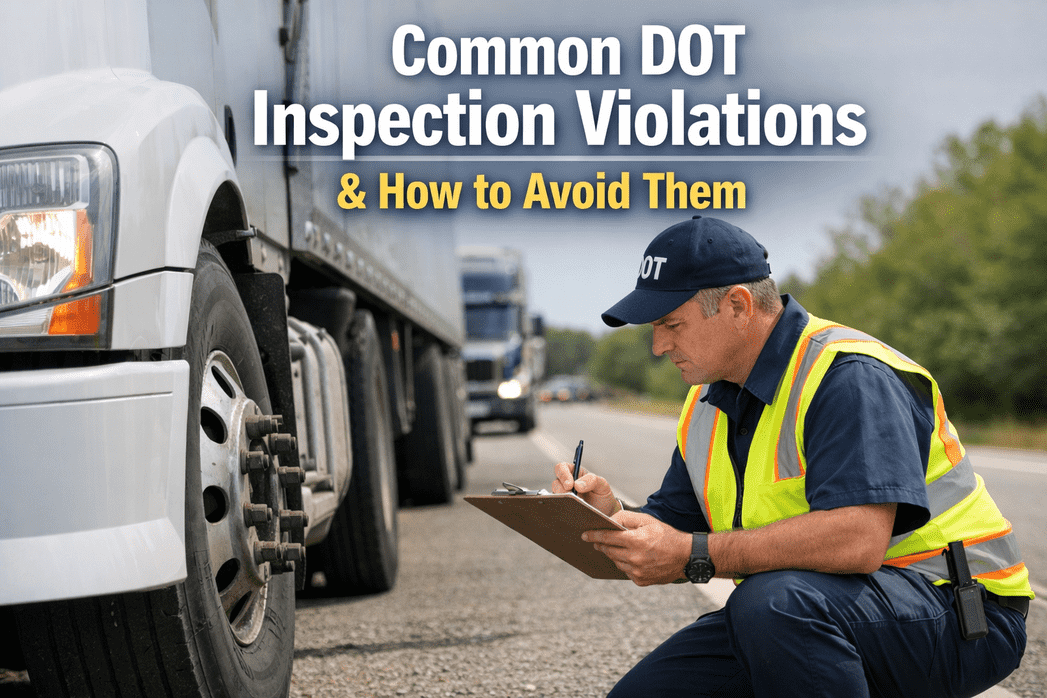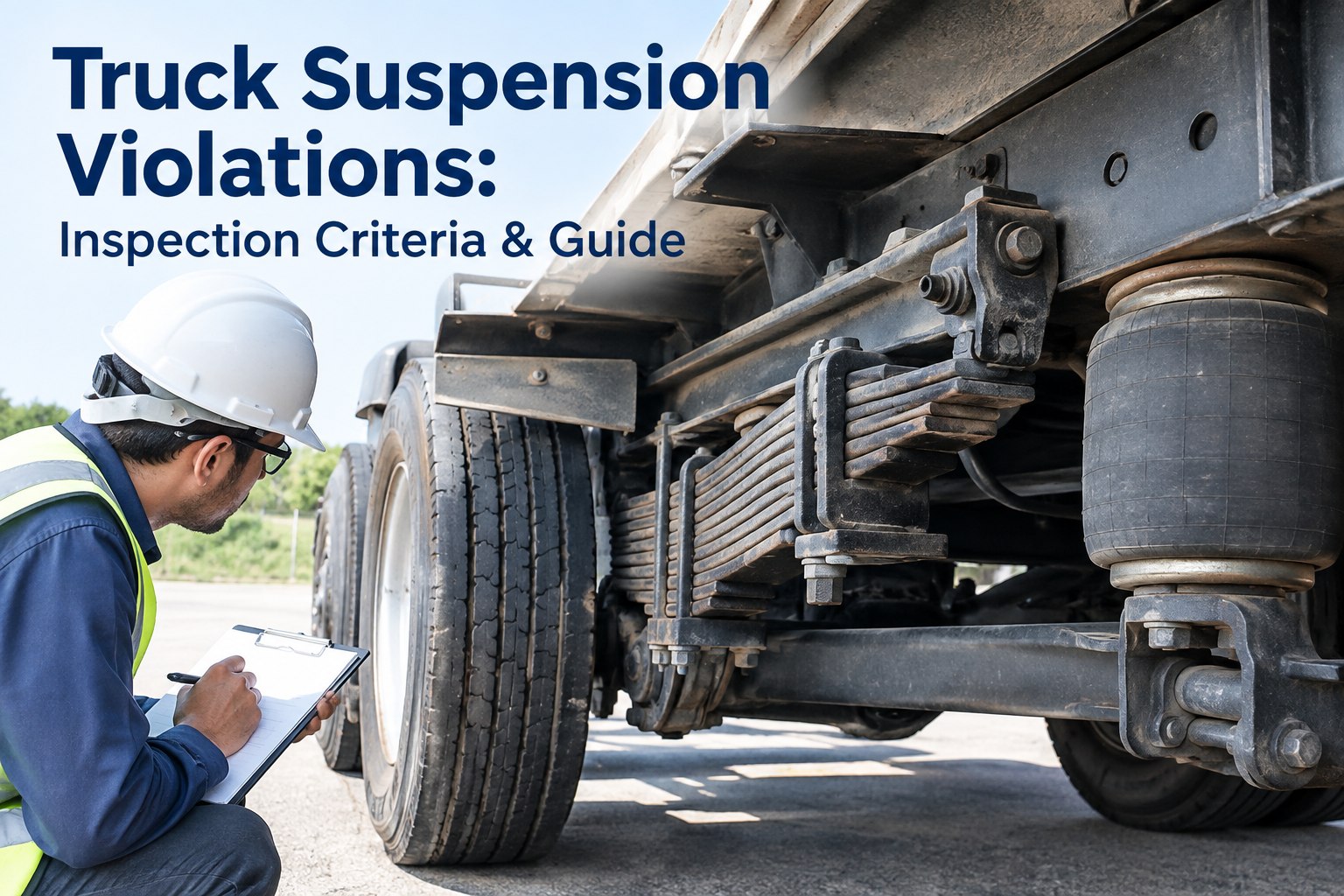
Suspension is the violation category fleets underestimate, and the reason is a trap hidden in plain sight: one broken leaf spring might be a note-it-and-keep-rolling item, while another puts the truck out of service on the spot — and the difference isn't obvious from the cab. Truck suspension inspection is really about two hard things at once: finding the defect at all, because most of it lives underneath where a walkaround glance never reachesand then knowing whether what you found crosses the out-of-service line. Suspension is only a small slice of roadside OOS orders, which lulls maintenance programs into treating it casually — right up until a component lets go, and unlike brakes, a suspension failure doesn't stop the truck slowly. This guide is the criteria, the hidden spots, and the consistency that catches both. Book a demo to see suspension defects captured with photo evidence.
When does a broken spring become out-of-service?
Add broken leaves to the stack. Watch the verdict flip from "repair it" to "out of service" — and see exactly which rule trips it.
Every leaf intact, nothing cracked, shifted, or missing. This is the baseline § 393.207 wants: no leaf spring cracked, broken, missing, or shifted out of position. Log the condition, watch for the first crack, and keep it greased and aligned.
A single broken helper leaf, on its own, may not trigger an out-of-service order — but it still violates the requirement that no leaf be broken, compromises load capacity, and must be repaired immediately. Left alone, it accelerates the failure of the leaves around it. This is a "fix before it spreads," not a "keep driving."
Any broken main leaf — the leaf that forms the spring eye at both ends and ties into the hanger — is an automatic out-of-service condition under CVSA criteria, regardless of how many other leaves are fine. The main leaf carries the assembly; break it and the whole stack's integrity is gone. One broken main leaf outranks several intact helpers.
One-fourth or more of the leaves in a spring assembly broken is an out-of-service condition, no matter which leaves they are. This is the threshold that surprises people: it's a proportion of the stack, not a raw count, so a small pack hits the line faster than a large one. Cross a quarter and the truck stops until it's repaired.
The rule isn't "a broken spring is OOS." It's a specific threshold — any main leaf, or a quarter of the stack — and knowing which side of it you're on is the whole inspection. Book a demo to see suspension findings judged against the OOS criteria
The suspension is the system that keeps the tyres on the road, the axles located, and the load stable — and it does all of that out of sight, under the truck, where a driver's pre-trip rarely reaches. That combination of high consequence and low visibility is exactly what makes it a compliance blind spot. The federal baseline is strict, the out-of-service thresholds are specific, and the components fail where you have to deliberately look. The rest of this guide walks the criteria by component, the spots most inspections miss, and how to make the call consistent across a fleet and a hundred drivers.
The criteria, component by component
Federal suspension requirements live in 49 CFR § 393.207, and the out-of-service thresholds come from the CVSA criteria on top of it. The baseline rule is simple — components must be sound, not cracked, broken, loose, missing, or shifted — but the OOS lines are component-specific and worth knowing cold, because they decide whether a finding is a work order or a roadside shutdown.
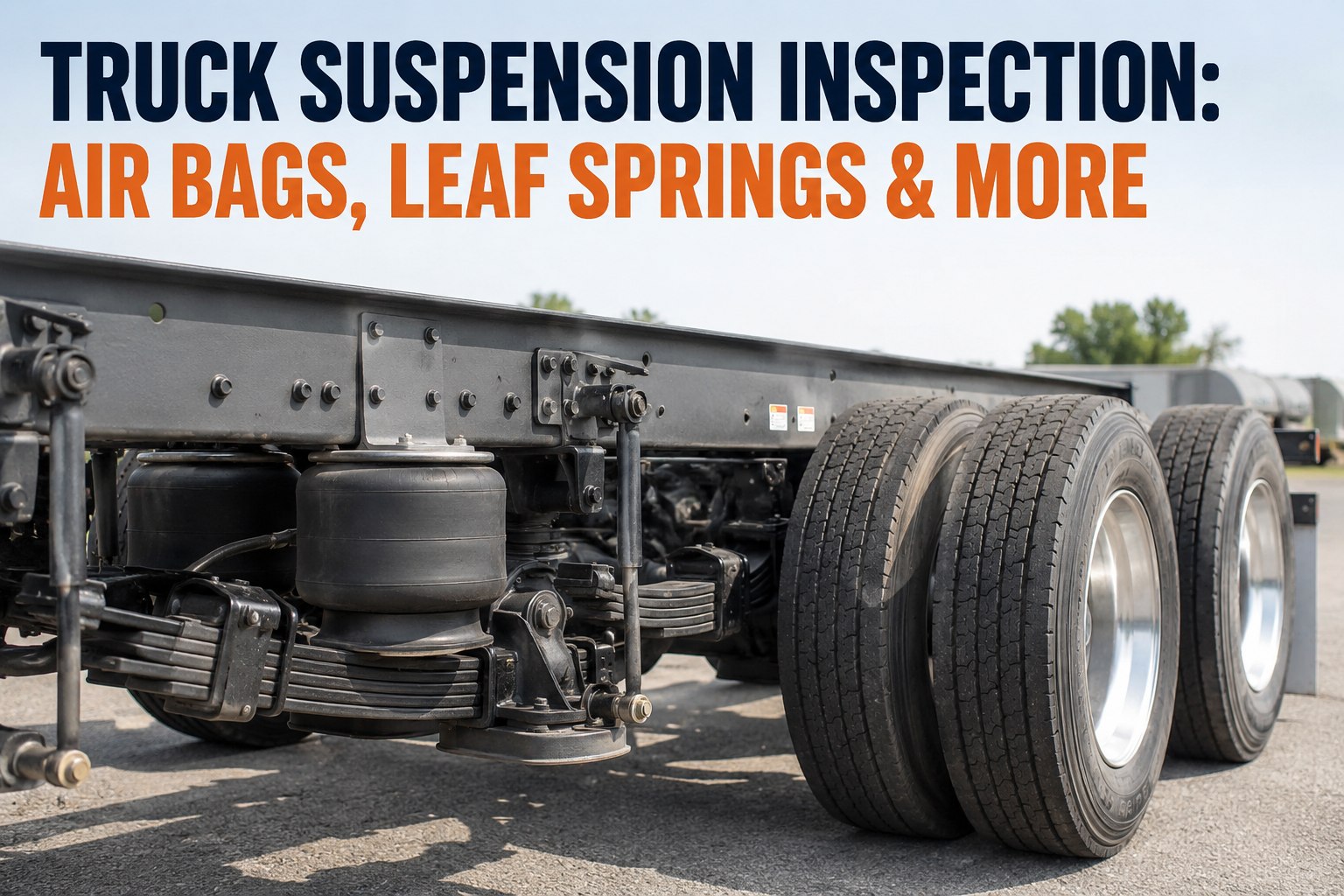
Leaf & coil springs
OOS on any broken main leaf, a quarter or more of the leaves in an assembly broken, a crack passing fully through the spring for more than three-quarters its length, intersecting cracks of any length, or a broken coil spring. A shifted or missing leaf counts too.
Air suspension
A deflated air suspension — a failed, leaking, or ruptured air spring — is an OOS condition. Check the bags for damage, chafing, and leaks, and the levelling valve and lines, since a bad valve deflates a good bag. A deflated secondary bag alongside a primary leaf/coil spring is treated differently.
U-bolts, hangers & axle location
An axle-positioning part — spring hanger, U-bolt, or connecting part — cracked, broken, loose, or missing so the axle shifts from its normal position is OOS, and these codes carry heavy severity weight. Loose U-bolts let the axle walk; a cracked hanger is a failure in progress.
Torque rods, bushings & shocks
Torque (radius) rods locate the axle fore-aft; worn bushings or a cracked rod let it move and throw alignment. Torsion bars are OOS if broken. Shocks that are blown, leaking, or detached let the suspension oscillate — check bushings, mounts, and rod condition, not just the springs.
One nuance worth internalising: FMCSA files these under separate violation codes with different severity weights — an axle-shift or U-bolt failure is weighted far more heavily than a general leaf-spring defect — so "a suspension violation" isn't one thing. The specific component and condition decide both the OOS call and the CSA impact. Reviewing the code, not just the word, is what makes a finding actionable. Start a free trial and record each suspension finding against its component and criterion.
Where the defects hide — and why walkarounds miss them
Here's the real reason suspension is hard to inspect consistently: a lot of the failure happens where you can't see it from a casual walk-around. A driver glancing along the frame at 6am isn't going to spot a hairline crack in a hanger tucked behind a spring seat, or a slow air leak at an attachment point, or a torque-rod bushing that's gone soft. These are the spots that separate a real inspection from a glance.
The through-line is that suspension rewards a deliberate, hands-on inspection and punishes a quick look. A structured checklist that names each hidden spot — and a photo requirement on the components that matter — is what turns a glance into an inspection, because it forces the inspector to actually go and look where the defect lives. Book a demo to see a suspension template that names every hidden checkpoint
Small slice of violations, catastrophic failure mode
Steering and suspension violations make up only a small share of roadside out-of-service orders — often hovering around a couple of percent during inspection blitzes. That low frequency is exactly the danger, because it lets a maintenance program quietly deprioritise the system. The number masks the severity of the failure mode.
When brakes degrade, a truck stops slowly and gives warning. When a suspension component lets go — a hanger fractures, an axle shifts under load, a U-bolt fails — the truck can lose axle location or stability without warning, at speed, and the outcome isn't a longer stopping distance, it's a loss of control. That's why the out-of-service criteria treat these conditions as an imminent hazard even though they're statistically rare. A fleet that inspects suspension casually because "we never get suspension violations" is confusing low frequency with low risk — and the two are not the same. The right posture is to maintain above the OOS minimums, not to the line, because the criteria themselves are a floor, not a target. Book a demo to see suspension caught early instead of at the failure point
Making the call consistent across the fleet
The hardest part of suspension isn't any single criterion — it's applying them the same way across dozens of drivers and inspectors, shift after shift. One tech knows a broken main leaf is an automatic OOS; another logs it as "one broken spring, monitor." That inconsistency is where trucks with disqualifying defects slip through and where good units get pulled unnecessarily. Closing it is a process, not a memo.
Each step removes a source of variation. A structured template means the inspection doesn't depend on which tech remembers to look under the spring seat. Photo evidence means the finding is judged on what's actually there, not a verbal description, and it gives you the record an inspector or insurer will ask for. Grading against the criterion by component keeps the OOS call consistent instead of subjective. And a dispatch lock on an out-of-service condition removes the human temptation to send a marginal truck out under schedule pressure. Together they turn suspension from the inconsistent, easily-missed category into one the fleet actually controls. Start a free trial and standardise the suspension call across every driver and shift.
From a maintenance director who took suspension seriously
Suspension was our blind spot precisely because we almost never got dinged for it — so it never got the attention brakes and tires did. Then an inspector pulled a trailer with a broken main leaf that two of our own pre-trips had "passed," and I realised the guys weren't lying, they just didn't know a broken main leaf was an automatic out-of-service. Different techs were calling the same defect completely differently.
We rebuilt the suspension check as a real template — look under the spring seat, rock the torque rods, photograph anything broken — and tied the OOS criteria right to the finding so there's no judgment call about whether a main leaf or a quarter of the stack is a shutdown. Photos on every broken component, and dispatch can't release a unit with an open OOS suspension defect. We haven't had a suspension OOS at the roadside since, because now we catch them at the yard, and everybody grades them the same way.
Truck suspension inspection FAQs
When does a broken leaf spring put a truck out of service?
Under the CVSA out-of-service criteria applied on top of 49 CFR § 393.207, a leaf spring puts a truck out of service in several specific situations: when one-fourth or more of the leaves in any spring assembly are broken; when any main leaf is broken (the main leaves are those that form a spring eye at both ends and tie into the spring hanger, equalizer, or end cap); when a crack passes completely through the spring and extends more than three-quarters of its length; or when there are intersecting cracks of any length passing completely through the spring. Importantly, a single broken helper leaf, on its own, may not trigger an out-of-service order, but it still violates § 393.207's requirement that no leaf spring be cracked, broken, missing, or shifted out of position, so it must be repaired immediately and it compromises the assembly's load capacity. The key point is that the out-of-service determination is a threshold, not simply the presence of any damage: it depends on which leaf is broken (any main leaf is automatic) or what proportion of the stack is affected (one-fourth or more). Because it is a proportion, a small spring pack can reach the threshold with fewer broken leaves than a large one. Always confirm the current criteria, since they are periodically updated.
What suspension defects are automatic out-of-service violations?
The CVSA out-of-service criteria identify several suspension conditions as serious enough to place a commercial vehicle out of service. For springs: any broken main leaf; one-fourth or more of the leaves in a spring assembly broken; a crack passing completely through a spring for more than three-quarters of its length; intersecting cracks of any length through the spring; a broken coil spring; and a broken torsion bar in a torsion-bar suspension. For air suspension: a deflated air suspension resulting from a system failure, leak, or ruptured air spring (with a specific exception where a deflated secondary or aftermarket air bag exists alongside a functioning primary leaf or coil spring). For axle location: an axle, axle housing, spring hanger, U-bolt, or other axle-positioning part that is cracked, broken, loose, or missing in a way that lets the axle shift from its normal position. These are the conditions inspectors treat as an imminent hazard. Beyond the out-of-service list, § 393.207 also requires more broadly that no suspension component be cracked, broken, loose, missing, or shifted, so a defect can be a citable violation even when it does not rise to an out-of-service order. The specific federal violation codes carry different CSA severity weights, so the exact condition and code matter for both the roadside outcome and the Vehicle Maintenance BASIC impact.
How do you inspect an air suspension for defects?
Air suspension inspection focuses on the air springs (bags), the levelling valve and linkage, the lines and fittings, and the ride height the system is supposed to hold. Start with the air springs themselves, checking each for damage, chafing, cracking, and signs of a leak — but do not stop at the visible face of the bag, because many air-ride failures develop at the mounting plates and attachment points where a slow leak or chafe is easy to miss on a casual look. Inspect the levelling (height control) valve and its linkage, since a faulty valve can deflate or over-inflate a perfectly good bag, and check the air lines for chafing, kinks, and leaks. Verify ride height against the manufacturer's specification rather than eyeballing it, because a sagging corner points to a deflating bag, a bad valve, or a deeper problem. A deflated air suspension — from a system failure, leak, or ruptured bag — is an out-of-service condition, with a specific exception for a deflated secondary bag that exists in addition to a primary leaf or coil spring. Because these defects hide at fittings and valves, a structured check that names each of these points, backed by photos, is far more reliable than a quick visual pass.
Why are suspension defects so hard to catch in inspections?
Suspension defects are hard to catch consistently for two connected reasons: they develop where they cannot easily be seen, and the criteria for whether a defect is disqualifying are specific enough that inspectors apply them inconsistently. On visibility, much of the suspension fails out of sight of a standard walk-around: cracks in spring hangers and seats hide behind and beneath the spring pack, air-ride leaks and chafing develop at mounting plates and fittings rather than on the visible bag face, and worn torque-rod and tracking bushings show play only when the component is physically pried or rocked, not when it is simply looked at. A driver glancing along the frame will miss all of these. On consistency, the out-of-service thresholds — a broken main leaf, a quarter of the stack, an axle shifted from position — are precise, and different inspectors who have not been trained to those exact lines will grade the same defect differently, so a genuinely disqualifying condition can be logged as a minor note while a benign one gets flagged. The combination means suspension rewards a deliberate, hands-on, structured inspection and punishes a quick visual one. Using a checklist that names each hidden checkpoint, requiring photo evidence on the components that decide an out-of-service call, and grading findings against the specific criteria by component are what make the inspection both thorough and consistent across a fleet.
How often should truck suspension be inspected?
Truck suspension should be inspected on two layers. First, a visual check of suspension components should be part of the driver's daily pre-trip inspection, with any defect found requiring repair before the vehicle operates — this catches acute failures like a newly broken spring, a deflated air bag, or a visibly shifted axle before the truck goes out. Second, commercial vehicles are subject to a comprehensive periodic inspection at least once every 12 months by a qualified inspector under the federal periodic inspection requirements, which includes a thorough suspension examination against the § 393.207 standards. In practice, fleets that manage suspension well go beyond these minimums, because the daily pre-trip is a visual pass that misses the hidden and hands-on defects, and twelve months is a long interval for a safety-critical wear system on a hard-working truck. Building suspension checkpoints into scheduled preventive-maintenance services — where components can be pried, rocked, and measured rather than just glanced at — catches the developing defects between the annual inspections. High-vibration, heavy-haul, and rough-road operations warrant tighter intervals. As always, confirm the specific inspection requirements and frequencies that apply to your operation and jurisdiction, and treat the regulatory minimums as a floor rather than a target given the severity of a suspension failure.
Turn suspension from a blind spot into a controlled inspection
HVI drives a structured suspension check that names every hidden checkpoint, requires photo evidence on the components that decide an out-of-service call, grades each finding against the CVSA criteria by component, and locks dispatch on a documented out-of-service condition so a broken main leaf or shifted axle never reaches the road. Consistent across every driver and shift, defensible on the record, and caught in the yard instead of the roadside. See it on your own fleet.
No credit card · Photo-documented suspension defects from day one · OOS criteria built into the call