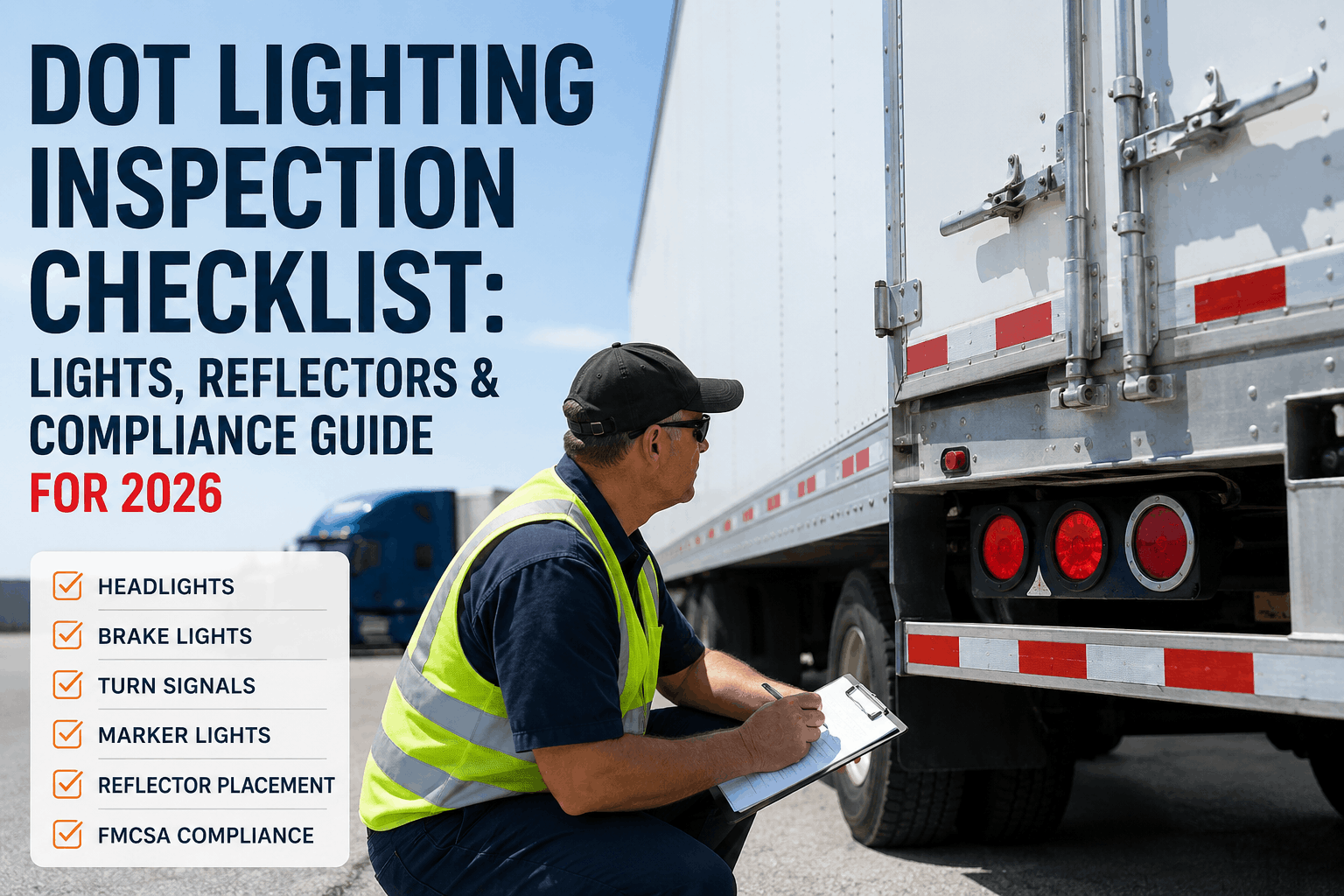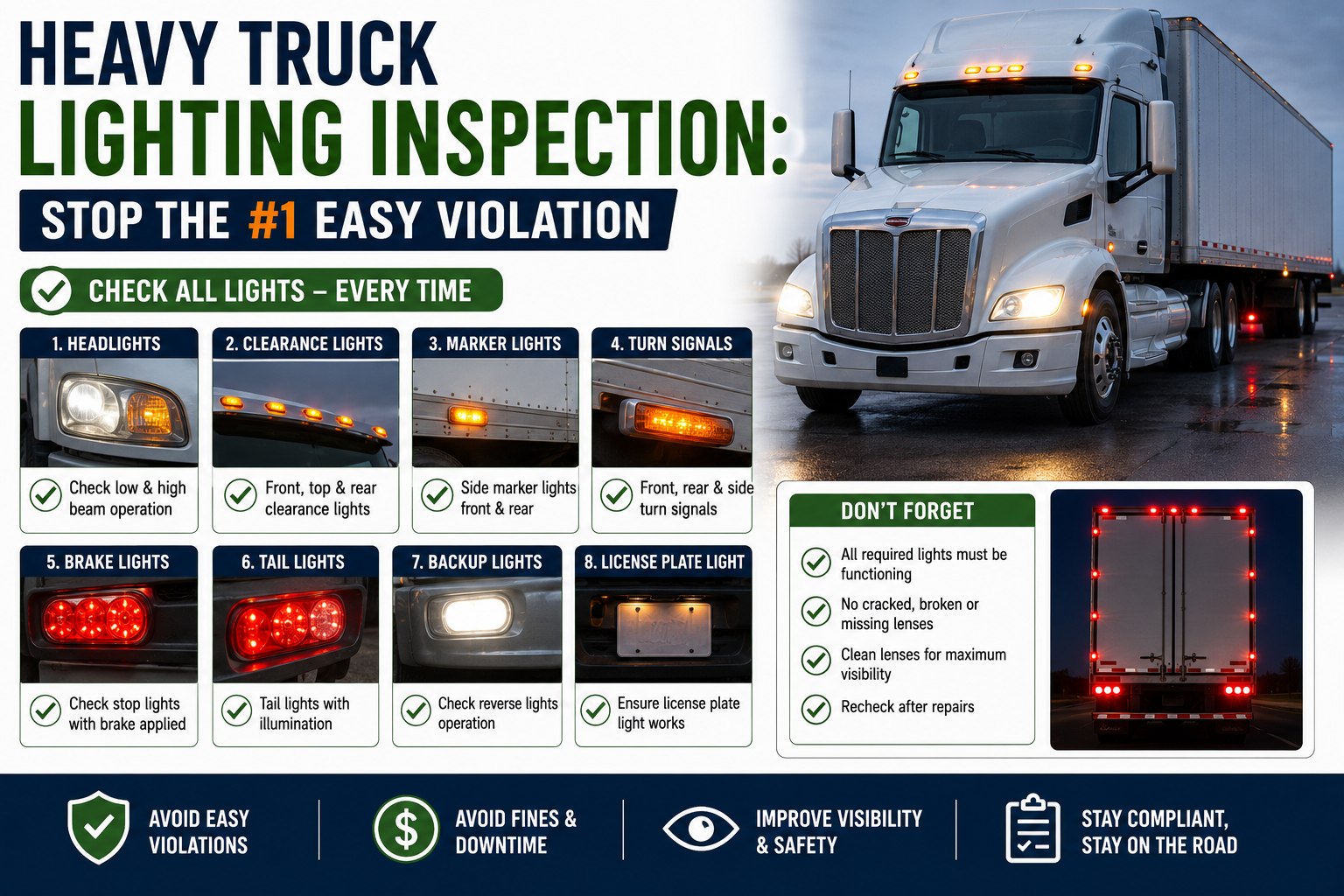
A driver clears the yard at dusk with every lamp burning bright, rolls two hundred miles down the interstate, and gets flagged at a weigh station for an inoperative tail lamp. There was no warning light on the dash, no gradual fade — just a failed diode somewhere between the pre-trip and the scale. Inoperative required lamps, cited under FMCSA 393.9, have been the single most-recorded roadside violation in the agency's inspection data for years running, showing up more than twice as often as the next most frequent defect. This guide breaks down the heavy truck lighting inspection process so you can catch these easy-fix defects in the yard before they become a gateway violation on the road. Start free with HVI to digitize your light checks.
Heavy Truck Lighting Inspection: Stop the #1 Easy Violation
A lamp-by-lamp breakdown of the pre-trip light check, the difference between a warning defect and an out-of-service violation, and why LED conversion pays for itself the first time a driver misses a checkpoint.
- Defect TypeOOS Condition
- Common CauseFailed LED Diode
- Repair Time~12 minutes
- Risk LevelGateway
Why a failed light is a gateway violation
Lights do not wear out gradually the way brake linings do. They do not give you a soft pedal or a vibration warning. An LED cluster can be fully functional when a driver pulls out of the yard and entirely dead by the time they hit the next scale. The failure is instantaneous, and because most modern trucks lack a bulb-out dashboard indicator for the trailer's clearance and marker lights, the driver often has no idea until a trooper steps up to the window.
That single burned-out lamp is a problem because it functions as a gateway violation. An inoperative required lamp is highly visible from a distance, giving an officer probable cause to pull the truck in. Once you are on the ramp, the inspector is not just looking at the light anymore — they are checking brakes, tires, suspension, and load securement. The easiest way to avoid a full Level I inspection is to make sure the officer has no reason to wave you over in the first place. You can see how HVI flags these gateway risks by booking a quick walkthrough of the platform.
- #1
most recorded roadside violation in FMCSA data (393.9 Inoperative Lamp)
FMCSA Motor Carrier Management Information System (MCMIS) - ~13-15%
of vehicle out-of-service violations during CVSA Roadcheck are lighting-related
CVSA Roadcheck data - 2x+
more frequent than the next most common roadside defect
FMCSA inspection violation trends - 25x
longer service life for LED lamps compared to traditional incandescent bulbs
General industry engineering estimates
The daylight trap: why marker and clearance lights get missed
The most common reason a truck fails a lighting inspection is not a smashed headlight. It is a failed clearance or marker light that looked fine during a daylight pre-trip. The physics of LED failure make this a persistent trap for drivers. When an incandescent bulb burns out, the filament breaks and the whole lamp goes dark. When an LED cluster fails, individual diodes stop working. In bright sunlight, the remaining diodes still produce enough light that the driver walking around the truck perceives the lamp as "on."
It is only when the sun goes down, or when the truck backs into a dark inspection bay, that the dim or partially lit lamp becomes obvious. By then, the truck is already on the road. To catch this, drivers need to physically shield marker lights with their hand during the pre-trip to block ambient light, or fleets need to move to a system that requires photo verification of lit lamps in low-light conditions. Relying on a quick glance in broad daylight is exactly how the #1 violation slips through the cracks.
Warning defect vs. out-of-service: know the difference
Not every lighting issue puts a truck out of service. Inspectors categorize lighting defects into two buckets, and understanding the line between them dictates whether your driver can roll or needs to call for a repair truck. The distinction is outlined in the North American Standard Out-of-Service Criteria.
Expert view from the maintenance bay
"The worst ones are the top clearance lights on the trailer. A driver walks the truck at noon, the sun is blasting, and three of those LEDs are half-dead. The driver sees a glow and checks the box. Twelve hours later, a trooper sees a dark spot on the top rail and pulls them in. We switched to requiring a shaded photo of the top rail during the DVIR, and our 393.9 citations dropped by eighty percent in a quarter.
-- Marcus S., Fleet Maintenance Manager, refrigerated regional carrier
The lamp-by-lamp pre-trip light check sequence
A proper truck lighting inspection is not a quick glance; it is a systematic sequence. Drivers should run through this workflow in the exact same order every time so nothing is missed. Having this sequence built into your digital DVIR workflow ensures every driver follows the same standard, every time.
-
1Front End Illumination
Turn the headlights to low beam, then high beam. Verify both high and low beam indicator lights on the dash function. Check that the lenses are clean, securely mounted, and not heavily pitted or crazed from road sand. A heavily oxidized headlamp that fails to project usable light can be cited just like a burned-out bulb.
-
2Front Corner Signals & Markers
Activate the left turn signal, then the right. Walk to the front and confirm both front turn signals and the corner clearance lights are flashing brightly. Check the reflectors on the front bumper — they must be intact and properly colored (amber for the front).
-
3Side Marker & Clearance Lights
This is the most-missed step. Walk the full length of the tractor and trailer. Physically shield each amber and red side marker light with your hand to verify the diode is actually firing. Look for moisture inside the lens housing, which indicates a failed seal and an impending failure.
-
4Rear Illumination & Identification
Have a helper apply the brakes, or chock the wheels and check from the cab mirror. All tail lamps must glow red, and stop lamps must be noticeably brighter than the tail lamps. Activate both turn signals, the hazard flashers, and finally the reverse lights. Ensure the rear license plate is illuminated and the DOT registration number is legible and properly lit.
-
5Reflective Tape & Conspicuity
Lighting compliance isn't just about bulbs. Run your hand over the red and white conspicuity tape along the sides and rear of the trailer. If the tape is peeling, heavily faded, or missing chunks, it fails to reflect headlights and is a common citation during nighttime inspections.
Incandescent vs. LED: The maintenance math
If you are still running incandescent bulbs on your trailers, you are fighting a losing battle against the #1 violation. The shift to LED lighting is not just about aesthetics; it is a direct line to reducing your CSA scores and maintenance labor costs. LEDs do not have a filament to break from road vibration, and their service life is magnitudes longer. While an incandescent bulb might give you a year of service before the vibration and thermal cycling snaps the filament, an LED cluster will often run for the entire life of the trailer.
The caveat with LED maintenance is that when they do fail, they rarely fail completely. They fail by the diode. A cluster of twelve diodes might lose three, leaving the lamp visibly lit but dimmer than legal spec. This is why photo-documented light checks are even more critical for LED-equipped fleets than they were for incandescent fleets. You cannot just look at the lamp; you have to verify its intensity against the surrounding lamps.
Frequently asked questions
What is the most common truck lighting violation?
The most common violation is an inoperative required lamp, cited under FMCSA regulation 393.9. This covers any mandatory light that is not functioning, including headlamps, tail lamps, turn signals, and stop lamps. It has been the most frequently recorded roadside violation in FMCSA data for several consecutive years, appearing more than twice as often as the next most common defect.
Is a cracked lens an out-of-service violation?
Not necessarily. A cracked or chipped lens that still allows the lamp to project the required color and intensity of light is typically a warning-level defect, meaning the truck can proceed. However, if the lens is missing entirely, or if the crack obscures the color (such as a red tail light showing white), it becomes an out-of-service condition that must be repaired immediately.
Why do LED marker lights fail in daylight?
LEDs do not burn out all at once like incandescent bulbs. Individual diodes within the cluster fail over time. In bright daylight, the remaining functional diodes still produce enough light to make the lamp appear "on" to a driver doing a quick walk-around. The failure only becomes obvious in low light or when an inspector physically shades the lamp to test its true brightness.
How often should fleet lighting be inspected?
Lighting must be checked during every pre-trip and post-trip Driver Vehicle Inspection Report (DVIR). Additionally, maintenance shops should perform a thorough lighting inspection during scheduled preventive maintenance intervals, looking for early signs of moisture intrusion, lens crazing, or partial diode failure that a driver might miss on the road.
Does a failed clearance light put a truck out of service?
It depends on the location and severity. A single failed side marker light might result in a warning citation depending on the inspector's discretion. However, multiple failed clearance lights, or failures of lamps that define the extreme dimensions of the vehicle, will put the truck out of service. Because a failed light acts as a gateway violation, it often triggers a full Level I inspection where other defects are found.
Conclusion: Fixing the easiest defect in your CSA score
Lighting violations are the most common roadside citation, but they are also the most preventable. A burned-out headlamp or a dead cluster of clearance lights requires almost no mechanical skill to fix — it just requires the discipline to catch it before the truck leaves the yard. By running a strict lamp-by-lamp pre-trip sequence, understanding the daylight trap of partially failed LEDs, and standardizing your checks through a digital workflow, you can eliminate the #1 easy violation from your fleet's record. Book a demo with HVI today to see how a guided lighting inspection can protect your CSA scores and keep your trucks rolling past the scale.
Put a photo-gated lighting inspection on every driver's phone
HVI enforces a complete, lamp-by-lamp light check on every pre-trip, catches the daylight LED failures, and routes defect photos straight to the maintenance shop for instant work order generation.
No credit card · No hardware · Live on your fleet in under two weeks