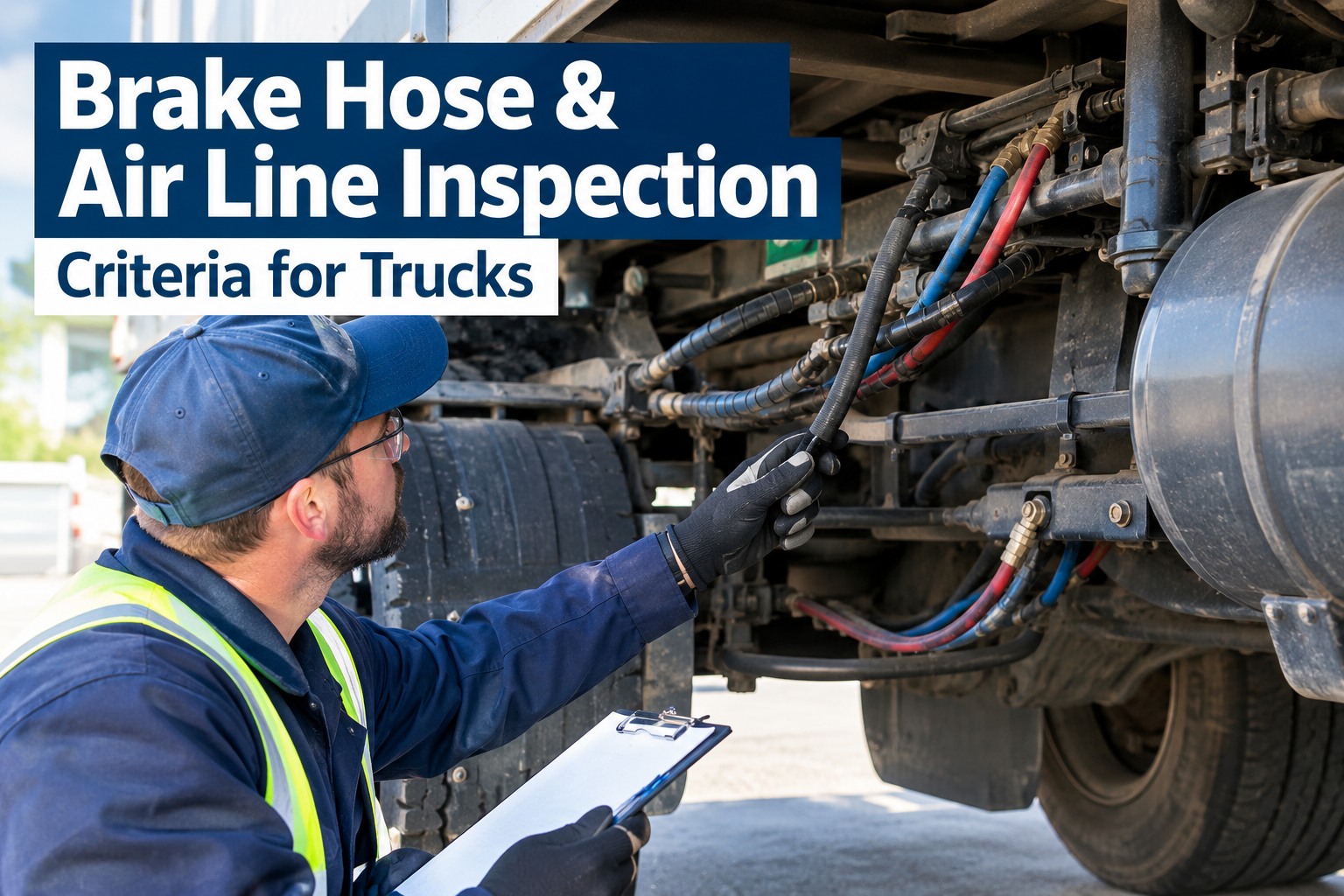
Most air brake failures don't announce themselves. A hose that's been rubbing the frame for six months looks fine until the day the reinforcement ply wears through and you lose air on a grade. That's what makes brake hose inspection deceptively easy to skip and expensive to get wrong — the damage is slow, visible, and almost always preventable if someone actually looks at the routing. The fix is a photo and a location, not a checkmark. See a chafe caught with a photo and a location
Brake defects lead every roadside blitz — hoses are a big part of why
A chafed line and a kinked line fail for different reasons and get caught different ways. Below is how to read each defect type, the exact conditions that ground a truck, why you can't patch your way out of a bad hose, and how fleets turn a rushed under-truck glance into a record that actually holds up.
The brake hose defects worth knowing on sight
Air lines don't fail one way. They chafe, bulge, kink, corrode at the fitting, and get "fixed" with the wrong part. Each has its own tell and its own consequence — and each one an inspector is trained to find in seconds. Learn to see them the same way.
Chafing & abrasion
The most common finding by far. Where a line rubs a frame member, crossmember, or moving component, it wears through in layers. Once abrasion reaches the outer reinforcement ply — or exposes the second colour on a thermoplastic nylon tube — it's an out-of-service defect, not a watch item.
Bulging & swelling
A hose that balloons or swells when air pressure is applied has failing internal structure — the reinforcement is no longer containing the pressure. Under the periodic inspection standard, bulge or swelling under pressure is a rejection condition. It's the hose telling you it's about to let go.
Kinks, crushing & restriction
A line that's kinked, crushed, or crimped restricts airflow and slows brake response — and slow air is unsafe air. Damage by heat, breakage, or a crimp that restricts flow is a defect. Kinking is usually a routing problem: a line too short or badly clipped, forced to bend where it shouldn't.
Fittings & end conditions
Follow every line to its fitting. Corrosion, cracks, damage, and audible leaks at anything other than a proper connection all count. A leak at the fitting means air is escaping where it shouldn't — soapy water, never oil, finds the slow ones a listen misses.
Routing & support
Missing, broken, or wrongly positioned clips are the root cause behind most chafing. A line without proper support swings, sags, and finds something to rub. Routing isn't cosmetic — regulation requires lines secured against chafing and kept away from exhaust and other heat sources.
Trailer connection & harness area
Where gladhand lines and the electrical harness meet the trailer, air lines and wiring rub each other and the catwalk. This high-motion zone is a chafing hotspot the walkaround often rushes past. Check the coiled lines, the retention springs, and every point they can contact.
None of these are hard to see once you know the pattern — which is exactly why the preventable ones keep showing up on CSA records. Book a demo to see each defect type built into a guided template
Brake hose out-of-service criteria at a glance
Here's the line between "note it and monitor" and "this truck doesn't leave the yard." These conditions come straight from the federal periodic inspection standard and the roadside out-of-service criteria — the same list an inspector works from. Swipe to see every column on mobile.
| Defect | Out-of-service condition | Reg reference | Why it matters |
|---|---|---|---|
| Chafing / abrasion | Damage through the outer reinforcement ply | 393.45(a) | Structural layer breached; hose can rupture under pressure |
| Nylon tube wear | Second colour exposed on thermoplastic tube | 393.45(a) | Wall worn past the safe layer; equivalent to ply damage |
| Bulge / swelling | Bulge or swelling when air pressure is applied | 393.45(a) | Reinforcement failing; imminent burst risk |
| Leak | Audible leak at other than a proper connection | 393.45(a) | System can't hold air while the truck works |
| Improper joint | Two hoses spliced over tubing and clamped | 393.45(a) | Unauthorised repair; not a rated connection |
| Heat / crimp | Damaged by heat, broken, or crimped to restrict flow | 393.45(a) | Restricted air slows or blocks brake response |
Note the pattern: a defect doesn't have to be leaking today to ground the truck. Damage that will fail is treated as failure. That's why catching it at the ply, not at the burst, is the whole game. Book a demo to put this criteria in every technician's pocket
Why a damaged brake hose can't be repaired
This is where good intentions cause violations. A technician sees a chafed line, wraps it in tape or slides a splice over it to hold until the next service, and thinks they've bought time. They've actually created a more serious defect. Under federal rules, a brake hose damaged through its reinforcement isn't repairable — it's replaceable, full stop.
- Tape, sealant, or wrap over a chafed or cut hose
- Splicing two hoses over a piece of tubing and clamping
- Grabbing a hydraulic line or the wrong hose type in a pinch
- Using an unrated fitting to "make it work"
- Replace the hose assembly with the correct rated type
- Match the hose type to the job — flexible connections need the reinforced type
- Fix the routing or support that caused the chafe in the first place
- Follow manufacturer service info and applicable regulations, not the workaround
The wrong hose in the right place is still a violation. Using a standard rubber line where a flexible reinforced connection is required — or a hydraulic line anywhere in an air system — is a common and completely avoidable citation. Replacement based on condition, done right the first time, is cheaper than a roadside out-of-service order every time. Book a demo to link every defect to its corrective action
The brake hose & air line inspection checklist
This is the pass that catches a chafe before it reaches the ply — the defects that put a truck out of service, and the routing problems that cause them. Use this hose inspection checklist online free, so every find gets a photo and a location, not just a checkmark.
Turning a hose inspection into a defensible record
A chafing defect found today is only half the job. The other half is proving it was found, showing where, and confirming it was fixed — because the frame rail that chafed a line last quarter will chafe the replacement too if nobody connects the two events. That connection is what a photo-backed digital record makes possible and a paper tick-box makes impossible. Book a demo to see the full inspection-to-repair trail
Capture the evidence
A photo of the actual chafe point, tagged to the vehicle and the spot on it, turns a vague "hose worn" note into proof of condition anyone can verify later.
Pin the defect location
Recording where on the truck the defect sits — drive axle frame rail, trailer harness area — is what lets you spot the same location failing again across different units.
Assign a corrective action
A flagged line generates a work order that stays open until the repair is signed off, so a found defect can't quietly disappear between the yard and the office.
Analyse repeat offenders
When the same chafe location keeps appearing, the record shows it. That's the difference between replacing hoses forever and fixing the routing that eats them.
That's the real payoff: not just passing the next inspection, but ending the cycle that creates the defects. A fleet that can point to a photo, a date, a technician, and a closed work order has proof — the kind that protects the carrier when a defect is questioned after the fact. Start free and keep a full defect history per line and location
From a lead technician who chased the same chafe twice
We replaced an air line on a drive axle, and eight weeks later the same truck came in with the same line chafed in the same spot. Nobody had written down where it was rubbing the first time — so we fixed the symptom twice and never touched the bracket that was actually the problem.
Once we started photographing defects and tagging the location, that stopped. Now when a line chafes, I can pull up the last three inspections on that unit and see if it's a pattern or a one-off. Half the time it's a routing fix, not a hose. We were buying hoses to cover for a missing clip.
Frequently asked questions
What makes a brake hose out of service during an inspection?
A brake hose is out of service when the damage reaches the part that contains air pressure — not just the outer cover. Chafing, cutting, or cracking through to the reinforcement ply is an automatic OOS, because that ply is what holds the pressure. Also out of service: a bulge under pressure, a leak, or damage exposing the reinforcement. Surface scuffing that hasn't reached the ply may be a monitor, but once the ply shows, the hose is done.
Can you repair a chafed or damaged brake hose?
No. Under federal rules, a brake hose cut, cracked, or chafed through to its reinforcement layer must be replaced, not patched, taped, or spliced. The reinforcement ply is a structural pressure boundary — once it's compromised, there's no safe way to restore it. Any 'repair' just hides a hose that can rupture under braking pressure. The correct action is replacement, plus fixing the routing or support that caused the damage.
What causes air lines to chafe on a truck?
Almost always a support and routing problem, not a bad hose. When a line lacks a clamp or grommet, is routed against a sharp frame edge, or runs too close to a moving part, vibration rubs it against that surface every mile until it wears through. That's why fixing a chafe means re-securing and re-routing the line, not just replacing it — swap the hose without fixing the cause and it chafes through in the same spot again.
How often should brake hoses and air lines be inspected?
They belong in every driver walkaround and pre-trip, and in every scheduled PM and the annual DOT inspection. The daily check catches the acute damage — a fresh chafe, a leak, a hanging line; the periodic inspection is the deeper look at routing, supports, and fittings. Because chafe damage develops over months of rubbing, recording where a line looked worn lets you catch it before it reaches the ply.
Why do brake hose defects hurt a fleet's CSA score?
Because roadside violations feed the Vehicle Maintenance category of the CSA Safety Measurement System, and brake-related findings carry significant severity weight. A single out-of-service hose is both a violation and an immediate OOS, and repeated hose or air-line findings signal a systemic maintenance gap — exactly what raises a carrier's percentile and audit exposure. Catching and documenting them before roadside is how a fleet keeps the score down.
Give every brake hose inspection a photo, a location, and a paper trail
HVI standardises your brake hose and air line templates, captures defect photos pinned to the exact spot on the vehicle, opens corrective work orders that stay open until they're closed, and surfaces the recurring chafe locations eating your lines — so a tick-box becomes evidence, repeat defects become fixable, and roadside inspections stop being a gamble. Live for your team in days.
No credit card · Mobile-first for the shop floor · Templates ready on day one