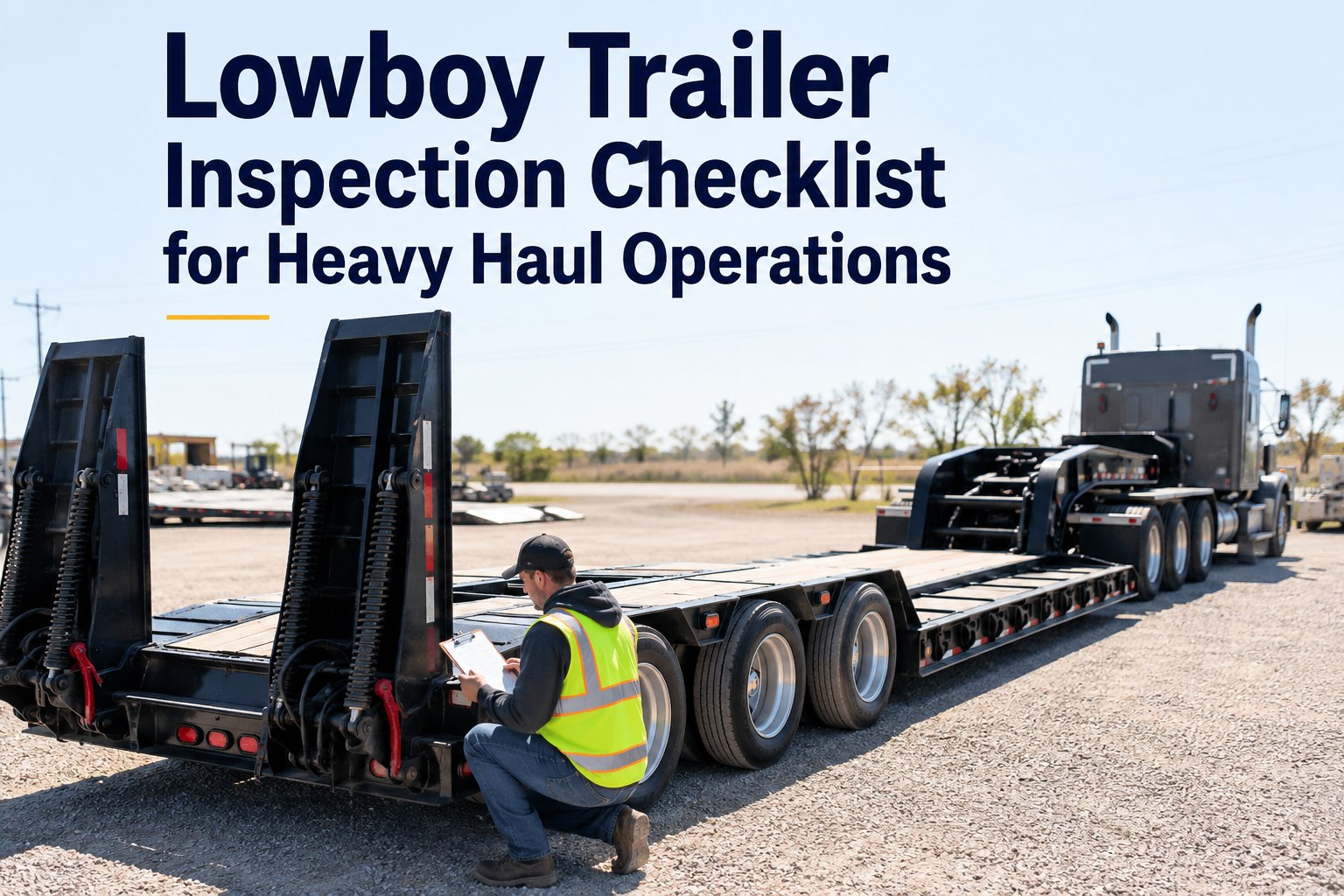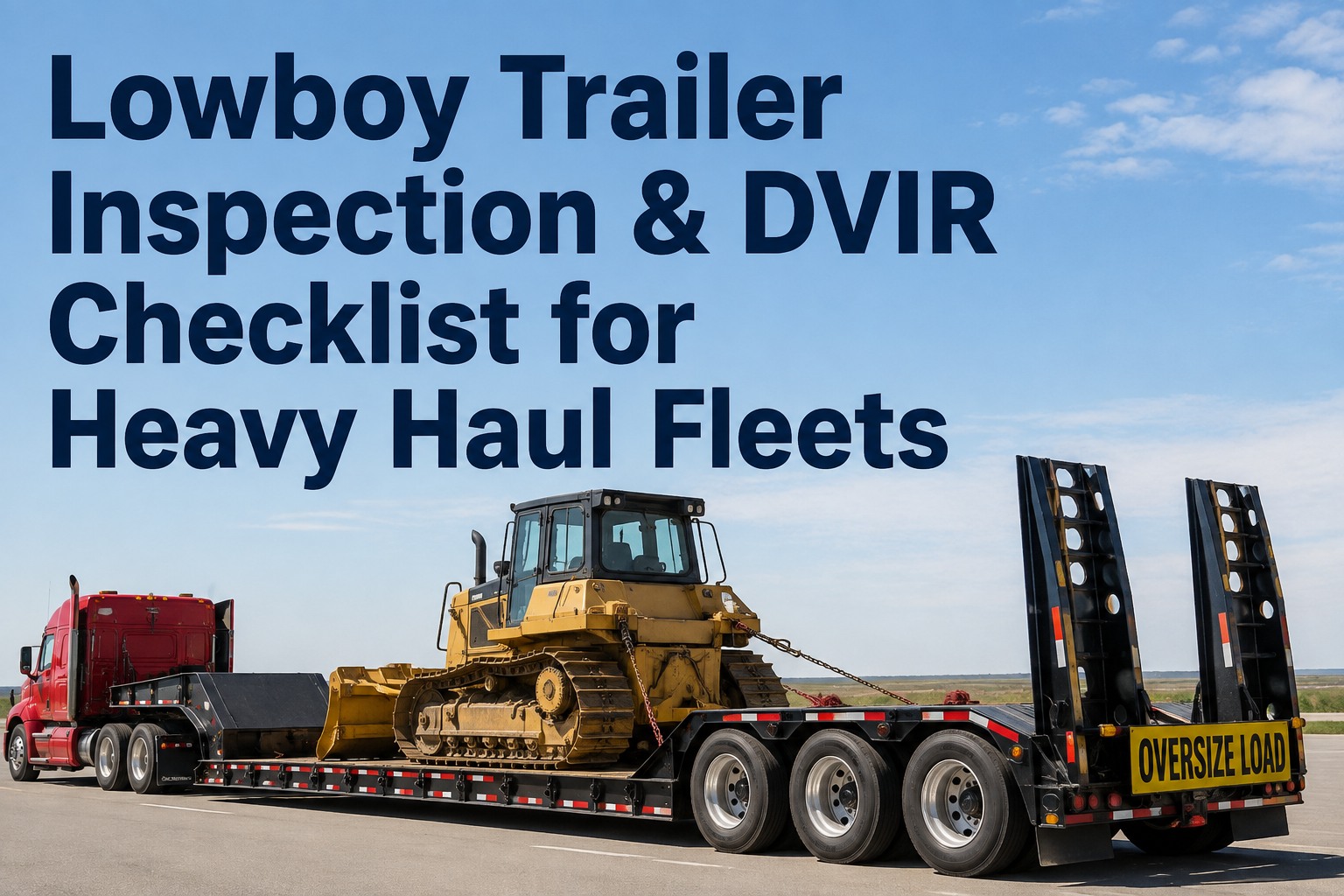
A lowboy trailer inspection is not a standard trailer walk-around. Heavy equipment loads riding 18–24 inches off the deck, hydraulic ramps that must hold under load, suspension carrying 55–75+ tons, brakes, tires and cargo securement all need eyes on before the haul begins — and 49 CFR 396.11 requires the DVIR to prove it. This lowboy trailer inspection guide walks the 8 critical inspection zones, the defect thresholds that trigger out-of-service and how digital DVIR with photo evidence replaces paper checklists. Book a demo .
The 8-Zone Lowboy Trailer Inspection Map
Top-down view of a standard lowboy. Every numbered zone triggers a specific inspection routine and photo requirement. Miss any zone and the DVIR is incomplete.
Every lowboy hauling a 40–100k lb excavator, dozer, or crane is one inspection failure away from a rollover, a crushed vehicle, or a bridge strike. Federal rules under 49 CFR 396.11 require a driver vehicle inspection report at the end of each driving day; 49 CFR 393 sets the standards for parts and accessories; 49 CFR 392.9 governs cargo securement. But federal rules define the floor. A working heavy haul fleet needs a lowboy-specific inspection routine that covers the components a generic trailer checklist misses — hydraulic ramps, well-deck integrity, axle-group alignment on 3-to-8 axle configurations, and equipment-load securement points.
Defect thresholds that put a lowboy out of serviceThe measurable checks that separate "note it" from "don't move it"
A defect log entry is not the same thing as an out-of-service condition. Below are the specific measurable thresholds where a lowboy trailer stops moving until repair is complete — the difference between a defect that goes on the shop schedule and one that grounds the load. Book a demo to see how HVI captures each defect with severity flag + photo evidence
Ramp hydraulic drift under 5-minute hold
Deploy ramps, raise fully, hold 5 minutes. Any downward drift indicates hydraulic seal failure. Ramp that drops during loading can cause equipment rollover — a $500K excavator crushed and a driver injured. Do not load until seals are replaced.
Axle-to-axle variance greater than ½ inch
Measure axle spacing across the rear group. Variance over ½ inch between any two axles indicates suspension damage, broken spring, or frame issue. Load imbalance under 55–75 tons compounds fast — do not move until corrected.
Tire tread depth below 2/32" (any tire)
Per 49 CFR 393.75, any tire on a commercial trailer with tread depth below 2/32" is an OOS condition. On lowboys the tire count is high (8–12 tires typical); one bad tire = trailer down. Measure at multiple points, not just center.
Air leak audible at any brake chamber
Charge the system, listen at each brake chamber and air line. Any audible leak is an OOS condition — brake performance under load is not something to chance. Fix at shop before dispatch.
Deck board damage — localized cracks or rot
Localized deck damage away from load-bearing zones can be flagged and scheduled if the damage doesn't affect load stability. Damage in the well-deck load area or under tie-down inserts requires immediate repair.
Chain hook or D-ring wear (visual)
Visible deformation or wear on cargo securement points needs replacement before the next heavy haul but doesn't necessarily ground the trailer for the current run if adequate alternative attachment points exist and match load spec.
Capacity-class differences: 55T vs 75T lowboy inspectionSame 8 zones — different tolerances, axle counts, and tire loads
A 55-ton lowboy and a 75-ton lowboy share the same inspection zone map but differ in axle count, tire loading, brake system sizing, and ramp hydraulic capacity. Inspection routine is the same; the numerical thresholds and the number of components to check per zone scale with capacity. Start a free trial to configure templates for each capacity class.
- Axles: Typically 3–4 rear axle group + 2 gooseneck
- Tires: 8–10 tires on trailer (rear group + neck)
- Brake chambers: One per axle end — 6–8 to inspect
- Ramp capacity: Typically rated for equipment up to ~50T tracked
- Typical loads: Mid-size excavators (30–50T class), backhoes, mid-size cranes
- Common use: Municipal, regional construction, mid-size site moves
- Axles: Typically 5–8 rear axle group + 2–3 gooseneck
- Tires: 12–20 tires on trailer — longer inspection
- Brake chambers: 10–16 to inspect — systematic approach required
- Ramp capacity: Rated for equipment up to ~70T tracked
- Typical loads: Large excavators (70–90T class), mining haul truck subassemblies, large cranes, industrial equipment
- Common use: Mining, oilfield, industrial project logistics, permit-required moves
Configuring separate templates for each capacity class in your fleet keeps the routine matched to the actual axle and brake count the driver is looking at. Book a demo to see per-class lowboy templates in HVI
Cargo securement — where the inspection meets the load49 CFR 392.9 and 49 CFR 393 subpart I compliance basics
The trailer inspection and the cargo securement inspection are two different disciplines that happen in sequence. Trailer is inspected empty; cargo is inspected loaded. Both must be documented per federal rules. The securement side of the inspection is where load-specific detail lives — and where the highest-consequence roadside violations happen.
Working Load Limit (WLL) verification
Every chain, strap, and binder rated at or above the load's WLL requirement. Aggregate WLL of all tie-downs = at least 50% of cargo weight per 49 CFR 393.106.
Minimum tie-down count
Heavy equipment (over 10,000 lb) requires minimum 4 tie-downs plus additional based on length. Rule of thumb: one tie-down per 10 ft of cargo length beyond initial 10 ft.
Attachment points on cargo
Chains attached to structural points on the equipment (frame, dedicated tie-down eyes) — not booms, buckets, cylinders, or other movable components. Photo evidence at each attachment point.
Edge protection where chains contact sharp edges
Corner protectors on any chain contacting sharp cargo edges. Prevents chain wear during transit; also required for compliance.
Post-departure re-check within 50 miles
49 CFR 392.9 requires load re-check within the first 50 miles of a trip — chains and straps settle under initial transit. This is a documented DVIR event, not a memory item.
The 50-mile re-check is one of the most-missed compliance items on lowboys because it happens away from the yard — digital DVIR completed on the driver's phone at the roadside is what turns it into a documented event instead of a policy someone forgot. Book a demo to see how the 50-mile re-check flows into the same asset history
From a heavy haul fleet manager after switching from paper to digital DVIR
We run 14 lowboys, mix of 55T and 75T, moving equipment for construction and pipeline clients. Under paper DVIRs, our roadside inspection outcomes were inconsistent — drivers were completing the form but our shop wasn't seeing the defects for days, and the annual audit had gaps we couldn't defend. Two out-of-service findings in one quarter cost us a client contract.
We moved to per-zone digital DVIR with photo evidence on the ramps, deck, axle group, and tire condition. Driver finishes the inspection on the tablet, defects fire straight to the shop as work orders, photos are timestamped and geo-tagged. Roadside inspections started passing consistently — the officers can see we're actually inspecting, not paper-completing. Twelve months in, zero OOS on lowboys and our insurance premium dropped 8% at renewal. That's what real DVIR looks like.
Frequently asked questions
What should you inspect on a lowboy trailer before hauling heavy equipment?
The 8-zone lowboy inspection covers: (1) kingpin and upper coupler for structural integrity, (2) gooseneck and front axle group including tires, brakes, and air lines, (3) front deck transition and welds, (4) well-deck condition including wood/metal decking and tie-down inserts, (5) cargo securement points (chain hooks, D-rings, side rails, edge protection), (6) rear deck transition and welds, (7) rear axle group with tires, brake components, and axle alignment, and (8) ramps and hydraulic system including the 5-minute drift test and locking pin engagement. Every zone requires a specific inspection routine and, for defensible DVIRs, photo evidence per zone. Federal rules under 49 CFR 396.11 require the DVIR at the end of each driving day; 49 CFR 393 governs the parts standards each zone must meet; 49 CFR 392.9 governs cargo securement inspection during and after loading.
What defects put a lowboy trailer out of service?
Four defect categories consistently trigger out-of-service on lowboys. First: ramp hydraulic drift under a 5-minute hold indicates seal failure — any downward movement means the ramps could drop during loading and crush the equipment or operator. Second: axle-to-axle variance greater than ½ inch across the rear group indicates suspension damage, broken spring, or frame issue — load imbalance under 55–75 tons compounds fast. Third: tire tread depth below 2/32" on any tire, per 49 CFR 393.75. Fourth: any audible air leak at a brake chamber or air line — brake performance under heavy load is not something to gamble on. Other defects (deck board damage away from load area, visible wear on cargo securement points, minor lighting issues) may be flagged for repair without grounding the trailer, but only if the specific defect doesn't affect the current load or route.
How is a 55-ton lowboy inspection different from a 75-ton lowboy inspection?
The 8-zone inspection routine is identical — the differences are numerical. A 55T lowboy typically has a 3–4 axle rear group, 8–10 tires on the trailer, 6–8 brake chambers to inspect, and ramps rated for equipment up to about 50T tracked weight. A 75T lowboy typically has a 5–8 axle rear group, 12–20 tires (nearly double), 10–16 brake chambers, and ramps rated for equipment up to about 70T. That means the 75T inspection takes 35–40 minutes versus 20 minutes on a 55T, with more items to check per zone at the same thoroughness. On paper checklists, this is where completeness slips — longer forms produce more skipped items. Digital DVIR with per-item photo evidence keeps completeness constant regardless of capacity class, because each item is a required completion, not a checkbox on a printed form.
Does HVI support DVIR templates specific to lowboy trailers?
Yes. HVI supports configurable digital inspection checklists and DVIRs that can be built for specific vehicle and trailer classes including lowboys, with per-zone photo evidence requirements, defect documentation with severity flags (out-of-service vs flag-and-repair), maintenance work orders auto-generated from flagged defects, and searchable inspection history at the asset level. The 8-zone routine described in this article becomes a configured template your drivers complete on their phone or tablet in the yard — not a paper form that gets lost between the driver and the shop. Different capacity classes (55T, 75T, and other configurations in your fleet) can each have their own template variant matched to axle count, tire count, and brake chamber count for that specific asset class.
What are the federal DVIR requirements for lowboy trailers?
The core federal rule is 49 CFR 396.11, which requires drivers of commercial motor vehicles to prepare a Driver Vehicle Inspection Report at the end of each driving day covering the truck-tractor and each towed trailer. The report must identify the vehicles, list any defect or deficiency that could affect safe operation or result in mechanical breakdown, and be signed by the driver. Motor carriers must retain DVIRs for at least three months. 49 CFR 393 sets the parts and accessories standards each component must meet (brakes, tires, lighting, coupling, cargo securement equipment). 49 CFR 392.9 governs cargo securement inspection during and after loading, including the requirement to re-inspect the load within the first 50 miles of the trip. 49 CFR 396.17 sets the annual inspection requirement performed by qualified inspectors, producing the annual inspection sticker that must be carried on the trailer. Digital DVIR platforms support all four requirements when configured correctly — but the requirements themselves are federal, not platform-specific.
Build your lowboy DVIR the way federal auditors expect to see it
HVI supports digital fleet inspections and DVIR configured for lowboy trailers, per-zone photo requirements, defect documentation with severity flags, maintenance work orders from defects, and searchable inspection history. The 8-zone routine, the OOS thresholds, the capacity-class differences, and the cargo securement checks all become configured templates — not paper forms that fail the audit.
No credit card · No hardware · Lowboy templates ready on day one