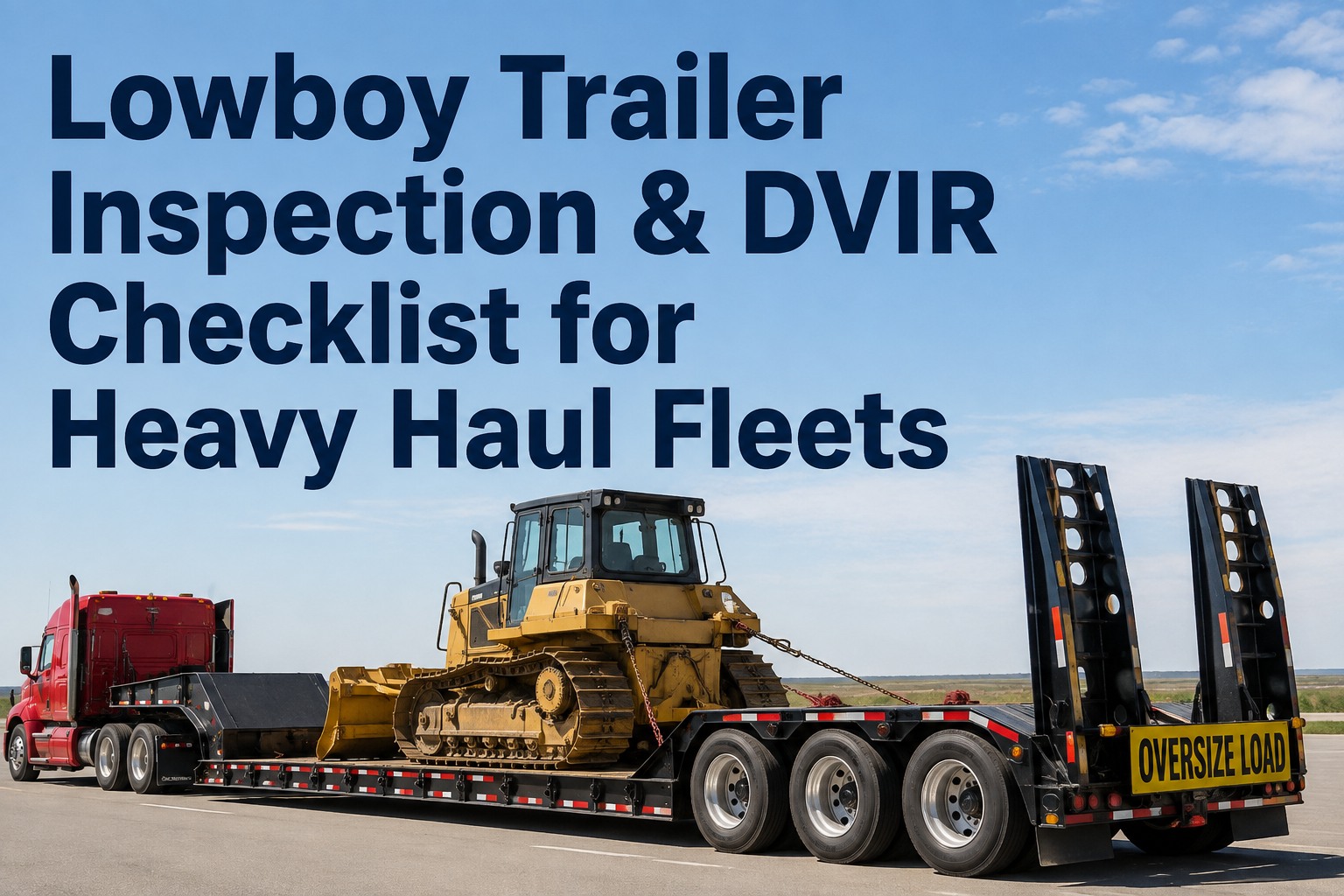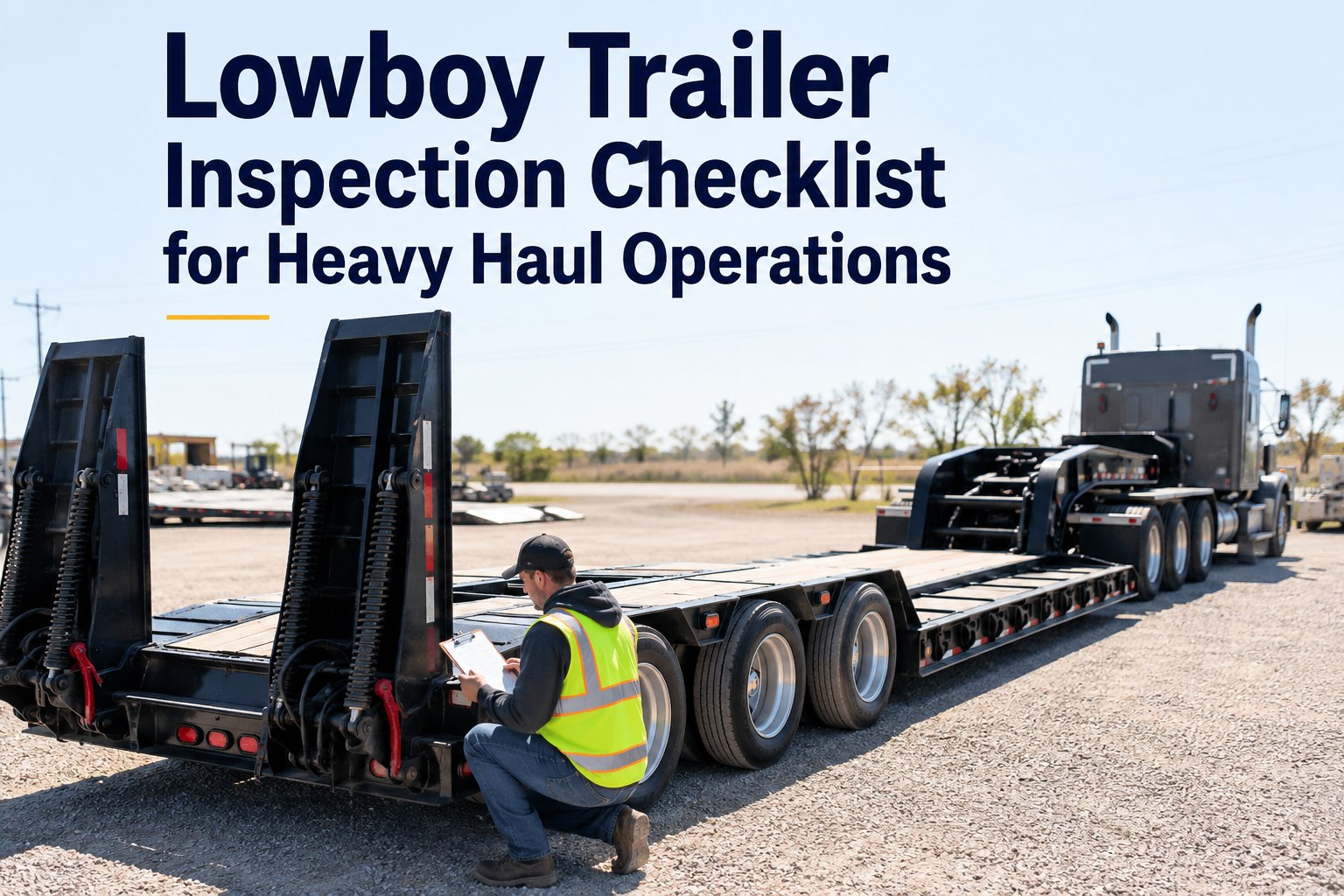
On a heavy haul, the cargo riding on a lowboy often costs more than the trailer carrying it — a single excavator, transformer, or crane can run half a million dollars, and a load shift, ramp failure, or gooseneck pin that backs out turns that into crushed equipment, a closed highway, and a seven-figure liability claim. That's the stakes that make a lowboy pre-trip different from a standard trailer walk-around. A lowboy isn't a flatbed with a dip in it: the detachable or hydraulic gooseneck, the low-profile load well, the multi-axle braking, and the heavy load securement are all systems a generic trailer checklist never touches, and they're exactly where heavy-haul failures happen. The consequences are immediate and documented — common out-of-service violations include rake push-rod travel beyond limits, cracked frame members, hydraulic leaks in the ramp or gooseneck, kingpin wear past 2 inches, and any securement deficiency that could lose the load and a single one can sideline the haul for hours and damage your CSA score. This guide is your lowboy trailer inspection checklist for heavy haul: what makes a lowboy different, the pre-trip walk-around, the gooseneck and securement checks that carry the most risk, and the DOT and out-of-service standards behind them. book a 30-minute walkthrough to see it set up for your fleet.
The load costs more than the trailer. The gooseneck pins and the chains are what keep it on the deck.
HVI runs the lowboy pre-trip from a phone — detachable gooseneck and locking pins, low deck and ramps, multi-axle brakes, tires, lights, and Grade 70 securement — flags any out-of-service condition, tags the trailer down until repaired, and keeps the DOT-compliant record for every heavy haul.
Why a lowboy needs its own checklist
A lowboy carries the heaviest, most valuable loads on the road, on systems a standard trailer doesn't have. The inspection priorities follow from the design and the stakes.
Four systems a generic trailer check skips
The detachable or hydraulic gooseneck lets equipment drive straight onto a lowered deck — but it adds locking pins, hydraulics, and a gooseneck-to-deck connection that must be verified every haul. The low-profile load well keeps tall machines under the 13'6" height limit, but its deck, well, and ramps take brutal stress from steel tracks. The multi-axle braking must be measured at every chamber because a heavy load multiplies the cost of any one weak brake. And the load securement — Grade 70 chains, binders, and the FMCSA working-load-limit math — is what actually keeps a 70,000-lb machine on the deck. None of these appear on a standard trailer checklist, which is why a lowboy needs a purpose-built one.
The pre-trip inspection checklist
This is the before-every-haul walk-around, covering the lowboy's unique systems alongside the standard DOT trailer items. Each is a pass-or-pull decision before the load moves.
The lowboy inspector's tools
A few inexpensive tools make these checks accurate: a chain wear gauge for measuring link stretch on securement chains, a high-lumen flashlight for the undercarriage, brake drums, and frame, a telescoping inspection mirror for behind axles and the gooseneck, and a dye-penetrant kit for finding hairline cracks in locking pins and welds. On a heavy haul, a hairline crack in a gooseneck pin found with dye penetrant in the yard is a non-event; the same crack discovered on the highway is a dropped load.
The first four rows are the lowboy-specific systems a generic form skips — the gooseneck, hydraulics, deck/well, and multi-axle brakes that the heavy haul depends on. sign up free and run the full lowboy pre-trip on a phone with photo capture, or book a demo to see heavy-haul trailer templates.
The gooseneck: where the haul lives or dies
The detachable gooseneck is the lowboy's signature feature and its highest-consequence connection. It gets the closest watch on every pre-trip.
Cycle & verify the pins
Verify hydraulic fluid, then cycle the gooseneck through a full detach and reattach, listening for unusual sounds and jerky movement. Every locking pin must seat flush with no visible gap, and the safety backup retainers must be in position.
Inspect the connection
Check the gooseneck-to-deck connection point for cracks or weld failures — a dye-penetrant kit finds the hairline cracks the eye misses. Any hesitation in the mechanism or a pin that doesn't fully seat is an out-of-service condition.
Pin that doesn't seat = down
A partially engaged lock can fail during transit, dropping the connection under load. If any pin won't seat flush or the mechanism hesitates, the trailer is out of service until repaired — no exceptions.
The gooseneck is what makes a lowboy a lowboy, and it's also the connection carrying the full force of a heavy load through the front of the trailer. A pin that looks engaged but sits with a visible gap is exactly the failure that drops a load on the highway. HVI makes the gooseneck pin-and-weld check a required, photo-verified item with the detach/reattach cycle built in.
Load securement: keeping it on the deck
On a lowboy, securement isn't a formality — it's the system holding tons of equipment in place at highway speed. FMCSA sets the math, and the pre-trip verifies it.
Grade 70 chains & binders
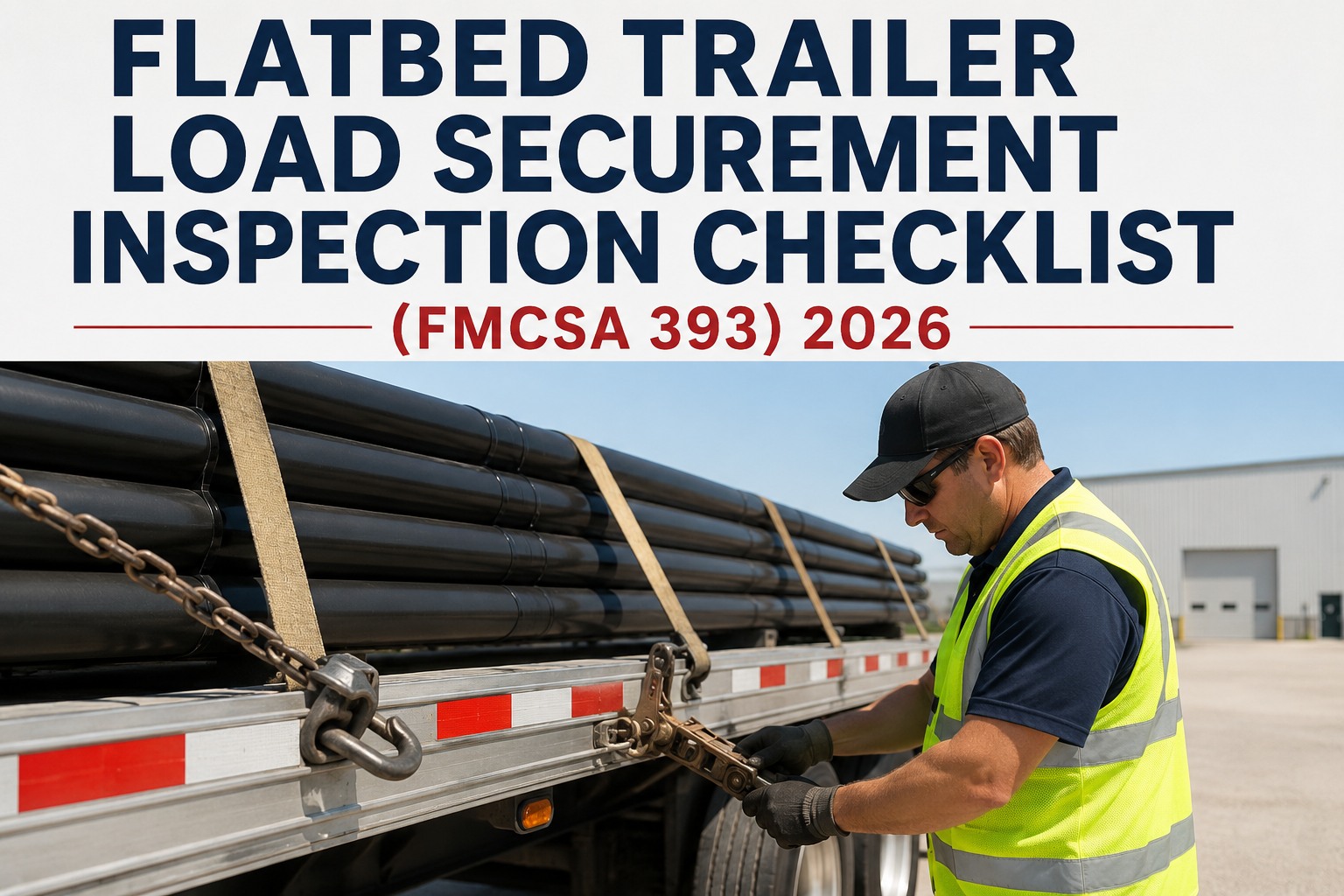
Grade 70 transport chains are the standard for heavy equipment. Verify each chain and binder is in good condition, fully tensioned with no slack, binders fully engaged, and no chain rubbing a sharp edge that could fail it in transit.
Meet the WLL math
Under FMCSA 49 CFR Part 393, the aggregate working load limit of all tie-downs must equal at least 50% of the cargo weight, with a minimum number of tie-downs by load length. Lower blades, booms, and buckets to cut height and center of gravity.
Measure & permit
Re-measure overall height after loading against 13'6" (or your permit), check width against 8'6", weigh each axle group against its limit, and confirm valid oversize/overweight permits and any required escort or flags for the route.
WLL minimum — and that's the floor. FMCSA requires the combined working load limit of all tie-downs to be at least half the cargo weight, plus a tie-down count scaled to load length, plus immobilization in every direction. On a lowboy that means a deliberate securement plan with Grade 70 chains, verified and documented before departure — because a securement deficiency that could lose the load is a roadside out-of-service order and, if it fails, a catastrophe. HVI captures the chain count, WLL, and securement photos on every haul.
Out-of-service triggers & DOT compliance
Certain defects don't just need fixing — they legally ground the trailer. Knowing the out-of-service line keeps a haul from being shut down roadside.
The out-of-service line
Brake push-rod travel beyond limit on any axle, inoperative brake lights or turn signals, cracked frame members, hydraulic leaks in the ramp or gooseneck, kingpin wear past 2 inches, any load-loss securement deficiency, or no valid oversize permit — each grounds the trailer.
Pre-trip, post-trip & annual
FMCSA requires a pre-trip before dispatch and a post-trip after each use, plus a comprehensive annual inspection under 49 CFR §396.17 with a report and sticker carried on the trailer. Hydraulics, ramps, and gooseneck get a monthly check at minimum.
Document or it didn't happen
A documented pre-trip is what proves Part 393 compliance and protects against a CSA hit. Digital records with photos and GPS timestamps are the defensible trail an inspector — or a liability claim — will demand.
A single out-of-service violation sidelines the haul for hours and damages your CSA score — catching it on a documented pre-trip is far cheaper than catching it at a scale house. sign up free and keep every lowboy haul DOT-compliant and documented.
Paper checklists vs. HVI
Both technically record a pre-trip. Only one covers the gooseneck, hydraulics, and securement, tags an out-of-service trailer down, and keeps the FMCSA-compliant record a heavy haul demands.
Paper / generic
- Generic trailer form skips the gooseneck system
- Locking-pin gap & weld cracks missed
- Brake push-rod travel not measured per axle
- Chain WLL math never documented
- Defects on paper, trailer rolls anyway
- No DVIR trail when an inspector or claim asks
With HVI software
- Lowboy template covers gooseneck, hydraulics & deck
- Pin-seat & weld check required, photo-verified
- Push-rod travel logged at every brake chamber
- Chain count, WLL & securement photos captured
- An out-of-service defect tags the trailer down
- DVIR & §396.17 records export in minutes
load, protected every haul. The machine on a lowboy deck routinely costs more than the trailer, the truck, and a year of insurance combined — and the gooseneck pins, the multi-axle brakes, and the Grade 70 chains are the only things standing between it and the pavement. A purpose-built pre-trip covering all of them, run every haul and documented for FMCSA, is what keeps the load on the deck and the haul on schedule. HVI makes that the routine across your heavy-haul fleet.
Frequently asked questions
What should a lowboy trailer pre-trip inspection include?
A lowboy pre-trip covers the trailer's unique systems alongside standard DOT trailer items, before every haul. The detachable or hydraulic gooseneck comes first — verify hydraulic fluid, cycle it through a full detach and reattach, confirm every locking pin seats flush with no gap and the safety backup retainers are in place, and inspect the gooseneck-to-deck connection for cracks or weld failures. The hydraulics and ramps are checked for leaks and smooth operation. The deck, load well, cross members, and frame are inspected for cracks or twist. Multi-axle brakes are measured at every chamber for push-rod travel within limits, and the tires, wheels, lights, reflectors, mud flaps, kingpin, coupling, and suspension are all verified. Finally, load securement — Grade 70 chains and binders, tie-down points, the working-load-limit math, and valid oversize permits — is confirmed. The gooseneck, hydraulics, deck/well, and multi-axle brakes are lowboy-specific systems a generic form skips. HVI's inspection and maintenance software provides a lowboy-specific template covering all of them. sign up free and run the full lowboy check.
How do I inspect a detachable gooseneck?
Start by verifying the hydraulic fluid level, then cycle the gooseneck through a full detach and reattach while listening for unusual sounds and watching for jerky movement, which can signal a hydraulic or mechanical problem. Once it's reattached, inspect all the locking pins for full engagement — the pins should seat flush with no visible gap, and any pin that doesn't fully seat means the trailer is out of service until repaired, because a partially engaged lock can fail during transit and drop the connection under load. Confirm the safety backup retainers are in position. Then inspect the gooseneck-to-deck connection point for cracks or weld failures; because hairline cracks in pins and welds are easy to miss by eye, a dye-penetrant kit is the right tool for finding them before they propagate. Any hesitation in the mechanism is also a stop. The gooseneck carries the full force of the load through the front of the trailer, so this is the single highest-consequence check on the pre-trip. HVI's inspection and maintenance software makes the gooseneck pin-and-weld check a required, photo-verified item. book a demo to see the gooseneck workflow.
What are the FMCSA load securement rules for heavy equipment?
Under FMCSA 49 CFR Part 393 Subpart I, cargo must be secured so it can't shift or fall in any direction, and the aggregate working load limit of all tie-downs must equal at least 50% of the cargo's weight. There's also a minimum tie-down count by length — generally one tie-down for articles up to 5 feet, with additional tie-downs as length increases. For heavy equipment, Grade 70 transport chains are the standard, and each chain and binder must be in good condition, fully tensioned with no slack, with binders fully engaged and no chain rubbing against a sharp edge that could cause it to fail in transit. Before departure, lower the equipment's blade, boom, and bucket to reduce height and center of gravity, re-measure the loaded height against the 13'6" limit or your permit, check width against 8'6", and weigh each axle group against its legal limit. A securement deficiency that could result in load loss is a roadside out-of-service violation. HVI's inspection and maintenance software captures the chain count, WLL, and securement photos on every haul. sign up free and document securement every load.
What puts a lowboy trailer out of service?
Several defects legally ground a lowboy. Common out-of-service violations include brake push-rod travel exceeding adjustment limits on any axle, inoperative brake lights or turn signals, cracked frame members, hydraulic leaks in the ramp or gooseneck system, kingpin wear beyond 2 inches in diameter, any load securement deficiency that could result in load loss, and operating without valid oversize permits. On the gooseneck specifically, any locking pin that doesn't seat flush or any hesitation in the mechanism is an out-of-service condition until repaired. A single one of these can sideline the haul for hours and damage your CSA score, and if the defect causes a failure under a heavy load, the consequences are catastrophic. That's why the pre-trip is structured around catching these conditions before dispatch rather than at a scale house or on the highway, and why each defect should drive an immediate repair, not a note for later. HVI's inspection and maintenance software flags out-of-service conditions and tags the trailer down until they're verified repaired. book a demo to see out-of-service flagging.
How does HVI help with lowboy trailer inspections?
HVI is an inspection and maintenance software platform built for heavy-haul fleets, including lowboy and RGN trailers. Drivers run the pre-trip from a phone or tablet using a lowboy-specific template that covers the unique systems — the detachable gooseneck with its detach/reattach cycle and locking-pin verification, the hydraulics and ramps, the deck, well and frame, and the multi-axle brakes measured at each chamber — alongside the standard tires, lights, kingpin, and coupling, with mandatory photo capture on defects and chain securement. It captures the load securement detail FMCSA requires, including chain count, working-load-limit math, and securement photos with GPS timestamps. A flagged out-of-service condition — a pin that won't seat, push-rod travel beyond limit, a gooseneck hydraulic leak — tags the trailer down until verified repaired, and every defect auto-creates a tracked work order. The platform tracks pre-trip, post-trip, and the annual 49 CFR §396.17 inspection, and exports an FMCSA-compliant DVIR and inspection record in minutes. book a demo and we'll map the software onto your fleet on the call.
Inspect the gooseneck, the brakes, and the chains before every haul — the load's worth it.
HVI runs the lowboy pre-trip from a phone — detachable gooseneck and locking pins, hydraulics and ramps, deck and frame, multi-axle brakes, tires, lights, kingpin, and Grade 70 securement — tags an out-of-service trailer down, auto-creates a work order from every defect, captures the WLL and securement photos, and exports an FMCSA-compliant record. Keep the load on the deck and the haul on schedule.
No credit card required · Live in under two weeks · Lowboy pre-trip + gooseneck & securement checks + out-of-service flagging + DVIR/§396.17 records in one platform