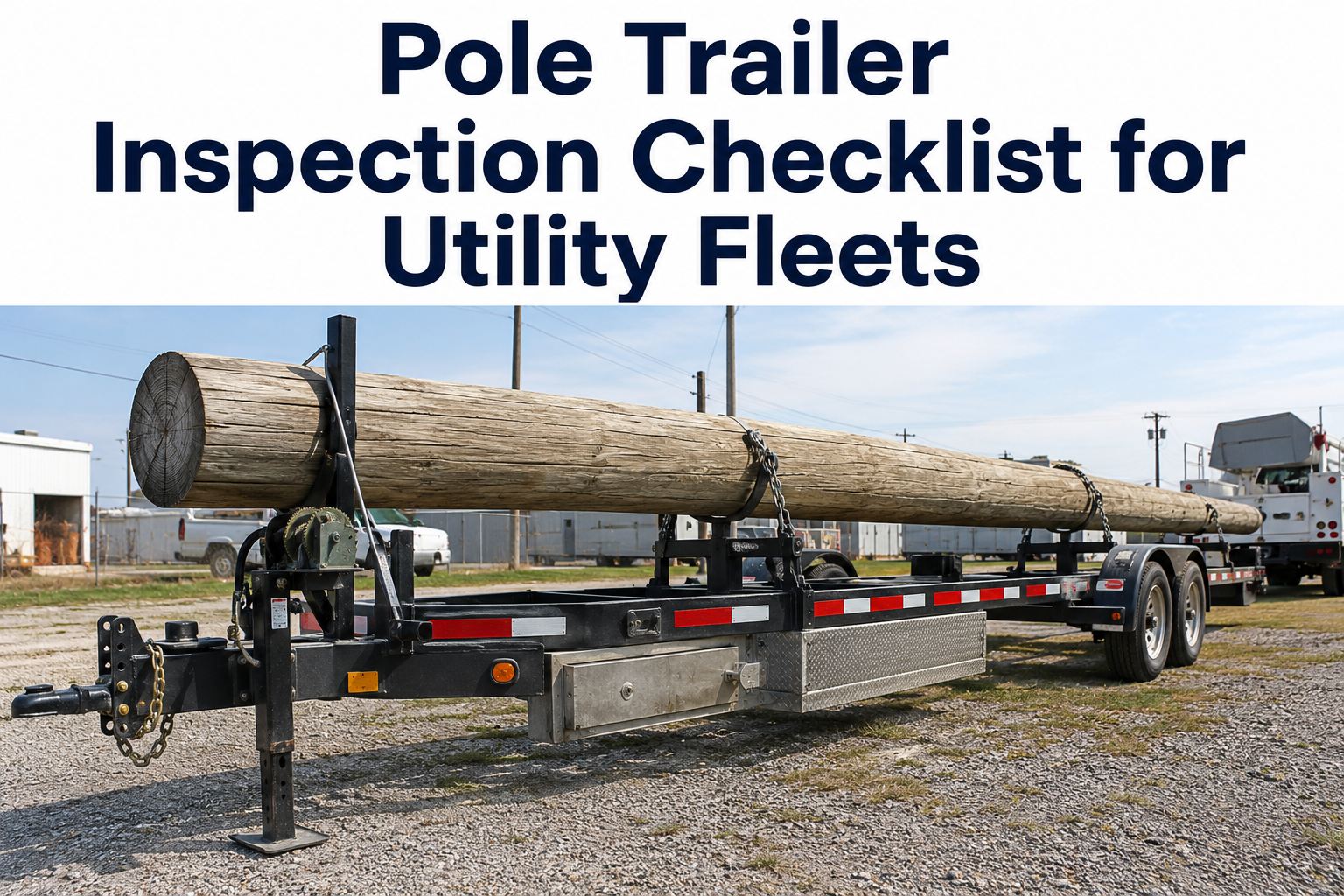
A pole trailer is the one piece of utility equipment built around a load that fights back. It carries 40-, 60-, even 90-foot wooden, concrete, or fiberglass poles weighing up to 36,000 lbs, riding on bolsters with sliding stanchions, an extendable reach that locks at a single pin, and a load that — as every line crew knows — settles and goes slack the moment you're on the road. Get the inspection wrong and the failure modes are severe: a stanchion that slides off its bolster, a securement strap that loosened twenty miles back, a reach pin that wasn't fully locked, or an overhang that deflects the tongue. Under FMCSA rules, a pre-trip inspection is required before the trailer ever moves (49 CFR 392.7), and cargo securement must meet the 50% aggregate working-load-limit standard with re-checks en route. This checklist covers every pole-trailer system — frame and reach, bolsters and stanchions, load securement, brakes, suspension, coupler and safety chains, lights, and tires — as a pre-dispatch walkaround built for the way these trailers actually carry. HVI's inspection & maintenance software runs the whole check on a phone, raises a work order on any defect, and keeps a DOT-ready record for every unit. Book a 30-minute walkthrough to see it set up for your fleet.
A 60-foot pole load settles, shifts, and goes slack on the road. The inspection is what stands between it and the windshield behind you.
A complete pre-dispatch inspection checklist for utility pole trailers — frame and extendable reach, bolsters and stanchions, load securement, brakes, suspension, coupler and safety chains, lights, and tires. HVI inspection & maintenance software runs it on a phone or tablet, raises a work order on any defect, schedules preventive maintenance, and keeps an FMCSA-ready record for every trailer — fully offline in the field.
Why a pole trailer isn't just another trailer
A pole trailer shares a chassis, brakes, and lights with any DOT trailer — but four things make it its own inspection problem. Miss these and a standard trailer checklist won't save you.
Bolsters & stanchions
The load rides on bolsters with sliding, lever-locking stanchions held by lynchpins. An unlocked stanchion can slide off its bolster in transit — the pin and lanyard are the only backstop.
Extendable reach
The reach extends from ~20 ft to 46 ft and locks at a single positive-locking pin. If that pin isn't fully seated, the trailer's effective length — and the whole load — is unsecured.
A load that settles
Poles compress and shift on the move, so straps and chains that were tight at the yard go slack. Securement has to be re-checked en route, not just signed off once at dispatch.
Overhang & tongue
Long rear overhang and the wrong center of gravity cause excessive tongue deflection. Pole stubs, binders, and overhang limits are part of keeping the trailer itself from being damaged.
The takeaway: most of what fails on a pole trailer is specific to how it carries — the bolsters, the reach lock, the securement that loosens in motion. A generic trailer walkaround skips exactly those. Treat the items marked critical below as hard stops: if one fails, the trailer doesn't roll until it's fixed.
The pre-dispatch inspection checklist
Work the trailer front to back, structure before securement, and finish with a securement re-check that you'll repeat on the road. The starred sections are the ones that lose loads — a failure there grounds the unit, not a flag for later.
Frame & extendable reach
- Mainframe rails free of cracks, bends, or weld failures
- Reach slides and adjusts smoothly with no binding
- Positive-locking adjustment pin fully seated and chained
- Internal wiring/airline energy chain undamaged
- No corrosion or deformation at high-stress weld points
- Toolbox and cargo box latches secure
Bolsters, stanchions & load securement
- Bolsters sound; no cracks, spread, or bent c-channel
- Sliding stanchions lock and lynchpins/lanyards in place
- Front bolster strap and binder rated and undamaged
- Straps free of cuts, fraying, knots, or UV damage
- Chains free of stretch, cracks, gouges, or wear
- Aggregate WLL at least 50% of the load weight
- Tie-down count meets FMCSA spacing for load length
- D-rings and anchor points intact, not corroded or torn
Brakes & breakaway
- Electric or air brakes apply firmly at all axles
- Air system holds pressure with no audible leaks
- Breakaway system charged and functional
- Brake drums and linings within wear limits
- Parking brake holds the loaded trailer on a grade
- ABS indicator (if equipped) working
Suspension, axles & tires
- Springs, hangers, U-bolts, and shackles sound
- No axle damage, leaks, or bearing play
- Tires within tread limits; no cuts or bulges
- Tire pressure correct on all wheels, including duals
- Lug nuts tight; no missing studs or rust streaks
- Even wear pattern — no alignment or overload signs
Coupler, hitch & safety chains
- Coupler/pintle secure, locked, and undamaged
- Safety chains rated, crossed, and properly attached
- No excessive play between coupler and tow vehicle
- Jack/landing gear operates and stows fully
- Electrical and air connectors seated, not chafing
- Tongue not deflected under load
Lights, reflectors & markings
- Tail, brake, and turn signals all working
- Clearance, marker, and triple taillights functional
- Reflective tape and reflectors intact
- Red flags/lights on rear overhang per regulation
- Oversize/Wide Load signage where required
- Strobes/amber beacons working if equipped
Six zones, around forty checkpoints, plus a securement re-check on every load — paper forms blow off a trailer, get soaked, and leave nothing behind when a roadside inspector pulls you in. sign up free and run this checklist in HVI's inspection & maintenance software, or book a demo to see a failed stanchion-lock check auto-raise a work order.
Two inspection cycles, one record
A pole trailer lives under two layers of inspection: the driver's daily DVIR before and after every trip, and the annual qualified inspection that produces the sticker the trailer has to carry. Both feed the same compliance record.
Before every dispatch
The driver walkaround above, required under 49 CFR 392.7 before the trailer moves — structure, securement, brakes, lights, and coupling.
Securement re-check
Because poles settle, straps and chains must be re-checked and re-tightened during the trip — typically within the first stretch and at stops.
DVIR after the run
A post-trip DVIR records any defect found in service so it becomes a work order before the next dispatch, not a surprise.
Qualified inspection
A full 49 CFR 396.17 inspection by a qualified inspector — brake measurement, frame, suspension — producing the report and sticker carried on the trailer.
Roadside violations feed your CSA score and stay on record for 24 months — and most of them happen in the gap between spotting a defect and certifying the repair. HVI closes that gap: a flagged defect becomes a work order, the repair links back to the inspection, and annual due dates are flagged before they lapse.
Paper checklist vs. HVI inspection & maintenance software
Both record the same checks. Only one makes the critical items impossible to skip, captures the securement photo, raises the repair as a work order, and keeps a per-trailer record a DOT auditor will accept.
Paper / clipboard
- Walkaround rushed before a long field run
- No proof the stanchion lock or reach pin was checked
- Defects noted on paper, lost before the repair
- Annual inspection dates tracked in a spreadsheet
- No photo evidence of securement at dispatch
- Records scattered across trucks and yards
With HVI software
- Critical items must be answered before sign-off
- Mandatory photo capture on securement and defects
- Failed checks auto-raise a maintenance work order
- Annual and PM intervals tracked per trailer
- Timestamped, FMCSA-ready digital records
- Works fully offline in the field, syncs when back online
Prove every pole load was secured before it rolled.
Put the full pole-trailer checklist on every operator's phone — critical items that can't be skipped, securement photos, instant work orders, and annual-inspection tracking that never lets a sticker lapse.
Frequently asked questions
What should a pole trailer inspection checklist cover?
A complete pole-trailer pre-dispatch inspection works front to back through six areas: the frame and extendable reach (rails crack-free, reach sliding smoothly, the positive-locking adjustment pin fully seated and chained, internal wiring/airline chain intact); the bolsters, stanchions, and load securement (bolsters sound, sliding stanchions locked with lynchpins in place, straps and chains free of damage, aggregate working load limit at least 50% of the load weight, tie-down count and spacing per FMCSA); the brakes and breakaway system; suspension, axles, and tires; the coupler, hitch, and safety chains; and lights, reflectors, and overhang markings. The bolsters/securement, brakes, and coupler/safety chains are the safety-critical zones where a failure grounds the trailer. HVI delivers all six as a phone checklist where critical items must be answered before sign-off.
How often does a utility pole trailer need to be inspected?
There are several overlapping cycles. A driver pre-trip inspection is required before the trailer moves under 49 CFR 392.7, and a post-trip DVIR records anything found in service. Because pole loads settle and straps go slack, securement has to be re-checked en route — typically within the first stretch of the trip and at stops, not just signed off once at the yard. On top of the daily checks, a qualified annual inspection under 49 CFR 396.17 examines brakes, frame, and suspension in detail and produces the report and sticker the trailer must carry. Preventive maintenance follows the manufacturer's hour or mileage intervals. HVI handles all of it in one place — daily checklists on a phone, securement re-check reminders, and annual and PM due dates tracked per trailer.
Why do pole loads have to be re-checked on the road?
Because poles settle. Whether wood, concrete, or fiberglass, a stacked pole load compresses and shifts as the trailer moves, so straps and chains that were drum-tight at the yard go slack within the first miles. A slack tie-down isn't securing anything, and on a long pole that slack can let the load creep toward the cab or off the back. Experienced crews plan for it: re-check and re-tension securement shortly after setting out and again at stops. The other moving target is the rear overhang and tongue — the wrong center of gravity or too much overhang causes excessive tongue deflection, which is why pole stubs and the right binders matter. On HVI, the en-route securement re-check is part of the workflow, with photo capture so there's a timestamped record the load was re-secured.
What load securement rules apply to a pole trailer?
FMCSA's cargo securement standard (49 CFR Part 393, Subpart I) is the baseline. The aggregate working load limit of all tie-downs must be at least 50% of the cargo weight, and the minimum tie-down count scales with length — generally two within the first stretch of the load and an additional tie-down for each further increment, with blocking or bulkheads adding security. Securement devices have wear limits of their own: straps come out of service for cuts, fraying, knots, or damage past about 10% of the webbing, and chains for visible stretch, cracks, gouges, or roughly 5% elongation. Wood poles are usually secured with a combination of chains and straps; concrete and fiberglass may need padded or additional bolsters and reduced overhang. HVI lets you log the tie-down count and WLL per load and flags securement devices that fail the wear check.
How does HVI's inspection & maintenance software help a utility fleet?
HVI runs the whole inspection and maintenance program for a pole-trailer fleet in one platform. The pre-dispatch checklist lives on a phone or tablet so it can't be rushed — critical items like the stanchion locks, reach pin, brakes, and securement must be answered before sign-off, with mandatory photo capture on defects and on the secured load itself. A failed check instantly becomes a maintenance work order routed to the right person, closing the gap between spotting a defect and certifying the repair where most roadside violations happen. Beyond the daily DVIR, the software schedules preventive maintenance and tracks the annual 396.17 inspection per trailer, flagging a sticker before it lapses. Everything works fully offline in the field and syncs when back in range, and every inspection and repair is a timestamped, FMCSA-ready record, exportable for a DOT audit or CSA review. book a demo and we'll set it up around your specific utility fleet on the call.
Keep every pole trailer compliant, documented, and road-ready.
HVI inspection & maintenance software turns this checklist into a digital pre-dispatch inspection — critical items that can't be skipped, securement and defect photos, auto-generated work orders, annual-inspection and PM tracking, and a full FMCSA-ready record per trailer, all working offline in the field. Protect your crews, your loads, and your CSA score on every run.
No credit card required · Live in under two weeks · Digital checklists + critical-item stops + securement photos + work orders + annual & PM tracking, fully offline