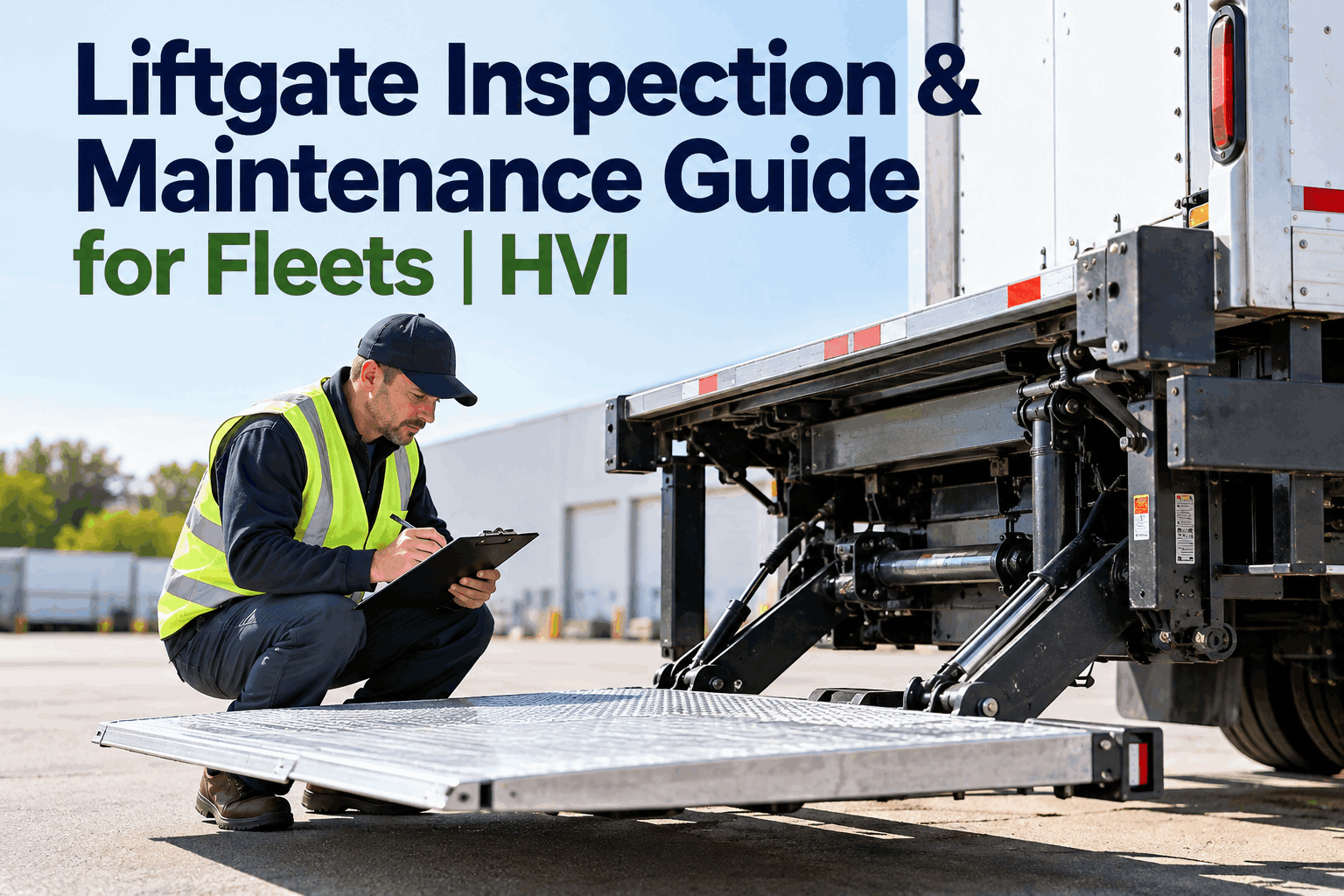
A liftgate spends its whole life under pressure — literally. Every lift runs on hydraulics at thousands of PSI, holding a full load on a platform bolted to the back of the truck. A liftgate inspection isn't about mileage; it is about whether that pressure system is still sound before the next load goes up. Book a demo to see it checked on its own schedule.
Your liftgate works under pressure. Inspect it that way.
Hydraulics, platform, controls, wear points and the capacity plate carry every load you lift. Watch them on cycles — not chassis miles — and the gate keeps lifting every stop.
A liftgate (tail lift, outside North America) is one of the hardest-working units on a delivery fleet and one of the most overlooked. It carries the full rated load every cycle, lives outside in road salt and grit, and runs entirely on hydraulic pressure. Industry guidance puts roughly 75% of liftgate problems in the "spot it on approach" category — a tech who simply looks before operating catches most of them. And under FMCSA rules, a liftgate defect affecting safe operation is reportable on the driver's DVIR, so a real liftgate inspection is a compliance tool as much as an uptime one.
What a skipped liftgate inspection actually costs
The check takes two minutes. Left undone, the same fault climbs a ladder — and every rung up is more expensive, more public and harder to undo.
A weep or worn pad is a logged note and a planned repair. Cheapest outcome there is.
The part fails on its own schedule, now a bigger job and a truck off the road for it.
A mobile tech or tow, a stranded driver, and the delivery stops stacking up behind him.
A safety defect never logged on the DVIR is a compliance problem, not just a repair.
That climb — from a two-minute check to a four-figure failure to an out-of-service hit — is the whole argument for a real program. Book a demo to keep every gate on rung one.
Why liftgate maintenance ignores the odometer
This is the trap: the gate gets serviced whenever the chassis does. But the two run on different clocks, and the mismatch is where failures hide.
Engine, brakes and tyres wear with distance. A long-haul truck piles on mileage and gets serviced often.
The gate wears every time it lifts. A city van doing 50 cycles a day batters its liftgate while barely moving the odometer.
Tie liftgate PM to mileage and you over-service the highway trucks and dangerously under-service the delivery fleet. HVI schedules preventive maintenance for the gate on its own cycle-based interval. Book a demo to see both clocks tracked separately.
The five systems a liftgate inspection covers
A liftgate safety inspection maps to five systems. Each has its own failure signs, and all five are visible on a walkaround before the gate ever carries a load.
Hydraulics & cylinders
The heart of the gate. A liftgate hydraulic inspection looks for weeping cylinders, chafed hoses, low fluid and a platform that drifts down under load.
Platform & welds
It takes the full load, drop after drop. Check for cracked welds, bent decking, a non-slip surface worn smooth, and failed safety flaps or edge guards.
Controls, wiring & battery
Controls take weather and abuse. Confirm every button works, the deadman stops the gate when released, wiring isn't corroded and the battery holds charge.
Wear pads, pins & pivots
Every pivot wears with use. Check pads for thinning, pins and bushings for play, and lube points for grease — worn pivots rack the platform sideways.
Capacity plate & decals
The capacity plate is the gate's legal limit and it has to be legible. Confirm the plate and safety decals are present and readable so operators load within rating — an overloaded gate cracks platforms and blows cylinder seals.
Every one of these is a photo in HVI — a tech flags a weeping cylinder, snaps it, and it's on the record before the truck leaves the yard. Start free and build the five-system template.
Give the liftgate the inspection it actually needs
HVI puts a liftgate-specific inspection in the driver's hand, attaches a photo to every defect, routes the repair as a work order, and schedules liftgate PM on cycles — separate from the chassis. The gate stops being the thing nobody checks.
Liftgate inspection checklist
The daily walkaround itself, written as an inspection card. Fold it into the driver's DVIR / daily operator report so any defect is logged every shift and backs up a DOT inspection.
On paper this gets a tick and lands in a glovebox. In HVI each box is dated, each failed item is a work order with a photo, and a gate flagged unsafe can't quietly stay in service. Book a demo to see the checklist live on a device.
A liftgate preventive maintenance rhythm
Build it around use. These are typical US rhythms — the daily check feeds the DVIR and the full inspection lines up with your FMCSA annual periodic inspection. Always confirm against the OEM manual.
Quick visual and operational check on the pre-trip — leaks, controls, platform — logged on the DVIR.
Wear pads, pins and pivots greased, hoses and wiring checked, hydraulic fluid topped.
Full service tied to cycle count — more often on high-use city delivery gates than long-haul.
Thorough liftgate inspection with the FMCSA annual periodic inspection, documented and retained.
Note for non-US fleets: some regions require a scheduled competent-person examination of lifting equipment (for example, the UK's LOLER every six months). Always follow your local regulation and the manufacturer's guidance.
HVI's multi-interval preventive maintenance handles exactly this — one schedule on cycles, another on the calendar, both on the same unit, so the liftgate never rides the chassis clock.
A maintenance manager on the liftgate blind spot
For years the liftgate was whatever the chassis PM happened to catch — which was basically never. It only got looked at when a driver called in stranded with a gate that wouldn't lift. Once we gave it its own inspection on the daily report and its own PM on cycles, the surprise failures almost stopped. The photo on every defect was the other win: no more arguing whether a cylinder was really leaking — there's a dated picture right on the record.
Dana M.Maintenance Manager · Regional distribution fleet · 60 liftgate-equipped trucks
Run the whole liftgate program on HVI
Configurable inspection templates
Build a liftgate-specific inspection template with the five systems — not a generic truck form that skips the gate.
Photo evidence on every defect
A dated picture of the leak, crack or worn pad attaches to the record for safety and warranty proof.
Multi-interval PM by cycles
Schedule liftgate PM on cycles and time, separate from the chassis clock, so high-use gates get seen more often.
Defects routed to work orders
A flagged gate becomes a tracked repair in maintenance management — nothing lost on a sheet.
One connected record per liftgate, built on the walkaround your drivers already do — so the gate is never the forgotten machine on the back of the truck. Start free and put your liftgates on a program.
Liftgate inspection questions
Q1How often should a liftgate be inspected?
In the US, operators should do a quick visual and operational check daily as part of the DVIR pre-trip, a closer look weekly, a full service roughly three to four times a year depending on use, and a thorough inspection with the FMCSA annual periodic inspection. (Outside the US, some regions require a scheduled competent-person exam — UK LOLER every six months, for example.) Always follow the OEM manual.
Q2What does a liftgate inspection cover?
Five systems: hydraulics and cylinders (leaks, hoses, fluid, drift), the platform and structural welds, the controls, wiring and battery, the wear pads, pins and pivots, and the capacity plate and safety decals. Each has visible failure signs you can catch on a walkaround before the gate carries a load.
Q3Why doesn't liftgate maintenance follow vehicle mileage?
A liftgate wears every time it lifts, not every mile driven. A city delivery truck doing dozens of cycles a day batters its gate while barely moving the odometer, so tying liftgate PM to mileage under-services the high-use gates. Liftgate preventive maintenance should run on cycles and time instead.
Q4What are the most common liftgate failures?
Damage and corrosion lead the list, followed by hydraulic leaks, worn wear pads, cracked platform welds and dead batteries or controls. Industry guidance notes roughly 75% of problems can be spotted on approach by simply looking before operating — which is why a disciplined visual inspection, logged on the DVIR, catches most issues early.
Q5How does HVI help with liftgate inspection?
HVI lets you build a configurable liftgate inspection template, attach photo evidence to every defect, route failures to work orders, and schedule liftgate preventive maintenance on cycles separate from chassis PM. It's an inspection and maintenance layer, not a replacement for the OEM service manual or a legally required examination.
Put your liftgate inspections and PM on HVI
Build the five-system template, capture photo evidence on every defect, route repairs as work orders, and schedule liftgate PM on cycles — independent of the chassis. Live in weeks, not quarters.
No credit card · PM by cycles & time · Built for fleet body equipment