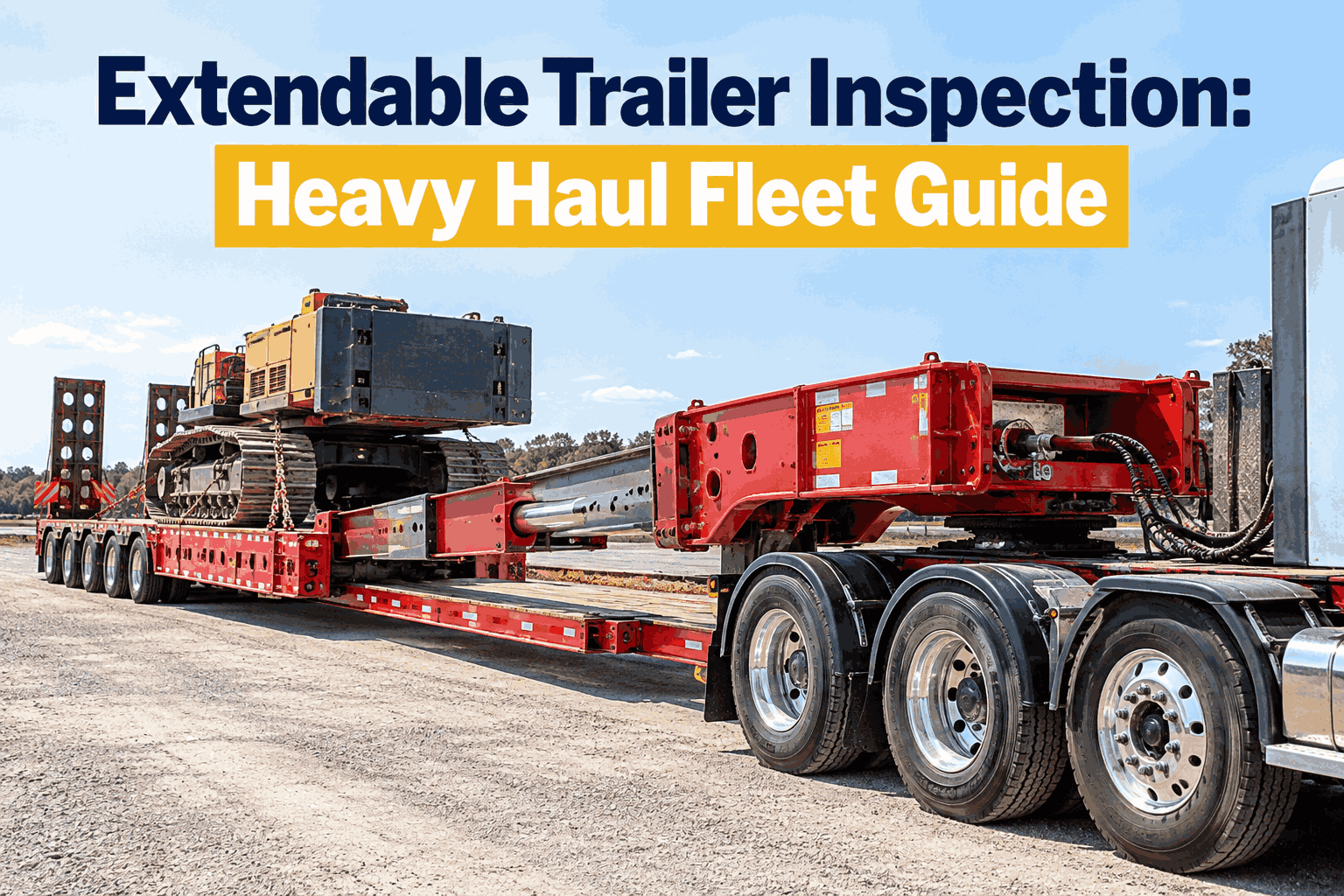
An extendable trailer inspection has to prove the trailer is safe in two shapes, not one. A stretch trailer that's solid retracted can be a moving hazard extended if the locking pins are worn or the deck isn't verified at length. That extension system — the sliding beams, pins and hydraulics a normal flatbed never has — is exactly where a heavy-haul load goes wrong. Book a demo to see it on a custom template.
A Stretch Trailer Has to Be Safe in Two Shapes
Retracted or extended, the extension system has to be locked, unworn and verified. That's a whole layer of inspection points a standard flatbed simply doesn't have.
Pins locked, beams home, deck secure at minimum length.
Pins re-seated at new holes, wear pads bearing, length within permit.
Here's the full picture — why an extendable trailer adds inspection points, how the extension mechanism works, why locking-pin wear is the failure that matters most, the hydraulic and air-electrical checks through the moving section, deck and length compliance, and the operator's extend-lock-verify routine before every haul.
Why an extendable trailer adds inspection pointsthe extension system is a whole subsystem to check
A standard flatbed is one fixed frame. A stretch trailer is two frames that slide, lock, and carry load at whatever length the freight demands — so on top of every normal trailer check, you inspect the mechanism that lets it change shape and the parts that hold it there. And because it runs at different lengths on different hauls, the same trailer never presents quite the same way twice.
Miss the mechanism and you can pass a retracted trailer that's unsafe the moment it's stretched for a load. That's why heavy-haul equipment can't ride on a generic checklist — it needs one built for its own parts, the way flatbed load securement has rules a dry van never needs. Book a demo to see an extendable-specific template
How the extension mechanism worksslide beams, wear pads, pins and holes
Knowing the mechanism tells you what to look at. An extendable trailer is a telescope: an inner frame slides inside an outer one, riding on wear pads, and locking pins drop into holes to fix the length at set positions. Every one of those parts is an inspection point.
Inner beam telescopes within the outer; check for straightness, cracks at welds, and smooth travel with no binding. A bent or scored beam drags on the pads and accelerates their wear.
Low-friction pads carry the sliding load; worn-through pads mean metal-on-metal and a sloppy, sagging extension. They're consumable, so they're measured against spec, not just eyeballed.
Heavy pins seat into holes to fix length; they take the shear load that stops the beams sliding under way. A bent, seized or under-spec pin is an immediate out-of-service item.
Multiple positions set the length; the holes elongate over time, letting a pin sit loose even when engaged. Ovaled holes are as dangerous as a worn pin, and harder to spot.
The pads and the pin-and-hole fit are the parts that quietly wear — the trailer keeps working while the tolerances open up, until one day the extension moves when it shouldn't. That slow drift is the whole reason these get measured, not just glanced at. Start free and log wear on every extension check.
Locking-pin wear is the failure that matterselongation is a slow leak, not a sudden break
If there's one thing an extendable trailer inspection exists to catch, it's a locking pin or hole that's worn out of tolerance. It doesn't fail all at once — the pin and hole slowly elongate, the fit gets loose, and the extension develops play long before it ever lets go.
- Pin drops in and seats with no slop
- Hole round, edges crisp, no ovaling
- Zero play when you rock the extension
- Length holds solid under load
- Pin rattles or sits loose when engaged
- Hole ovaled, edges peened or cracked
- Visible movement when the extension is rocked
- Length can creep or shift in transit
The test is simple: with pins engaged, try to move the extension — any play is a defect, and it only grows. Catch it with a measurement and a photo on record, and a worn pin is a planned repair instead of a shifted load. Book a demo to trend pin wear on the asset over time
Hydraulics, air and electrical through the moving sectionthe runs that have to survive the extension
On a stretch trailer, the air lines, wiring and any hydraulics have to flex or route through a section that physically changes length — so they wear and pinch where a fixed trailer's never would. Each gets checked in the position you'll actually haul in.
Cylinders, hoses, fittings and controls checked for leaks, chafing and smooth even extension; fluid level and pressure correct where powered.
Routing that flexes with the extension, secured and free of pinch points; brakes must work at every length, not just retracted.
Wiring protected across the moving section; all marker, clearance and brake lights confirmed working extended, when the load is longest.
The trap is checking these retracted, when everything's slack and connected — extend the trailer and a pinched line or a stretched harness shows itself. Always verify in the hauling configuration. Start free and check every run in the extended position.
Deck, securement and length compliancethe platform changes, so the load plan does too
Extending the trailer changes the deck, the securement points available, and the legal length — so all three have to be re-checked at the configured length, not assumed from the retracted setup.
Boards, cross-members and the joint area across the extended platform sound, with no gap or sag where the sections meet. The exposed inner rails only show once it's stretched, so inspect them at length.
Anchor points, rub rails and winch tracks intact and reachable at the length you're running — some sit on the moving section and shift position as the deck extends, changing your tie-down plan.
Configured length verified against the permit and route limits; an over-length haul that outruns its permit is a compliance stop and a fine. Measure it, don't estimate it from the hole position.
Load distribution matters more here too, because a stretched deck changes how weight sits over the axles — securement follows the same federal principles as any DOT-compliant coupling and load check, applied to a platform that moves. Book a demo to record length and securement per haul
The operator's extend-lock-verify routinethe sequence before every heavy haul
Setting an extendable is a procedure, not a pull — extend to the needed length, lock it properly, then prove it's locked before any load goes on. Done in order, it's what stops a length change on the road.
Capturing that verification — a photo of the seated pins and the measured length — turns a routine into a record you can stand behind if the haul is ever questioned, and gives the next driver proof of how it was set. Book a demo to make extend-lock-verify a logged step
From a heavy-haul fleet manager
Our stretch decks were the trailers our generic checklist just didn't cover — a driver could tick "trailer OK" and never once look at a locking pin. We had one develop enough play in the holes that the deck shifted a few inches on a haul. We built a proper extendable template with pin, pad and hydraulic checks and a photo on each, and now the extension gets inspected like the safety-critical system it is.
How HVI inspects specialist trailerscustom templates, recurring alerts and photo evidence
An extendable trailer only gets inspected properly when the checklist knows its parts. HVI's custom inspection templates, annual-inspection alerts and photo capture put the extension, locking and hydraulic checks on the record — and keep them recurring.
Build the extendable template
Pins, holes, wear pads, hydraulics and length become required checklist lines.
Capture wear & defects with photos
Pin play, pad wear and leaks logged against the asset with photo evidence.
Keep it recurring
Annual-inspection alerts and maintenance history keep the specialist checks on schedule.
See how a custom extendable template and its history live inside HVI's inspection and maintenance platform. Line it up in a quick demo
Extendable trailer inspection: quick answers
What makes an extendable trailer inspection different?
It adds a whole extension subsystem a fixed trailer doesn't have — sliding beams, wear pads, locking pins and holes, and often hydraulics. The trailer also has to be verified safe in both retracted and extended configurations, and its length checked against the permit. A standard trailer checklist has no line for any of that, which is why extendables need a custom template that names each extension component as its own required check.
How do you check extendable trailer locking pins?
With the pins engaged at the set length, try to rock the extension — any play is a defect. Inspect each pin for wear and each hole for elongation or ovaling, since a loose pin-and-hole fit lets the length shift under load. The wear builds slowly, so measuring and photographing it over time is how you catch it before it becomes movement in transit.
What are the main wear points on a stretch trailer?
The wear pads that the sliding beam rides on, and the locking pins and holes that fix the length. Pads wear thin and let the extension sag or bind; pins and holes elongate and introduce play. On hydraulic models, cylinders, hoses and fittings are additional leak and wear points. All of these need checking in the configuration you actually haul in — and because they wear gradually, they're best measured and trended over time rather than judged by eye on the day.
Do you inspect an extendable trailer retracted or extended?
Both, but the load-critical checks happen in the extended, hauling configuration. Air lines, wiring and hydraulics can look fine retracted and pinch or stretch when extended, and locking pins seat into different holes at each length. Verify the trailer in the shape you'll actually run it, then confirm the length against your permit — a check done only retracted can miss the exact defects that put a stretched load at risk.
How does HVI help inspect extendable trailers?
HVI lets you build a custom inspection template with the extension, locking-pin, wear-pad, hydraulic and length checks built in, capture photo evidence and defects against the specific asset, and keep the inspection recurring with annual-inspection alerts and maintenance history. The specialist checks become required steps instead of items a generic checklist quietly skips.
Give your stretch trailers a checklist built for their parts
HVI builds a custom template for every extendable — locking pins, wear pads, hydraulics and length — captures wear and defects with photos against the asset, and keeps the checks recurring with annual-inspection alerts. The extension gets inspected like the safety-critical system it is.
No credit card · Custom extendable templates on day one
- Locking-pin & hole wear
- Wear-pad condition
- Hydraulic & air-line checks
- Deck & securement at length
- Configured length vs permit