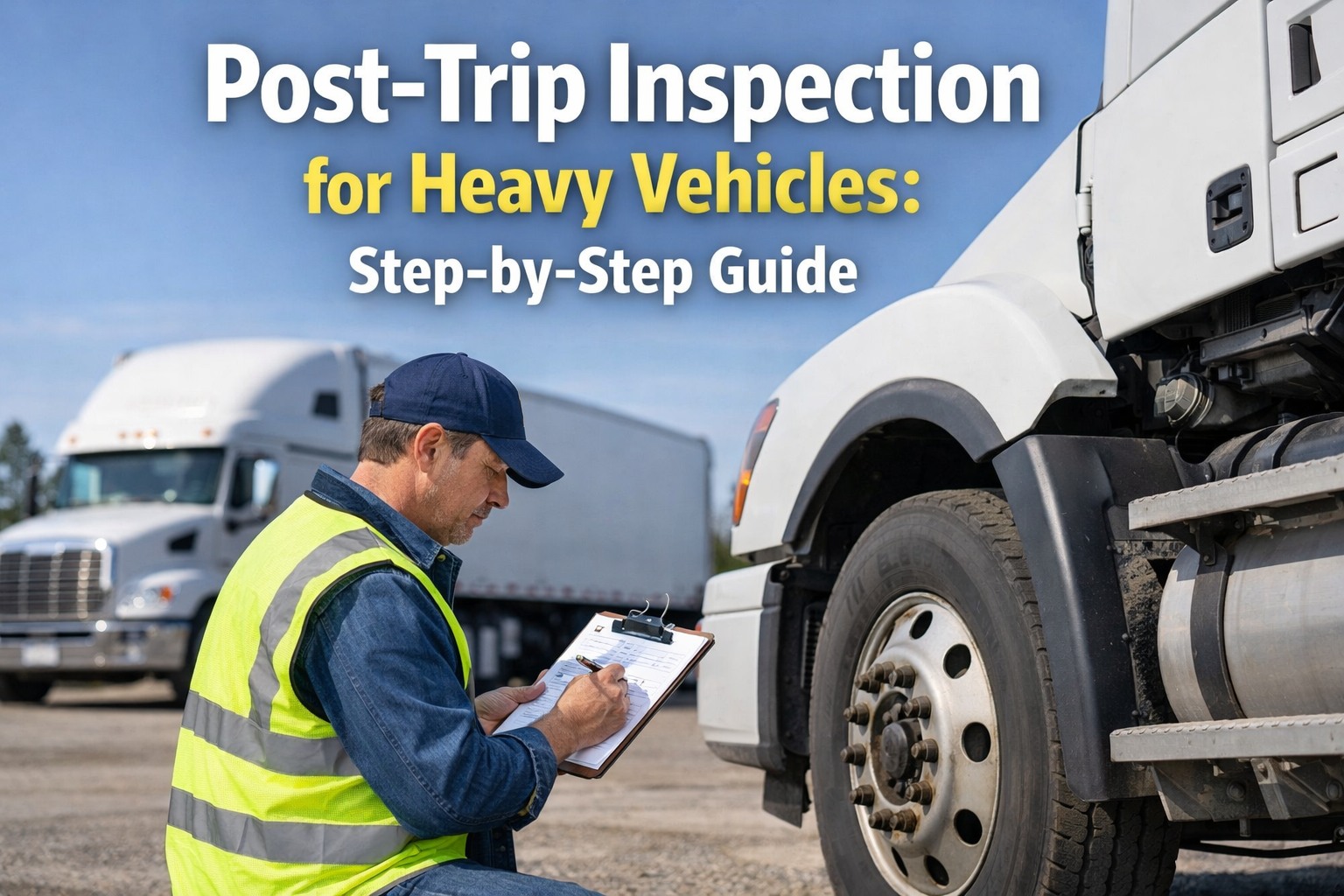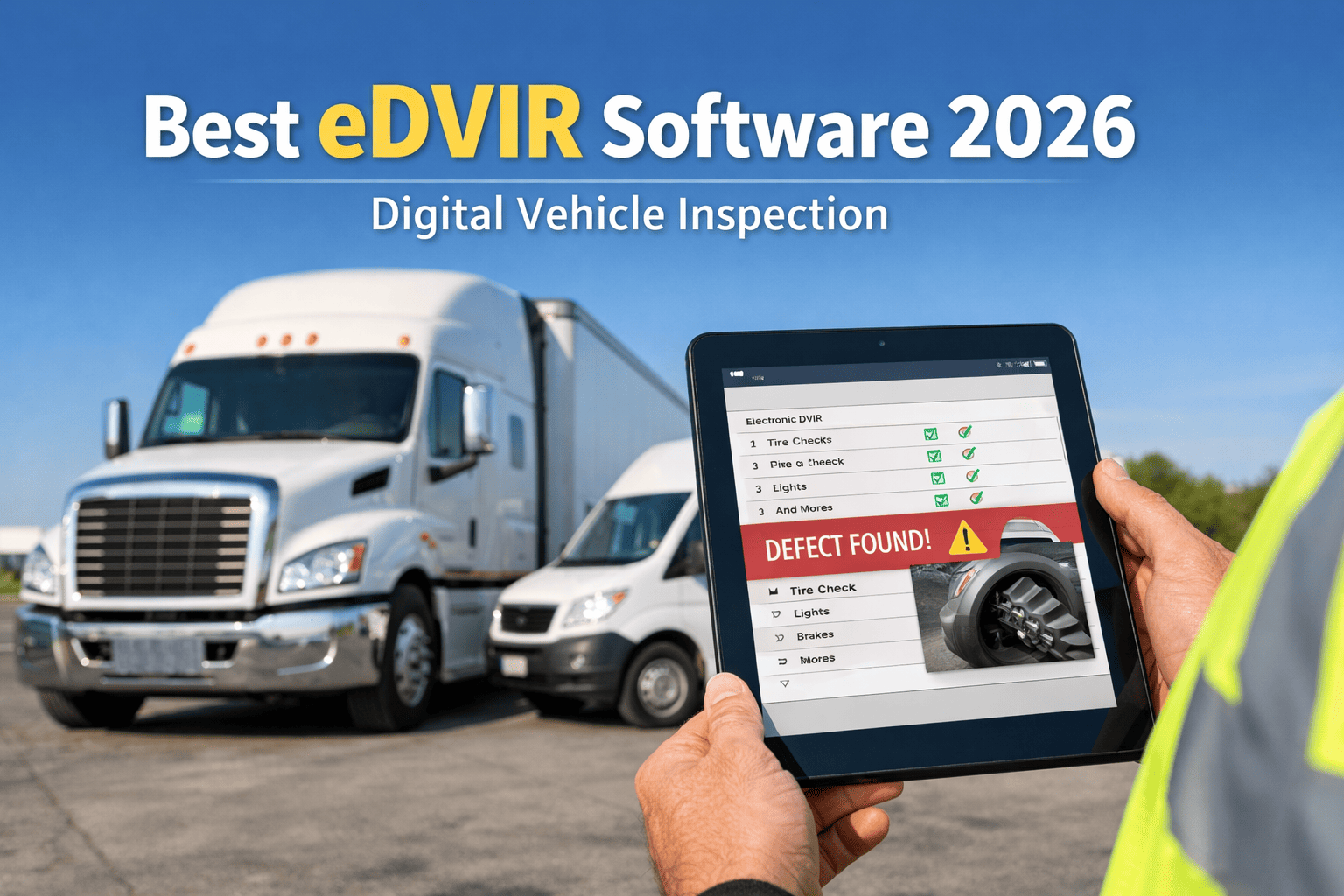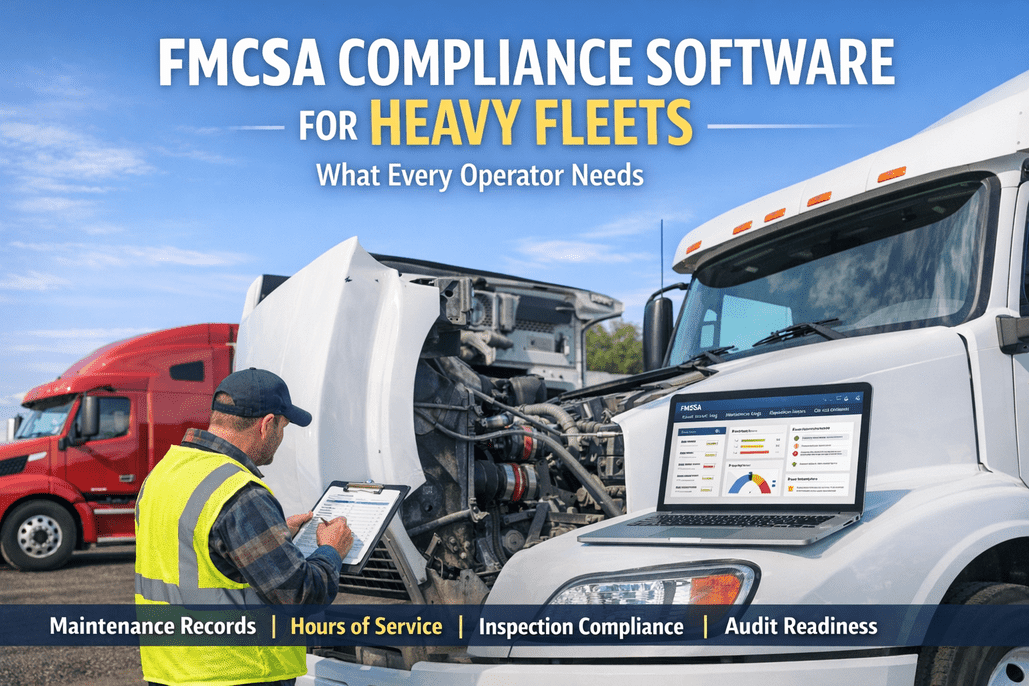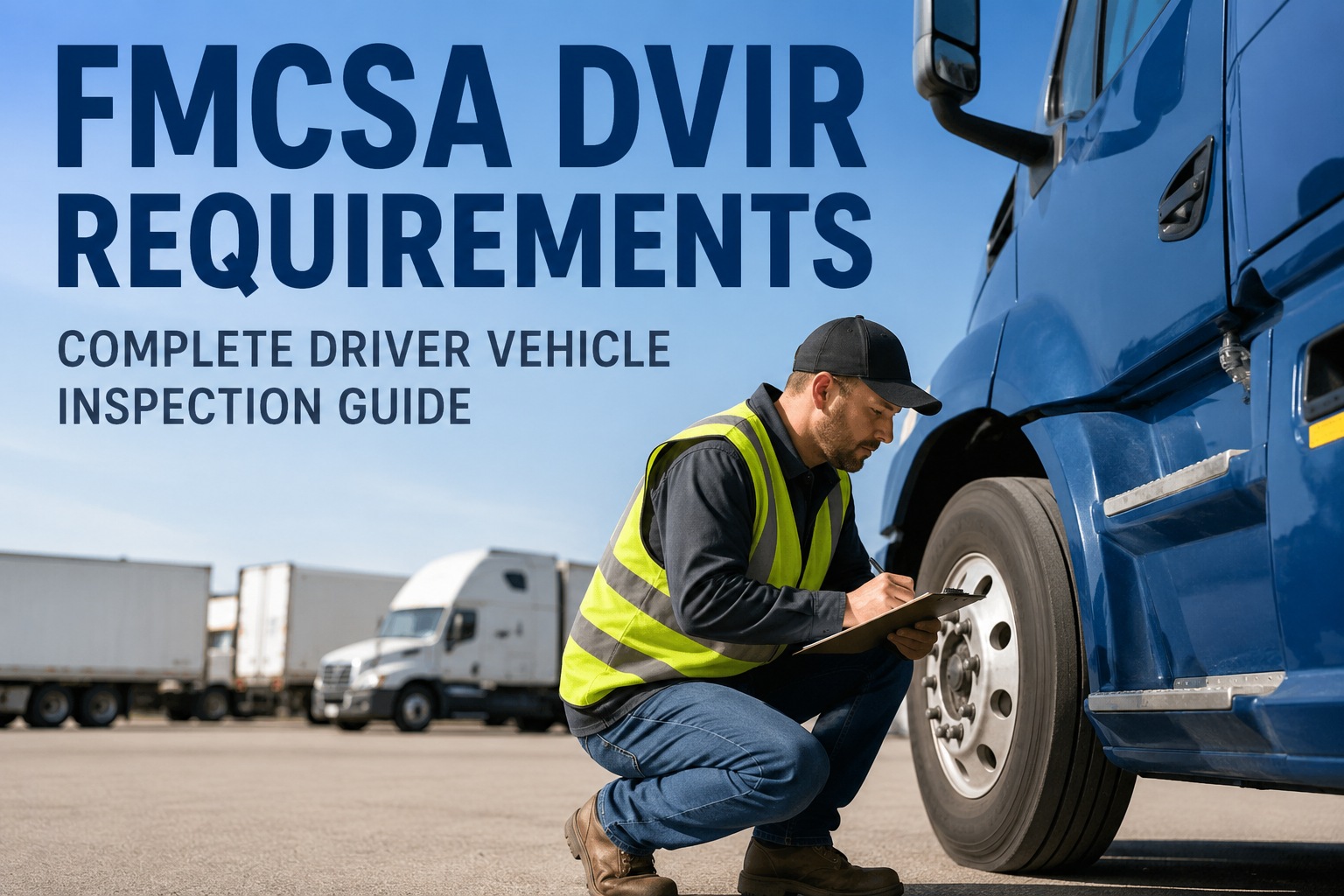
FMCSA DVIR requirements — the federal Driver Vehicle Inspection Report rules codified under 49 CFR §396.11 and §396.13 — set the compliance floor every commercial motor carrier operates on. Get them right and you have a clean audit trail, defect-to-repair traceability, and a routine that catches issues before they turn into roadside citations. Get them wrong and you face fines starting at $200 per violation, escalating to $16,000+ for a pattern of falsified inspections, plus a compliance investigation that can end in operating authority suspension. This page walks the 15 inspection items FMCSA requires, the three signatures that make a DVIR legally complete, the five most common compliance mistakes and their fine ranges, and what electronic DVIR software does that paper forms simply cannot. Book a demo after you see the compliant DVIR mockup.
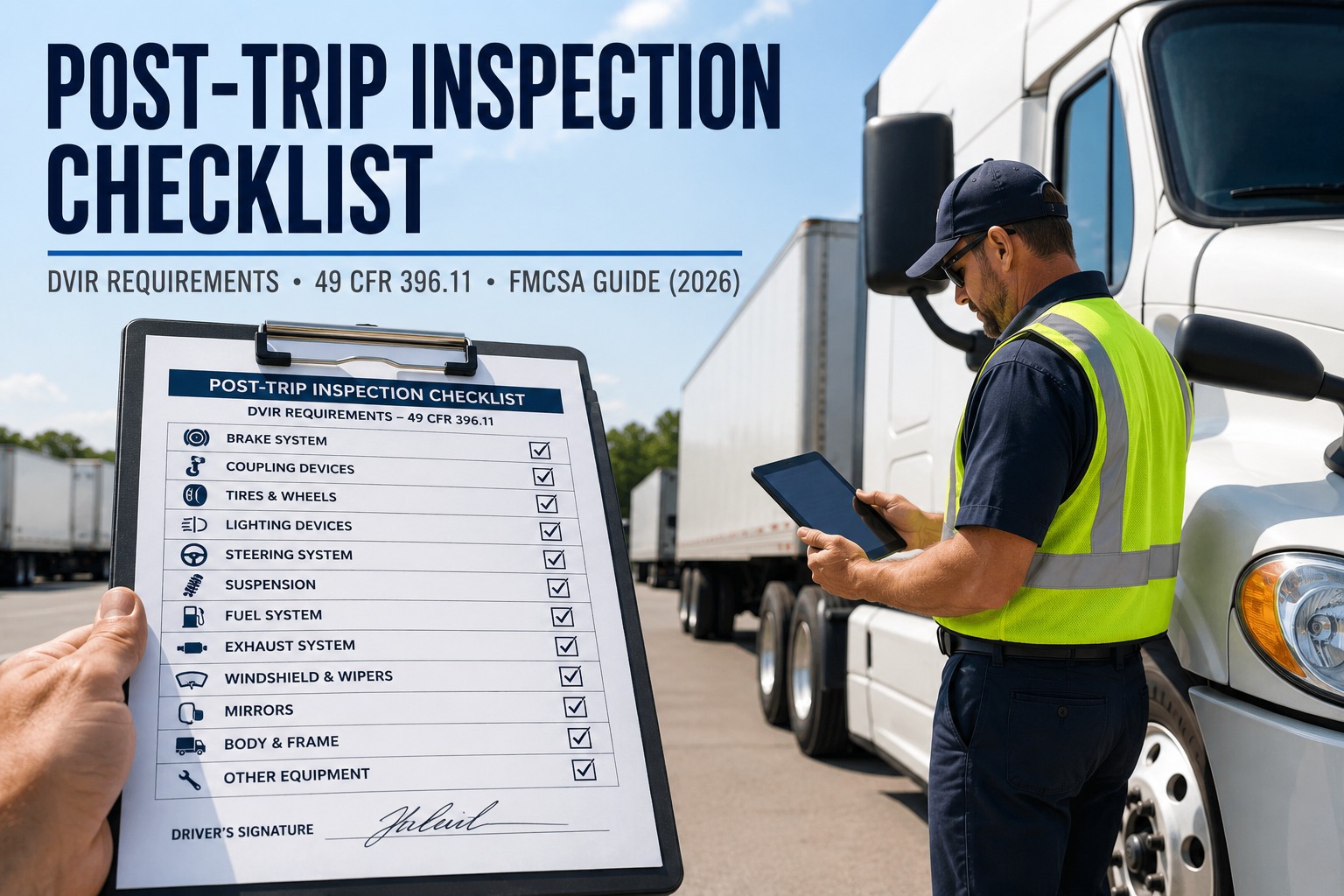
This is what a compliant FMCSA DVIR actually looks like.
Every item inspected. Every defect logged. Every signature in the chain accounted for. Below is the digital DVIR that keeps auditors moving through your file quickly — and violations out of your record.
Every element above is what FMCSA regulators expect to see when they open a DVIR during a compliance review: the 15 mandatory inspection items with pass/fail status, any defect logged clearly, and the three-signature chain (driver, mechanic, next driver) traceable end-to-end. Miss any piece and the DVIR is technically non-compliant — regardless of whether the truck was actually inspected. Below is exactly what the rules require, where compliance breaks down most often, and what electronic DVIR software brings to each step.
The 15 inspection items FMCSA DVIR requirements specify
49 CFR §396.11 lists 11 required inspection categories; most credible fleet DVIR programs add four more (fuel, exhaust, suspension, frame) that show up in roadside inspections and CSA scoring. That gets you to the standard 15-item DVIR you see on virtually every commercial fleet's inspection form. Grouped by function, they look like this.
- Service brakes (with trailer brake connection)
- Parking brake
- Coupling devices
- Steering mechanism
- Suspension
- Wheels & rims
- Tires
- Lighting devices & reflectors
- Windshield wipers
- Rear-view mirrors
- Horn
- Emergency equipment (flares, extinguisher, spare fuses)
- Fuel system
- Exhaust system
- Frame & body
Every item on the list has to be inspected pre-trip (per §396.13, driver satisfaction that vehicle is safe) and reported post-trip if any defect exists (per §396.11). A driver who signs "no defects" while a marker light is clearly out has just falsified a federal record — the classification carries fines up to $16,000+ per pattern and disqualifies operators from the CDL registry. Book a demo to see the 15-item DVIR captured on a driver's tablet
The 3 signatures that make a DVIR legally complete
A DVIR with a filled-out inspection list but incomplete signatures is not a compliant DVIR. FMCSA requires three distinct certifications in sequence, and each step has its own timing and legal effect. Missing any one voids the DVIR for compliance purposes even if the inspection itself was performed correctly.
Certifies inspection performed
Driver signs the DVIR at the completion of each day's work per §396.11. Lists any defects observed; signs "no defects" if the vehicle checks out clean. Legal certification: inspection actually happened.
Certifies repair or no repair needed
If defects were noted, mechanic must certify one of two things: repair was completed, or repair is not necessary for safe operation. Both classifications carry legal weight and must be documented on the DVIR itself.
Reviews prior DVIR & mechanic action
Next driver to operate the vehicle must review the prior DVIR and mechanic certification before departure and sign acknowledgment. This closes the chain and transfers legal responsibility for the vehicle's safe condition to the incoming driver.
On paper, this chain is where compliance most commonly breaks down — illegible signatures, missing timestamps, folders lost between the driver's clipboard and the shop's inbox. On electronic DVIR, each of the three steps produces a time-stamped signature with GPS location and cannot be skipped in the workflow. Start free and get the signature chain enforced by workflow on day one
The 5 most common FMCSA DVIR compliance mistakes and their fines
Roughly 90% of DVIR compliance violations FMCSA writes fall into five recurring patterns. Each has a specific fine range and each is preventable with the right process — the pattern of an entire fleet's DVIR record is what drives the difference between a routine audit and a Compliance Review that puts operating authority at risk.
Missing driver signature
$200 – $500 per violationThe single most common finding in FMCSA reviews. Paper DVIR forms fill out easily but forget the signature line at the bottom — especially at shift change on Friday. Electronic DVIR makes the signature step non-skippable in the workflow.
No mechanic certification when defects noted
$500 – $1,000 per violationDefect logged, repair completed, but nothing written back on the DVIR certifying the fix. Technically the vehicle went back into service uncertified. Electronic workflows tie work-order completion directly to the DVIR record so this gap can't open.
Missing next-driver review signature
$200 – $500 per violationHandoff DVIRs regularly skip the incoming driver's review-and-sign step, especially on quick turnaround runs. Digital DVIR blocks the truck's next assignment until the review is acknowledged.
Failing the 3-month retention rule
$1,000 – $2,000+ per violationFMCSA requires every DVIR to be retained for 3 months after preparation. Lost paper files, damaged binders, and departed compliance managers account for most retention failures. Digital retention is automatic and cannot decay.
Pattern of falsified DVIRs (pencil-whipping)
$16,000+ · CDL disqualificationThe most serious classification: a pattern of "no-defect" DVIRs on vehicles that were demonstrably defective — often surfaced when a roadside inspection finds a defect that "wasn't there" on the same day's DVIR. Fines run to $16,000+ per pattern, CDL disqualification, and can end operating authority.
The pattern is worth reading twice: paper DVIR isn't just slower than electronic — it's actively riskier because the failure modes above are structurally hard to prevent on paper and structurally hard to allow on digital. Book a demo to see the five failure modes prevented by workflow
6 things electronic DVIR software does that paper can't
Electronic DVIR isn't just "the same form on a tablet." Six specific capabilities separate a compliant digital DVIR from a scanned paper form — and each of them closes a compliance gap the five mistakes above expose.
GPS-stamped signatures
Every signature captured with time, date, and GPS location. Auditors get certainty that the signature happened at the vehicle, not the desk.
Automatic 3-month retention
Every DVIR archived in the cloud the moment it's signed. Retention window enforced by the software, not by whoever remembers to file the paper.
Defect → work order routing
Any defect logged on the DVIR opens a work order automatically, routes it to the shop, and locks the truck's next assignment until the mechanic certifies the fix. No manual handoff step.
Photo attachment on defects
Drivers photograph the defect on the same tablet. Auditors and mechanics see the actual condition, not just a text description that could be misread or contested.
Fleet-wide compliance dashboard
Every DVIR status visible across the fleet in real time: which trucks have signed DVIRs, which have open defects, which are approaching audit thresholds. One screen instead of a file cabinet.
One-click audit-ready export
When FMCSA requests DVIRs for a compliance review, filtered export by date range, vehicle, or driver produces the record in seconds. Auditors move through the file in minutes instead of days.
The upcoming FMCSA electronic DVIR rule (effective March 2026) explicitly permits and encourages digital records with equivalent legal weight to paper — provided the software meets specific requirements around signature authenticity, timestamp integrity, and retention. Modern platforms are built to those specs by default. Book a demo to see the compliant workflow end-to-end — or start free and file your first electronic DVIR this week .
From a compliance manager who switched off paper
We ran paper DVIRs for 20 years. Every FMCSA audit was three days of pulling folders from the file cabinet, and about 20% of them had missing signatures or unreadable handwriting. Every finding was a $250 to $500 fine per violation, and we averaged 12 to 15 findings per audit.
We moved to electronic DVIR last spring. First FMCSA audit under the new system took 40 minutes total. Auditor was in and out. Zero findings on the 90 DVIRs he pulled. That's the difference: paper is a compliance risk, digital is compliance proof.
Frequently asked questions
What is a DVIR under FMCSA rules?
A DVIR — Driver Vehicle Inspection Report — is the federally mandated inspection record that documents the condition of a commercial motor vehicle at the end of each day's work. Codified under 49 CFR §396.11 and §396.13, the DVIR requires that a driver inspect specific vehicle systems (brakes, steering, tires, lights, and others totaling roughly 15 categories in standard practice) and formally certify the vehicle's condition through signature. If any defect is found, it must be recorded on the DVIR; a mechanic must then certify either repair completion or a determination the defect does not affect safe operation; and the next driver must review and acknowledge the prior DVIR before departure. FMCSA uses the DVIR record as the primary compliance artifact during Compliance Reviews, and a pattern of missing, incomplete, or falsified DVIRs is one of the most common triggers for regulatory action.
When is a DVIR required to be prepared?
Under current FMCSA rules, a post-trip DVIR must be prepared at the completion of each day's work only when the driver has identified defects that affect safe operation. A 2014 rule change removed the requirement for a "no-defect" DVIR at the end of every day for carriers operating owned equipment — drivers still perform the inspection under §396.13, but a paper record is only required if defects exist. Intermodal equipment providers (chassis and container operators) are still required to submit DVIRs at the completion of every dispatch regardless of defect status. In practice, many carriers continue to require no-defect DVIRs as internal company policy because the record proves the inspection was performed and creates the audit trail that protects the carrier if a roadside inspection later finds a defect. Pre-trip inspections under §396.13 are always required — the driver must be satisfied the vehicle is in safe operating condition before every trip — but the pre-trip does not produce a formal DVIR record unless defects are found.
What are the 15 items on an FMCSA DVIR?
49 CFR §396.11 explicitly lists 11 required inspection categories: service brakes (including trailer brake connections), parking brake, steering mechanism, lighting devices and reflectors, tires, horn, windshield wipers, rear-view mirrors, coupling devices, wheels and rims, and emergency equipment. Standard commercial fleet practice adds four more categories that show up in roadside inspections and CSA scoring: fuel system, exhaust system, suspension, and frame/body. That gets to the 15-item DVIR checklist used on virtually every commercial fleet's inspection form. The specific items included above the regulatory floor vary slightly by carrier and vehicle type — hazmat carriers add tank integrity checks, refrigerated carriers add reefer unit checks, tanker operators add discharge valve inspection. The core 11 are non-negotiable; the additional items are best-practice discipline that also happens to improve CSA scores and reduce roadside citations.
How long must FMCSA DVIRs be retained?
FMCSA requires DVIR retention for a minimum of 3 months after the report is prepared, per 49 CFR §396.11(c). This applies to every DVIR generated — whether it noted defects or not. The 3-month window covers the typical compliance review lookback during a Safety Audit or Compliance Review. Best-practice carriers retain DVIRs significantly longer — 12 months to 3 years is common — because DVIRs also serve as evidence in accident investigations, insurance disputes, and internal maintenance planning. Electronic DVIR systems handle retention automatically, storing records indefinitely in the cloud without the physical space and file management burden of paper. Retention failures (lost binders, damaged files, records not produced during an audit) drive $1,000 to $2,000 per DVIR in fines and are one of the top-five compliance mistakes.
Is electronic DVIR compliant with FMCSA?
Yes. FMCSA has recognized electronic DVIRs as legally equivalent to paper for years, and the upcoming electronic DVIR rule (effective March 2026) formalizes the standard: an electronic DVIR is compliant provided it captures the same required information as paper (all 11-plus inspection categories, defect notation, and the three-signature chain), preserves signature authenticity, maintains timestamp integrity, meets the 3-month retention window, and can be produced in a readable format when requested. Every modern electronic DVIR platform is built to those requirements by default. Beyond regulatory equivalence, electronic DVIR offers structural advantages paper cannot match — GPS-stamped signatures, automatic retention, workflow enforcement that prevents the five common compliance mistakes, and audit-ready export. Fleets moving from paper to electronic DVIR routinely report FMCSA audit times dropping from days to minutes and finding rates dropping to zero.
Turn your next FMCSA audit into a 40-minute file review
HVI captures every DVIR digitally with time-stamped, GPS-verified signatures across the full driver-mechanic-next-driver chain; routes defects into work orders automatically; enforces the 3-month retention window; and produces filtered audit exports in one click. Live in under two weeks — and the first compliance review under the new system typically finishes with zero findings.
No credit card · No hardware · DVIR ready day one