FMCSA §396.13 sets three specific driver duties before operating any commercial motor vehicle: be satisfied the vehicle is in safe operating condition, review the last driver vehicle inspection report when required by §396.11(a)(2)(i)and sign the report to acknowledge review and that required repairs have been certified. Signature requirement does not apply to listed defects on a towed unit no longer part of the combination. Records may be maintained electronically per 49 CFR 390.32. Book a demo .
FMCSA §396.13 — Driver Inspection Requirements Before Operating
Three sequential driver duties before operating any CMV. Not to be confused with §396.11 recordkeeping. Signature exception applies to detached towed units. Electronic records authorized per §390.32.
Active affirmative driver duty. Not passive assumption — driver must ascertain the vehicle can be operated safely. Applies before every operation regardless of whether a prior DVIR exists.
Cross-references §396.11 which requires DVIR when defects/deficiencies exist. Review means actual reading — driver must know what was reported and what corrective action was taken.
Two things acknowledged in one signature: (1) driver reviewed the report, (2) required repairs have been certified as performed. Towed unit signature exception applies where noted.
FMCSA 49 CFR §396.13 — "Driver inspection" — sets three specific duties every driver must complete before operating a commercial motor vehicle: (a) be satisfied that the motor vehicle is in safe operating condition, (b) review the last driver vehicle inspection report if required by §396.11(a)(2)(i), and (c) sign the report to acknowledge review and that required repairs have been certified. The regulation is short but operationally critical because it puts the pre-operation safety burden on the driver personally — not on the fleet, not on the mechanic, not on dispatch. The driver's signature closes the DVIR loop that starts with the prior driver's defect report and continues through the mechanic's repair certification. Confusing §396.13 with §396.11 is one of the most common compliance patterns; they work together, but they're separate regulations with separate audit exposure.
§396.13 vs §396.11 — the driver rule and the recordkeeping rule are distinctTwo regulations, two audit exposures, one connected DVIR workflow
The two regulations sit adjacent in Part 396 and both involve DVIRs, so treating them as one is the most common compliance framing error. They cover different duties, apply to different parties, and produce separate audit findings. A fleet can be compliant with §396.11 (proper DVIR recordkeeping) and non-compliant with §396.13 (driver review + signature discipline), and the reverse. Book a demo to see per-regulation DVIR records
§396.13(a): satisfied that the motor vehicle is in safe operating conditionThe affirmative driver duty that applies before every operation regardless of DVIR status
Section 396.13(a) is the broadest driver duty in Part 396. Every driver, before operating any commercial motor vehicle, must be satisfied that the vehicle is in safe operating condition. The word "satisfied" is deliberately active — the driver must reach an affirmative determination based on some form of inspection or verification, not simply climb into the cab and start driving.
The safe-condition duty applies before every CMV operation, not just at shift start or after a long break. A driver taking over a vehicle mid-shift, resuming after a fuel stop, or picking up a vehicle from a shop for a road test all face the same §396.13(a) duty to be satisfied of safe operating condition.
Even when no prior DVIR exists (new vehicle assignment, first operation of the day for a vehicle with no defects reported), §396.13(a) still applies. Safe-condition ascertainment is the driver's baseline duty; DVIR review under §396.13(b) is an additional layer that triggers when a prior DVIR exists.
§396.13(a) harmonizes with §392.7 pre-trip inspection requirements — the driver must inspect the same category of items (service brakes, parking brake, steering, lights, tires, horn, mirrors, coupling, emergency equipment) to reach the "satisfied" determination. Digital pre-trip templates aligned to §392.7 categories produce the operational discipline §396.13(a) contemplates.
Undocumented pre-trip inspection is a frequent audit finding tied to §396.13(a). Without a documented pre-trip record showing what the driver checked and confirmed, the "satisfied of safe operating condition" determination is difficult to prove after the fact — particularly in incident investigations where the driver's pre-operation ascertainment becomes a key question.
Digital pre-trip templates aligned to §392.7 inspection categories produce the documented record that satisfies §396.13(a) proof-of-ascertainment requirements. Book a demo to see HVI's §392.7-aligned pre-trip templates
§396.13(b) + (c): review the last DVIR + sign to acknowledgeWhen review is triggered, what signature acknowledges, and the towed unit exception
Sections 396.13(b) and 396.13(c) work as a paired duty: when §396.11(a)(2)(i) requires a prior DVIR, the driver about to operate must review it AND sign the report acknowledging two things at once — that they reviewed the report AND that there is a certification that required repairs have been performed. Start a free trial to configure driver acknowledgment templates.
What "review" means operationally: The driver must actually read the last DVIR — know what was reported by the prior driver, know what corrective action was documented, know what repair certification exists. Passive receipt of the DVIR isn't review; active reading is.
When it's triggered: §396.11(a)(2)(i) requires review when a prior DVIR exists for the vehicle. Not every operation triggers §396.13(b) — only operations of vehicles for which a DVIR exists per §396.11 requirements.
Two things in one signature: The signature acknowledges (1) that the driver has reviewed the DVIR, AND (2) that there is a certification that the required repairs have been performed. Both acknowledgments are captured in the same signature; a driver signing acknowledges both.
Signature exception: The signature requirement does NOT apply to listed defects on a towed unit which is no longer part of the vehicle combination. Applies specifically to the scenario where a towed unit (trailer, etc.) with listed defects is no longer being operated in the combination.
Electronic DVIR permitted: The reports required by §396.13 may be created and maintained in electronic format in accordance with 49 CFR §390.32. Electronic DVIRs meeting §390.32 requirements satisfy the §396.13 record and signature requirements just as paper DVIRs do.
What §390.32 requires: Electronic records must be readily accessible, capable of being produced in printed format upon request, and maintained with integrity throughout the retention period. Electronic signature meeting §390.32 standards satisfies the §396.13(c) signature requirement.
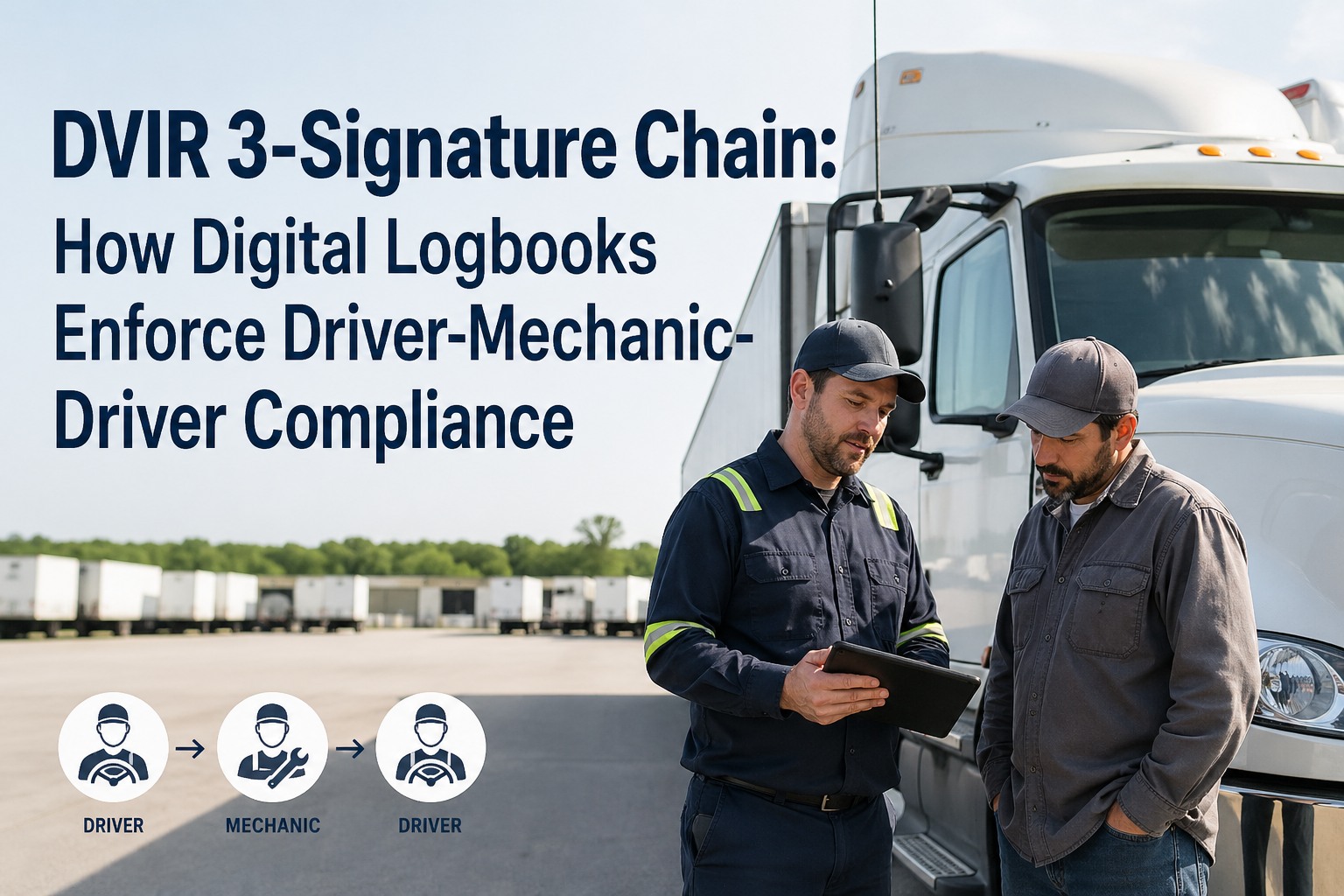
The multi-signature DVIR chain — where §396.13 fitsReporting driver, mechanic, and next driver signatures across §396.11 and §396.13
The full DVIR compliance chain spans both §396.11 (post-trip reporting + repair certification) and §396.13 (driver review + acknowledgment). Every driver-facing signature in the chain has a specific regulatory basis. Understanding which regulation drives which signature is what separates fleets that pass DVIR audits from fleets that repeatedly cite the same missing links.
Driver completing shift documents any defects affecting safe operation or likely to cause breakdown, or certifies "no defects" (where fleet policy requires). Signature is the reporting driver's attestation to the DVIR content.
Motor carrier's mechanic or authorized person addresses defects, then signs the DVIR certifying that repairs were performed OR that repair is not necessary for safe operation. This is the middle link in the chain.
Driver about to operate the vehicle reviews the DVIR (§396.13(b)) and signs acknowledging both the review AND that required repairs have been certified (§396.13(c)). Signature closes the loop and authorizes operation.
Dispatch-blocking workflow — where a vehicle cannot be released to a next driver until every required signature is captured — is the operational discipline that closes the multi-signature chain automatically. Book a demo to see HVI's chain enforcement workflow
From a fleet safety manager on §396.13 driver discipline
The finding that changed how we run driver acknowledgments wasn't about missing signatures — every driver was signing the DVIR handoff. The finding was that the auditor asked our drivers, on the spot, to explain what defects were reported by the prior driver on the truck they were operating that morning. Three of five drivers couldn't answer. They had signed acknowledging review, but they hadn't actually reviewed. The signature was a habit, not a duty.
What we changed was the DVIR review interface. Instead of a signature at the bottom of a form, the driver now sees the specific defects the prior driver reported and the specific repair certification the mechanic entered, and has to tap through each item before the signature button becomes active. Same regulation, same signature — different workflow that forces actual review before acknowledgment. Six months in, our drivers can answer the auditor's question consistently because they actually saw what they signed for. §396.13(b) says review; the workflow needs to make review the only path to the signature.
Frequently asked questions
What are the FMCSA 396.13 driver inspection requirements?
Under 49 CFR §396.13, before driving a motor vehicle, the driver shall: (a) be satisfied that the motor vehicle is in safe operating condition — an active affirmative duty to ascertain that the vehicle can be operated safely, applied before every CMV operation regardless of whether a prior DVIR exists; (b) review the last driver vehicle inspection report if required by §396.11(a)(2)(i) — when a prior DVIR exists for the vehicle, the driver must actually read it to know what was reported and what corrective action was taken; and (c) sign the report to acknowledge that the driver has reviewed it and that there is a certification that required repairs have been performed. The signature requirement does not apply to listed defects on a towed unit which is no longer part of the vehicle combination. Per §396.13(d), reports may be created and maintained in electronic format in accordance with 49 CFR §390.32. The three duties bracket every pre-operation moment: satisfied of safe condition, review last DVIR, sign to acknowledge. §396.13 is the driver-side rule; §396.11 is the recordkeeping rule; together they build the multi-signature DVIR chain that dispatch depends on.
What must a driver do before operating a commercial vehicle?
§396.13(a) requires every driver, before operating a commercial motor vehicle, to be satisfied that the vehicle is in safe operating condition. This is an active affirmative duty — the driver must reach an affirmative determination based on some form of inspection or verification, not simply climb into the cab and start driving. The safe-condition duty harmonizes with §392.7 pre-trip inspection requirements which specifies the categories of items the driver must inspect (service brakes and trailer brake connections, parking brake, steering mechanism, lighting devices and reflectors, tires, horn, windshield wiper or wipers, rear-vision mirror or mirrors, coupling devices, and emergency equipment). The safe-condition duty under §396.13(a) applies before every operation regardless of whether a prior DVIR exists, applies to every driver taking control of the vehicle (including drivers resuming operation mid-shift after a break), and is independent of the DVIR review and signature requirements under §396.13(b) and (c). Undocumented pre-trip inspection is a frequent audit finding tied to §396.13(a) — without a documented record showing what the driver checked, the "satisfied of safe operating condition" determination is difficult to defend particularly in post-incident investigations.
When must a driver review the previous DVIR?
Under §396.13(b), the driver must review the last driver vehicle inspection report when required by §396.11(a)(2)(i). §396.11(a)(2)(i) requires review when a prior DVIR exists for the vehicle — typically triggered by the prior driver's post-trip DVIR documenting defects or deficiencies. The scope of "review" is operational: the driver must actually read the last DVIR, know what was reported by the prior driver, and know what corrective action was documented (repair performed or repair not necessary for safe operation, as certified by the mechanic under §396.11). Passive receipt of the DVIR — picking it up from a slot or having it handed over — is not review; active reading is. In practice, many fleets face compliance challenges here not because signatures are missing but because signatures are given without the review actually happening. Digital DVIR review interfaces that require the driver to tap through each documented defect and each repair certification before the signature button becomes active enforce the actual review that §396.13(b) contemplates. The signature under §396.13(c) attests to both review having occurred AND to the existence of repair certification; a signature without actual review satisfies the form but not the substance of the regulation.
Can DVIR records be electronic under FMCSA 396.13?
Yes — §396.13(d) explicitly authorizes electronic DVIR records. The reports required by §396.13 may be created and maintained in electronic format in accordance with 49 CFR §390.32. Electronic DVIRs meeting §390.32 requirements satisfy the §396.13 record and signature requirements just as paper DVIRs do. §390.32 electronic records requirements include: records must be readily accessible, must be capable of being produced in printed format upon request from authorized federal, state, or local officials, and must be maintained with integrity throughout the required retention period. Electronic signature meeting §390.32 standards satisfies the §396.13(c) signature requirement — the signature does not need to be handwritten to be regulatory-compliant. While electronic DVIRs have been permitted since 2018 under §390.32, the explicit authorization language was added directly to §396.13 (and §396.11) through amendments to make the electronic option unambiguous. Practical benefits of electronic DVIRs beyond simple regulatory compliance include automated multi-signature chain tracking (dispatch can be blocked until every required signature is captured), timestamped signature records providing stronger audit-defensible evidence, and searchable multi-vehicle DVIR history supporting compliance-review response.
How does HVI support §396.13 driver inspection compliance?
HVI provides the digital DVIR templates, driver acknowledgment capture, repair certification workflow, and electronic records per §390.32 that §396.13 driver inspection compliance operates within. Features that apply to §396.13 workflow include: configurable pre-trip inspection templates aligned to §396.13(a) safe-condition ascertainment (harmonized with §392.7 inspection categories) producing documented pre-trip records; digital DVIR review interfaces supporting §396.13(b) prior-report review with defect and repair-certification visibility, showing the driver what was reported and what corrective action was taken before signature; driver electronic signature capture for §396.13(c) acknowledgment meeting §390.32 electronic records standards; multi-signature DVIR chain tracking supporting the full §396.11 + §396.13 workflow (reporting driver + mechanic + next driver) with dispatch-blocking until every signature is captured; and searchable multi-year records supporting compliance-review response and incident investigation. HVI is not itself an FMCSA compliance authority, driver certification body, legal compliance counsel, or roadside inspection authority — those functions remain with authorized regulatory personnel and qualified compliance professionals. What HVI provides is the digital DVIR infrastructure that turns §396.13 driver duties from a paper-signature workflow into a documented multi-signature chain with audit-ready records.
§396.13 says review; the workflow needs to make review the only path to the signature
HVI supports §396.13(a) safe-condition pre-trip templates, §396.13(b) prior-DVIR review interfaces with defect and repair-certification visibility, §396.13(c) driver electronic signature capture, and §396.13(d) electronic records per §390.32 — the digital DVIR infrastructure that closes the multi-signature chain automatically and turns driver duties into documented workflow.
No credit card · No hardware · Setup in minutes