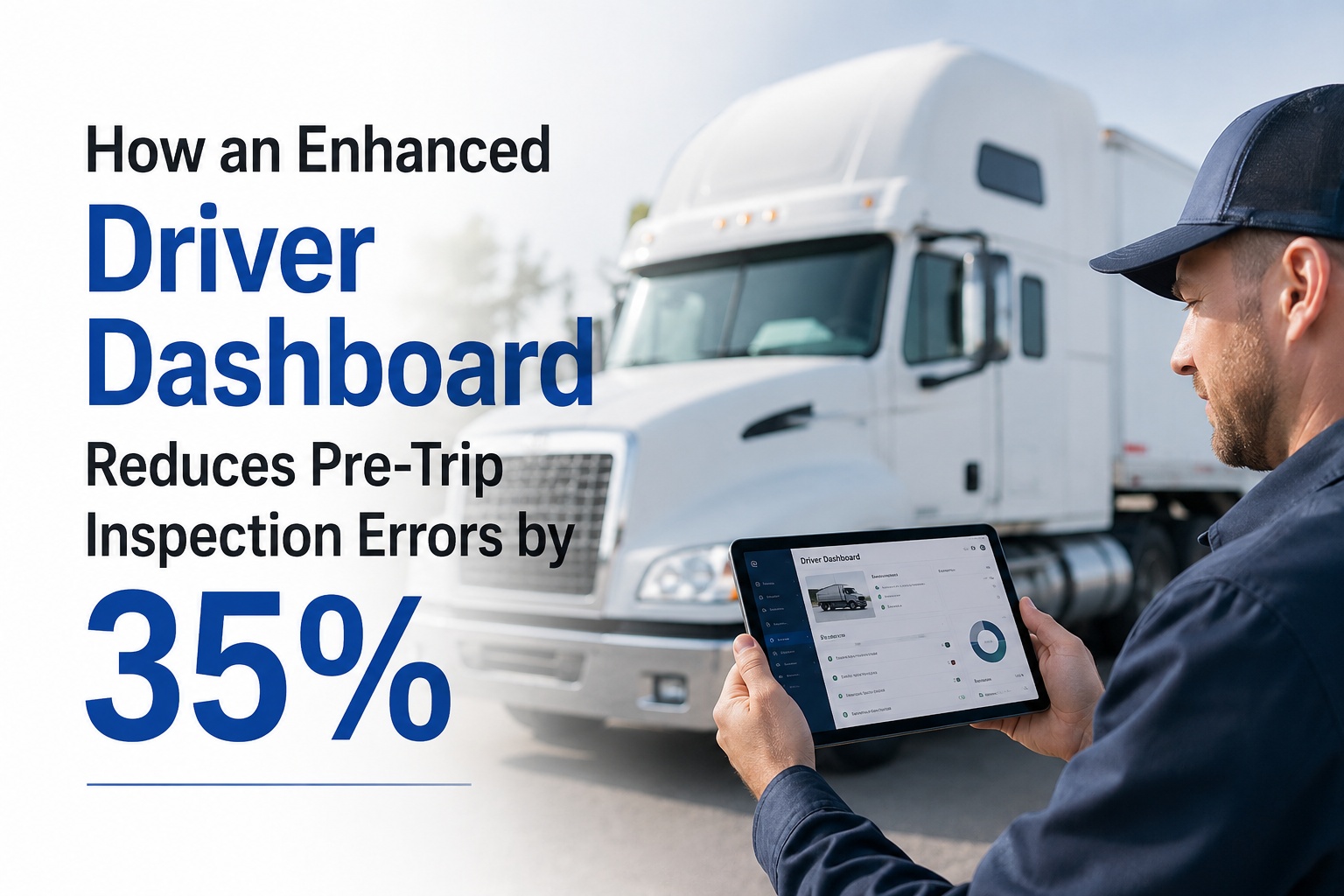
Pre-trip inspections are the single most important compliance task drivers perform each shift — and one of the most frequently rushed, skipped, or "rubber-stamped" tasks across commercial fleets. FMCSA estimates proper DVIRs prevent approximately 14,000 accidents every year, yet only 7% of motor carriers pass focused compliance reviews without a DVIR citation. The gap between what pre-trip inspections are supposed to do and what they actually do in paper-based operations is enormous — and it's driven almost entirely by interface design. Drivers using paper clipboards average 35-40% defect miss rates because the workflow itself encourages shortcuts. Drivers using enhanced digital dashboards built specifically for inspections drop that miss rate to 5-10% — a 35% reduction in inspection errors that directly translates to fewer OOS violations, better CSA scores, lower insurance premiums, and fewer roadside surprises. This guide covers exactly how enhanced driver dashboards reduce pre-trip inspection errors, the specific UI features that drive the 35% improvement, dashboard workflow examples, and how HVI's driver dashboard delivers each capability inside a fleet-grade compliance platform. Start your free HVI trial or book a 30-minute demo to see the dashboard live.
HVI's driver dashboard turns pre-trip from a clipboard formality into a guided, photo-verified workflow. 35% fewer inspection errors, 90%+ driver adoption within 30 days, and a structurally enforced 3-signature chain.
What is an enhanced driver dashboard for pre-trip inspections?
An enhanced driver dashboard for pre-trip inspections is a mobile-first digital interface that replaces paper clipboards with a guided, photo-verified workflow — auto-loading the right checklist for the assigned vehicle, requiring photo evidence at every safety checkpoint, GPS-stamping each inspection, presenting the prior DVIR for review, and routing defects directly to maintenance work orders. The result is a documented 35% reduction in pre-trip inspection errors compared to paper-based workflows.
Enhanced driver dashboards differ from basic digital DVIR apps by combining the inspection workflow with vehicle telematics data, prior-DVIR review enforcement, photo-evidence requirements, time-tracking analytics, and integration with the broader fleet maintenance platform. HVI's driver dashboard was built specifically for this purpose — a single mobile app that handles 49 CFR § 392.7 pre-trip checklists, § 396.11 DVIRs, and the complete defect-to-repair chain.
Why do paper-based pre-trip inspections fail so often?
The 35-40% defect miss rate on paper inspections isn't a driver problem — it's a workflow problem. Five structural failures plague every paper inspection program regardless of driver experience or fleet size.
Paper checkmarks prove nothing. Drivers can "complete" an entire inspection from inside the cab. No proof the walk-around actually happened.
Paper DVIRs sit in a filing cabinet. New driver gets keys, walks out, drives away. Acknowledgment signature gets skipped — the most-cited DVIR audit violation.
A proper pre-trip takes 10-15 minutes. Paper systems can't tell whether the driver took 12 minutes or 90 seconds. Rushed inspections look identical to thorough ones.
Driver fills out paper DVIR, leaves it in a folder. Maintenance team never sees the report. Vehicle dispatches with unrepaired defect — up to $15,420 fine.
Generic paper forms don't match vehicle specifics. Drivers check items that don't apply, miss items that matter. Reefer units, hazmat-rated assets, specialty equipment all get the same form.
Paper smudges, gets wet, gets lost between truck and office. Auditors find incomplete or illegible records — 92% of paper systems fail modern FMCSA audits.
How does an enhanced driver dashboard reduce errors by 35%?
The 35% reduction in pre-trip inspection errors comes from six specific dashboard capabilities that structurally prevent the failure modes above. HVI's driver dashboard delivers each.
Driver scans QR or selects vehicle — the right checklist auto-loads for that specific asset (tractor, reefer, hazmat, specialty). All 11 FMCSA components plus vehicle-specific items.
Critical components (brakes, tires, lighting, coupling) require photo evidence to pass. Can't complete inspection without proof the walk-around actually happened.
Every checkpoint geotagged at the vehicle location. No more "signed from the cab" inspections. Each step timestamped — auditors see real inspection duration.
Pre-trip workflow blocked until driver reviews prior DVIR and acknowledges repair status. The 3-signature chain is enforced structurally, not procedurally.
Defect flagged = work order auto-created with vehicle, defect description, severity, photo evidence, and assigned technician. Defects never sit in a folder.
Dashboard rates each inspection on time, completeness, photo quality, and consistency. Manager review flags suspicious patterns. Rushed inspections surface immediately.
What does an enhanced driver dashboard workflow actually look like?
The shift from paper to enhanced dashboard isn't just digitization — it's a fundamentally redesigned workflow. Here's how a real driver's pre-trip looks in 2026 with HVI's dashboard, step by step.
App authenticates driver via biometric/PIN. Vehicle identified from QR code (or selected from assigned list). Prior DVIR loads automatically if defects were reported.
If a prior DVIR exists with defects, driver reviews each item, sees repair certification by mechanic, and signs acknowledgment. Pre-trip cannot begin until this step completes.
Dashboard guides driver through all 11 FMCSA components in fixed sequence. Photo-required items prompt camera. GPS confirms driver is at the vehicle for each step.
Found defect = tap "report defect." Severity classification (critical/major/minor). Photo evidence attached. Voice-to-text notes for additional detail. Submitted in seconds.
Critical defects auto-block dispatch and notify maintenance + dispatch. Work order created instantly. Driver sees status of repair workflow in real time.
Inspection signed digitally. Stored permanently in cloud. Driver clears to dispatch (if no critical defects). Complete record audit-ready by default.
What ROI does an enhanced driver dashboard deliver?
The 35% inspection error reduction translates to measurable annual savings across multiple value streams. Below is the documented annual breakdown for a representative 50-vehicle heavy fleet running HVI's enhanced driver dashboard versus paper-based pre-trip inspections.
How does an enhanced dashboard improve fleet safety?
Beyond compliance and ROI, enhanced driver dashboards measurably improve safety outcomes. Three mechanisms drive the change.
Photo-required workflows + guided checklists drop defect miss rates from 35-40% to 5-10%. Brakes, tires, and lights — the top 3 OOS categories — all benefit from photo-evidence requirements.
Pre-trip workflow blocked until prior DVIR is reviewed and acknowledged. The 3-signature chain (driver-mechanic-driver) becomes structural, not procedural — eliminating the most-cited DVIR violation.
Inspection time analytics surface drivers averaging under 5 minutes (proper pre-trip = 10-15 min). Coaching opportunity caught before it becomes a roadside OOS — or worse, an incident.
FMCSA's own analysis: proper DVIRs prevent approximately 14,000 accidents every year through early defect identification. Enhanced dashboards drive "proper" from aspiration to default.
Frequently asked questions
Turn pre-trip inspections into your strongest compliance asset.
HVI's enhanced driver dashboard delivers every capability covered in this guide on one mobile-first platform — vehicle-specific guided checklists, photo-required checkpoints, GPS verification, prior-DVIR review enforcement, auto-WO routing, time analytics, and offline support. Most fleets see 35% inspection error reduction within the first quarter and 95%+ driver adoption within 30 days.
No credit card required · Live in 2-4 weeks · 95% driver adoption in 30 days