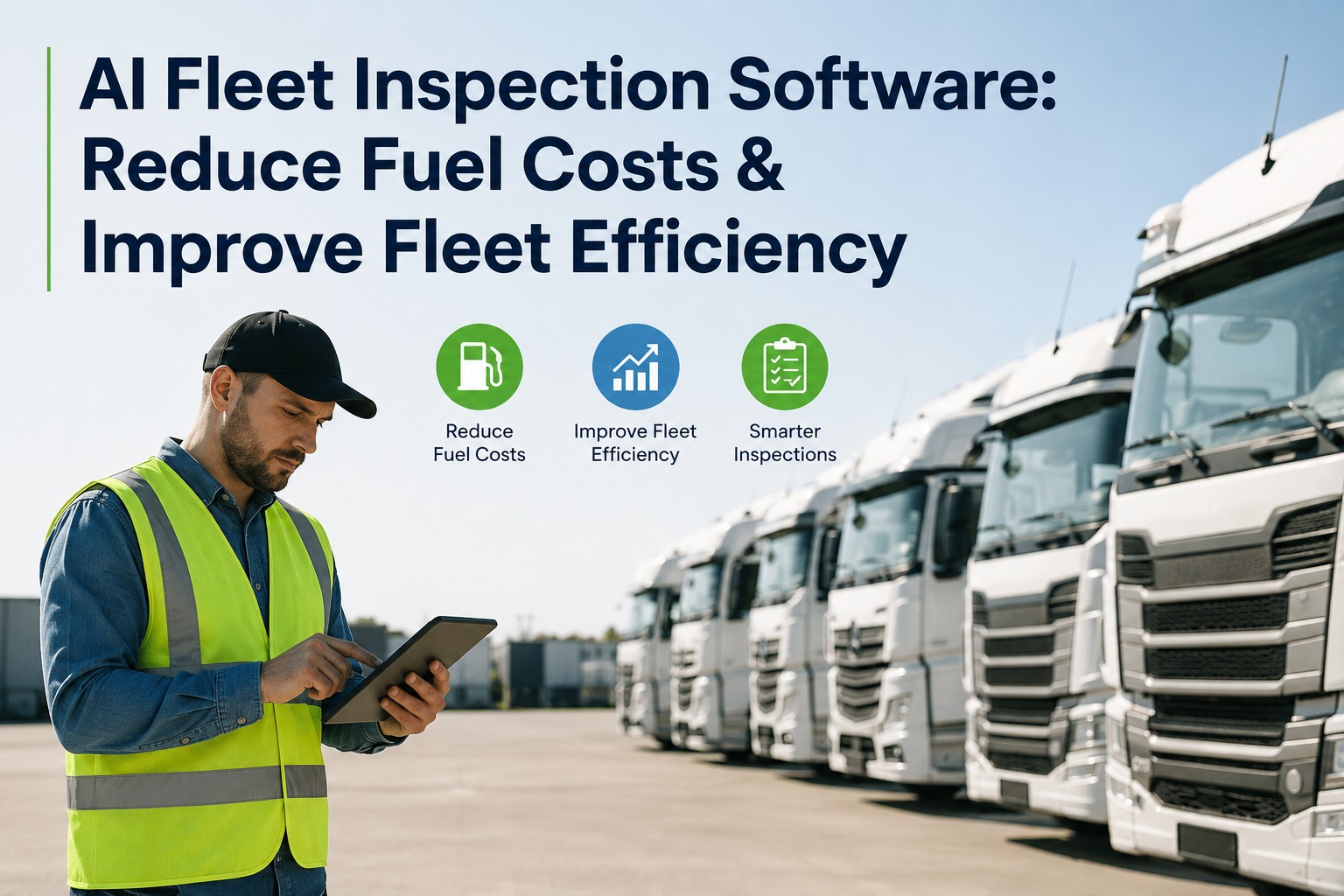
Fuel is one of the three largest costs in any fleet, eating 10–15% of total operating budget — and a punishing share of it is wasted on problems nobody can see. A slowly underinflating tire, a dragging brake, a clogged filter, an idling engine: each quietly burns money for weeks before it ever shows up as a breakdown. The trouble is that a typical commercial truck generates over 25,000 data points a day, and no human maintenance team can watch all of it across a whole fleet. That's exactly the gap AI fleet inspection software closes. By turning every inspection into structured data, learning each vehicle's normal fuel and performance baseline, and flagging the anomalies that signal a fuel-wasting fault, AI surfaces the problem while it's still a cheap fix. The results are real: fleets using AI report 8–15% fuel savings, and 40% report at least a 50% improvement in fuel, cost, and route efficiency. This guide breaks down how AI inspection software finds fuel waste, what it catches, the savings it delivers, and how to put it to work — no fleet-wide hardware rip-out required. book a 30-minute walkthrough to see it on your own fleet.
Your trucks already generate the data to cut fuel costs. AI is what finally reads it.
HVI turns every inspection into structured data, learns each vehicle's normal fuel and performance baseline, flags the anomalies that signal a fuel-wasting fault, and routes it to a repair — so the underinflated tire and dragging brake get fixed before they burn another tank.
The fuel waste hiding in plain sight
Most fuel waste isn't dramatic — it's slow, distributed, and invisible on a monthly fuel-card statement. The numbers show how much is on the table.
The problem was never data scarcity — it's that human teams can't monitor 25,000 daily signals per truck and spot the subtle combinations that waste fuel. A tire losing 2 PSI a week, an engine idling 30 minutes a shift, an MPG that's drifted 8% on one truck: each is buried in noise until something reads the whole picture. That's the job AI does.
How AI inspection software finds the waste
AI doesn't replace the inspection — it makes it intelligent. The shift is from a static checklist to a system that learns what normal looks like for each truck and flags when it drifts.
Capture inspection as data
Every pre-trip — tread, pressure, fluids, brakes, plus fuel and mileage — becomes structured data per vehicle instead of a paper checkmark that's filed and forgotten.
Learn each truck's baseline
The model builds a profile from that specific vehicle's history — not a generic industry average — so it knows what normal fuel use and performance look like for that truck.
Flag the anomaly
When readings drift from baseline in a pattern tied to a fuel-wasting fault, the system raises it — surfacing risk 20–45 days before traditional diagnostics would.
Route it to a repair
The flag auto-creates a work order, cutting the time from detected anomaly to completed repair from days to hours — before the fault burns another tank.
The key word is baseline. A generic threshold misses a truck that's quietly drifting but still "in range"; a per-vehicle baseline catches the drift the moment it starts, and the model gets sharper the longer it runs. HVI builds that per-vehicle profile from your own inspection and fuel data.
The fuel-wasting issues AI catches
Almost every mechanical fault that wastes fuel announces itself in the data first. These are the culprits AI inspection software surfaces before they drain the budget.
Each of these shows up as a fuel-economy drift the AI catches per truck — invisible on a fuel-card statement, obvious in the data. sign up free and let AI surface your fuel-wasting faults automatically, or book a demo to see anomaly detection live.
Beyond fuel: the compounding payoff
The same AI that finds fuel waste delivers a stack of adjacent savings — because a fuel-wasting fault is usually a developing failure too. Catch it early and you save twice.
Predictive maintenance
The anomaly that's burning fuel is often a component degrading. Catching it cuts unplanned breakdowns 20–40% and turns reactive repairs into planned ones.
Less downtime
Shrinking the gap from detected fault to completed repair from days to hours means fewer trucks on the shoulder and more working the route.
Longer asset life
A truck whose faults are caught early runs cleaner, wears slower, and holds resale value — the fuel savings are the visible edge of a healthier fleet.
annual ROI. Well-implemented AI fleet management typically returns 200–500% a year — fuel optimization at 8–15%, predictive maintenance cutting failures 20–40%, and better utilization on top. Most fleets see positive ROI within 3–6 months, and the first prevented breakdown often pays for the platform. The fuel savings alone justify it; everything else compounds. HVI delivers it from your existing inspection data.
Manual inspections vs. AI-powered HVI
Both technically run a pre-trip. Only one turns it into data, learns each truck's baseline, and flags the fuel-wasting drift weeks before a human would notice the fuel bill climb.
Manual / reactive
- Inspection is a checkmark, never analyzed
- Fuel waste blamed on prices, not faults
- Drift hidden in a fleet-wide average
- Problems found at breakdown, not before
- 25,000 daily data points per truck ignored
- Reactive repairs cost 3–5× planned ones
With AI-powered HVI
- Every inspection becomes structured per-vehicle data
- Fuel-wasting faults surfaced by anomaly detection
- Each truck measured against its own baseline
- Risk flagged 20–45 days before failure
- The data finally read, not just collected
- Anomaly auto-routed to a verified repair
The best part: this doesn't require ripping out your tech stack or wiring up every truck. The approach works from the inspection data you already collect, enriched by OBD-II or telematics where you have it — so you can start small and let the model sharpen as it runs.
Frequently asked questions
How does AI fleet inspection software actually reduce fuel costs?
It works by turning inspections into data and reading the signals humans can't. A single commercial truck generates over 25,000 data points a day, and no maintenance team can monitor all of it across a fleet to spot the subtle patterns that waste fuel. AI inspection software captures each pre-trip as structured per-vehicle data, learns that specific truck's normal fuel and performance baseline, and flags anomalies — an underinflating tire, a dragging brake, a clogged filter, excessive idling, fouled injectors — that signal a fuel-wasting fault, often 20–45 days before traditional diagnostics would. Because almost every fuel-wasting mechanical issue shows up as a measurable economy drift first, catching and fixing it restores MPG across the fleet. Fleets using AI optimization report 8–15% fuel savings, and 40% report at least a 50% improvement in fuel, cost, and route efficiency. HVI's inspection and maintenance software delivers this from your existing inspection data. sign up free and start cutting fuel waste.
What fuel-wasting problems can AI inspection software detect?
The common culprits are all detectable because they each show up as a fuel-economy drift before they become a breakdown. Underinflated tires add rolling resistance — every 10 PSI below spec costs roughly 10–15% of tread life and burns extra fuel. A dragging brake from a stuck caliper adds constant resistance the engine fights all day. Clogged fuel and air filters restrict flow and force the engine to work harder. Excessive idling burns fuel for zero miles and is the most common and most fixable waste. And fouled injectors or failing sensors disrupt combustion and the air-fuel mixture, quietly cutting MPG fleet-wide. The power of AI is that it spots these per truck, against each vehicle's own baseline, rather than waiting for the fault to become obvious. HVI's inspection and maintenance software surfaces these anomalies and routes each to a work order automatically. book a demo to see fuel-fault detection.
Do I need to install new hardware or sensors in every truck?
No. While telematics and OBD-II or J1939 connections enrich the data and sharpen predictions, AI inspection software works from the inspection data you already collect — turning each pre-trip into structured, per-vehicle data the model can learn from. That makes it accessible to fleets of any size, including those without a full telematics rollout, and you can always add deeper engine data later for richer anomaly detection. The point is that most of the value comes from systematically capturing and interpreting the data you already have, not from ripping out and replacing your tech stack. For fleets that do want engine-level signals, affordable OBD-II devices are an inexpensive add-on rather than a fleet-wide overhaul. HVI's inspection and maintenance software is built around this start-where-you-are approach. sign up free with no hardware required.
How accurate is AI at predicting fleet problems, and what's the ROI?
Modern machine-learning models achieve roughly 85–95% accuracy in predicting major component failures, surfacing risk 20–45 days before traditional diagnostics raise an alarm, with false-positive rates reduced to a manageable range and accuracy improving the longer the model runs on your fleet's data. On ROI, well-implemented AI fleet management typically returns 200–500% annually, driven by fuel optimization of 8–15%, predictive maintenance reducing failures 20–40%, fewer accidents, and better asset utilization. Most fleets see positive ROI within 3–6 months, and smaller fleets often see higher percentage ROI because a single prevented breakdown has an outsized impact on tight margins. In practice, the first prevented breakdown frequently pays for the platform. HVI's inspection and maintenance software is built to deliver that return from data you already generate. book a demo to model your fleet's ROI.
How does HVI use AI to cut fuel costs and improve efficiency?
HVI is an inspection and maintenance software platform that turns your fleet's inspection and fuel data into fuel savings. It captures every pre-trip as structured per-vehicle data, builds a behavioral baseline for each truck from its own history rather than a generic average, and flags the anomalies that signal fuel-wasting faults — underinflated tires, dragging brakes, clogged filters, excessive idling, fouled injectors — surfacing them well before they become breakdowns. Each flagged issue auto-creates a tracked work order routed to the shop, shrinking the time from detected anomaly to completed repair from days to hours so the fault stops burning fuel fast. The same system drives predictive maintenance that cuts unplanned breakdowns, tracks fuel and performance trends per vehicle, and keeps a complete documented history for cost analysis. It works from the data you already collect, with no fleet-wide hardware required, and gets sharper the longer it runs. book a demo and we'll map the software onto your fleet on the call.
Stop paying for fuel waste you can't see. Let AI read the data you already collect.
HVI turns every inspection into structured data, learns each truck's fuel and performance baseline, flags the anomalies that signal a fuel-wasting fault 20–45 days early, and routes each to a verified repair — all in one platform, no fleet-wide hardware required. Capture the 8–15% fuel savings and the breakdowns you prevent along the way.
No credit card required · Live in under two weeks · AI anomaly detection + per-vehicle baselines + fuel-waste flags + automated work orders in one platform