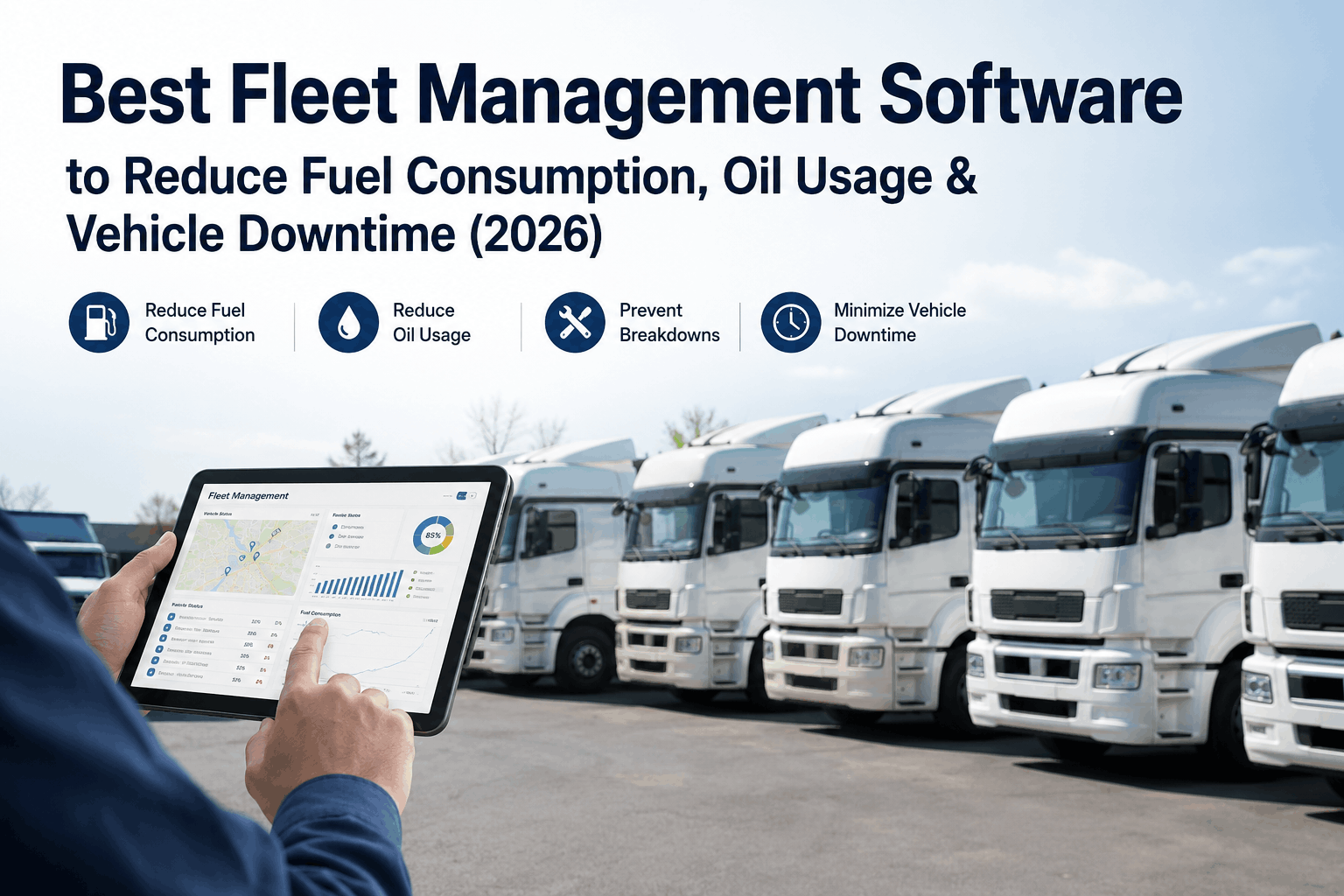
Fleet management software in 2026 has moved from a competitive advantage to operational survival. Industry data from leading platforms and analysts consistently shows the same three-way ROI: comprehensive fleet software delivers an average 30% operational cost reduction, 25% fuel savings, and up to 60% reduction in maintenance-related downtime. For a 25-vehicle fleet spending $800,000 per year on fuel alone, the 15% reduction that route optimization and driver-behavior monitoring deliver translates to $120,000 per year in direct fuel savings — payback periods now average 8 months, with 32% of fleets seeing positive ROI within 6 months. The platforms that achieve this aren't all the same: telematics-first systems (Samsara, Geotab, Verizon Connect) excel at fuel and routing, while inspection and maintenance software like HVI attacks the oil-usage, preventive-maintenance, and downtime side of the equation. This guide breaks down how fleet management software actually reduces fuel consumption, oil usage, and vehicle downtime — the mechanisms behind each savings category, pricing tiers from $3 to $50+ per vehicle per month, ROI math for a 25-vehicle fleet, and the buying criteria that separate the platforms that deliver from the ones that don't. For fleet managers building a defect-prevention, PM-automation, and audit-ready maintenance program, Start your free HVI trial to put guided eDVIRs, engine-hour PM scheduling, and defect-to-work-order routing on every vehicle, or book a demo to see how HVI inspection and maintenance software fits alongside your telematics stack.
The three cost categories fleet software attacks
Every dollar a fleet management platform saves comes from one of three buckets: fuel consumption, oil and lubricant usage (which is really PM compliance), or vehicle downtime. The platforms that deliver real ROI attack all three with specific, measurable mechanisms — not generic dashboards.
Largest variable cost on a typical fleet's P&L. Reduced through telematics-based route optimization, idle-time monitoring, driver behavior scoring, and tire-pressure tracking. Direct dollar impact — first place ROI shows up.
Oil usage is a PM-compliance metric — when intervals fire on engine hours instead of memory, oil and fluid waste drops and engine life extends. Reduced through preventive maintenance scheduling, OEM-spec tracking, and fluid sampling.
The hidden killer — every hour a truck is off the road costs $400–$700 in lost revenue, and unplanned days run $500–$2,000 per vehicle. Reduced through predictive maintenance, defect-to-work-order routing, and parts inventory automation.
How fleet software actually reduces fuel consumption
Fuel is typically the largest variable cost on a fleet's P&L — and the place ROI shows up first. Modern platforms attack fuel waste through four mechanisms that compound to deliver the 15–25% reduction the industry reports.
Algorithm-driven routing reduces unnecessary miles by 8–15% on typical urban delivery routes. Geofencing flags out-of-route detours. Real-time traffic integration reduces congestion idle time.
Heavy trucks burn 0.8–1 gallon per hour idling. Telematics flags excessive idle events per driver, per vehicle. Idle-reduction programs alone typically save 4–8% of total fuel spend.
Hard braking, rapid acceleration, and speeding all spike fuel consumption. Telematics scores drivers per shift; coaching programs reduce the worst behaviors and improve fleet MPG by 5–10%.
Underinflated tires cost ~3% MPG. Engine sensors flag combustion issues that waste fuel. Daily inspections that capture tire PSI and engine warning indicators feed into the same fuel-efficiency picture.
How fleet software reduces oil usage and maintenance cost
"Oil usage" really means PM compliance discipline. When oil changes happen at OEM-spec engine hours instead of guesses, engines wear less, fluid waste drops, and downstream maintenance costs decline. This is the core domain of inspection and maintenance software.
PM alerts fire on actual engine hours per VIN, not calendar dates or memory. Oil, filter, hydraulic, and fluid changes happen exactly at the OEM-recommended interval — never early (waste) or late (damage).
Each VIN carries its OEM service schedule. Software flags upcoming intervals 250 / 500 / 1,000 / 5,000-hour services automatically. Quarterly brake adjustments, annual 49 CFR 396 Appendix A inspections — all on the calendar.
Oil-analysis lab results logged against the VIN. Extended drain intervals validated by lab data instead of guesswork — large fleets routinely extend oil change intervals 20–50% with sampling discipline, cutting oil consumption and disposal cost.
Every PM service, part, technician hour, and outside-vendor invoice logged against the machine. Real cost-per-engine-hour surfaces — informing replacement timing, OEM warranty claims, and the next vehicle purchase.
How fleet software cuts vehicle downtime by 60%
Downtime is the hidden killer of fleet economics. At $400–$700 per hour in lost revenue (and $500–$2,000 per day for heavier vehicles), even modest downtime reduction reshapes the P&L. Software achieves the industry-reported 60% reduction through four compounding mechanisms.
Machine learning analyzes sensor data, inspection trends, and historical failure patterns to forecast component failures weeks in advance. Fleets using predictive maintenance report 70% fewer unplanned breakdowns — turning emergencies into planned services.
Any "Fail" tap during a digital inspection auto-creates a maintenance work order with photo evidence, vehicle ID, and DVIR reference. Defects route to the shop the moment they're flagged — no paper inbox delays, no missed handoffs between shifts.
Critical parts are pre-staged based on PM forecasts. When a brake job is scheduled, the parts are already on the shelf. Reduces the "waiting for parts" delay that turns a 4-hour service into a 3-day downtime event.
Audit-ready DVIRs and PM records mean a vehicle pulled at a roadside inspection doesn't go OOS for missing paperwork. Eliminates the documentation-related downtime that adds days to an otherwise simple issue.
Pricing tiers — what fleet software actually costs in 2026
Fleet software pricing has stratified into four tiers in 2026. Per-vehicle costs range from free entry-tier plans to $50+/vehicle/month for full-featured enterprise telematics + maintenance suites. Pick the tier that matches your fleet size and operational complexity — over-buying is as wasteful as under-buying.
| Tier | Cost / vehicle / month | Typical fleet size | Capabilities |
|---|---|---|---|
| Entry / free tier | $0–$5 | 1–10 vehicles | Basic PM scheduling, inspection logs, mobile DVIR, service records |
| Small fleet | $5–$15 | 10–50 vehicles | Adds work orders, parts inventory, multi-user, basic telematics integration |
| Mid-market | $15–$30 | 50–250 vehicles | Adds predictive maintenance, advanced reporting, full telematics, API access |
| Enterprise | $30–$50+ | 250+ vehicles | Adds EAM depth, ERP integration, multi-site, fuel card, custom reporting |
ROI worked example — a 25-vehicle fleet in 2026
Concrete numbers make the ROI math tangible. Here's what a 25-vehicle medium-duty fleet looks like with and without fleet management software, using mid-range industry savings rates and 2026 cost benchmarks.
Buying criteria — what fleet managers should evaluate
Feature sheets all look impressive in a sales demo. Here's the operational reality check fleet managers should run before signing. Each criterion separates the platforms that deliver from the ones that don't.
Operators run inspections on smartphones in the field, not paper. Required fields, photo capture, GPS timestamp. If the inspection UX is bad, no other feature matters because drivers won't use it.
Calendar-based PM wastes oil on light-use vehicles and damages heavy-use ones. True PM scheduling fires on actual engine hours per VIN. Verify this is engine-hour based, not date based.
A "Fail" tap during an inspection must auto-create a work order with photo evidence — not require a separate workflow. Manual handoffs are where defects get lost between shifts.
Every part, repair, inspection, and PM logged against the VIN. Cost-per-hour and cost-per-mile must surface automatically — otherwise you can't make data-driven replacement or warranty decisions.
One-click export of DVIRs, PM history, and repair certifications by VIN and date range. 90-day DVIR retention enforced. Audit prep becomes a non-event instead of a fire drill.
The platform should integrate with Samsara, Geotab, Verizon Connect, Motive, and fuel card systems — not force you to use a proprietary hardware stack. Open APIs matter.
Avoid platforms that gate core features behind premium tiers. PM scheduling, work orders, mobile DVIRs, and audit export should be in the base price — not upsells.
Real software lets you try it before you talk to sales. If a vendor won't let you touch the product without a 45-minute discovery call, that's a signal about how they'll treat you post-sale.
HVI — inspection & maintenance software built for fleets that need to reduce fuel, oil, and downtime
HVI is purpose-built heavy equipment and commercial fleet inspection and maintenance software. It attacks the oil-usage, PM-compliance, and downtime sides of the fleet management equation — the three areas where most maintenance-related savings show up — and integrates cleanly with the telematics platform you already run for fuel and routing. The platform makes daily inspection and maintenance discipline automatic, documented, and audit-ready.
Mobile-first digital inspection software that operators complete on smartphones in 5–12 minutes. Required fields, photo-verified defects, GPS-timestamped, archived per VIN. The daily compliance backbone for every vehicle in the fleet.
Oil, filters, hydraulic services, brake inspections, undercarriage checks — all on OEM-spec intervals fired automatically on actual engine hours per VIN. Eliminates the oil waste and engine damage that calendar-based PM causes.
Any "Fail" tap during an inspection instantly creates a maintenance work order with photo evidence and vehicle ID. Defects route to the shop the moment they're flagged — eliminating the between-shift handoff delays that turn issues into downtime.
Every inspection, repair, PM service, fluid sample, and replaced part indexed against the machine. Cost-per-hour and reliability trends per VIN surface automatically — informing replacement timing and warranty decisions.
HVI integrates with Samsara, Geotab, Verizon Connect, and fuel card systems — pulling engine-hour data for PM scheduling without forcing you to abandon your existing telematics investment.
Inspection history, work orders, repair certifications, PM compliance, and operator records — exportable as a unified OSHA, FMCSA, and insurance audit package in under a minute. Audit prep becomes a non-event.
HVI inspection and maintenance software is the operational platform behind the 15–25% maintenance cost reduction and 60% downtime decline the industry reports. Pair it with your telematics stack for fuel and routing, and you have the full fleet management picture covered. Start your free HVI trial to put guided inspections, PM scheduling, and defect routing on your fleet in under an hour, or schedule a 30-minute walkthrough with our team to see how HVI fits your specific operation.
Frequently asked questions
The right fleet software pays for itself in 8 months. The right inspection & maintenance software keeps every vehicle compliant for the lifecycle.
HVI is purpose-built inspection and maintenance software for fleets — guided eDVIRs, engine-hour PM scheduling, defect-to-work-order automation, per-VIN cost history, and audit-ready records. The platform behind the 60% downtime reduction and 15–25% maintenance cost decline the industry reports.
No credit card required · Inspection & maintenance software for commercial and heavy fleets · OSHA, FMCSA & insurance audit-ready