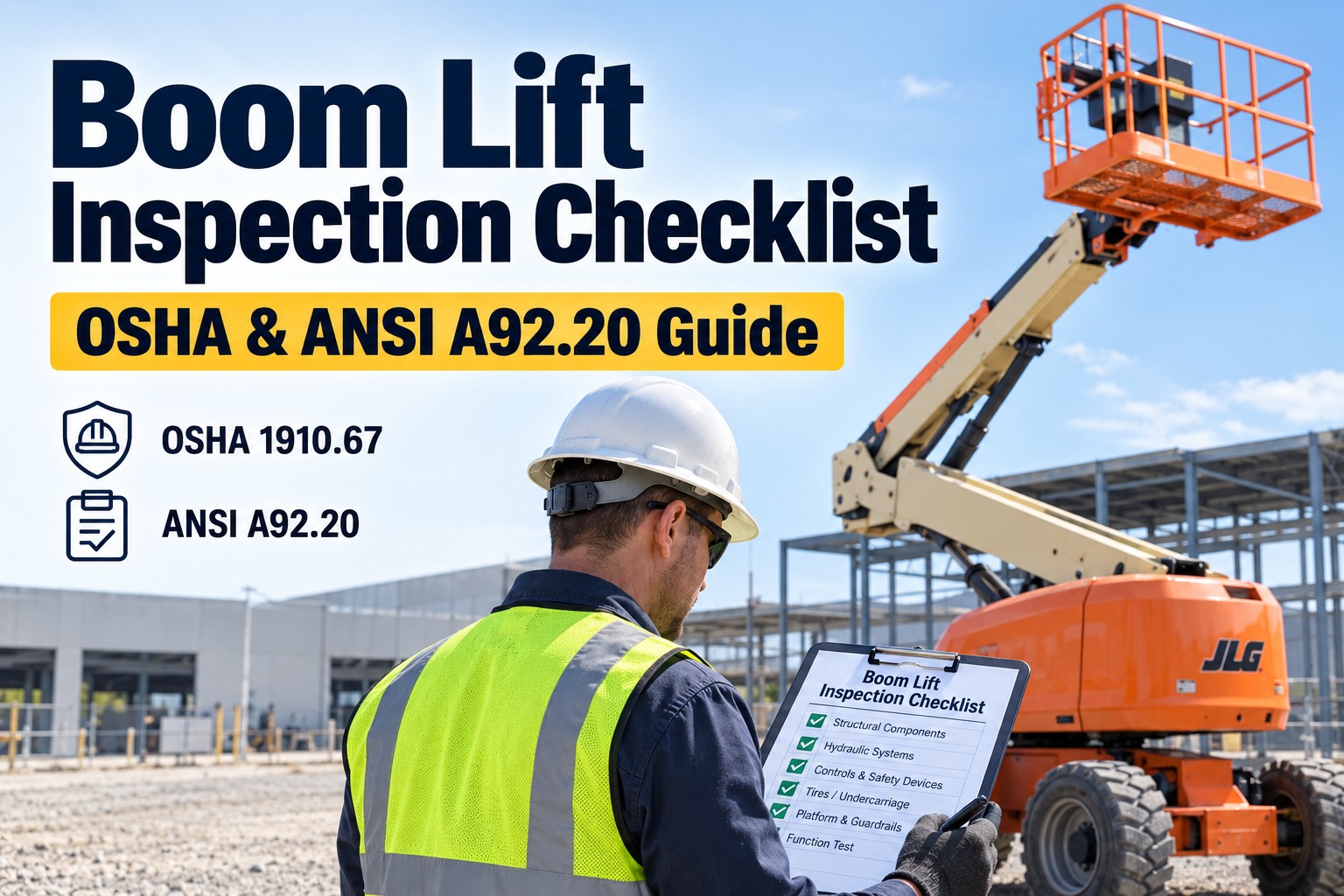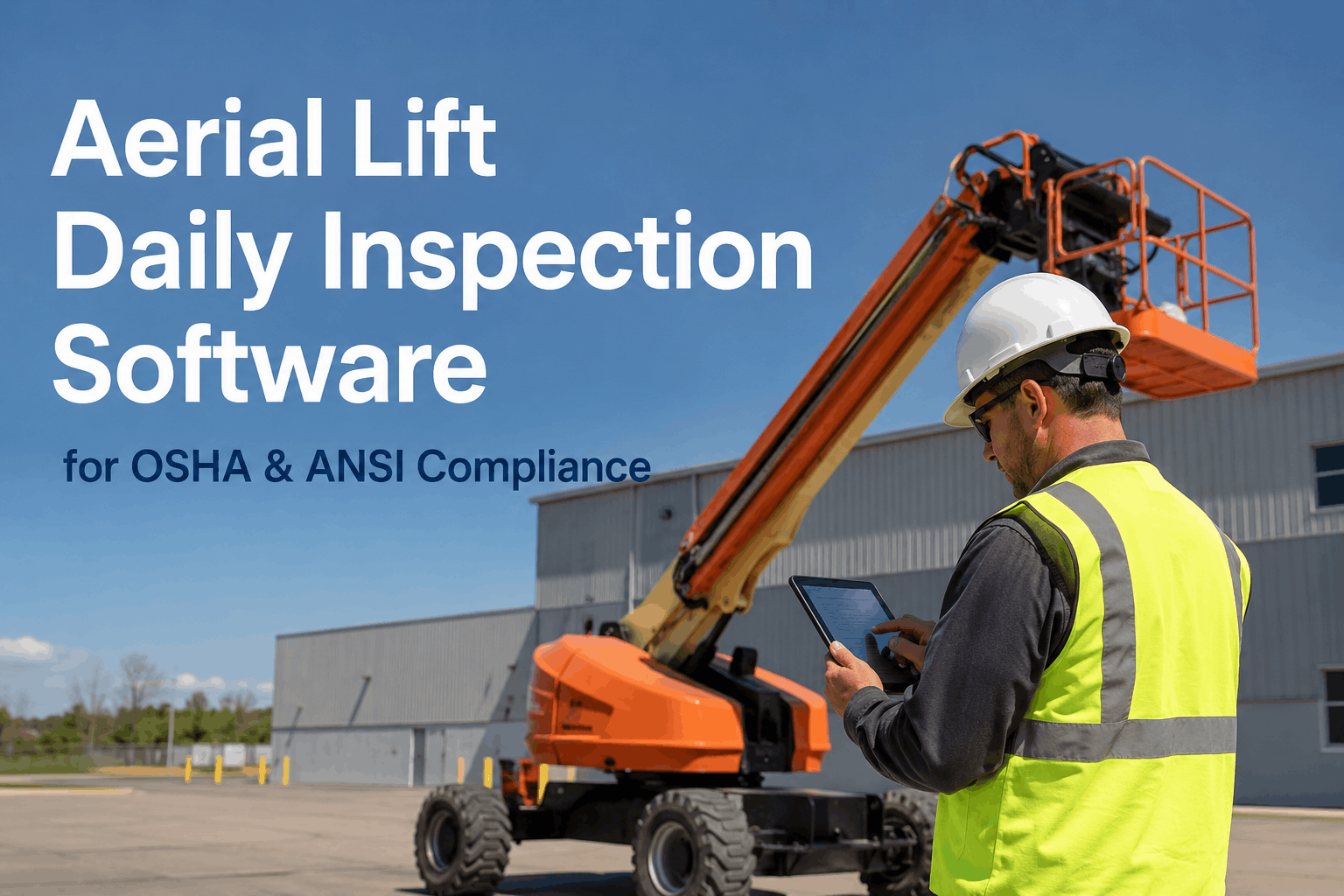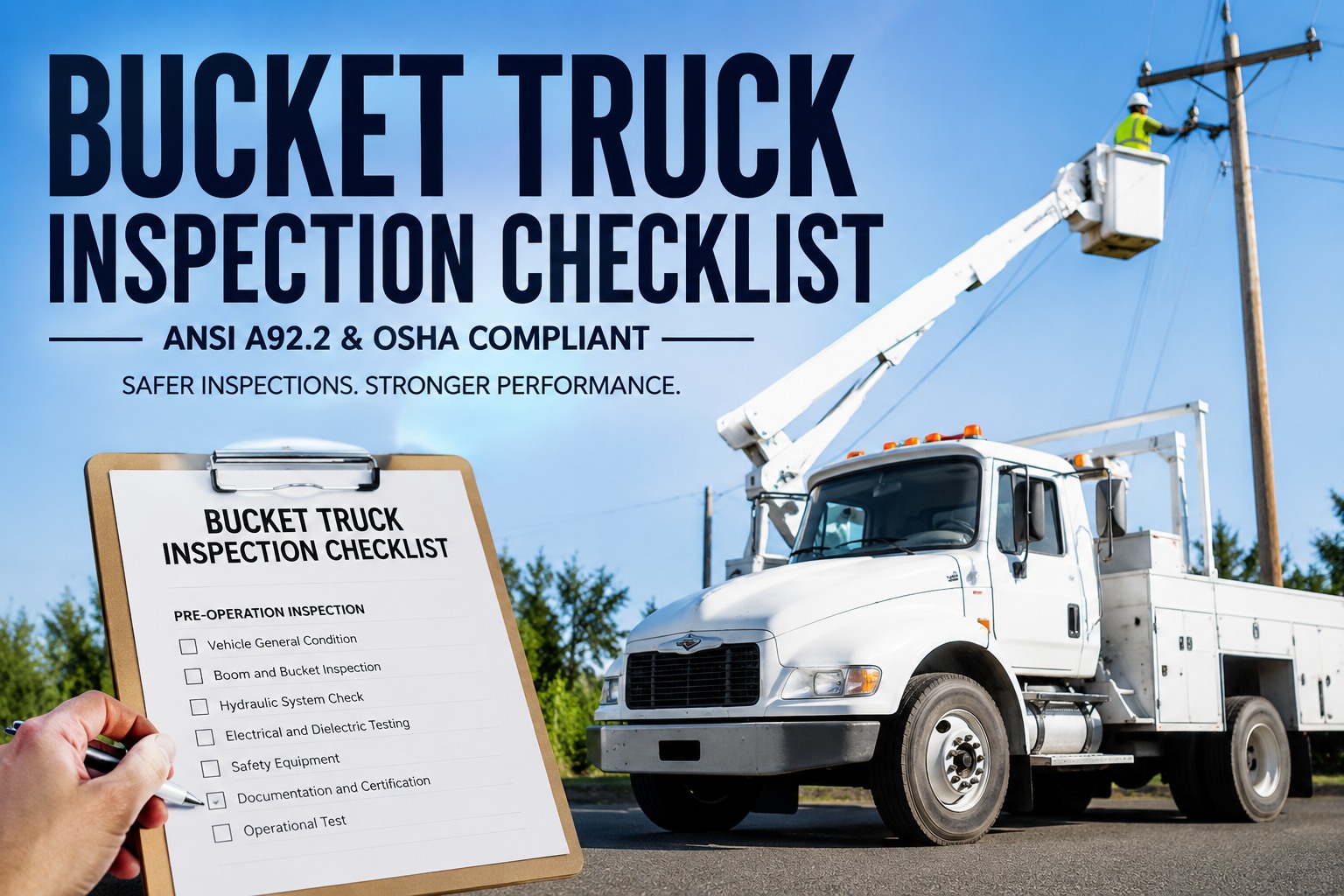
Bucket truck inspection checklists sit at the intersection of DOT vehicle inspection, ANSI A92.2 aerial device standards, and OSHA 1910.67 workplace safety requirements. Unlike standard commercial vehicles, a bucket truck is simultaneously a vehicle AND an aerial work platform where linemen work at 40-100 feet above energized transmission lines. Missing an inspection item on a bucket truck isn't a compliance issue — it's a potential fatality. ANSI A92.2 mandates 4 distinct inspection tiers plus annual dielectric testing on insulated booms. Book an HVI demo to deploy compliant templates.
Four inspection tiers. One aerial device. Zero acceptable shortcuts.
ANSI A92.2 defines four distinct inspection cadences for vehicle-mounted aerial devices — each with a specific interval, a qualified inspector, and a defined scope. Skip any one and you've broken the compliance chain.
Visual walkaround, controls test per OSHA 1910.67(c)(2)(i), leakage test on Class A boom, DVIR completion.
Detailed hydraulic system, boom articulation, cylinder condition, control linkage, fluid analysis.
Full structural + dielectric test on insulated booms per ANSI A92.2 Section 5. "Hi-pot" testing required.
Added ANSI A92.2 (2021) Section 8.2.5. NDT weld inspection, fatigue analysis, boom pin condition.
ANSI A92.2 is the American National Standard for Vehicle-Mounted Elevating and Rotating Aerial Devices. OSHA 1910.67 incorporates ANSI A92.2 by reference, making it enforceable federal law. NFPA 70E governs electrical safety for workers near energized conductors. Your inspection program must satisfy all three simultaneously.
Why bucket trucks need a dedicated inspection framework
A bucket truck is not one thing — it's three simultaneously: a DOT-regulated commercial vehicle, an ANSI A92.2 aerial work platform, and an OSHA 1910.269-governed electrical work environment when used near energized conductors. A single inspection framework must satisfy all three regulatory frames or the truck cannot legally be dispatched.
The consequences of gaps in that framework are severe. Falls from aerial lifts are among the leading causes of workplace fatalities in the utility, telecom, and tree-service industries. Contact with energized conductors during aerial work is the single most-common electrocution scenario for linemen. Boom structural failures at height create both fall and crush hazards for ground crews. Every incident traces back to something that was inspectable and either wasn't inspected or wasn't documented as inspected.
DOT regulates the chassis; ANSI regulates the aerial device; OSHA regulates the worksite. Generic checklists cover the chassis and miss the aerial device or worksite requirements entirely.
Class A trucks work at transmission voltages up to 500kV. The boom itself is the insulating barrier. Cleaning, waxing, and dielectric testing failures produce electrocution risk that isn't visible in normal walkaround.
Outriggers, upper controls, secondary stow, boom pins, fiberglass boom sections — none appear on a standard commercial vehicle DVIR. Missing them isn't a paperwork gap; it's a structural failure risk at 60 feet.
Post-incident investigations pull inspection records first. Photo-verified digital DVIRs satisfy OSHA documentation requirements in seconds; paper checklists trigger multi-day file searches.
Book an HVI demo to see ANSI A92.2-aligned templates against your bucket truck fleet
Pre-start daily inspection — what the operator must verify
The pre-start inspection is the operator's responsibility before every shift per OSHA 1910.67(c)(2)(i). It's the last line of defense before the truck is at height with a lineman in the bucket. ANSI A92.2 breaks it into three distinct phases: vehicle chassis, aerial device, and functional operation.
- Tires, wheel lugs, brake air build 100-125 psi
- Lights: headlights, brake, turn, hazards, strobes
- Windshield, wipers, mirrors, back-up alarm
- Engine fluids: oil, coolant, DEF, fuel
- Fire extinguisher pressure & inspection tag
- Previous DVIR reviewed; no open defects
- Boom clean, dry, no visible contamination
- Fiberglass sections free of nicks, cuts, tracking
- Hydraulic hoses: no leaks, chafing, or bulging
- Outrigger pads, cylinders, pins secure
- Bucket liner condition, mounting bolts torqued
- Boom rest / cradle engaged before travel
- Upper & lower controls tested each day
- Emergency stop (upper & lower) verified
- Emergency lowering / auxiliary power works
- Outriggers deploy, level indicator functional
- Full boom cycle: extend, rotate, elevate
- Boom drift test at hold with load
- Boom cleaning & waxing per OEM interval
- Leakage test: 5-8 min at working voltage
- Ground cable and clamp inspected
- Fiberglass insulator sections dry, no tracks
- Barehand tools inspected & certified in date
- Meter for barehand potential-check functional
Pre-start takes 12-15 minutes with paper and 6-8 minutes with a mobile DVIR that photo-documents critical items. The time saved isn't the point — the photo evidence is. Start a free trial to deploy photo-verified pre-start templates.
Boom & aerial device inspection — what fails and where
The aerial device is the highest-consequence system on the truck. Boom structural failure at height is catastrophic; hydraulic failure during elevated work strands linemen at altitude; control system failure removes the operator's ability to bring the boom down safely. Systematic inspection focuses on five critical subsystems.
Inspect steel boom sections for cracks at weld joints, deformation at pivot points, or paint damage suggesting corrosion. On insulated booms, examine fiberglass for surface nicks, cuts, delamination, or "tracking" marks — carbon paths across the insulator surface indicating dielectric failure. Any tracking is immediate out-of-service.
Check lift cylinder, telescope cylinder, and rotation motor for external leaks. Rod seal failures produce oil weeping visible at daily inspection. Inspect hoses along boom articulation path for chafing where they cross moving joints. Test boom drift with load at elevated position: more than 2 inches over 5 minutes signals cylinder seal bypass.
OSHA 1910.67(c)(2)(i) requires daily controls test. Verify upper (bucket) controls function through full range: boom up/down, extend/retract, rotate left/right. Test lower controls identical functions. Verify emergency stop at both stations. Test emergency lowering system — the auxiliary means to bring boom down if primary hydraulics fail.
Inspect outrigger cylinders, pads, and pins for wear or damage. Verify outrigger interlocks prevent boom deployment without outriggers set. Test outrigger extension to full deploy and confirm level indicator reads accurate. Level tolerance typically 5° per OEM spec; excessive tilt destabilizes boom at height.
Inspect fiberglass bucket for cracks, delamination, or UV damage. Check liner for wear that would compromise dielectric properties. Verify fall arrest anchor points (100% tie-off required per OSHA) are undamaged and securely mounted. Inspect bucket door latch, entry step, and interior control mount.
Each subsystem failure has a distinct signature at daily inspection if the inspector knows what to look for. Book an HVI demo to see photo-verified DVIR templates that create the audit trail OSHA and insurance carriers require post-incident.
Dielectric testing — annual "hi-pot" requirement for insulated booms
Dielectric testing (also called "hi-pot" or high-potential testing) is the annual electrical integrity verification required by ANSI A92.2 Section 5 and enforced under OSHA 1910.67(c)(3). It applies to insulated booms on Class A (barehand) and Class B (gloving) bucket trucks — only the boom is tested, never the bucket. Missing or failing dielectric tests take the truck out of service until re-certified.
Boom is insulating barrier between energized bucket and grounded vehicle chassis. OSHA 1910.269(p)(4)(iii)(C) requires grounding to best available ground. Leakage test 5-8 min before each energized contact.
Boom insulates from chassis; workers use rubber gloves & protective cover as primary protection. Boom cleaning & waxing per OEM interval to prevent tracking on insulator surface.
- Only booms are tested — not buckets. Buckets don't insulate; that's why rubber gloves are required on Class B.
- Booms/buckets must stay clean and dry — contamination creates tracking paths that defeat insulation.
- DC voltage tests may be substituted for AC per OSHA 1910.67(c)(3) if OEM-approved.
- Leakage test before each energized contact — 5-8 minutes of measured potential per OSHA 1910.269(p).
- Test records retained for OSHA record inspection; digital records satisfy documentation requirements immediately.
Book an HVI demo to see automated dielectric test tracking with renewal alerts
From a utility fleet manager running 84 bucket trucks across three states
Before we digitized, our bucket truck inspections were a paper mess. Pre-start DVIRs sitting in cab folders. Annual dielectric certs in three-ring binders at each yard. Frequent inspection records in the maintenance shop's file cabinet. Nobody could tell you in under an hour which trucks had current certifications and which were coming due.
Deployed HVI with ANSI A92.2 templates. Pre-start goes digital with photo evidence on boom cleanliness, outrigger deploy, and controls test. Dielectric renewals auto-alert 45 days before expiration. Annual periodic inspections upload directly to the truck record. OSHA audit last quarter took 20 minutes to produce full compliance history versus the 3-day scramble we used to run. Zero dielectric expirations in 18 months. Zero incidents. Same crews, same trucks — different documentation.
Frequently asked questions
What are the required inspections for a bucket truck under ANSI A92.2?
ANSI A92.2 requires four distinct inspection cadences for vehicle-mounted aerial devices. Pre-Start Inspection: performed by the operator before each shift, covering visual walkaround, controls test, emergency stop verification, and leakage test on Class A booms. OSHA 1910.67(c)(2)(i) makes this legally enforceable. Frequent Inspection: performed every 3 months or 150 operating hours, whichever comes first, by a qualified technician. Covers hydraulic system detail, boom articulation, cylinder condition, control linkage, and fluid analysis. Annual (Periodic) Inspection: performed every 12 months by a certified technician. Covers full structural inspection, complete hydraulic pressure testing, and — for insulated booms — the annual dielectric test per ANSI A92.2 Section 5 (also called hi-pot testing). Major Structural Inspection: added to ANSI A92.2 in 2021 under Section 8.2.5. Performed at extended intervals (typically 10 years or manufacturer-specified cycles), covering non-destructive weld inspection, fatigue analysis, and boom pin condition. Requires OEM or certified laboratory involvement. All four tiers are non-negotiable for compliant operation. Missing any tier breaks the compliance chain and creates both OSHA violation exposure and insurance liability. Digital DVIR platforms with ANSI A92.2-aligned templates track all four cadences automatically, alert on upcoming intervals, and preserve documentation for post-incident review.
What is dielectric testing on a bucket truck and how often is it required?
Dielectric testing (also called "hi-pot" or high-potential testing) verifies the electrical insulation integrity of insulated bucket truck booms. It's required at least once every 12 months per ANSI A92.2 Section 5, enforced under OSHA 1910.67(c)(3). Only the boom is dielectrically tested — not the bucket. Buckets don't provide electrical insulation to workers; that's why Class B trucks require rubber gloves and protective cover as primary electrical protection. The test applies AC voltage (or DC-equivalent per OSHA approval) between the bucket and the vehicle chassis to verify the fiberglass boom sections properly dissipate current without allowing conduction to ground. Class A barehand bucket trucks used in transmission work up to 500kV require the most demanding testing regime. Class B gloving distribution trucks operating up to 46kV also require annual dielectric certification. In both cases, the boom is the insulating barrier that separates the energized work area from grounded vehicle. Beyond the annual test, operators perform a leakage test before each energized contact — 5-8 minutes of measured potential per OSHA 1910.269(p) to verify field-condition insulation. Booms and buckets must be kept clean, dry, and waxed per OEM interval to prevent surface contamination that creates tracking paths and defeats dielectric integrity. Digital compliance platforms track dielectric test dates with renewal alerts and preserve test certificates for OSHA documentation requirements.
What's the difference between Class A and Class B bucket trucks?
Class A bucket trucks are barehand-work vehicles used in transmission line work at voltages up to 500 kV. In Class A operation, the lineman intentionally makes energized contact with high-voltage conductors while working from an insulated bucket suspended by an insulated boom. The boom itself is the insulating barrier between the energized bucket and the grounded vehicle chassis. Because the worker is at line potential (equipotential with the energized conductor), OSHA 1910.269(p)(4)(iii)(C) requires the vehicle to be grounded to the best available ground and the site to be barricaded to protect nearby workers from step and touch potential hazards. Barehand tools must be inspected and certified in-date; a meter is used to verify potential match before contact. Class B bucket trucks are gloving-distribution vehicles used at distribution voltages up to 46 kV. The boom insulates the bucket from the chassis, but the worker's primary electrical protection is rubber gloves and protective cover — not the boom itself. Class B trucks are the more common configuration in utility distribution and telecom work. Both classes require annual dielectric testing on the boom per ANSI A92.2. Both require the boom to be kept clean, dry, and waxed to prevent tracking. The critical operational difference: Class A workers are at line potential intentionally; Class B workers rely on rubber PPE to stay isolated. Getting the classification wrong on truck selection or on inspection framework produces immediate life-safety risk.
Can bucket trucks be moved with workers in the elevated bucket?
Generally no. OSHA 1910.67(c)(2)(viii) specifically prohibits moving an aerial lift truck when the boom is elevated in a working position with workers in the basket. The only exception is equipment specifically designed by the manufacturer for this type of operation — typically identified in the manufacturer's operator manual and marked on the truck. For the vast majority of bucket trucks in utility, telecom, tree service, and public works operation, the truck must be fully set up with outriggers deployed and boom stowed before any repositioning, then re-set at the new work location. This requirement exists because moving an elevated boom introduces dynamic loads the truck's stability envelope doesn't accommodate — the risk of tip-over or boom failure during travel with workers at height is unacceptable. Pre-start inspection per OSHA 1910.67(c)(2)(i) must include verifying the boom rest and stow position work correctly and are used before any travel. Operator training must reinforce this requirement; violations typically occur when crews attempt to shortcut multi-stop work by moving the truck between poles without re-stowing. Digital operator training platforms and DVIR templates that require photo confirmation of stow position before dispatch help prevent this specific violation pattern. Post-incident review of tip-over or boom failure events during utility operations typically identifies "moved while elevated" as a contributing factor in a significant percentage of cases.
What documentation is required for bucket truck inspections?
Bucket truck inspection documentation must satisfy three regulatory frameworks simultaneously: DOT 49 CFR 396.11 for the vehicle chassis, ANSI A92.2 for the aerial device, and OSHA record-keeping requirements for workplace safety. Pre-start DVIR: completed each shift, signed by operator, retained per DOT and OSHA requirements. Digital DVIRs with photo evidence on critical items satisfy documentation immediately; paper DVIRs require file retention systems that produce OSHA inspection records within reasonable retrieval time. Frequent inspection records: completed each 3-month or 150-hour interval by qualified technician, retained with truck maintenance records. Must document specific items inspected, technician credentials, and any defects noted with corrective action taken. Annual periodic inspection certificates: dated, signed by certified technician, retained for the life of the equipment. Include full mechanical inspection findings and — for insulated booms — the dielectric test certificate with voltage applied and results. Major structural inspection reports: dated, signed by OEM or certified laboratory, retained per manufacturer specification. Include non-destructive testing findings and any structural repair authorizations. Additional required records: operator training and certification records, incident/near-miss documentation, corrective action logs, and periodic safety audit findings. Modern digital platforms consolidate all of this into a single truck record retrievable within seconds during OSHA audit — versus the multi-day paper chase that typically follows a workplace incident on a paper-based system.
From paper compliance chase to audit-ready in 20 seconds.
HVI ships with pre-built ANSI A92.2-aligned templates for all 4 inspection tiers. Pre-start DVIR on mobile with photo evidence. Frequent inspections scheduled by hours or calendar. Annual dielectric test tracking with 45-day renewal alerts. Major structural inspection archives retained for equipment life. Templates configurable by OEM (Altec, Versalift, Terex Utilities) — live for your fleet in 5-7 days.
ANSI A92.2 alignment · OSHA 1910.67 compliant · NFPA 70E aware · SOC 2 Type II