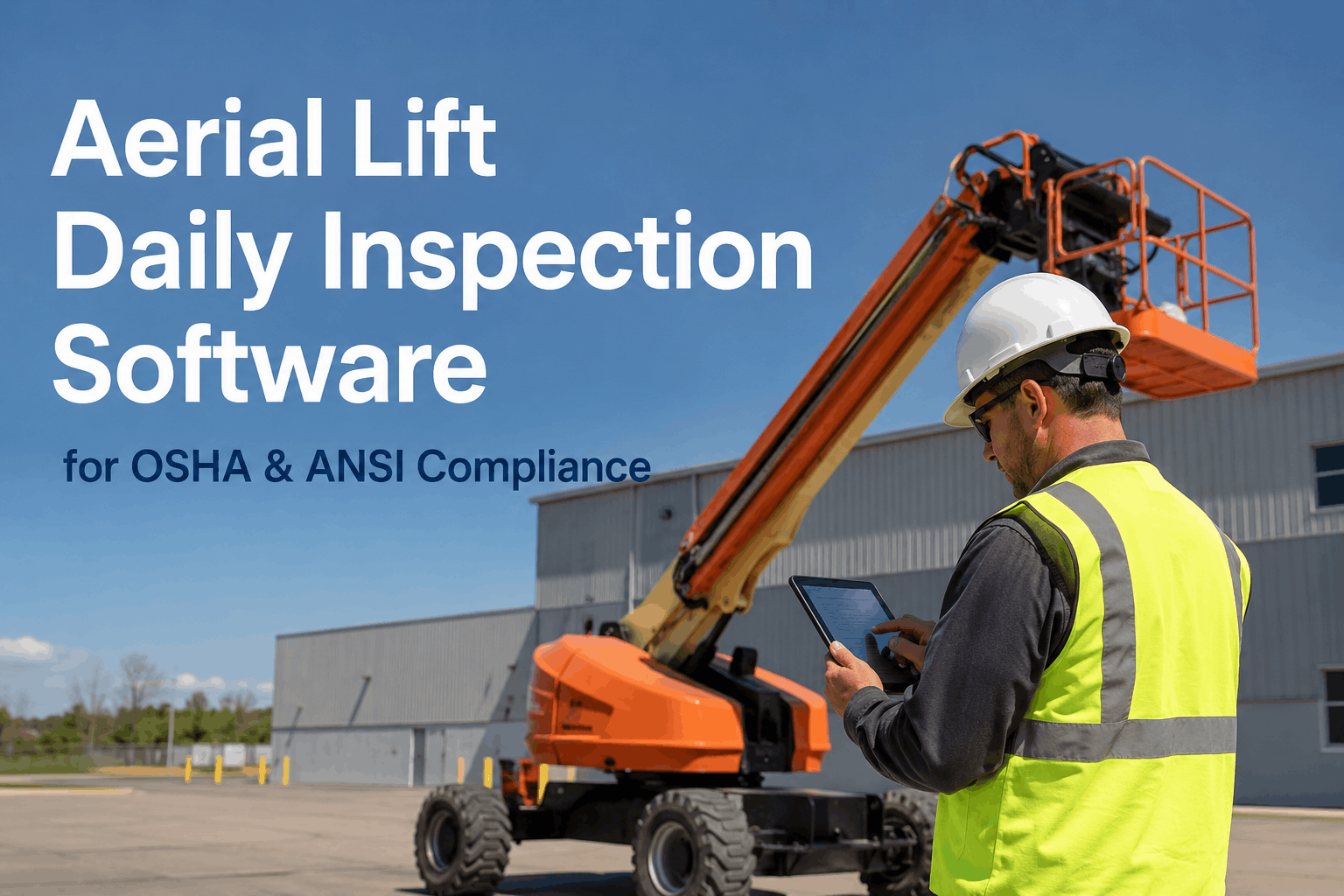
Roughly 26 workers die in aerial lift incidents every year, and falls from elevation account for about a third of all construction fatalities — which is why a daily pre-use inspection isn't a box-ticking exercise but the first line of defense between an operator and a tip-over, structural failure, or contact with an overhead power line. The rules are unambiguous: OSHA 29 CFR 1926.453 and the ANSI A92 family require every aerial lift to be inspected before each use and verified safe to operate, with annual inspections by a qualified person documented in writing. Yet the regulation that trips most fleets isn't the inspection itself — it's proving it happened. A paper checklist in a truck cab is invisible to a safety manager and worthless in an audit. HVI's aerial lift inspection software turns the daily ground and function checks, the 4-tier ANSI inspection schedule, and every defect into one timestamped, photo-backed, audit-ready record across your whole MEWP fleet. This guide breaks down exactly what OSHA and ANSI require, the daily checklist your operators run, and how HVI keeps the documentation airtight. schedule a 30-minute walkthrough with our team to see it mapped to your boom and scissor lifts.
The inspection is required. Proving it happened is what saves you in an audit.
HVI puts OSHA- and ANSI-aligned daily checks on every operator's phone — ground checks, function tests, and defects logged with photos, time-stamped per machine, and exportable for an inspector in seconds.
What OSHA and ANSI actually require
The regulatory picture has two overlapping authorities. OSHA sets the legal floor; ANSI A92 sets the detailed standard OSHA enforces in practice. Here's the framework every utility fleet needs to map.
OSHA 1926.453
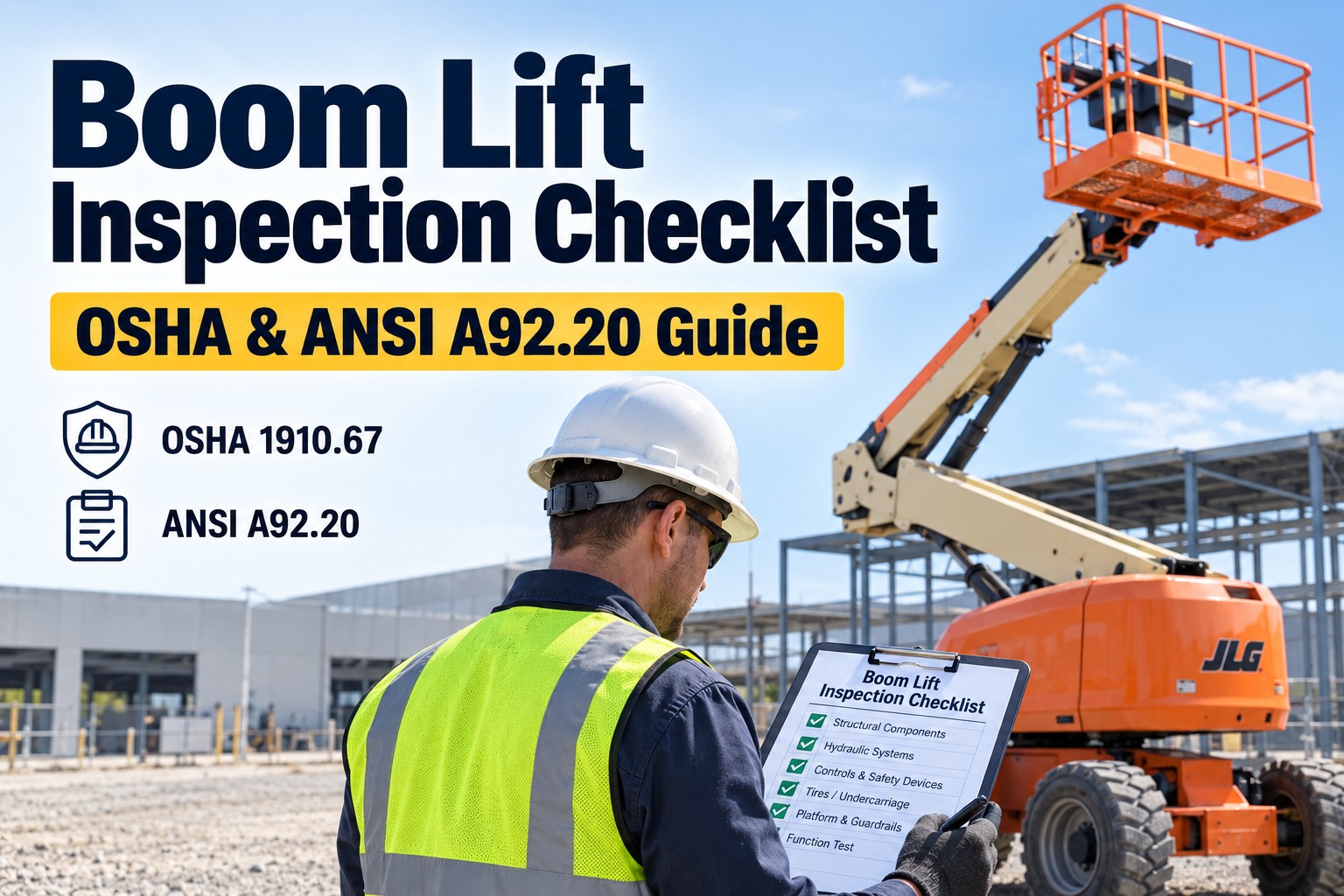
Governs aerial lifts — boom lifts, cherry pickers, bucket trucks. Requires inspection before each use, operation only by authorized persons, and a body belt with lanyard attached to the boom or basket. A damaged or missing component takes the lift out of service until repaired.
ANSI A92 (.20 / .22 / .24)
Reorganized in 2018–2020 into A92.20 (design), A92.22 (safe use), and A92.24 (training). A92.22 defines the inspection tiers; A92.24 requires operators trained and familiarized on each specific MEWP type and model, authorized in writing.
The boom vs. scissor distinction
Scissor lifts are not aerial lifts under OSHA — they fall under scaffold standards (1926.451). Harness tie-off rules for booms don't apply to scissors if guardrails are intact. But both require pre-use inspection by a trained operator before every shift.
Fines aren't the worst outcome. An undocumented or skipped inspection puts a worker at height on a machine that may have a hydraulic leak, a failing tilt alarm, or a worn boom pin — the exact failures a 15-minute check is designed to catch.
The 4 tiers of aerial lift inspection
ANSI A92.22 layers inspections by frequency and depth. Knowing which tier applies — and who is qualified to perform it — is the backbone of a compliant program.
Pre-use / frequent inspection
Before each work cycle, at minimum daily. Performed by the trained operator. A general check of all components, controls, fluids, and safety devices — takes roughly 15–20 minutes.
Who: trained operatorFrequent (3-month / 150-hr)
Every 3 months or 150 hours of use, whichever comes first — also triggered when a machine returns from 3+ months out of service or is bought used without current records.
Who: qualified mechanicAnnual (13-month) inspection
No later than 13 months from the last annual. A thorough evaluation against manufacturer items and open safety bulletins, with written documentation. The lift can't return to service until every fault is corrected.
Who: qualified mechanicPost-event / structural
After any accident or excessive load or stress, the lift is inspected before reuse. Major structural inspections follow at the 15-year mark, then every 10 years thereafter.
Who: qualified mechanicInspecting a lift once every 13 months is nowhere near enough — mechanical issues become safety problems between annuals. sign up for a free HVI account and schedule all four inspection tiers per machine automatically, or schedule a live demo to see overdue 150-hour and 13-month inspections flagged before they lapse.
The daily pre-use checklist: two stages
A proper daily inspection runs in two stages — a powered-off ground check, then a powered-on function test. In HVI, each stage is a checklist section the operator completes on a phone, with a photo required on any flagged item.
Stage 1 Ground check (power off)
- 360° walkaround: chassis, base, outriggers, tires/tracks for damage or leaks
- Hydraulic oil, engine oil, fuel, and coolant levels
- Hoses, fittings, and cylinder rods for leaks, scoring, or seal seepage
- Boom pins, fasteners, and structural welds for wear or cracks
- Platform guardrails, mid-rail, and gate latch intact and secure
- All safety decals and capacity placards present and legible
Stage 2 Function test (power on)
- Lift, lower, extend, and rotate — smooth, no jerking or hesitation
- Emergency stop halts all functions instantly
- Emergency lowering tested from both platform and ground
- Ground controls override upper controls correctly
- Tilt alarm, pothole guards, and boom-extension limits function
- Horn, beacons, and warning lights all working
A daily check takes about 15–20 minutes and catches hydraulic leaks, damaged tires, and malfunctioning tilt alarms before the lift is ever elevated — the failures most likely to cause a tip-over or fall at height.
Found a defect? Stop, isolate, tag out
The moment an inspection finds a fault — even a minor-seeming one — the response is the same. A damaged lift may not be used until repaired, full stop.
Stop operation
Do not use the machine, even if the defect seems trivial. Working at height removes any margin for "good enough."
Isolate it
Remove the key from the lower control panel so the lift cannot be started by another worker.
Tag it out
Place a clear "Out of Service" tag on the control box, and log the defect so repair and re-inspection are tracked to completion.
This is where paper fails and software wins: in HVI a flagged defect auto-creates a work order, locks the machine's status, and keeps it out of service in the system until the repair is signed off. sign up free and turn every defect into a tracked work order with a full repair trail.
Paper checklists vs. HVI compliance tracking
Both approaches run the same inspection items. Only one survives an OSHA audit and actually surfaces problems before someone goes up in the basket.
Paper checklists
- Completed checks sit in a truck cab, invisible to safety managers
- No proof of inspection when an OSHA inspector arrives
- 150-hour and 13-month inspections lapse unnoticed
- A flagged defect gets verbally mentioned — then forgotten
- No way to confirm operators are authorized on that model
- Audit prep means hunting through binders and clipboards
With HVI software
- Every check time-stamped per operator and machine
- Full inspection history exports for OSHA or ANSI in seconds
- All four inspection tiers scheduled and flagged before they lapse
- A defect becomes a photo-backed work order that locks the machine out
- Operator authorization and training records tracked per model
- Audit-ready documentation always one click away
worker deaths a year in aerial lift incidents — from falls, tip-overs, structural failures, and overhead contact. A documented daily inspection is the single most effective control, and the one OSHA checks first. HVI makes sure it's done, logged, and provable on every machine, every shift.
Frequently asked questions
How often do aerial lifts need to be inspected?
There are four tiers. A pre-use (frequent) inspection is required before each work cycle, at minimum daily, performed by the trained operator. A frequent inspection by a qualified mechanic is due every 3 months or 150 hours of use, whichever comes first — also after a machine has been out of service 3+ months or bought used without current records. An annual inspection by a qualified mechanic is required no later than 13 months from the last one, with written documentation. And a post-event inspection is required after any accident or excessive load, plus a major structural inspection at 15 years and every 10 years after. HVI schedules all four tiers automatically and flags them before they lapse.
What's the difference between a boom lift and a scissor lift for compliance?
It matters more than people expect. Under OSHA, boom lifts (and cherry pickers and bucket trucks) are aerial lifts governed by 1926.453, which requires a body belt and lanyard tied off to the boom or basket. Scissor lifts are technically not aerial lifts — they're classified as mobile scaffolds under 1926.451, so the harness tie-off rule doesn't apply if proper guardrails are in place. But both are MEWPs, and both require a documented pre-use inspection by a trained operator before every shift. HVI handles both with the correct checklist for each equipment type.
What does a daily aerial lift inspection actually cover?
It runs in two stages. The ground check (power off) is a 360° walkaround covering the chassis, outriggers, tires, fluid levels, hydraulic hoses and cylinder rods, boom pins and welds, platform guardrails and gate latch, and the presence and legibility of all safety decals. The function test (power on) verifies lift, lower, extend, and rotate operate smoothly; the emergency stop halts everything; emergency lowering works from platform and ground; ground controls override upper controls; and tilt alarms, pothole guards, horns, and beacons all function. The whole thing takes about 15–20 minutes and is logged in HVI with photos on any flagged item.
What happens if an inspection finds a defect?
The lift comes out of service immediately — a damaged or malfunctioning machine may not be used until repaired, regardless of how minor the issue looks. The standard response is stop operation, isolate the machine by removing the key from the lower control panel, and tag it out with a clear "Out of Service" tag on the control box. The fault must then be repaired and re-inspected before the lift returns to use. In HVI, a flagged defect automatically creates a work order, sets the machine's status to out-of-service, and keeps it locked until the repair is signed off, so nothing slips back into rotation unrepaired.
How does HVI help with aerial lift compliance specifically?
HVI turns the whole program into one provable system. Operators run OSHA- and ANSI-aligned daily ground and function checks from a phone, with photos required on flagged items. All four inspection tiers — pre-use, 150-hour, 13-month annual, and post-event — are scheduled per machine and flagged before they lapse. Defects auto-create work orders and lock the machine out of service. Operator training and authorization records are tracked per MEWP model as A92.24 requires. And the complete inspection and service history exports in seconds when an OSHA or ANSI auditor asks. It works the same across boom lifts, scissor lifts, and mixed fleets. schedule a demo and we will set it up around your specific lifts and inspection intervals on the call.
Make every aerial lift inspection logged, scheduled, and audit-ready.
HVI runs your daily ground and function checks, all four ANSI inspection tiers, defect work orders, and operator authorization records in one platform built for utility fleets. Meet OSHA 1926.453 and ANSI A92 with documentation you can produce in seconds — and protect the people you send up in the basket. Sign up free today.
No credit card required · Live in under two weeks · Daily checks + 4-tier scheduling + defect work orders + audit export in one platform