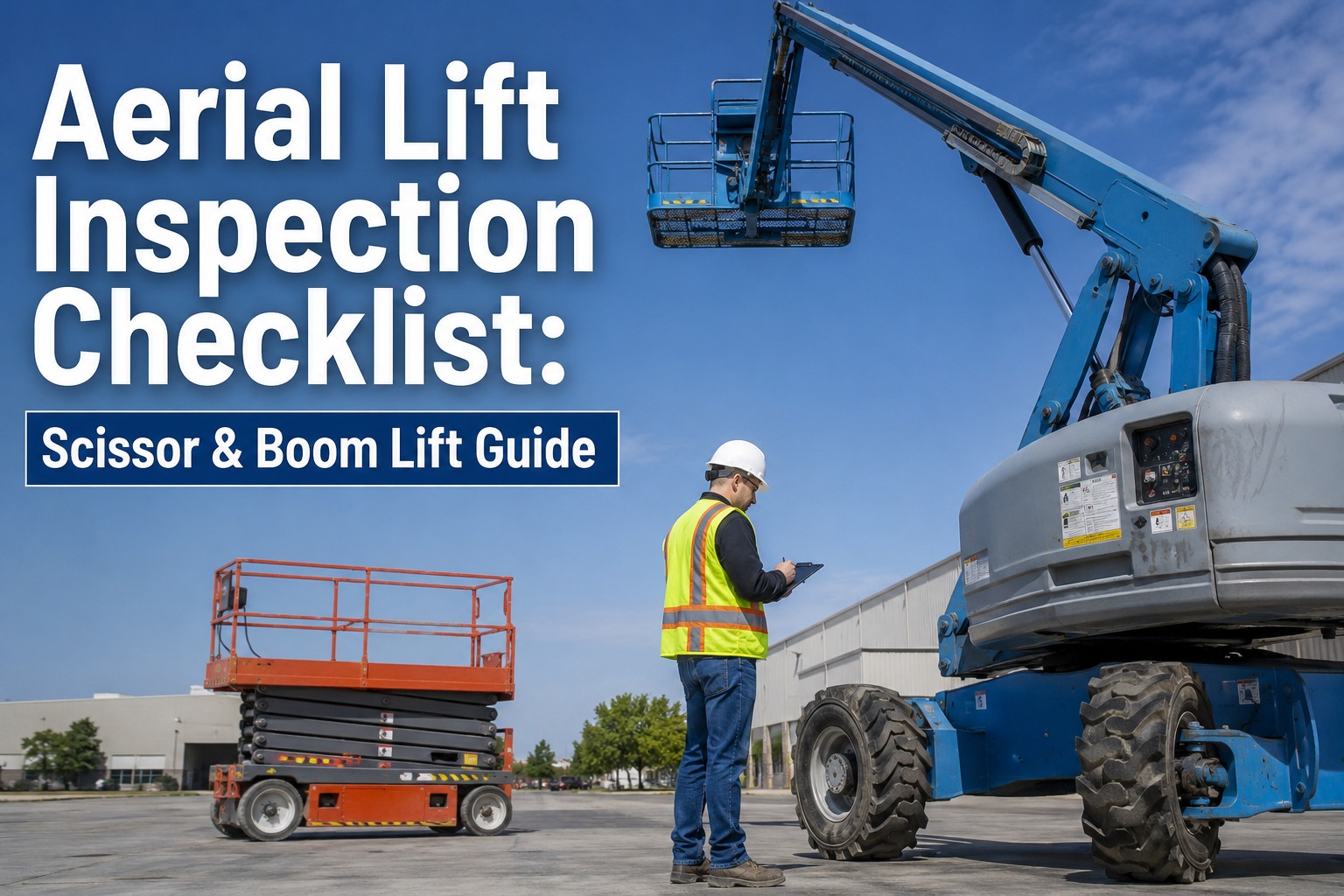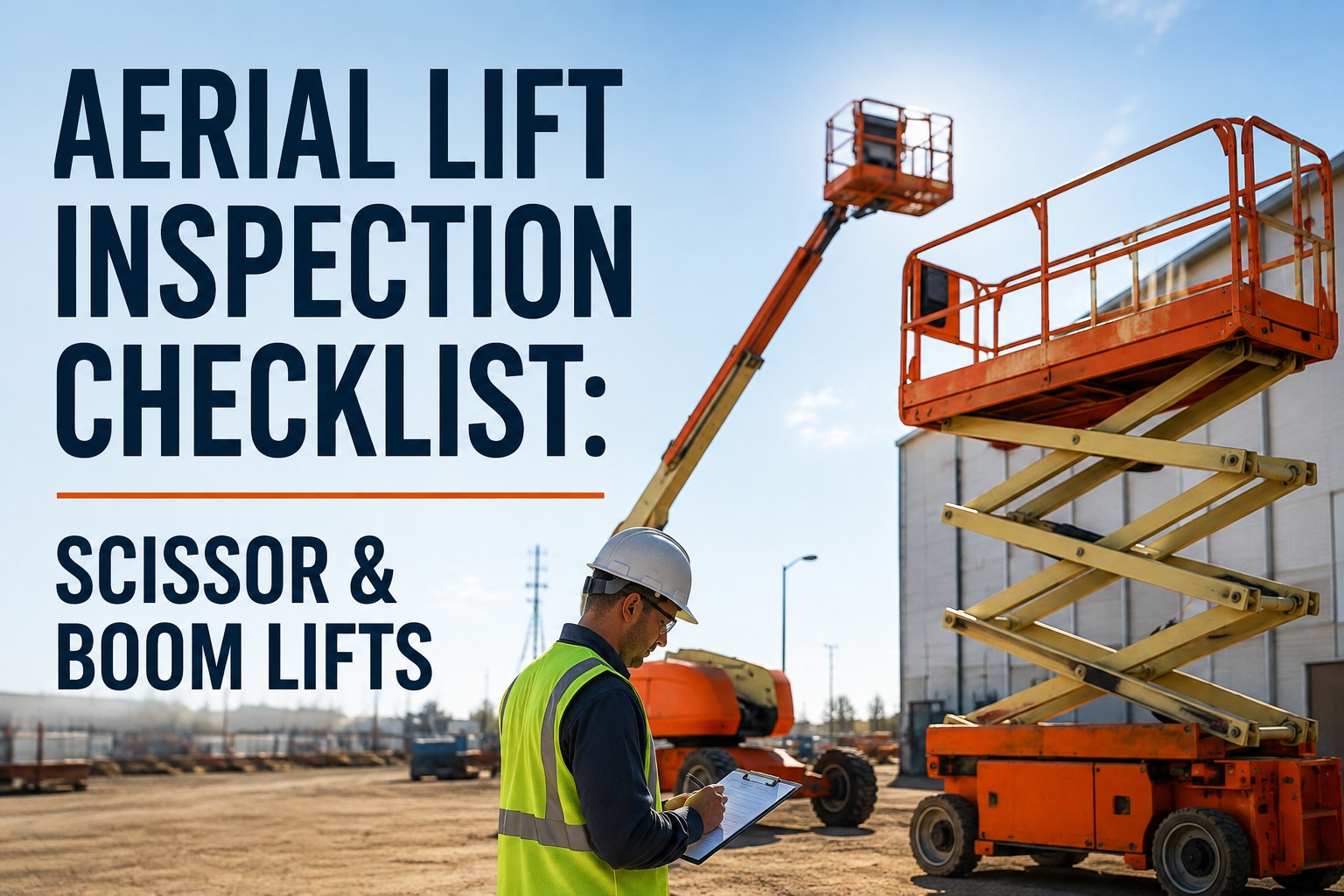
An aerial lift inspection checklist isn't one document. It's three, running on three different clocks, performed by three different qualification tiers. Pre-use daily by the operator. Frequent every 3 months or 150 machine hours (whichever hits first) by a qualified person. Annual by a qualified mechanic within 13 months of the last one. This guide walks the 3-tier regime, the scissor-vs-boom regulatory split, and how digital scheduling closes the gaps. Book a demo
Three inspection tiers on every MEWP. Different clocks, different inspectors, one machine.
ANSI A92.22 and OSHA 1926.453 require a daily operator check, a frequent inspection every 3 months or 150 hours (whichever first), and an annual by a qualified mechanic within 13 months. On a fleet of 30 scissor and boom lifts across 8 sites, that's 90+ separate inspection deadlines — and hour-based ones don't show up on any calendar.
The 3-tier inspection regime — who does what, on which clock
Every MEWP under ANSI A92.22 and OSHA 1926.453 (aerial lifts, construction) or 1910.67 (general industry) sits under a stacked three-tier inspection framework. Each tier has its own inspector qualification, its own interval, and its own documentation requirement. Understanding the split is what separates a compliant program from one that gets cited.
The three tiers stack — running the daily pre-use doesn't satisfy the frequent, and running the frequent doesn't satisfy the annual. Each is its own deadline with its own qualification requirement. Book a demo to see all three tiers tracked per machine on one dashboard
The hour-based problem — why frequent inspections get missed
The 3-month calendar side of the frequent inspection is straightforward: schedule alerts fire at 60/45/30 days, book the inspector, done. The 150-hour side is where compliance quietly breaks. Machines that don't get their hour meters actively tracked can burn through 150 hours in 5 weeks — well inside the 3-month window — and the inspection deadline arrives without warning.
Fleets running paper pre-use forms and quarterly hour audits lose frequent inspections to this gap constantly. Digital pre-use with mandatory hour-meter entry closes it in one step. Start free and configure hour-meter capture on every pre-use form this week
Scissor lift vs boom lift — the regulatory split most fleets get wrong
OSHA classifies these two machine types differently even though they look similar and share ANSI A92 coverage. The distinction matters because it changes the tie-off rules, some documentation requirements, and how inspections are structured. Getting the classification wrong is one of the most common findings in aerial-lift OSHA reviews.
Both machine types run the same 3-tier ANSI inspection regime. But the OSHA fall-protection rule differs, and the inspection template should be model-specific — a scissor-lift template with boom-lift items on it doesn't serve either. Digital templates configured per model close the gap. Book a demo to see model-specific inspection templates on scissor and boom lifts
From a safety manager running 40 MEWPs across 8 construction sites
We have 22 scissor lifts and 18 boom lifts spread across 8 active construction sites. Daily pre-use forms used to be paper on a clipboard at each machine. Frequent inspections were tracked on a spreadsheet the maintenance coordinator updated once a week. Annual inspections were on a calendar in the office. Three separate systems, none of them talking to each other, and hour meters got read whenever someone remembered.
Twice in 2024 an OSHA compliance officer showed up unannounced at active sites and asked to see inspection records. Both times we scrambled — drove paper forms across town, pulled the spreadsheet, printed the annual calendar. First time got a warning. Second time got a $6,800 citation on frequent-inspection recordkeeping across three machines. That was the moment we moved everything into HVI.
Fourteen months in: every pre-use is done in the app with hour-meter capture mandatory. Frequent inspections fire whichever clock hits first — hour or calendar — and lock the machine out until completed. Annual AMIs schedule automatically 90 days before due. Zero missed inspections, zero OSHA citations on paperwork, and the last compliance walk-through took 15 minutes because everything the inspector asked for pulled up on my tablet immediately.
Frequently asked questions
What are the OSHA and ANSI inspection requirements for aerial lifts?
OSHA and ANSI together create a three-tier inspection regime for aerial lifts and MEWPs. OSHA 29 CFR 1926.453 governs aerial lifts in construction, 29 CFR 1910.67 covers general industry, and 29 CFR 1926.451 / 1926.452(w) governs scissor lifts (which OSHA classifies as mobile scaffolds rather than aerial lifts). Both frameworks incorporate the ANSI A92 family of standards — specifically A92.20 (design), A92.22 (safe use, including inspection requirements), and A92.24 (training). The three inspection tiers under this combined framework are: pre-use inspection before every work shift, performed by a trained and authorized operator, covering controls, guardrails, emergency descent, fluid levels, tires, and safety placards (documentation strongly recommended even where not federally mandated for daily); frequent inspection every 3 months or 150 machine hours (whichever comes first), performed by a qualified person, with written documentation strictly required and covering structural, hydraulic, electrical, and safety systems beyond operator scope; and annual machine inspection (AMI) no later than 13 months after the previous one, performed by a qualified mechanic or factory-authorized technician, producing a written report evaluating welds, hydraulic pressure, electrical testing, and pin wear with calibrated instruments. Operators must additionally be trained, familiarized, and authorized in writing for each specific machine type and model under ANSI A92.22 and A92.24 before operation.
How often should aerial lifts and MEWPs be inspected?
Three separate schedules apply and all three must be maintained on every MEWP. Pre-use daily: before every work shift or work cycle, no exceptions, by the trained operator. Frequent inspection: every 3 months OR every 150 machine hours, whichever comes first, by a qualified person. This "whichever comes first" language is what trips up most fleets — a machine on a heavy-use jobsite running 7-8 hours a day burns through 150 hours in roughly 4-5 weeks, well inside the 3-month calendar window, and the inspection deadline arrives without any calendar alert firing. Machines on light-use assignments (1-2 hours a day) may go 6+ months on the hour meter before the calendar 3-month trigger dominates. The only way to catch both is to capture the hour meter reading during every pre-use inspection and let the software fire the alert on whichever clock hits first. Annual machine inspection (AMI): no later than 13 months after the previous AMI, by a qualified mechanic or factory-authorized technician. That 13-month window is a hard ceiling, not a target — scheduling AMIs on an exact 12-month cadence gives a 30-day buffer for scheduling and access issues without falling outside the regulation. Manufacturer schedules may add additional intervals (500-hour hydraulic checks, specific service items on specific models); the fleet-wide standard is the OSHA/ANSI three-tier framework plus whatever the manufacturer service manual overlays on top.
What's the difference between an aerial lift and a scissor lift inspection under OSHA?
The regulatory classification differs, which changes some rules even though the inspection framework is largely the same. Boom lifts, articulated aerial devices, cherry pickers, and bucket trucks are classified as "aerial lifts" under OSHA and fall under 29 CFR 1926.453 (construction) or 29 CFR 1910.67 (general industry). Scissor lifts are NOT aerial lifts under OSHA definitions — they're classified as "mobile scaffolds" under 29 CFR 1926.451 (scaffold general requirements) and 29 CFR 1926.452(w) (mobile scaffold specific requirements). The most practical difference: fall protection rules. Aerial lift operators must wear a personal fall arrest system with harness and lanyard tied off to the boom or basket anchor point. Scissor lift operators are generally not required to wear tie-off harnesses if the guardrails are intact and the platform gate is closed, because the scissor lift's guardrails themselves serve as the fall protection. Both machine types fall under the same ANSI A92.20 / A92.22 / A92.24 framework for inspection requirements, so the 3-tier inspection regime applies identically. But the inspection template should be model-specific: a scissor lift template checks scissor arms, lift cylinders, guardrail gates, and pothole protection; a boom lift template checks boom pivots, cylinder rods, outriggers, lower and upper controls, and tilt sensors. Confusing the two at the OSHA classification level or on the inspection template is one of the most common findings during compliance reviews.
Who is qualified to perform aerial lift inspections?
Each inspection tier has its own qualification requirement. Pre-use inspections may be performed by any trained and authorized operator who has been properly familiarized on the specific make and model of the machine per ANSI A92.22 and A92.24. Training must cover pre-use inspections, safe operation, hazard recognition, and emergency procedures, and the operator must be authorized in writing before operating any MEWP. Frequent inspections (3 months or 150 hours) must be performed by a "qualified person" — someone with recognized knowledge, training, and experience to identify defects that could affect safe operation. This is typically a maintenance technician, fleet mechanic, or third-party inspector with documented training on the machine class. Annual machine inspections must be performed by a "qualified mechanic" or factory-authorized service technician with the technical skill, calibrated instruments, and documented training to evaluate structural welds, perform hydraulic pressure testing, conduct electrical system testing, and measure pin wear against manufacturer tolerances. Some employers use in-house qualified mechanics; many contract with third-party inspection services (some specifically NCCCO-certified) or the equipment manufacturer's service network for AMIs. Regardless of who performs the inspection, the written report must be signed by the qualified person, retained in the equipment file, and available on demand during any OSHA compliance review. Documentation of the inspector's qualifications should be retained with the inspection records.
How does HVI help fleets manage aerial lift and MEWP inspections?
HVI runs the full 3-tier aerial-lift inspection program on one platform. Pre-use daily inspections run in the mobile app with model-specific templates for scissor lifts, boom lifts, and vertical mast lifts, mandatory hour-meter capture on every check, prompted photo verification on safety-critical components, and operator sign-off with timestamp. Frequent inspection alerts fire on whichever clock hits first — 3 months calendar or 150 machine hours — and lock the machine out of service until the qualified-person inspection is completed and signed. Annual machine inspections schedule automatically 90 days ahead of the 13-month ceiling, with scheduling assistance to book a qualified mechanic or factory-authorized technician. Defects noted during any tier flow straight to a work order with repair certification required before the machine can be returned to service. Operator training and authorization records archive per person per machine model, so proof of ANSI A92.24 compliance is retrievable during any OSHA audit. Every inspection archives with signed PDF export by machine, by site, by date, or by inspection tier. For safety managers like Ellen A. running 40 MEWPs across 8 active construction sites, the typical result is zero missed inspections, zero OSHA citations on paperwork, and compliance walk-throughs completed in minutes rather than hours. Book a demo to see the aerial lift 3-tier workflow running live.
Three tiers, one dashboard. Every MEWP in the fleet, every inspection date, every hour meter tracked.
HVI keeps daily pre-use, frequent (3 months / 150 hours), and annual inspections running on every scissor and boom lift in the fleet. Alerts fire on whichever clock hits first. Machines lock out on defect until certified. Records archive with signed PDF export. Live in under two weeks; typical result is zero missed inspections and clean OSHA compliance reviews.