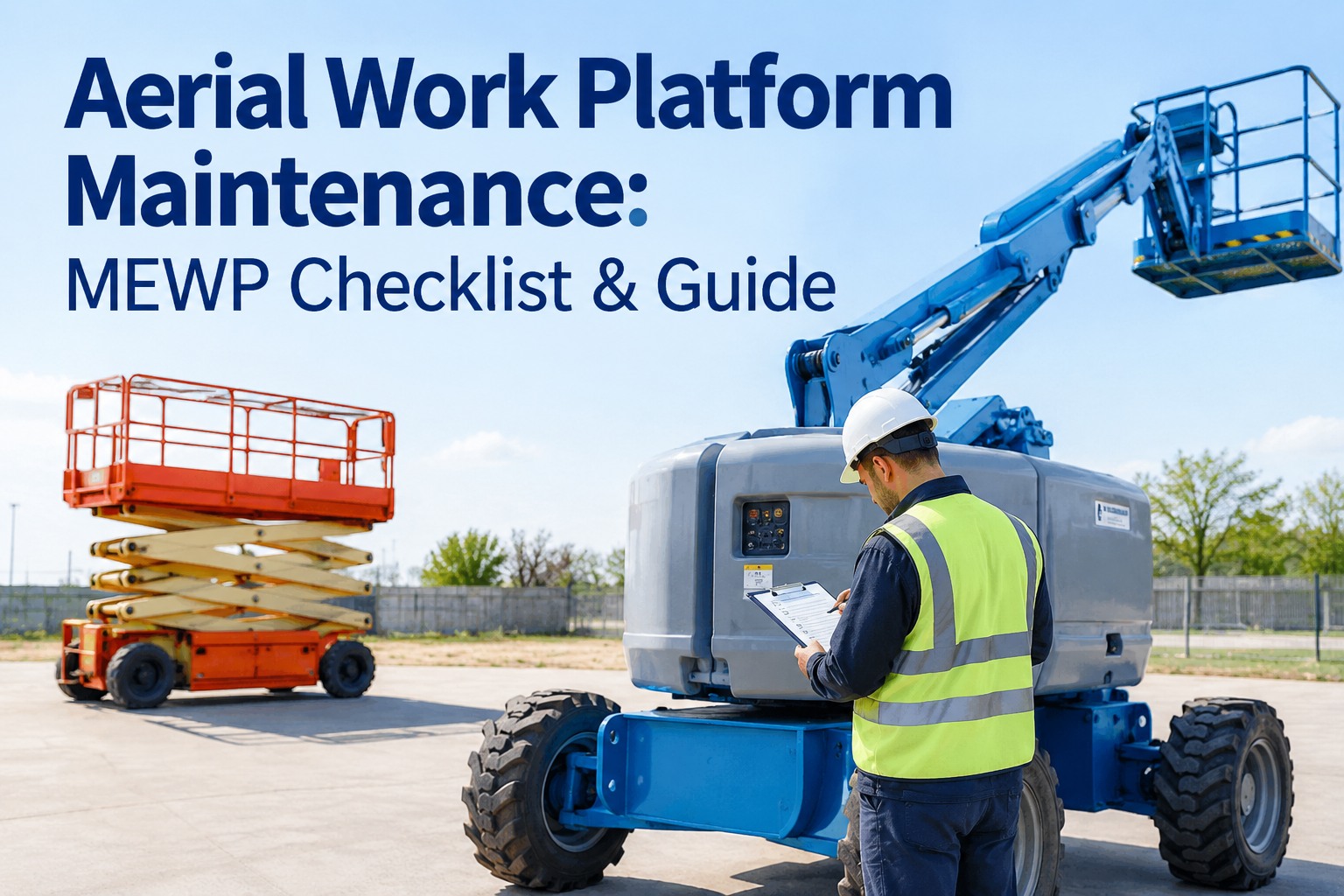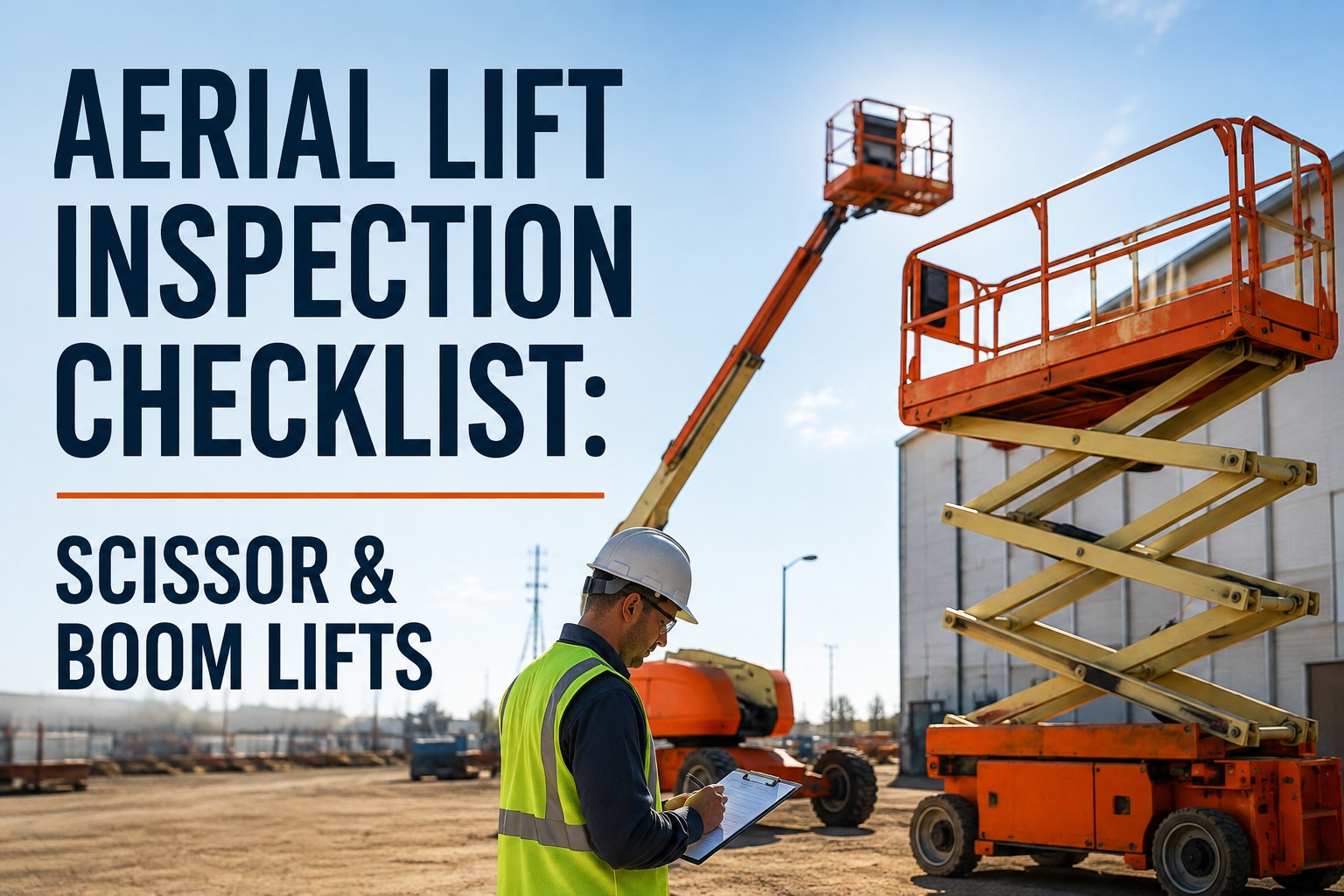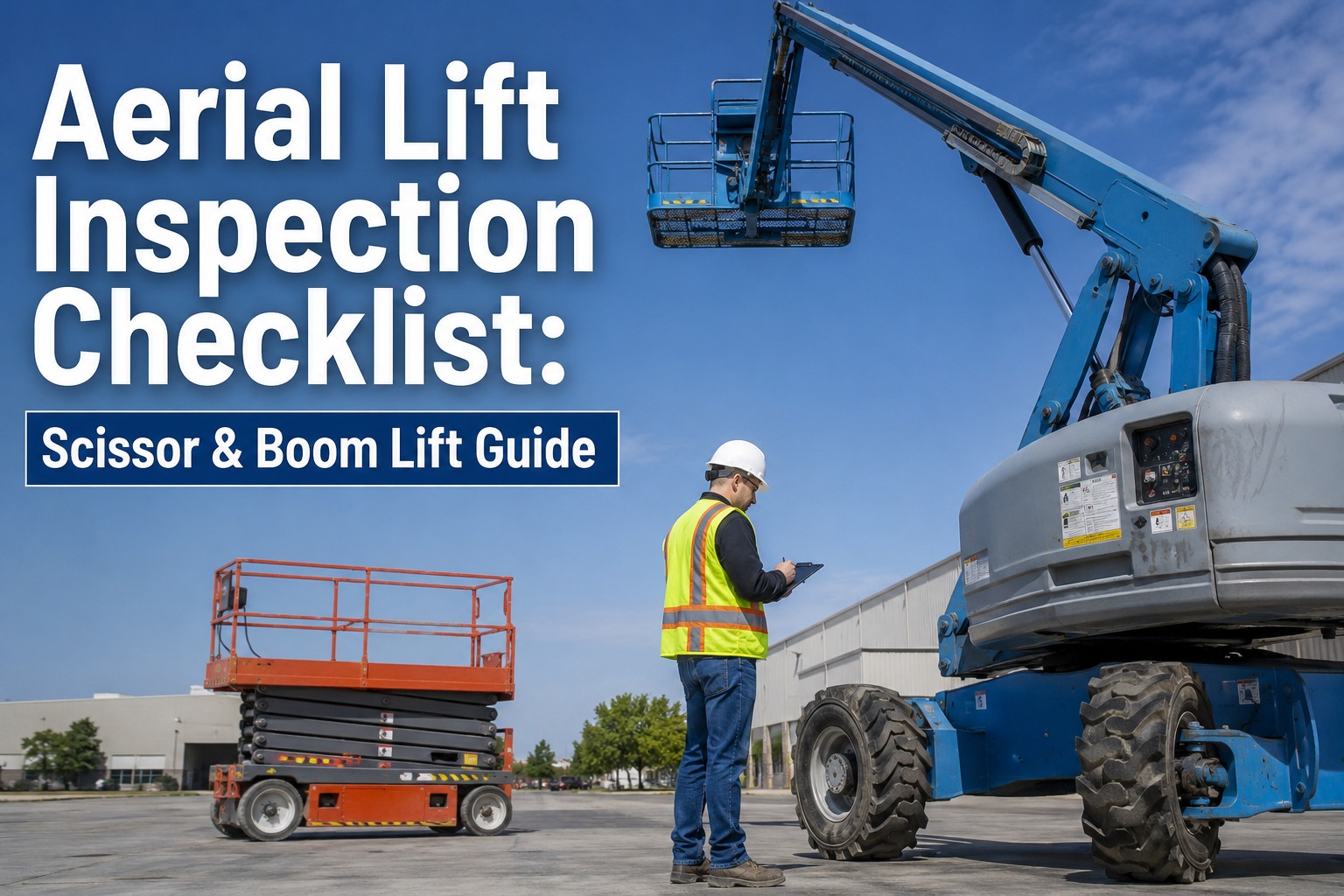
An aerial lift inspection checklist that treats every check the same is missing the point of ANSI A92.22. Three distinct tiers — pre-use before every work cycle, frequent every 3 months or 150 hours, and annual every 12 months — each with a different scope, qualified person, and documentation the AHJ actually looks for. Fold them together and one lapses silently. This aerial lift inspection checklist covers all three, for scissor and boom lifts across US, UK & Canadian sites — book a demo to digitize inspections in HVI.
Pre-Use, Frequent, Annual — Three Tiers, Three Records
Each tier has its own frequency, its own qualified person, and its own documentation. Fold them together and one of them lapses without anyone noticing until the inspector arrives.
Annual inspection — qualified person, full documentation
Comprehensive teardown-level inspection by a qualified person (typically a certified service technician). Structural welds, load-hold hydraulics, safety interlocks bench-tested, control system verified, decals and capacity plates confirmed. Written report with serial number, inspection date, findings, corrective actions, and inspector signature required. This is the tier the AHJ pulls first at an audit.
Frequent inspection — qualified person, systematic
Every 3 months of service or 150 hours of use, whichever comes first. Also required whenever the machine has been out of service for 3+ months, before it re-enters service. Qualified person walks structural condition, hydraulic system, safety devices, controls, and battery/engine per manufacturer criteria. Written record retained.
Pre-use inspection — operator, every shift
Performed by the trained operator before every work cycle. Visual walkaround plus function tests of controls, emergency stops, emergency lowering, alarms, guardrails, gates. 10-15 minutes; documented per site policy. This is the foundation the other two tiers depend on — miss it and defects go undetected between the longer-interval checks.
Each tier is required — not either/or. A frequent inspection doesn't skip the pre-use; an annual doesn't skip the frequent. Three parallel schedules per asset, three separate records.
The rest of this page walks each tier in detail, covers the scissor-vs-boom differences that matter for the checklist, and outlines the LOLER 6-monthly requirement that layers on top in Great Britain. Book a 30-minute demo to see per-asset templates that fire pre-use, frequent, and annual alerts on the right cadence.
Pre-use inspection — the operator's 10-15 minute walkaround
OSHA 29 CFR 1926.453 (construction) and 29 CFR 1910.67 (general industry) require aerial lifts to conform to ANSI A92 design and construction standards. ANSI A92.22-2021 requires the operator to perform pre-use inspection before every work cycle — at minimum, daily. The check covers four categories on both scissor and boom lifts, with additional items specific to the machine type.
Frame, platform, guardrails
- Chassis and frame for cracks, damage, corrosion
- Scissor arms or boom sections for deformation or cracks
- Platform floor, guardrails, mid-rails, toeboards intact
- Platform gate self-closing and latching
- Decals and capacity plates legible
Cylinders, hoses, leaks
- Every hose along boom/scissor for abrasion at pinch points
- Cylinder rods for scoring, damage, uneven wear
- Fittings and manifolds for wet spots or weeping
- Hydraulic reservoir level in operating range
- No visible drips under machine on level ground
E-stops, alarms, interlocks
- Emergency stop at ground & platform — both functional
- Emergency lowering system test from platform
- Tilt sensor / alarm operational (boom & some scissor)
- Overload sensor / Load Sensing System (LSS) functional
- Backup alarm, horn, work lights operational
Full range test
- Drive controls forward/reverse, low/high speed lockout
- Steering full lock both directions
- Lift/lower through full range from ground controls
- Lift/lower through full range from platform controls
- Boom articulation (boom lifts): swing, jib, telescope
Every defect gets photo-documented, not verbally reported. On boom lifts, ANSI A92.22 additionally requires operator fall-arrest attachment to be used and inspected; on scissor lifts with adequate guardrails, harness attachment is not required unless the manufacturer or site policy specifies it. Site-specific rescue plans are required regardless — the operator must know how they'll be rescued if the lift becomes inoperative at height. Book a demo to see how HVI captures pre-use observations with photos and defect flow to the shop.
Frequent inspection — every 3 months or 150 hours
The frequent inspection is often the most-missed tier because it doesn't hit on the calendar day the way the annual does, and it doesn't happen every shift the way pre-use does. It's the tier that catches wear developing between the pre-use walkaround and the annual teardown — and it's mandatory under ANSI A92.22 for any machine in continuous service.
| Trigger | Interval | Who performs | Documentation |
|---|---|---|---|
| Time in service | Every 3 months of service | Qualified person per ANSI A92.20 | Written record retained per manufacturer |
| Hours in service | Every 150 hours of use | Qualified person per ANSI A92.20 | Written record retained per manufacturer |
| Out-of-service return | Machine out of service for 3+ months | Qualified person per ANSI A92.20 | Full inspection before returning to service |
| Whichever comes first | Time OR hours OR return-to-service | Qualified person per ANSI A92.20 | Retained record with findings & corrective actions |
Scope of the frequent inspection is defined by the manufacturer's service manual and ANSI A92.22 guidance combined. Typical items: structural condition (cracks, welds, fatigue), hydraulic system (cylinder condition, hose age, filter status), safety devices (interlock function tests, load-sensing system verification, tilt sensor calibration), controls (drive, steering, boom, lift function through full range), and battery or engine condition. It's less exhaustive than the annual but far more comprehensive than a pre-use walkaround. Book a demo to see HVI trigger frequent inspections on either time or hours — whichever hits first.
Annual inspection — the one the AHJ pulls first
The annual inspection is the comprehensive tier and the one auditors reach for first because it's the tier with the clearest documentation trail. Every 12 months from the date of the last annual inspection, performed by a qualified person (typically a certified service technician from the OEM, an authorized dealer, or a third-party ANSI-qualified inspector). The written report is mandatory and must include enough detail to demonstrate the machine met every ANSI A92.20 criterion at the time of inspection.
Structural & weld inspection
All primary structure examined for cracks, fatigue, deformation. Critical welds may require magnetic particle testing or dye penetrant per manufacturer criteria. Scissor arms, boom sections, pivot points, chassis frame.
Hydraulic system evaluation
Load-hold test on lift and boom cylinders. Hose inspection with age tracking. Filter status. Reservoir condition. Any hydraulic component approaching manufacturer service-life limits identified for replacement.
Safety system verification
Every interlock, sensor, and safety device bench-tested. Tilt sensor calibration verified. Load-sensing system (LSS) verified against manufacturer spec. Emergency stops, emergency lowering, guard interlocks all confirmed functional.
Documentation & report
Written report with machine serial number, inspection date, findings, corrective actions taken or required, inspector name and qualification, next-due date. Retained per manufacturer and jurisdictional requirements — typically for the life of the machine.
Two practical points on the annual: first, stagger annual inspections across the fleet so multiple units don't come due the same week, which creates a scramble and cost premium; second, act on findings before the machine returns to service — a red-tagged unit stays red-tagged until repaired, and a repair-then-inspect cycle is often faster than trying to negotiate around an open finding. Annual cost typically runs $300–$600 per unit for third-party inspection depending on machine type and market, and units that fail on the first pass generate a re-inspection fee on top. Passing at first inspection is a maintenance-program signal, not luck. Start a free HVI trial to schedule annual inspections against every asset with staggered due dates and per-asset audit history.
Scissor vs boom — the checklist differences that matter
ANSI A92.22 covers both but recognizes they are mechanically different machines with different failure modes. The pre-use and frequent inspections differ in specific items even though the tier structure is identical.
Scissor lift (vertical only)
- Scissor arms & pins — each cross-brace inspected for cracks or bent members
- Pothole protection / drop-out bar deployment
- Level indicator function on outdoor-capable units
- Extension deck locking and stability
- Guardrail height and gap compliance (typically 39-45")
- OSHA classification: mobile scaffold (Subpart L), NOT aerial lift
- Harness typically not required if guardrails intact
Boom lift (articulating / telescopic)
- Boom sections telescope pins, wear pads, extension cylinders
- Articulating joint pins and hoses at pivot points
- Jib boom (if fitted) — pins, cylinders, controls
- Turret swing bearing, slew ring, swing motor
- Outriggers/stabilizers if fitted, ground pressure pads
- OSHA classification: aerial lift (1926.453)
- Fall-arrest harness with lanyard attached to platform anchor required
Two operational distinctions worth flagging separately: first, on scissor lifts, OSHA classifies them as mobile scaffolds under 29 CFR 1926 Subpart L rather than as aerial lifts — which means the fall-arrest harness requirement for boom lifts does not automatically apply if the scissor's guardrails are intact and properly configured; second, on boom lifts, the operator must be tied off to a platform anchor with a fall-arrest lanyard whenever the machine is in operation, regardless of guardrail condition. Site policy or a manufacturer's directive can override to require harnesses on scissor lifts, but the OSHA baseline differs. This distinction shows up on every pre-use inspection template and every fall-protection audit. Beyond harness policy, the wear items differ too — scissor cross-braces and pothole protection systems concentrate the mechanical inspection points at the base of the machine, while boom lifts spread them across articulation pins, telescope wear pads, and turret swing components. A single generic MEWP template misses items on both types; per-type templates are the operational answer.
LOLER in Great Britain — the 6-month layer on top
MEWPs used to lift people = 6-month thorough examination, not 12-month
In Great Britain, MEWPs used to lift people fall under the Lifting Operations and Lifting Equipment Regulations 1998 (LOLER) with a shortened statutory inspection interval. LOLER Regulation 9 requires a thorough examination by a competent person every 6 months for any lifting equipment used to lift people, and MEWPs sit squarely in that category. This is on top of — not instead of — the daily operator pre-use inspection, and it does not replace the manufacturer's own service schedule. The examination is documented in a written report under Schedule 1 of the regulations, categorising defects as Cat A (immediate danger, reportable to HSE), Cat B (requiring timescaled repair), or Cat C (observation). The interval is 6 months regardless of the machine's service hours, and it applies to every scissor lift, boom lift, MEWP with work platform, and any equivalent lifting device carrying personnel. Multi-jurisdictional fleets that operate the same machine model across US and UK sites will find the same asset on a 12-month cadence for the US annual and a 6-month cadence for LOLER — both requirements apply on the UK site, both records must be retained, and the shortened LOLER interval governs the machine while it's in that jurisdiction. Rental fleets moving MEWPs across borders need per-jurisdiction inspection schedules attached to each asset, not a single global calendar — a machine that meets US annual requirements is not automatically LOLER-compliant when it enters a UK site. Beyond LOLER, PUWER also applies to MEWPs as work equipment, meaning general maintenance and inspection obligations layer on top of both. Three regimes, three records, all required — and a competent person, not the same person who did the manufacturer's service, must perform the thorough examination.
A rental fleet safety manager on the shift to digital inspection records
We run a mixed rental fleet — 340 aerial lifts across seven yards. Scissor, boom, mast, some vertical lifts. When we ran paper inspection records, three problems compounded. Annual inspections drifted — some units expired for weeks before anyone caught it. Frequent inspections at the 3-month mark almost never happened because they weren't on a calendar anyone was watching. Pre-use records existed on clipboards in the yard office and were often illegible or missing altogether. When OSHA visited two years ago and pulled 12 random units to audit, we couldn't produce clean records on 4 of them.
Digital changed the game. Every asset has its own three-tier schedule: pre-use required before rental release, frequent triggered by hours or time whichever comes first, annual scheduled with 90-day advance alert. Photo evidence on every check. Defects flow to work orders with parts logged. OSHA came back last spring, pulled 15 units, cleared all 15 in about 40 minutes. Same fleet, same machines, same team — different records. That's the only thing that changed.
Frequently asked questions
What are the three types of aerial lift inspections?
ANSI A92.22-2021 defines three parallel inspection tiers for MEWPs (scissor lifts, boom lifts, and other mobile elevating work platforms). First, pre-use inspection: performed by the trained operator before every work cycle, minimum daily. Visual walkaround plus function tests of controls, emergency stops, emergency lowering, guardrails and gates, structural condition, hydraulics for leaks, tyres, and battery/fuel. 10-15 minutes. Second, frequent inspection: performed by a qualified person every 3 months of service or every 150 hours of use, whichever comes first. Also required whenever the machine has been out of service for 3+ months before it re-enters service. Covers structural condition, hydraulic system, safety devices, controls, and power system per manufacturer criteria. Written record retained. Third, annual inspection: performed by a qualified person every 12 months from the date of the last annual inspection. Comprehensive teardown-level evaluation including structural weld inspection, hydraulic load-hold testing, every safety device bench-tested, and full documentation with serial number, findings, corrective actions, and inspector qualification. Each tier is required — not either/or — and each has its own record.
How often does an aerial lift need to be inspected under OSHA?
OSHA 29 CFR 1926.453 (construction) and 29 CFR 1910.67 (general industry) require aerial lifts to conform to ANSI A92 design and construction standards, which by reference incorporates ANSI A92.22-2021 inspection requirements. Practically this means three inspection cadences apply to every aerial lift. Pre-use inspection by the operator before every work cycle, at minimum daily — OSHA cites missing or inadequate pre-use records as a frequent finding. Frequent inspection by a qualified person every 3 months of service or every 150 hours of use, whichever comes first, and also required whenever the machine has been out of service for 3+ months. Annual inspection by a qualified person every 12 months from the date of the last annual inspection, with written documentation of serial number, findings, and corrective actions. On scissor lifts specifically, OSHA classifies them under Subpart L (scaffolds) rather than as aerial lifts, but the inspection framework is functionally identical because ANSI A92.22 applies to both scissor and boom lifts. State OSHA plans and some local jurisdictions may add supplementary requirements — always verify against the specific site's regulatory framework.
Who is qualified to inspect an aerial lift?
The qualified person varies by inspection tier. Pre-use inspection: performed by the trained operator. Under ANSI A92.24, the operator must be trained and familiarized on the specific type and model of MEWP they will use, and the training must cover pre-use inspection procedures. Operator training is refreshed every 3 years. Frequent inspection: performed by a "qualified person" as defined in ANSI A92.20 — typically a service technician trained on the specific machine type with documented ability to identify defects and recommend corrective action. This can be an in-house technician who has completed manufacturer training, an authorized dealer technician, or a third-party ANSI-qualified inspector. Annual inspection: performed by a qualified person, typically an OEM-certified service technician, an authorized dealer, or an independent third-party inspector with documented ANSI qualification. The annual is often the tier where in-house capability ends and third-party services begin because it requires the deepest teardown-level evaluation and the most detailed documentation. Regardless of who performs the inspection, the written record must identify the inspector by name and demonstrate qualification.
Is a scissor lift the same as an aerial lift for inspection purposes?
Under ANSI A92 the two are grouped together as MEWPs (mobile elevating work platforms), and the same three-tier inspection framework (pre-use / frequent / annual) applies to both. ANSI classifies scissor lifts as Group A (platform center stays within chassis perimeter at all times) and boom lifts as Group B (platform can extend beyond chassis perimeter), and the inspection tier requirements are identical. Under OSHA, however, scissor lifts and aerial lifts are classified differently: scissor lifts fall under 29 CFR 1926 Subpart L (scaffolds), while aerial lifts (boom lifts, articulating booms, vehicle-mounted aerial devices) fall under 29 CFR 1926.453 (aerial lifts). The practical difference: on aerial lifts (boom), operators must be tied off to a platform anchor with a fall-arrest lanyard during operation regardless of guardrail condition; on scissor lifts, harness attachment is not required by OSHA if the guardrails are intact and properly configured, though site policy or manufacturer directive can override to require harnesses. Both machine types require the full ANSI A92.22 three-tier inspection cadence.
Do UK MEWPs need a LOLER inspection?
Yes, in addition to any manufacturer or ANSI-derived inspection routine. In Great Britain, MEWPs used to lift people fall under the Lifting Operations and Lifting Equipment Regulations 1998 (LOLER). LOLER Regulation 9 requires a thorough examination by a competent person every 6 months for any lifting equipment used to lift people, and MEWPs (scissor lifts, boom lifts, vertical mast lifts, articulated booms with work platforms) all fall in that category. This is on top of the daily operator pre-use inspection and does not replace the manufacturer's service schedule. The examination is documented in a written report under Schedule 1 of the regulations, categorising defects as Cat A (immediate danger, reportable to HSE), Cat B (requiring timescaled repair), or Cat C (observation). PUWER also applies to MEWPs as work equipment, adding general maintenance and inspection obligations. Multi-jurisdictional fleets that operate the same MEWP model across US and UK sites need per-jurisdiction inspection schedules attached to each asset — a machine that meets ANSI A92.22 annual requirements is not automatically LOLER-compliant on a UK site.
Every MEWP, every tier, every jurisdiction — one clean compliance record
HVI holds each aerial lift's pre-use, frequent, and annual cadence per asset, layers LOLER 6-month scheduling for UK-based units, fires 90/60/30-day alerts before each interval, launches the correct tier's template on the operator or technician's phone with photo capture, flows defects into work orders with parts and labor logged, and produces the audit-ready evidence trail OSHA, HSE, or fleet insurers actually inspect. Live in under two weeks. No hardware. No credit card.
Trusted by rental, construction & utility fleets across USA, Canada, UK & Australia · Ready on day one