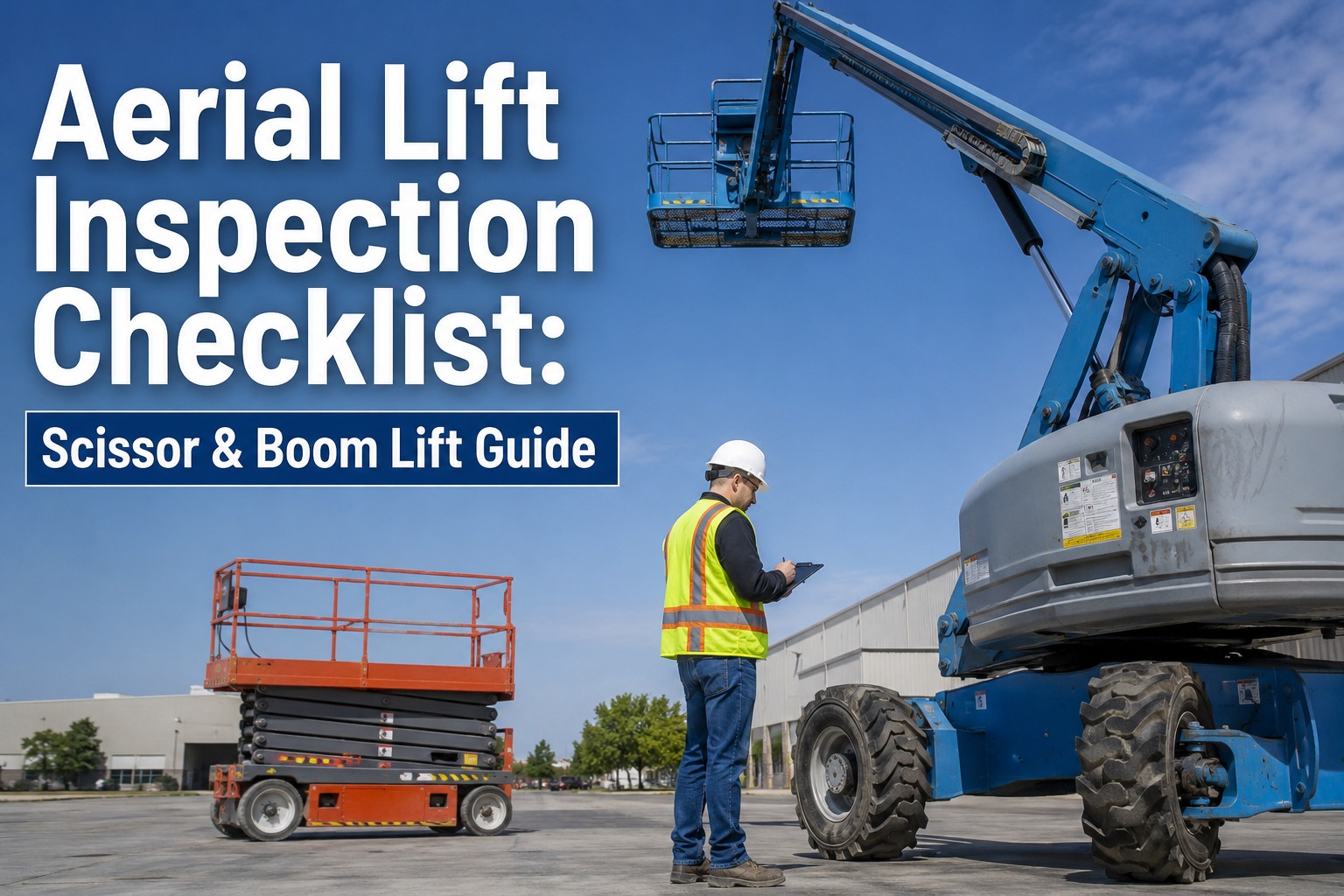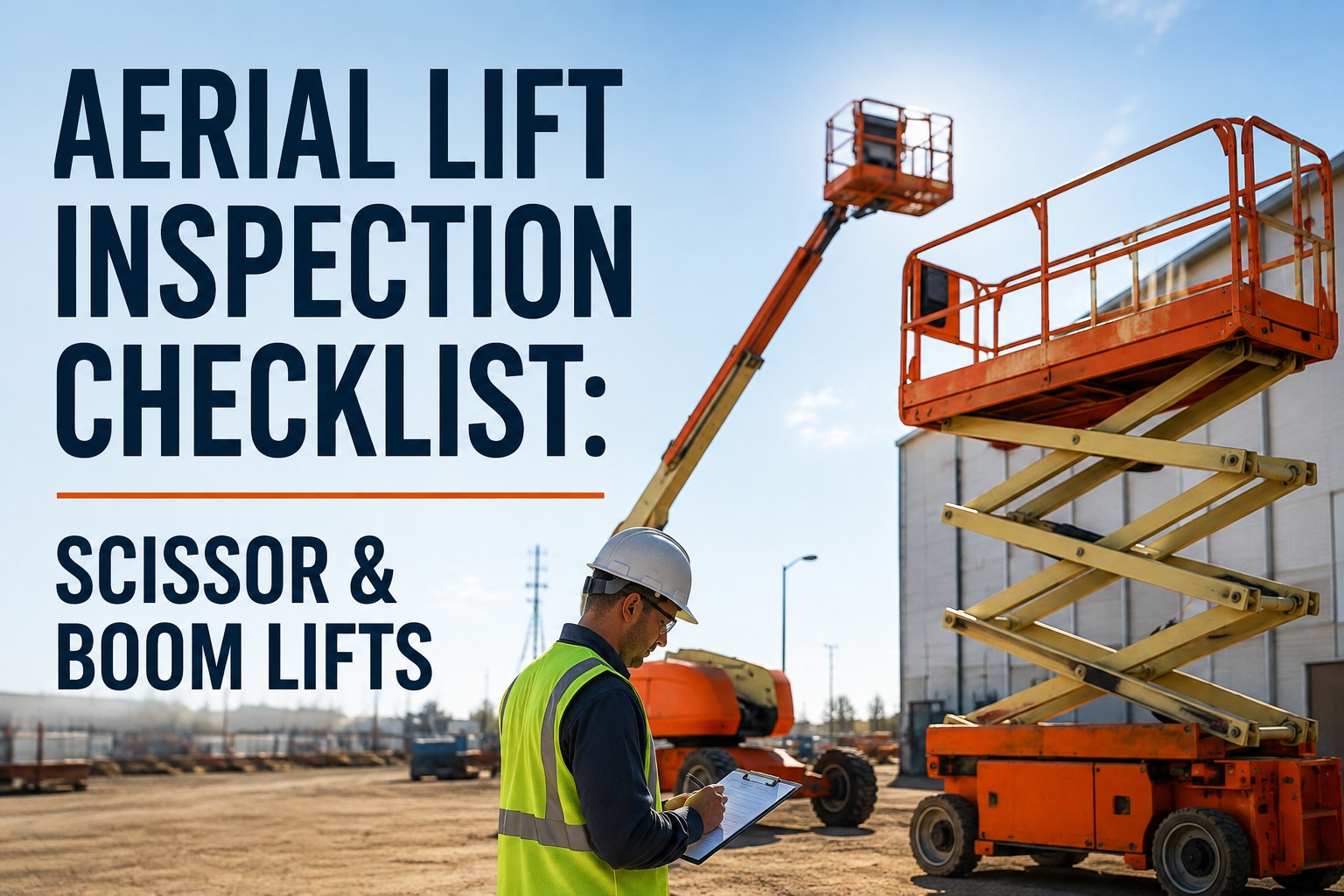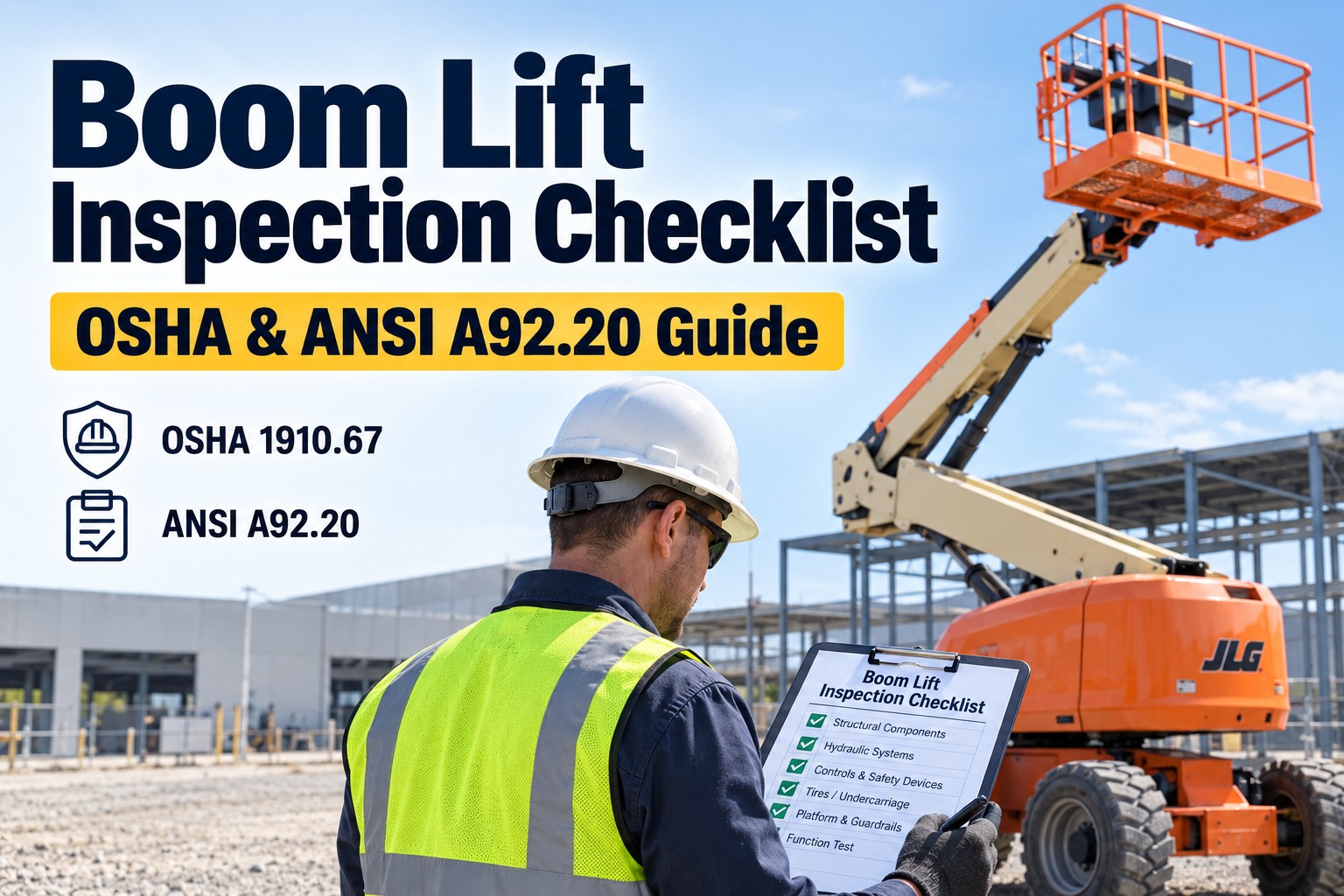
Falls from aerial lifts remain one of the top causes of workplace fatalities on U.S. construction and industrial sites — and OSHA violations tied to boom and scissor lift inspection failures rank among the most cited each year. The compliance landscape shifted meaningfully with the June 2020 adoption of the ANSI A92 standards suite (A92.20 design, A92.22 safe use, A92.24 training), which replaced the older A92.3, A92.5, and A92.6 standards and reclassified everything the industry used to call an Aerial Work Platform (AWP) as a Mobile Elevating Work Platform (MEWP). Boom lift inspection checklist requirements now sit at the intersection of OSHA 29 CFR 1910.67 (general industry) and 29 CFR 1926.453 (construction), layered with the ANSI/SAIA A92.22 Safe Use standard that mandates pre-use, frequent, and Annual Machine Inspection (AMI) protocols. Get any tier wrong and the exposure is measurable: OSHA serious violations run over $16,000 per finding, willful or repeat violations exceed $160,000, and a job-site fatality tied to inspection failure triggers regulatory, insurance, and legal cascades that can shut a small operator down entirely. This guide is the operational reference safety and rental managers use to run OSHA- and ANSI-compliant boom lift inspection programs across all three legally required tiers. Book an HVI demo to see the digital checklist configured for your fleet.
Every MEWP requires 3 inspections. Skip any tier, own the liability.
OSHA and ANSI A92.22 require pre-use, frequent, and Annual Machine Inspections on every boom lift — performed at defined intervals by defined roles, with defined documentation.
OSHA 1910.67(c)(2)
OEM service manual
OSHA 1910.67(c)(2)(i)
MEWP classification — where boom lifts sit in the ANSI A92.20 framework
Boom lift inspection intersects with equipment classification because ANSI A92.20 assigns different safety requirements, training obligations, and inspection protocols by Group and Type. Understanding where a specific boom lift falls tells the safety manager which requirements apply.
Stowed only
Elevated / chassis controls
Elevated / platform controls
Stays inside tipping line
the tipping line
JLG, Genie, Snorkel articulating & telescopic
The most common boom lifts on U.S. job sites — the self-propelled articulating and telescopic booms from JLG, Genie, and Snorkel that dominate the rental fleet — sit as Group B, Type 3 MEWPs. These require the most rigorous safety features under A92.20 including active tilt sensors with cutout, load-sensing systems, and operator-side controls. Frequent and annual inspection scope reflects the higher stakes. Book an HVI demo to see MEWP classification tagging on your inventory
The pre-use inspection checklist — 35 checkpoints in 6 systems
The pre-use inspection is the frontline safety check and the most enforceable tier — OSHA compliance officers can and do ask to see the current shift's checklist during inspection. The framework below is aligned with ANSI A92.22 §7.1 and the operator-manual pre-use requirements of JLG, Genie, and Snorkel across their boom lift product families.
- Operator & safety manual on machine (weatherproof storage)
- Load capacity placard legible at platform
- ANSI Manual of Responsibilities present
- Warning & caution decals intact, legible, none defaced
- Current AMI decal or tag with valid expiration date
- Tires: no cuts, gouges, or embedded debris (foam or solid confirmed)
- Wheels & lug nuts: correct torque, no missing
- Outriggers / stabilizer pads: extension, condition, ground-contact indicators
- Fuel or battery: level check, no leaks, terminals clean if electric
- Hydraulic fluid: level check within manufacturer window
- Engine oil & coolant (diesel/gas units): levels within spec
- Ground condition assessment for planned work area (slope, soft ground, holes)
- Boom sections: visual for cracks, dents, corrosion, missing hardware
- Turret & slew ring: no visible play, no loose bolts
- Platform & gate: intact guardrails, gate closes and latches
- Anchor points for personal fall arrest system (PFAS): rated, undamaged
- Non-slip platform surface: clean, no oil or debris
- Emergency lowering system operational (rehearsed if possible)
- Cylinders: no visible leaks at rod seals or end caps
- Hoses: no chafing, kinks, or cracked outer jacket
- Fittings: no seepage or dripping at connections
- Boom-drift check: platform holds position when unattended for 60 seconds
- Reservoir cap secure, breather clear
- Lower controls: all functions operate correctly
- Upper (platform) controls: all functions operate correctly
- Emergency stops (upper & lower): tested, both cut power
- Control enable switches / foot pedals functional
- Wire harnesses secure, no exposed conductors
- Battery disconnect switch tested
- Warning lights & strobes operational
- Tilt sensor: alarm activates when platform tilted beyond limit
- Load-sensing system: alarm activates at rated capacity
- Horn: audible at operator station and ground
- Travel alarm (backup): audible when unit moves in reverse
- Fall arrest lanyard on operator: rated, undamaged, correct anchor
Any single failed checkpoint is grounds for tagging the machine out-of-service pending correction. Do not operate a MEWP with a known deficiency — the OSHA and civil-liability exposure of continuing after a documented finding is severe. Start a free trial to configure this 35-point checklist on your fleet with photo requirements and signature capture.
Frequent inspection — the 3-month / 150-hour deep check
The Frequent Inspection sits between daily pre-use and the Annual Machine Inspection. Performed by a qualified mechanic every 3 months or 150 operating hours (whichever comes first per manufacturer guidance), it catches the wear patterns and defects that pre-use inspections cannot detect. Coverage typically expands to include:
Close-range examination of boom section welds, turret weldments, pivot pin bosses, and cylinder mounts for hairline cracks, weld failures, or metal fatigue signatures. Dye-penetrant or magnetic-particle testing for high-stress zones.
System pressure verification at pump, main relief, and holding valves. Cylinder rod inspection for pitting, scoring, or seal deterioration. Cross-port leakage testing on holding valves. Filter replacement per OEM schedule.
Physical measurement of pin diameter and bushing bore. Play tolerances against OEM spec. Cotter pin and retainer condition. This is where boom lifts fail catastrophically when neglected — worn pins introduce sway that compounds under load.
Tilt sensor calibration verification. Load-sensing system verification against a known test weight. Emergency descent system functional test at full boom extension. Function cutout verification at overload and tilt thresholds.
Battery load testing (electric units). Alternator output testing (engine units). Wire harness continuity testing at flex points. Control panel diagnostic scan. Ground-fault checking on 24V and 48V systems.
Foam-fill inspection for degradation. Wheel bearing repack per interval. All chassis and turret bolt torque verification against OEM torque specification chart. Outrigger cylinder inspection.
Missed Frequent Inspections are the most common gap in fleet compliance programs — often skipped or delayed under production pressure and forgotten until the Annual Machine Inspection reveals accelerated wear. Book an HVI demo to see automatic Frequent Inspection scheduling by engine hours
Annual Machine Inspection (AMI) — the ANSI-qualified deep audit
The Annual Machine Inspection is where the equipment's continued fitness for service is formally certified. ANSI A92.22 §7.3 requires the AMI to be performed by a qualified person — defined as someone with recognized certification, professional standing, or extensive knowledge and training specific to the make and model. In practice this means an OEM-trained mechanic or a certified third-party inspection service. The AMI decal placed on the machine documents the current-year certification and is what OSHA compliance officers verify first.
- Non-destructive testing (NDT) of high-stress welds
- Boom section geometry measurement against OEM spec
- Turret mount bolt torque verification
- Chassis frame inspection for stress cracks
- Cylinder rod inspection with dial indicator
- Pump flow & pressure testing at full spec load
- Cylinder end-cap and gland re-seal per OEM schedule
- Complete hose and fitting replacement per interval
- Holding valve function verification under load
- Reservoir cleaning and fluid change
- Load-sensing calibration with test weights
- Tilt sensor calibration at defined angles
- Emergency lowering system full-cycle test
- Function cutout verification at all thresholds
- Redundant control-system continuity testing
- Full AMI report signed by qualified inspector
- Current-year AMI decal affixed to machine
- Findings log with severity and disposition
- Rectified defects photo-documented
- Records retained for equipment life
An operator without a current AMI decal on the machine is presumptively out of compliance with ANSI A92.22 and, by OSHA's incorporation of ANSI standards under the general duty clause, out of compliance with OSHA. Insurance underwriters increasingly require proof of current AMI as a condition of coverage for rental fleets and construction operators. Book an HVI demo to see AMI status tracked automatically across your fleet
The 6 most common inspection findings on boom lifts
Aggregated across OSHA violation data, rental-fleet inspection reports, and OEM warranty claim patterns, six findings account for the majority of boom lift inspection defects. Every one of them is preventable with disciplined pre-use inspection.
Load capacity placards, warning decals, and operator manual sleeves are removed, damaged by weather, or defaced. Any missing decal is a citation-eligible finding under OSHA 1910.145 (specifications for accident prevention signs and tags) and ANSI A92.22.
Slow weeping at the primary lift cylinder rod seal, boom telescope cylinder, or platform level cylinder is the most common defect found on rental-fleet return inspection. Small leaks propagate to boom-drift and safety compromise if ignored.
Guardrails bent from impact, gate latches broken, and platform anchor D-rings damaged or missing. Personal Fall Arrest System (PFAS) attachment integrity is required whenever the boom is elevated on Group B (boom-type) MEWPs.
E-stop buttons that stick, don't fully cut power, or have never been tested. Emergency descent systems that fail during activation because they've never been rehearsed. These are the highest-severity findings and unambiguous take-out-of-service conditions.
ANSI A92.20-required tilt and load sensors are jumpered, disabled, or intentionally bypassed by operators or shop personnel. This is both an OSHA violation and a manufacturer warranty voider, and it creates catastrophic tipping and overload exposure.
Machine is past its 12-month AMI due date and continues to operate. The AMI decal is what OSHA compliance officers check first — and an expired one is presumptive out-of-compliance until the current-year AMI is documented and re-decaled.
Every one of the six findings is trivially preventable with disciplined inspection cadence and digital documentation that surfaces exactly which units are due for what — before OSHA does. Start a free trial to configure automatic AMI expiration alerts on every unit in your fleet.
From a Safety Manager running 87 boom and scissor lifts across 12 job sites
We run 87 MEWPs across 12 active job sites in the Southeast — a mix of JLG articulating booms, Genie telescopic booms, and Skyjack scissor lifts, mostly rental fleet but some owned. Before we digitized, our pre-use inspection compliance rate was roughly 60% and audit-ready documentation took hours to compile per unit. We had two OSHA citations in 18 months tied to missing decals and expired AMI.
We rolled out digital pre-use checklists on the operators' phones with photo requirements on the critical items and signature capture at completion. Compliance rate went to 96% in the first month. Every failed checkpoint automatically tagged the machine out-of-service until the shop cleared it. OSHA compliance visits stopped being fire drills — we pulled full history for any unit in under thirty seconds on tablet. Nothing about our safety program was broken. The paper trail was.
Frequently asked questions
What are the three legally required boom lift inspections?
OSHA and ANSI A92.22 require three distinct boom lift inspection tiers on every Mobile Elevating Work Platform (MEWP): First, the Pre-Use Inspection, performed at the start of every shift or before each use by a trained MEWP operator, covering roughly 35 checkpoints across documentation, chassis, boom, hydraulics, electrical controls, and A92.20-required safety systems (tilt sensor, load sensor). Takes 10-15 minutes and must be documented with a signed checklist. Second, the Frequent Inspection, performed every 3 months or 150 operating hours (whichever comes first per manufacturer guidance) by a qualified mechanic or technician. Covers structural welds, hydraulic pressure testing, pivot pin and bushing wear measurement, safety system calibration verification, and electrical system deep-checking. Takes 2-4 hours and produces a formal inspection report. Third, the Annual Machine Inspection (AMI), performed every 12 months by an ANSI-qualified inspector (typically an OEM-trained mechanic or certified third-party inspection service). Covers non-destructive testing of high-stress welds, complete hydraulic system testing, safety system calibration with test weights, and full re-certification. Takes 4-8 hours per unit and results in an AMI decal affixed to the machine plus a comprehensive inspection report retained for equipment life. Missing any tier creates OSHA exposure — serious violations run over $16,000 per finding, willful or repeat exceed $160,000, and job-site fatalities tied to inspection failure trigger regulatory, insurance, and legal cascades.
What's the difference between OSHA 1910.67 and ANSI A92.22?
OSHA 29 CFR 1910.67 (general industry) and 29 CFR 1926.453 (construction) are federal regulations with the force of law — enforceable by OSHA compliance officers with citation authority. They cover vehicle-mounted elevating and rotating work platforms and aerial lifts, setting minimum training, inspection, fall protection, and operational requirements. Non-compliance results in citations, fines, and potential criminal exposure in fatality cases. ANSI/SAIA A92.22-2021 is a consensus industry standard covering safe use of Mobile Elevating Work Platforms (MEWPs) — not a federal regulation but incorporated by reference into OSHA's General Duty Clause (Section 5(a)(1) of the OSH Act) which requires employers to provide workplaces free from recognized hazards. In practice, OSHA compliance officers use ANSI A92.22 as the definition of industry best practice when determining whether an employer has met the general duty clause. Effect: while A92.22 is technically "voluntary," non-compliance with A92.22 requirements — including the three-tier pre-use, frequent, and Annual Machine Inspection protocols — is functionally treated as non-compliance with OSHA. Additionally, ANSI A92.20-2021 covers equipment design requirements (like active load-sensing and tilt-sensor cutouts), and ANSI A92.24-2018 covers operator and supervisor training. Together the three ANSI A92 standards define the U.S. safe-use framework MEWPs operate under. Insurance underwriters routinely require documented A92 compliance as a condition of coverage.
Who is qualified to perform an Annual Machine Inspection?
ANSI A92.22 defines a "qualified person" as someone who by possession of a recognized degree, certificate, or professional standing, or by extensive knowledge, training, and experience has successfully demonstrated the ability to solve or resolve problems related to the subject matter, work, or project. In practice for AMI purposes this means: an OEM-trained technician (JLG, Genie, Skyjack, Snorkel, Terex certified) working under a factory or dealer service program; a certified third-party inspection service employing technicians with make/model-specific credentials; or an in-house maintenance technician who has completed accredited MEWP inspector training (such as the two-day programs offered by Crane Tech, IPAF, or accredited manufacturer training centers). The critical requirement is make-and-model-specific competency — a technician qualified to inspect JLG 400S articulating booms is not automatically qualified to inspect Genie Z-135 telescopic booms. Employers must maintain documented evidence of the inspector's qualifications for each equipment class inspected, including training certificates, hands-on experience records, and ongoing competency verification. This documentation is what OSHA compliance officers review during citation proceedings if an AMI's validity is challenged. Fleet operators managing multiple OEM platforms typically maintain a matrix mapping technicians to authorized equipment classes and rotate inspection responsibilities accordingly.
How is a MEWP different from an aerial work platform (AWP)?
Effectively the same equipment under different terminology. The ANSI A92.20 standard adopted in June 2020 renamed what the industry historically called an Aerial Work Platform (AWP) to Mobile Elevating Work Platform (MEWP) to align U.S. terminology with international ISO standards used globally (particularly EN 280 in Europe). Boom lifts, scissor lifts, vertical mast lifts, and truck-mounted articulating booms are all MEWPs under the current standards. Alongside the terminology change, ANSI A92.20 introduced a formal classification system that didn't exist under the older A92.3, A92.5, and A92.6 standards it replaced. MEWPs are classified by Group (Group A stays inside the tipping line, moves vertically only — includes scissor lifts and vertical mast lifts; Group B extends beyond the tipping line — includes all boom lifts) and by Type (Type 1 can travel only in the stowed position; Type 2 travels elevated with chassis-mounted controls; Type 3 travels elevated with platform-mounted controls). Most self-propelled boom lifts in U.S. rental fleets and construction fleets are Group B, Type 3 MEWPs. This classification determines applicable safety features, training scope, and inspection requirements. Any inspection checklist, training document, or safety program referencing "AWP" terminology predates the June 2020 standard shift and should be updated to current MEWP terminology and framework.
Can boom lift inspection checklists be digital instead of paper?
Yes. Neither OSHA 1910.67 nor ANSI A92.22 specifies paper as the required documentation medium — the standards require documentation of inspection findings, operator identification, timestamps, and defect disposition, but the format may be digital. Digital pre-use inspection platforms have become the dominant approach for serious fleet operators for several practical reasons: enforcement of every checkpoint (paper checklists routinely show partial completion; digital forms can require every field before submission), photo evidence attached to critical items (impossible to do in an audit-ready way on paper), operator signature capture with device timestamp and GPS location (higher-integrity documentation than a paper signature), automatic routing of failed checkpoints to the maintenance shop as a work order, instant retrieval of inspection history for any unit during OSHA visits (paper systems routinely take hours to compile and often reveal gaps), and integration with the rest of the fleet management platform (PM scheduling, work orders, AMI tracking). Regulatory-wise, digital records must satisfy the same documentation retention requirements as paper — typically the life of the equipment for AMI records, three years for pre-use and frequent inspection records under OSHA recordkeeping standards. Fleets moving from paper to digital typically see pre-use inspection compliance rates rise from 55-70% to over 95% in the first month, driven by the combination of easier operator workflow and the impossibility of skipping mandatory fields.
Turn every pre-use inspection into audit-ready evidence — on every shift, every unit.
HVI's digital MEWP inspection module replaces paper checklists with mobile-first forms enforcing all 35 pre-use checkpoints, photo evidence for critical items, operator signature with GPS timestamp, automatic out-of-service tagging on failed items, work-order routing to the shop, and instant retrieval for OSHA visits. Configured for JLG, Genie, Skyjack, Snorkel, and Terex boom and scissor lift fleets. Live for your team in under two weeks.
Pre-loaded MEWP templates · JLG, Genie, Skyjack, Snorkel, Terex · OSHA-ready audit exports