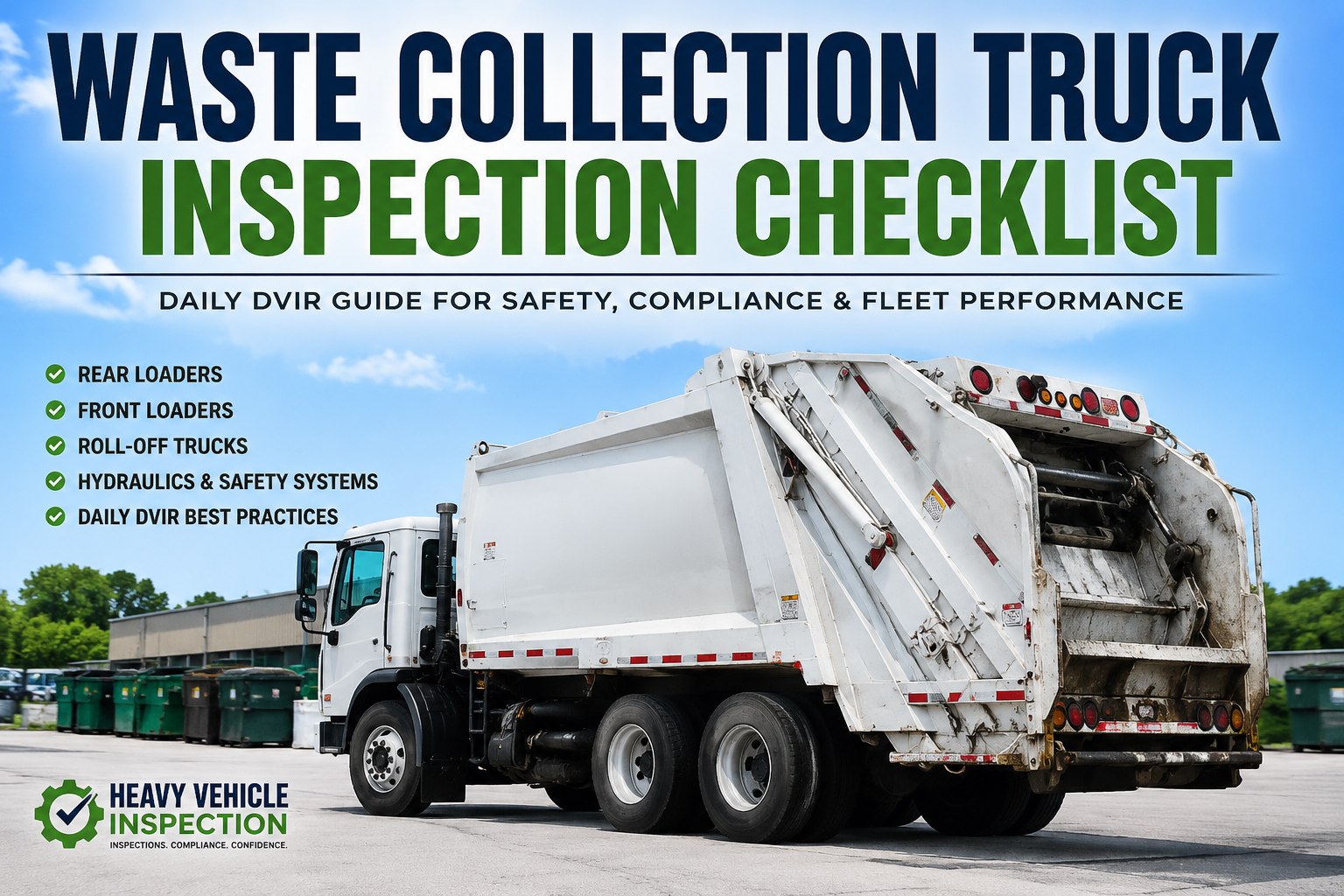
Waste truck inspection checklists differ fundamentally from generic commercial vehicle DVIRs — refuse fleets operate stop-and-go every 30 seconds, cycle hydraulics 800-1,200 times per shift, and carry 25,000+ pounds of compaction load through routes that destroy standard trucks within months. Hydraulic system failures alone account for 30-40% of refuse fleet maintenance spend. ANSI Z245.1-2017 is the safety standard OSHA references — but real-world inspection needs body-type specificity: rear loaders, front loaders, and roll-offs each fail differently. Book an HVI demo to deploy body-specific templates.
One generic DVIR won't cover three fundamentally different refuse trucks.
Each waste truck body type has its own critical inspection zones and its own failure modes. Body-specific checklists catch what generic templates miss — before the truck reaches the route.
- Packer blade cylinder
- Tailgate seal / ejector
- Riding steps & handholds
- Hopper wear plates
- Fork mechanism & pins
- Top-mount arm hydraulics
- Container grippers
- Overhead visibility clearance
- Winch cable & sheaves
- Hoist cylinder & pins
- Rails & rollers
- Container locks / safety chains
The American National Standard for Mobile Wastes and Recyclable Materials Collection, Transportation, and Compaction Equipment. OSHA doesn't publish refuse-specific regulations — enforcement leans on the General Duty Clause plus ANSI Z245. Your internal inspection program is what protects your operators, not a federal checklist.
Why generic DVIRs fail waste trucks
A standard Class 8 DVIR was designed for over-the-road tractors that make 5-10 stops per shift, cruise at highway speeds, and rarely cycle body equipment. Refuse trucks operate an inverse duty cycle: 800+ stops per shift, hydraulic engagement every 30 seconds, and compaction pressures that would destroy tractor hydraulics within weeks. A generic checklist misses more than half of what actually breaks on a refuse truck.
The consequences are severe. Waste collection is the 5th most dangerous job in the United States, with fatality rates 5x the all-industries baseline and roughly 60% of fatalities transportation-related. Mid-route hydraulic failures cost $500-$1,500 per incident plus $2,000+ per day in lost route revenue. Structured body-specific inspection prevents 85% of these breakdowns.
Packer blade cylinders, tailgate cylinders, fork arm cylinders, hoist cylinders — each body type has 6-12 dedicated hydraulic assemblies. Generic checklists cover "hydraulic leak inspection" as one line, missing 90% of actual failure points.
ANSI Z245 mandates specific checks on riding steps, handholds, and dismount grips — components involved in most transportation-related waste worker fatalities. Generic DVIRs don't include them.
Refuse trucks back into residential streets thousands of times per week. Back-up alarms, cameras, mirrors, and blind-spot sensors are safety-critical — but generic DVIRs treat them the same as on a highway tractor that backs 5 times per shift.
Waste exposure creates corrosion patterns generic checklists don't anticipate: hopper wear plates, tailgate seals, hydraulic hose end fittings. These need inspection frequency 3-5x higher than highway equivalents.
Book an HVI demo to see body-specific templates against your fleet's actual failure history
Universal daily DVIR items — every waste truck, every shift
Universal items apply to all three body types before body-specific checks begin. These are the ANSI Z245-aligned safety items that fail a truck for dispatch if not verified.
- Back-up alarm audible from 30+ feet
- Rear camera and screen operational
- Side and blind-spot mirrors clean, positioned
- Strobe / hazard lights functional
- Fire extinguisher pressure gauge in green
- First-aid kit stocked, sharps container present
- Tire pressures at spec, no visible damage
- Wheel lug indicators aligned
- Brake air pressure builds to 100-125 psi
- No air leaks (10 psi loss over 2 minutes)
- Engine oil, coolant, DEF levels correct
- Fuel level sufficient for full route
- Windshield clear, no cracks in driver sightline
- Wipers and washer fluid functional
- All exterior lights: headlights, brake, turn, marker
- Horn sounds when activated
- Seat belt latches and retracts properly
- Dashboard warning lights all clear at startup
- Registration, insurance, IFTA current
- Previous DVIR reviewed, no open defects
- DOT decals legible on both sides
- Driver credentials and training current
- Route sheet and container manifest present
- Emergency contact / spill response info onboard
Universal items take 8-12 minutes with paper and 4-6 minutes with a mobile DVIR app that photo-documents each item. Time saved goes into body-specific inspection.
Rear loader — body-specific inspection
Rear loaders are the most common refuse configuration and produce the highest hydraulic cycle count of any body type. Every 30 seconds during a residential route, the packer blade completes a compaction cycle. Body-specific inspection focuses on packer, tailgate, hopper, and riding-step safety.
Inspect packer blade for cracks, wear, or bent edges. Cycle blade fully with no load; verify smooth extension and return without hesitation. Check cylinder for external leaks at rod seals and hose connections. Listen for grinding during cycle — suggests seal or bushing wear.
Check tailgate closure seal for tears or missing rubber — primary source of leachate leaks. Verify tailgate lock engages fully. Test ejector panel for full stroke without binding. Inspect ejector rod for scoring or plating damage.
Inspect riding step grip surface for wear, corrosion, or damage — safety-critical per ANSI Z245. Test handhold rigidity by full body weight pull. Verify step-in-use indicator activates when helper is on step. Confirm truck inhibits speed above 10 mph with helper on step.
Check hopper floor and sidewalls for thin spots, cracks, or hydraulic-fluid staining indicating internal leak. Verify wear plate fasteners intact and torqued. Inspect leachate drain valve for closure and function.
Front loader — body-specific inspection
Front loaders serve commercial dumpster routes with fewer cycles but higher lift loads (up to 8,000 pounds per dumpster). Body-specific inspection focuses on fork mechanism, arm hydraulics, overhead clearance, and container controls.
Inspect fork tines for bent, cracked, or worn condition. Check pivot pins for looseness or missing retainers. Verify fork alignment matches dumpster pocket spacing. Test fork extension and retraction for smooth operation.
Inspect main arm cylinders for external leaks, especially at swivel joints. Check hydraulic hoses along arm articulation path for chafing, kinking, or age cracking — refuse fleet leading failure point. Verify arm lifts to full height and holds without drift over 30 seconds.
Verify height-limit warning system functional — front loaders regularly encounter overhead power lines, canopies, and low bridges when arms are extended. Test audible and visual alerts. Confirm operator has current route hazard mapping for low-clearance stops.
Test grip cylinders for equal pressure on both sides. Verify tipping motion is smooth and dumping angle reaches spec (typically 90-100°). Check for hydraulic drift with loaded arm at full height. Inspect joystick and control panel for stuck buttons.
Roll-off truck — body-specific inspection
Roll-off trucks handle construction and industrial containers with dramatically different duty cycles — 8-15 heavy container swaps per shift versus 800+ compaction cycles on residential routes. Body-specific inspection focuses on winch cable, hoist system, rails/rollers, and container locking.
Inspect winch cable full length for broken wires, bird-caging, kinks, or corrosion. Cable with 6+ broken wires in one lay length requires immediate replacement per industry standard. Check sheave grooves for wear indicating cable misalignment. Verify drum spooling is even.
Inspect hoist cylinder for external leaks, especially at rod-end seal — largest hydraulic cylinder on any refuse body. Check pivot pins for wear, missing keepers, or bushings that have worn oval. Verify hoist raises to full tilt (typically 55-60°) and holds without drift.
Inspect roller wear rings and bearings — failures strand loaded containers on the truck bed. Check rails for straightness, weld condition, and damaged sections. Grease rollers per OEM interval. Verify rear roller pivot moves freely.
Test forward and rear container hooks for solid engagement. Inspect safety chains for wear or damaged links — last-line defense against container release during transit. Verify locking mechanism engages positively and operator can visually confirm lock status before departure.
Roll-off inspection completes in 6-8 minutes but must be documented before every container swap, not just start-of-shift. Start a free trial to deploy per-swap inspection workflows.
Hydraulic system — the highest-failure area on every body type
Hydraulics account for 30-40% of total refuse fleet maintenance spend across all body types. Every refuse body relies on 8-15 hydraulic cylinders, 40-80 feet of high-pressure hose, and pumps rated for 3,000+ PSI continuous duty. Systematic inspection catches developing failures before mid-route rupture.
Check reservoir level with body fully retracted. Fluid should be clear amber — dark or milky indicates contamination requiring service. Verify breather cap and filter housing intact. Sample fluid quarterly for particulate analysis.
Visually inspect all accessible hoses for chafing, bulging, cover damage, or wet spots indicating slow leaks. Focus on articulation joints and points where hoses cross moving components. Replace hoses showing exterior wear before pressure failure.
Look for fluid staining below cylinders and around rod ends — earliest indication of seal failure. Check cylinder rods for scoring, chrome plating damage, or corrosion. Cycle each cylinder to full stroke; drift indicates internal seal bypass.
Listen for pump noise changes at idle and under load — cavitation whine signals suction issues. Check pump mounting bolts and drive coupling. Inspect valve block for external leaks around solenoid connections. Test pressure gauge readings against OEM specs.
A worn $200 hydraulic hose caught at daily inspection stays a $200 fix. The same hose ruptured mid-route on a residential street becomes an $8,000+ event with contaminated components, environmental cleanup, towing, and a route nobody finished.
From a municipal fleet manager running 68 refuse trucks across three body types
Before we deployed body-specific templates, our DVIRs took 15 minutes and caught nothing. Drivers were checking "brakes OK, lights OK, tires OK" and dispatching. Our mid-route breakdowns averaged 3-4 per week. Half were hydraulic. All were preventable.
Switched to digital DVIR with separate rear-loader, front-loader, and roll-off templates — each with photo evidence on packer cylinders, fork hydraulics, and winch cables respectively. Inspections now take 10 minutes but actually catch problems. Mid-route breakdowns dropped from 3-4 per week to 3-4 per month. Hydraulic emergency repair spend dropped 62%. Our route completion rate went from 91% to 98.5%. Same trucks, same drivers — better checklists.
Frequently asked questions
What is ANSI Z245 and does it apply to my waste fleet?
ANSI Z245.1-2017 is the American National Standard for Mobile Wastes and Recyclable Materials Collection, Transportation, and Compaction Equipment. It provides safety requirements covering the manufacture, operation, maintenance, and inspection of refuse collection equipment mounted on truck chassis, grapple vehicles, satellite vehicles, waste transfer trailers, recycling vehicles, and container/cart lifting equipment. ANSI Z245 applies to essentially every commercial waste fleet in North America. OSHA does not publish refuse-collection-specific regulations, so OSHA enforcement of workplace safety in waste operations leans heavily on the General Duty Clause combined with ANSI Z245 as the recognized industry safety standard. In practice, this means your internal inspection program built around ANSI Z245 requirements is what defends against OSHA citations, not a specific federal checklist. Key ANSI Z245-driven inspection items include: riding step and handhold condition, back-up alarm audibility, hydraulic interlock functionality preventing packer cycling with helper on step, container lifter guarding, blind-spot mirrors and cameras, emergency stop button accessibility, and lockout/tagout capability during maintenance. Waste fleet managers who don't build their inspection program around ANSI Z245 leave both worker safety and legal defense in a gap that generic commercial vehicle DVIRs cannot fill. Digital DVIR platforms with pre-built ANSI Z245-aligned templates make compliance operational rather than aspirational.
What are the most critical inspection points on a rear loader garbage truck?
Rear loaders have the highest hydraulic cycle count of any refuse body type — 800 to 1,200 cycles per shift on a typical residential route — which drives the priority ranking of critical inspection points. First priority: packer blade cylinder and packer blade condition. The packer completes a full compaction cycle every 30 seconds during the route; a failing rod seal or bent blade edge strands the truck mid-route within hours. Second priority: tailgate seal and ejector system. Tailgate seal damage is the primary source of leachate leaks on residential streets — a regulatory and reputational issue. Third priority: riding steps and handholds per ANSI Z245 requirements. These components are involved in the majority of transportation-related waste worker fatalities. Grip surface wear, handhold rigidity, and step-in-use interlock functionality are safety-critical checks that generic DVIRs miss entirely. Fourth priority: hopper wear plates and sidewalls. Wear plate failure exposes structural sidewall to compaction pressure and rapidly progresses to catastrophic hopper damage. Fifth priority: hydraulic hoses along packer and tailgate cylinder paths — the leading source of mid-route hydraulic rupture. A pre-shift inspection covering these five priority areas takes 4-6 minutes and prevents an estimated 70-80% of body-specific rear loader breakdowns industry-wide.
How often should waste trucks be inspected?
Waste trucks operate an inspection cadence that exceeds generic commercial vehicle standards because of duty cycle intensity and body-specific safety exposure. Daily pre-trip DVIR: every truck, every shift, before dispatch. Federal DOT 49 CFR 396.11 requires DVIR completion; ANSI Z245 adds body-specific requirements. Daily DVIR should cover universal safety items (brakes, lights, tires, air pressure, back-up systems, cab), body-specific hydraulics and mechanical items per body type, and documentation review of prior DVIRs. Target time: 10-14 minutes with digital DVIR, 15-20 minutes with paper. Post-trip DVIR: end of shift, focused on defects discovered during route and any hydraulic system stress observed. Roll-off trucks specifically benefit from per-swap inspections at each container drop and pickup — cable, hoist, and lock systems get stress-tested each swap. Weekly PM inspection: 25-30 point inspection at higher detail than daily DVIR. Covers fluid levels, filter conditions, hydraulic pressure testing, and cylinder drift testing. Target: 30-45 minutes per truck. Monthly PM inspection: comprehensive walkaround with lift for undercarriage inspection, hydraulic system pressure decay testing, and body-specific wear measurement. Target: 90 minutes to 2 hours per truck. Fleets running this cadence achieve 95%+ route completion rates and reduce hydraulic emergency repair spend 50-60% versus daily-only inspection programs.
What causes most mid-route breakdowns in waste trucks?
Hydraulic system failures are the leading cause of mid-route waste truck breakdowns industry-wide, accounting for approximately 30-40% of unplanned repair events and 30-40% of total maintenance spend on refuse fleets. The failure hierarchy within hydraulics: first, hose ruptures at chafing points along cylinder paths and articulation joints — worn hoses that would have been visible at daily inspection. Second, cylinder rod seal failures producing external leaks and cylinder drift — catchable by trend inspection of fluid levels and rod-end staining. Third, pump failures usually preceded by cavitation noise changes and fluid darkening — audible at daily startup. Fourth, valve block leaks around solenoid connections. Non-hydraulic breakdown causes account for the remaining 60-70% of events: brake system issues, electrical faults in body control systems, tire failures from curb impacts, and structural failures in packer blades, forks, or rails. The critical insight for refuse fleet managers: most mid-route breakdowns are preventable. A structured inspection program covering universal DVIR items plus body-specific critical inspection zones catches 85% of the underlying issues before they progress to breakdown. Fleets that treat mid-route breakdowns as inspection failures rather than inevitable overhead reduce breakdown frequency 60-70% within 90 days of deploying body-specific digital DVIR templates.
Can a digital DVIR replace paper inspection checklists for waste fleets?
Yes — and digital DVIR is now the industry-standard approach for waste fleets serious about safety, compliance, and route completion rates. Paper DVIRs have three structural limitations that digital platforms eliminate. First, paper DVIRs produce no photo evidence — inspection completion is signature-based and unverifiable. Digital DVIRs require photo capture on critical items, producing timestamped evidence that satisfies DOT 49 CFR 396.11 documentation and provides General Duty Clause defense in OSHA proceedings. Second, paper DVIRs produce no defect workflow — a driver noting a defect on paper triggers a manual notification process that frequently fails, resulting in trucks dispatched with known defects. Digital DVIRs auto-generate work orders when defects are noted and prevent dispatch until defect status is resolved. Third, paper DVIRs produce no trend data — the storeroom of paper checklists cannot answer "which trucks are showing declining brake performance" or "how often is Truck 47 failing hydraulic checks." Digital platforms aggregate every inspection into pattern data that reveals developing failures weeks in advance. Digital DVIR platforms designed for waste fleets ship with body-specific templates (rear loader, front loader, roll-off, side loader, grapple) pre-configured for ANSI Z245 requirements. Deployment typically completes within 5-7 days. The transition typically produces measurable results in the first quarter: 30-50% reduction in mid-route breakdowns, 15-25% reduction in average DVIR completion time, and OSHA/DOT documentation retrievable in 30 seconds versus 30 minutes of file cabinet search.
From generic DVIR to body-specific safety in one week.
HVI ships with pre-built ANSI Z245-aligned inspection templates for rear loaders, front loaders, roll-offs, and side loaders. Mobile-first DVIR with photo evidence on critical items. Defects auto-generate work orders; OSHA/DOT documentation retrievable in 30 seconds; hydraulic inspection trends surface developing failures weeks in advance. Live for your fleet in 5-7 days — typical result: 50-60% reduction in mid-route breakdowns, hydraulic emergency spend cut 40-60%, and route completion rates climbing to 98%+.
ANSI Z245 alignment · DOT 49 CFR 396.11 compliant · Photo evidence built-in · SOC 2 Type II