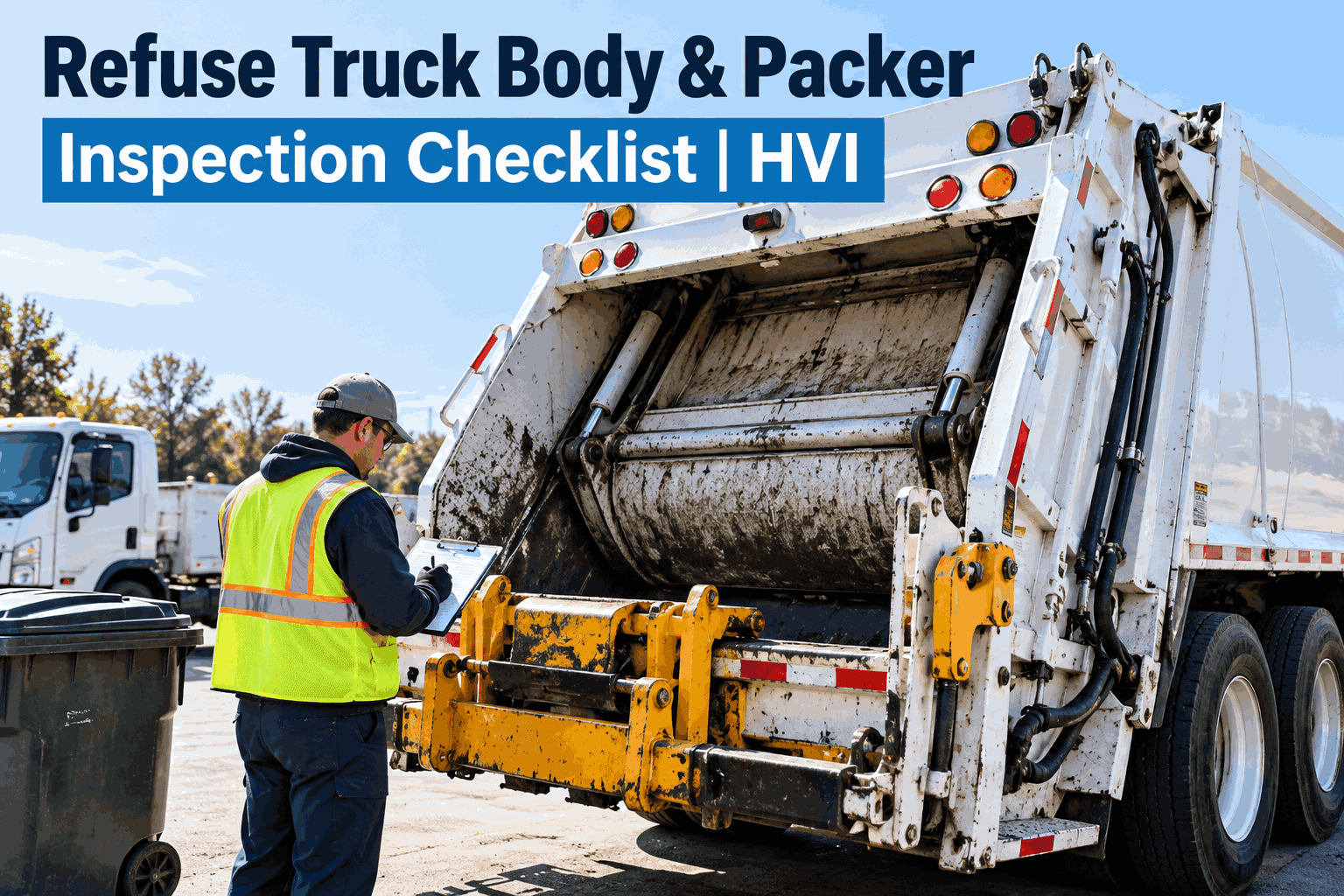
A refuse body inspection is where the real wear on a garbage truck hides. The chassis rolls a few hundred miles a day, but the packer runs hundreds of pack-and-eject cycles on the same route — and it's those cycles, not the odometer, that chew through blades, cylinders and hydraulics. This guide walks the refuse body and packer top to bottom. Book a demo to see it scheduled by cycle.
The Packer Wears by the Cycle, Not the Mile
Every load-pack-eject cycle loads the blade, the cylinders and the hydraulics again. A refuse body that looks fine on mileage can be badly overdue on cycles — which is exactly what a proper body inspection catches.
- 1Load hopper
- 2Sweep in
- 3Pack / compress
- 4Eject at tip
Below is the full walk of the refuse body — the safety lockout that comes first, the wear trigger that mileage misses, the four systems to inspect, and the way HVI schedules each by the trigger that actually drives its wear.
First, make the body safe to inspecttailgate prop and blade lockout before anyone reaches in
A raised refuse tailgate and a packing blade are both held by hydraulics — and hydraulics bleed down. Before anyone puts a hand or head inside the hopper or under a raised tailgate, the body has to be mechanically secured and the packer locked out. This isn't optional prep; it's the step that keeps an inspection from becoming a fatality.
Hydraulics holding a raised tailgate
A raised tailgate on hydraulic pressure alone can drop without warning as fluid bleeds past a valve or seal. Treat a raised tailgate as unsupported until the mechanical stay is in place.
Engage the prop, lock out the packer
Deploy the tailgate prop or safety stay, shut down and lock out the packer controls, and confirm zero stored pressure before reaching into the hopper or blade path.
Every OEM refuse body ships with a tailgate stay for a reason. Make its use a required, photo-verified step and no one improvises with a bucket or a length of pipe. Book a demo to see the prop-engaged step enforced before the checklist opens
Why cycles beat miles for refuse PMthe wear trigger a mileage schedule misses
Two identical refuse trucks can show the same odometer and be worlds apart on body wear. The one on a dense residential route packs far more per mile than the one running long stretches between commercial bins. Schedule the body on mileage and you either over-service the light user or run the heavy one straight into a failure.
Books the body off the odometer — the same trigger as the chassis. A high-cycle, low-mileage truck slips past its real wear point; a low-cycle, high-mileage truck gets serviced too early.
Books blade, cylinder and hydraulic service off pack cycles, hydraulic hours or a calendar backstop — the triggers that actually load the body. Each truck is serviced on its own wear, not the fleet average.
Refuse bodies wear on a mix of cycles, hydraulic hours and calendar time, and the right trigger differs by component — always confirm the interval against your body OEM's schedule. Start free and set each component's PM to the trigger that fits it
The four systems to inspectblade & floor, cylinders & hydraulics, tailgate, bin lift
With the body safed and the packer locked out, the refuse body inspection works through four systems. Each fails in its own way, and each has a couple of tells that a technician can catch before it becomes a mid-route breakdown or a leak on the street.
Packing blade & floor
- Blade edge and wear plates within OEM thickness, not worn thin or cracked
- Slide tracks and guides free of packed debris and excessive play
- Floor and hopper for cracks, gouges and thinning from abrasion
Cylinders & hydraulics
- Packing and ejector cylinders for weeping seals, scored rods or drift
- Hoses and fittings free of chafe, bulges and seepage at high-flex points
- Fluid level and condition; no milky or burnt fluid signalling trouble
Tailgate & seals
- Tailgate hinges, latches and lock pins secure and undamaged
- Tailgate seal intact so leachate doesn't track onto the street
- Safety prop or stay present, undamaged and free to deploy
Bin lift / lifter
- Lifter arms, grabbers and pivots for wear, cracks and lost play
- Lift cylinders and hoses for leaks and smooth, complete travel
- Interlocks and guards working so the lifter can't cycle unsafely
Grouping the walk by system means nothing gets skipped when the yard is running hot. Book a demo to see all four systems on one refuse body template
Read the wear, know the movewhat a body defect means for the route
The point of the inspection is deciding fast: does this park the truck, or get logged for the shop? A worn blade and a weeping cylinder aren't the same call, and a driver at 5 a.m. shouldn't have to guess. This is the read HVI turns into an automatic status the moment a defect is logged.
| What you find | What it means | Move |
|---|---|---|
| Cracked packing blade or mount | Risk of blade failure under pack load | Out of service until repaired |
| Tailgate prop missing or damaged | No safe way to work under a raised tailgate | Do not raise / repair first |
| Weeping cylinder seal or chafed hose | Hydraulic failure and leak risk on route | Tag & schedule before it lets go |
| Torn tailgate seal, leachate tracking | Street contamination and complaints | Schedule seal replacement |
| Light wear-plate thinning | Normal wear, still within spec | Log, photo, trend it |
Every row is a decision the crew makes at the curb. Book a demo to see a logged defect flip a refuse truck out of service automatically
From a waste fleet maintenance manager
We used to service the packer bodies on the same PM as the chassis, off mileage. Our densest residential trucks were the ones breaking down mid-route, and it took us too long to see why — they were packing twice the cycles of the commercial units for half the miles. Once we tracked the body on pack cycles and hydraulic hours instead of the odometer, the mid-route failures dropped off. The truck that wears the fastest is never the one with the most miles.
How HVI holds the refuse bodythe right trigger, a photo, a work order
The refuse body problem isn't knowing what to check — it's making sure each component is serviced on the trigger that actually wears it, and that a defect turns into a repair instead of a note that gets lost. That's what HVI's configurable templates and PM scheduling do.
Configurable body templates
Build the blade, cylinder, tailgate and bin-lift walk once and reuse it across the fleet — rear, side and front loaders, each with its own items.
PM by cycle, hour or calendar
Schedule each component on the trigger that fits it — pack cycles, hydraulic hours or a calendar backstop — so nothing rides the wrong clock.
Photo evidence to work order
A dated photo at each check makes the record defensible, and a logged defect routes straight to a work order instead of a lost note.
See how body PM, the daily walk and defect repair live on one screen inside HVI's preventive maintenance, and how it connects to the broader whole-vehicle garbage truck inspection checklist for the chassis side. Line them up in a quick demo
Refuse body inspection: quick answers
What does a refuse body inspection cover?
It covers the four body systems: the packing blade and floor, the cylinders and hydraulics, the tailgate and its seals and safety prop, and the bin lift or lifter. The goal is catching wear, cracks, leaks and damaged safety gear before they cause a mid-route breakdown or a leak on the street.
Why schedule a refuse body by cycles instead of mileage?
The packer wears with every load-pack-eject cycle, and a dense residential route packs far more per mile than a commercial one. Mileage misses that, so a high-cycle low-mileage truck slips past its real wear point. Scheduling on pack cycles or hydraulic hours matches service to actual wear.
What safety steps come before inspecting a refuse body?
Before reaching into the hopper or under a raised tailgate, deploy the mechanical tailgate prop or stay, shut down and lock out the packer controls, and confirm zero stored hydraulic pressure. A raised tailgate on hydraulics alone can drop as fluid bleeds down, so it's treated as unsupported until the stay is in.
What refuse body defects should take a truck out of service?
A cracked packing blade or mount and a missing or damaged tailgate prop are out-of-service items — one risks blade failure under load, the other removes the only safe way to work under a raised tailgate. Weeping seals, chafed hoses and torn tailgate seals get tagged and scheduled; light wear-plate thinning is logged and trended.
How does HVI help with refuse body inspection and PM?
HVI lets you build a configurable refuse body template, require a photo at each check, and schedule each component by pack cycles, hydraulic hours or a calendar backstop. A logged defect routes straight to a work order and can flip the truck out of service, and every record is retained for audit.
Put the refuse body on the clock that actually wears it
HVI runs the daily body walk with a photo at every check, schedules blade, cylinder and hydraulic PM by pack cycles or hydraulic hours instead of chassis mileage, and routes any defect straight to a work order. The truck that wears fastest stops being the one you find out about mid-route. Live in under two weeks.
No credit card · Refuse body template ready on day one · Photo evidence built in