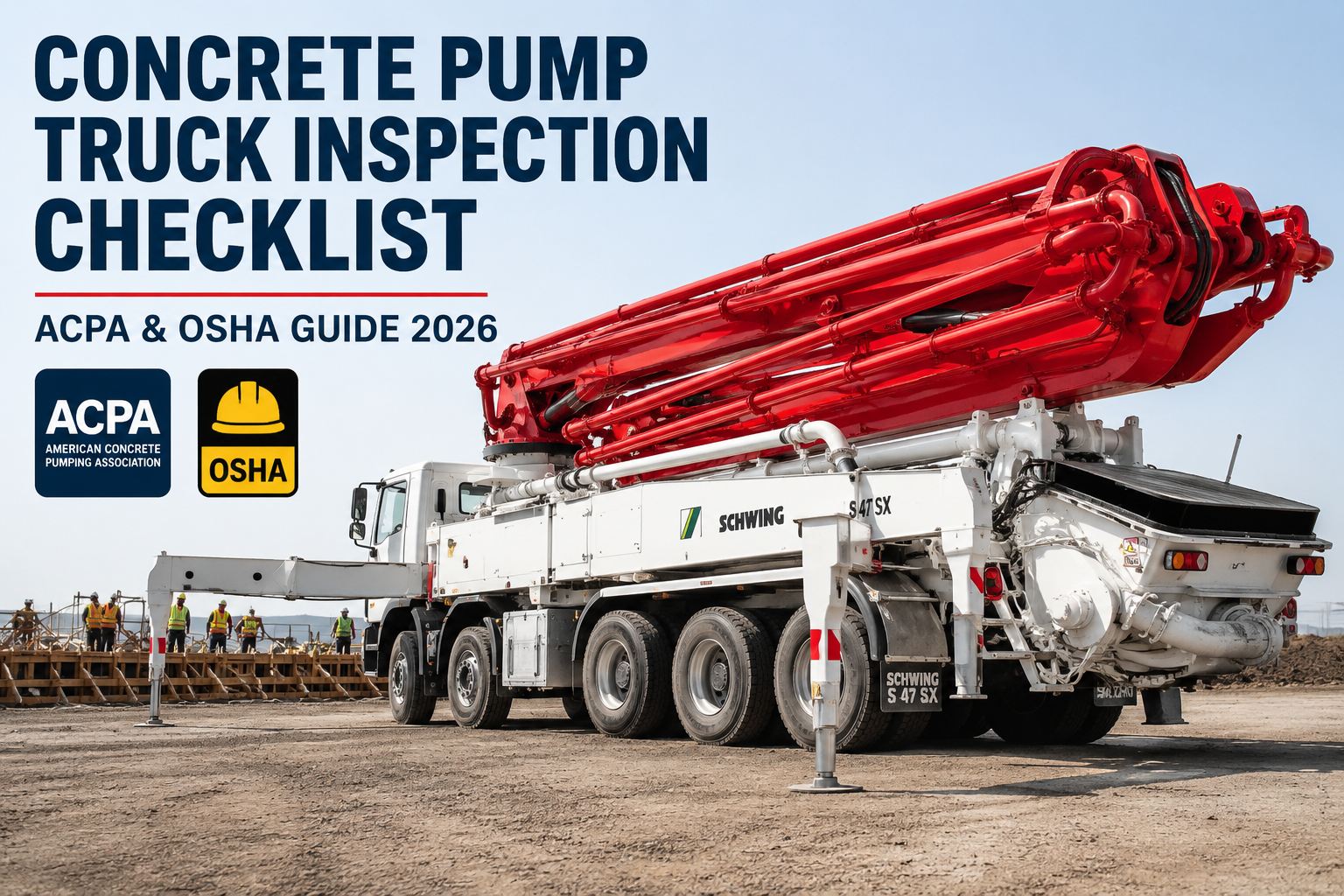
A concrete pump boom extends 70 to 100 feet over workers, held in place by hydraulic cylinders and balanced on outrigger pads sitting on construction ground that shifts. When a boom joint fails — a cracked pin, a blown hydraulic hose, a soft outrigger pad — the collapse happens in seconds and the consequences are catastrophic. OSHA doesn't have a concrete-pump-specific standard, but the General Duty Clause (Section 5(a)(1)) and Subpart Q apply to every pour, and ACPA certification requires documented pre-operation inspection. This is the complete concrete pump truck inspection checklist for 2026. Book a demo to digitize your pump fleet inspections.
Concrete Pump Truck Inspection: The 6 Systems That Keep the Boom Off the Ground
Every pour starts with these six zones. Miss one, and the boom decides when the pour ends.
A concrete pump truck is a $300,000 to $800,000 machine operating under extreme stress — high-pressure concrete flowing through steel pipeline, multi-section boom extended over active crews, all balanced on four outrigger pads. Below is the system-by-system inspection that keeps it safe, compliant, and pour-ready.
Why This Inspection Mattersthe regulatory and safety framework behind every check
Concrete pump trucks sit at the intersection of three regulatory frameworks: OSHA construction standards (29 CFR 1926), DOT commercial vehicle requirements (pre-trip DVIR for road travel), and ACPA operator safety standards. OSHA's General Duty Clause (Section 5(a)(1)) requires employers to maintain workplaces free from recognized hazards that cause or are likely to cause death or serious harm — and boom collapse over workers is exactly that kind of recognized hazard. ACPA has certified over 5,000 concrete pump operators nationwide, and their certification program requires documented pre-operation inspections following manufacturer guidelines and ASME B30.27.
OSHA classifies boom collapses as caught-in/between hazards — the fourth leading cause of construction fatalities. A daily pre-operation inspection isn't paperwork; it's the operator's last verification that the machine is safe to deploy over people. Book a demo to see how HVI digitizes per-pump inspections with photo capture
Zone 1: Boom Sectionsthe structure holding everything over the crew
The boom is the heart of a concrete pump truck. A typical 3 to 5-section boom folds and unfolds hydraulically, with each section connected by pivot pins and held in position by hydraulic cylinders. Every joint is a potential failure point — and fatigue cracks at boom section pivot points are the failure mode that kills.
Zone 2: Outriggersthe four points holding 100,000+ pounds stable
A fully loaded concrete pump truck can exceed 100,000 pounds. With the boom extended, the center of gravity shifts dramatically. The outriggers are the only thing preventing a tip-over — and outrigger failure on soft or uneven ground is one of the most common causes of pump truck incidents.
Zone 3: Hydraulic Systemthe pressure that moves everything
Every movement on a concrete pump truck — boom unfold, outrigger extension, pump cycling, turret rotation — is hydraulic. A single blown hose at operating pressure can spray oil 30 feet, cause an instant boom droop, and create a fire hazard near the engine.
Zone 4: Pipeline + Delivery Systemconcrete under pressure through steel pipe
Zone 5: Hopper + Pump Systemwhere concrete enters the machine
Zone 6: Controls + Emergency Stopsthe last line of defense when something goes wrong
Pre-Pour Site Checkthe setup inspection that happens before the boom goes up
Survey the full boom path from setup through washout. Maintain OSHA-specified minimum distances. If voltage is unknown, assume 20 feet minimum clearance.
Assess soil bearing capacity for outrigger loads. Position on level, compacted ground. Avoid fill, excavation edges, and slopes beyond manufacturer limits.
Monitor continuously. High winds may require limiting boom extension or stopping operations per manufacturer specs. Extended booms act as sails.
Establish exclusion zones under the boom. Use ACPA-approved hand signals. Assign a spotter for power line proximity and overhead hazards. Book a demo
From a concrete pumping fleet manager running 12 boom pumps
We had operators filling out paper checklists in the cab before they even walked around the truck. One morning a guy signed off a complete inspection, drove to the site, deployed, and found a cracked boom pin when the third section wouldn't unfold smoothly. If that crack had propagated under load with the boom over a rebar crew, we'd be in a different conversation entirely.
Since we moved to a photo-required digital inspection, completion time actually went down because operators follow the walk-around sequence instead of checking boxes from memory. And when OSHA showed up on a foundation pour last quarter, we pulled the inspection with GPS, timestamp, and six tagged photos in about 30 seconds.
Frequently asked questions
How often should a concrete pump truck be inspected?
Concrete pump trucks should be inspected before each use or shift according to OSHA standards and manufacturer recommendations. A daily pre-operation inspection covers all critical safety systems including boom sections, hydraulic systems, outriggers, pipeline, pump components, controls, and emergency stops. For DOT compliance, a pre-trip DVIR is also required each day the truck travels on public roads. Annual structural inspections of the boom should follow manufacturer guidelines and ASME B30.27 standards, including detailed inspection of all welds, pivot pins, and structural members. Any time the truck is involved in an incident, over-pressurization event, or contact with a power line, a full inspection by a qualified person is required before returning to service.
What OSHA standards apply to concrete pump trucks?
Multiple OSHA standards apply to concrete pump truck operations. Subpart Q (29 CFR 1926.700-706) covers concrete and masonry construction operations, including the requirement that discharge pipe supports be designed for 100% overload per 1926.702(e)(1). Subpart O (29 CFR 1926.600(a)(6)) addresses power line clearance for mechanized equipment. The General Duty Clause (Section 5(a)(1) of the OSH Act) requires employers to maintain workplaces free from recognized hazards, which applies directly to boom collapse risks. OSHA has confirmed in a 2013 standard interpretation letter that existing standards adequately cover concrete boom pump trucks, and that enforcement using industry norms through the General Duty Clause is sufficient without a pump-specific standard.
What is ACPA certification and why does it matter for inspections?
ACPA (American Concrete Pumping Association) certification is the only nationally recognized safety certification program for concrete pump operators in the United States. The ACPA has certified over 5,000 operators through point-by-point exams covering all aspects of safe pump operation. Certification prerequisites include completing the ACPA Operator Safety Training Presentation (online, DVD, or the full 23-day Operator Training Program). ACPA certification requires operators to be familiar with manufacturer-specific equipment, perform documented pre-operation inspections, and follow ASME B30.27 standards. For fleet managers, requiring ACPA certification means your operators have demonstrated competency in the inspection procedures that prevent boom collapses, hydraulic failures, and setup errors.
What are the most common concrete pump truck inspection failures?
The most common inspection failures on concrete pump trucks fall into five categories. Boom section pivot pins showing excessive wear or elongation, which allows boom drift and increases collapse risk. Hydraulic hose deterioration including chafing, bulging, and weeping at fittings, which can cause sudden loss of boom control. Outrigger pad damage or inadequate cribbing for ground conditions, which reduces stability margins. Pipeline wear at elbows and bends, which leads to blowouts under pumping pressure. Emergency stop buttons that fail to cut power immediately, which removes the operator's last-resort safety control. Each of these failures is detectable during a thorough pre-operation walkaround, and each can cause a catastrophic incident if missed.
Can I digitize concrete pump truck inspections with a CMMS?
Yes. A platform like HVI (Heavy Vehicle Inspection) allows concrete pumping fleets to build custom inspection templates for each pump model (Putzmeister, Schwing, Alliance, or any OEM), require photos at critical inspection points like boom pivot pins, outrigger pads, and hydraulic connections, automatically generate work orders from flagged defects, store every inspection with timestamp, GPS location, and operator digital signature, and retrieve inspection records instantly for OSHA, ACPA, or insurance compliance documentation. Digital inspections ensure operators follow the physical walk-around sequence rather than checking boxes from memory, which is the primary failure mode of paper-based checklists. HVI also supports DOT pre-trip DVIRs for road travel, so both the site inspection and the DOT inspection live in one platform.
Every concrete pump inspection: digital, documented, defensible
Build inspection templates per pump model. Require photos at boom pins, outrigger pads, and pipeline joints. Auto-generate work orders from defects. Store every inspection with timestamp, GPS, and digital signature. Pull any inspection in seconds for OSHA, ACPA, or insurance. Live in under two weeks.
No credit card · No hardware · Works on any phone or tablet