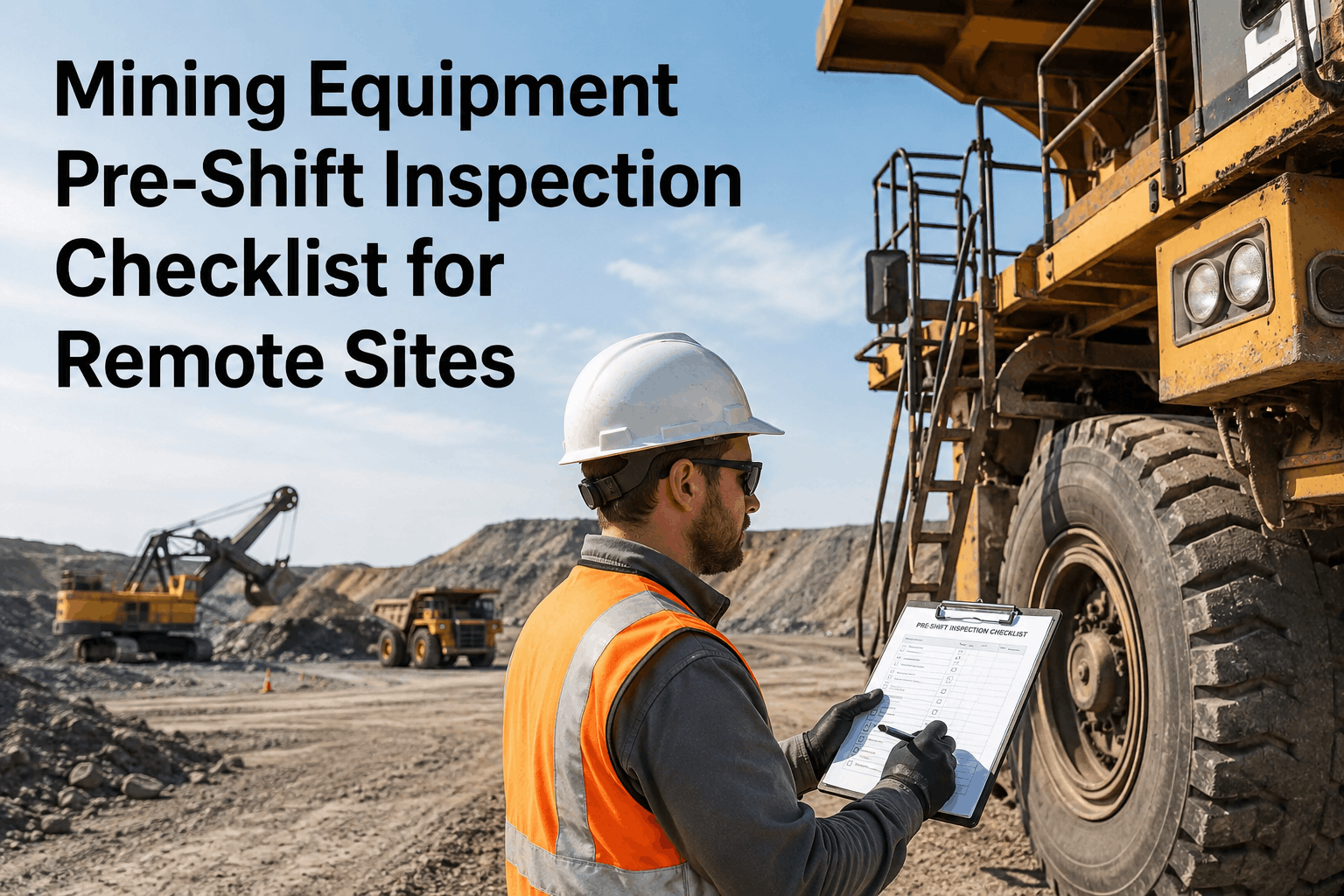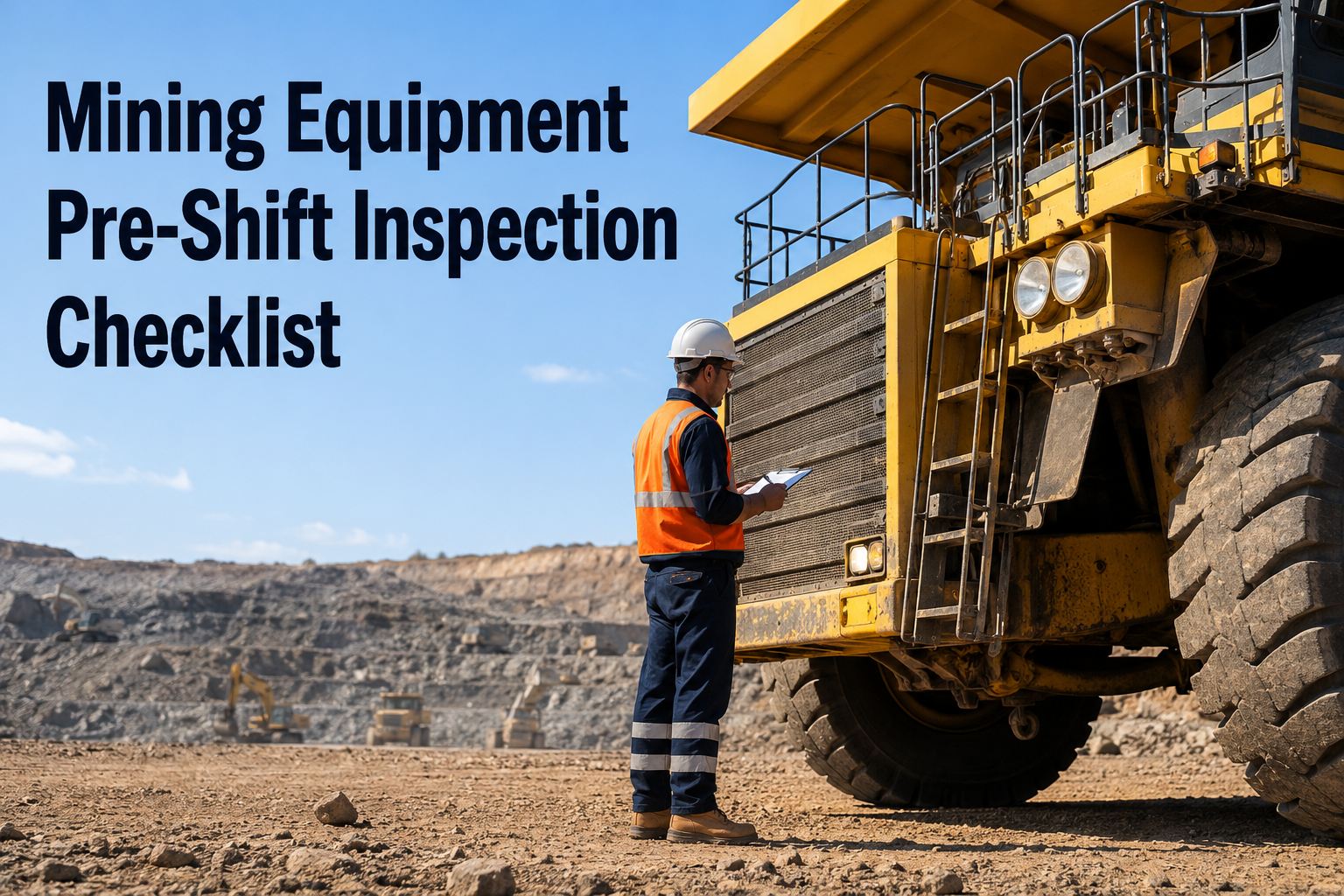
Mining equipment pre-shift inspections are not paperwork — they are the structural defense between routine operation and catastrophic failure. Ultra-class haul trucks cost $5,000-$20,000 per hour in downtime, with a single major breakdown cascading to $2 million per day in lost production, idle loaders, and emergency repair premiums. Engine rebuilds alone run approximately $400,000 for large haul trucks. Tires cost $40,000-$70,000 each. Yet the difference between world-class mines (92-94% haul truck availability) and average operations (75-82%) is not the equipment — it is the inspection discipline. MSHA mandates pre-shift inspections before every operating shift under 30 CFR Part 56/57, with specific requirements for brakes (§ 56.14101), steering (§ 56.14106), and operator task training (Part 46.7). This guide provides a complete mining equipment pre-shift inspection checklist covering all 8 critical sections — walk-around, tires, brakes & steering, engine & fluids, hydraulics, cab & controls, lights & warnings, fire suppression & safety equipment — plus the regulatory framework, common defects to watch for, and how HVI digitizes the entire workflow for audit-ready records. Start your free HVI trial or book a 30-minute demo to digitize your mining inspection program.
Digitize your mining pre-shift inspections with HVI
HVI replaces paper checklists with photo-verified mobile DVIRs built for MSHA compliance — haul truck, loader, dozer, drill, and underground equipment workflows. Offline mode for remote sites. Audit-ready records by default.
What is a mining equipment pre-shift inspection?
The inspection is documented (paper or digital), defects are reported, and equipment with safety-critical defects is tagged out until repair. This isn't a regulatory formality — pre-shift inspections are the operational discipline that separates world-class availability (92-94%) from average mining operations (75-82%) and prevents the catastrophic single-failure events that can cost $2 million per day.
Why mining pre-shift inspections carry stakes no other inspection does
Mining equipment operates in extreme conditions — abrasive dust, temperature swings, vibration, steep grades, heavy loads — that accelerate every failure mode. Combined with the operating costs and safety consequences, the stakes are unique.
Ultra-class haul truck downtime cost per hour — every hour the truck sits idle is lost ore production and idle loaders waiting upstream.
Single major breakdown cascades to $2M+ in lost production, idle equipment chain, and emergency repair premiums.
Engine rebuild cost for large haul trucks (Cat 797F, Komatsu 980E-5, Liebherr T 284). Often preventable with pre-shift defect catch.
Cost of a single ultra-class haul truck tire. Lifespan 4,000-6,000 hours when maintained properly — half that under heat, pressure, and load abuse.
Haul truck availability achieved by world-class mining operations through disciplined pre-shift inspection programs vs 75-82% average.
Frequency of MSHA inspections at underground mines (2x for surface). Pre-shift documentation determines audit outcomes.
MSHA regulatory framework — what you must comply with
The pre-shift inspection requirements live in specific 30 CFR sections. Understanding them isn't optional — citations for non-compliance can result in unwarrantable failure findings, civil penalties, and pattern-of-violation status.
Pre-shift equipment inspection (surface)
Self-propelled mobile equipment must be inspected by the operator before being placed in operation each shift. Defects affecting safety must be reported. Equipment with safety defects must be removed from service or tagged until repair is complete.
Brakes — service & parking
Self-propelled mobile equipment service brakes must hold the equipment on the maximum grade encountered. Parking (secondary) brake must hold equipment on maximum operating grade. Hydraulic brake fluid at proper level with no leaks at lines or cylinders.
Steering performance
Steering must operate smoothly with no excessive play or binding. Industry guidance: less than 2 inches of play at the rim for haul trucks. Loss of steering response = immediate tag-out.
Task training for equipment operators
Operators must be trained on the specific equipment they operate before performing pre-shift inspections. Documentation of training maintained on file.
Roll-over & falling-object protection
Roll-over and falling-object protection structures must remain intact and structurally sound. Visible damage, cracking, or compromised welds = immediate tag-out.
Berms & guardrails for haulage roads
Where elevated roadways pose a falling-off hazard, berms or guardrails are required. Operator pre-shift includes confirming road conditions before dispatch.
The complete 8-section pre-shift inspection checklist
This is the complete pre-shift checklist used at world-class mining operations — adapted to MSHA requirements and aligned with HVI's digital workflow. Each section covers specific check points with the defect criteria that should trigger a tag-out.
Walk-around exterior inspection
Tires & wheel assembly
Brakes & steering systems
Engine, fluids & cooling
Hydraulic systems
Cab, controls & operator interface
Lights, horn & warning devices
Fire suppression & safety equipment
How HVI digitizes the mining pre-shift workflow
Paper checklists are MSHA-acceptable but operationally inferior. Digital pre-shift inspections — HVI's specialty for mining operations — drive 35% defect detection improvement, 95%+ operator adoption within 30 days, and audit-ready records by default.
Mobile-first operator workflow
Operator opens HVI app, scans equipment QR, and the right checklist auto-loads — haul truck, loader, dozer, drill, or underground equipment specific. Offline mode for remote sites.
Photo-verified at each section
Critical sections (brakes, tires, ROPS, fire suppression) require photo evidence to pass. No more rubber-stamp inspections. GPS-tagged at the equipment location.
Defect-to-work-order automation
Defect flagged = work order auto-created with photo evidence, severity, and assigned technician. Critical defects auto-block dispatch. Maintenance sees defects in real time.
MSHA-ready audit export
Every inspection retained indefinitely. One-click MSHA audit export by equipment, date range, or operator. Inspection history searchable in seconds, not retrievable from filing cabinets in hours.
Frequently asked questions
QWhat MSHA regulation requires pre-shift inspections on mining equipment?
30 CFR Part 56.14100 (surface) and 30 CFR Part 57.14100 (underground) require operators to inspect self-propelled mobile equipment before placing it in operation each shift. Defects affecting safety must be reported and equipment with safety defects removed from service or tagged out until repair is complete. Specific component requirements live in adjacent sections including 30 CFR 56.14101 (brakes), 56.14106 (steering), and 56.9300 (haulage road conditions).
QHow long should a mining equipment pre-shift inspection take?
A thorough mining equipment pre-shift inspection typically takes 15-30 minutes depending on equipment complexity. Ultra-class haul trucks and large excavators require closer to 30 minutes; smaller equipment may complete in 15-20 minutes. Operators averaging under 10 minutes are likely rushing — HVI flags rushed inspections automatically through time analytics, surfacing coaching opportunities before they become safety incidents.
QWhat's the difference between pre-shift and pre-operation inspections?
MSHA uses both terms — pre-shift inspections occur before each operating shift begins (typically at shift change), while pre-operation inspections occur before a specific piece of equipment is put into service. For most mining operations, the terms are functionally equivalent: the operator performs the inspection before starting their shift's work on that equipment. Documentation requirements are identical.
QWhat happens if a critical defect is found during pre-shift inspection?
Equipment with safety-critical defects must be removed from service immediately and either repaired or tagged out until repair is completed. The defect must be documented. Operating equipment with known safety defects is an MSHA citation-level violation that can result in unwarrantable failure findings, civil penalties, and pattern-of-violation status for repeat offenders. HVI auto-blocks dispatch when critical defects are flagged, making structural compliance the default.
QHow does HVI handle the specific needs of remote mining sites?
HVI's mobile app supports full offline mode — operators complete inspections, capture photos, and document defects without cellular or satellite connectivity. Data syncs automatically when connectivity returns. Critical for remote surface mines, underground operations, and sites with intermittent network coverage. The app is designed for gloved hands, harsh conditions, and varying lighting environments.
Make every pre-shift inspection a documented, defect-catching, audit-ready event.
HVI digitizes the entire mining pre-shift workflow — equipment-specific checklists, photo-verified checkpoints, offline mode, automatic work order generation, MSHA-ready records, and structural enforcement that blocks dispatch on critical defects. Most mining operations see measurable defect-catch improvement within the first month and audit-prep time drop from days to minutes.
No credit card required · MSHA-ready in 2-4 weeks · Offline mode for remote sites