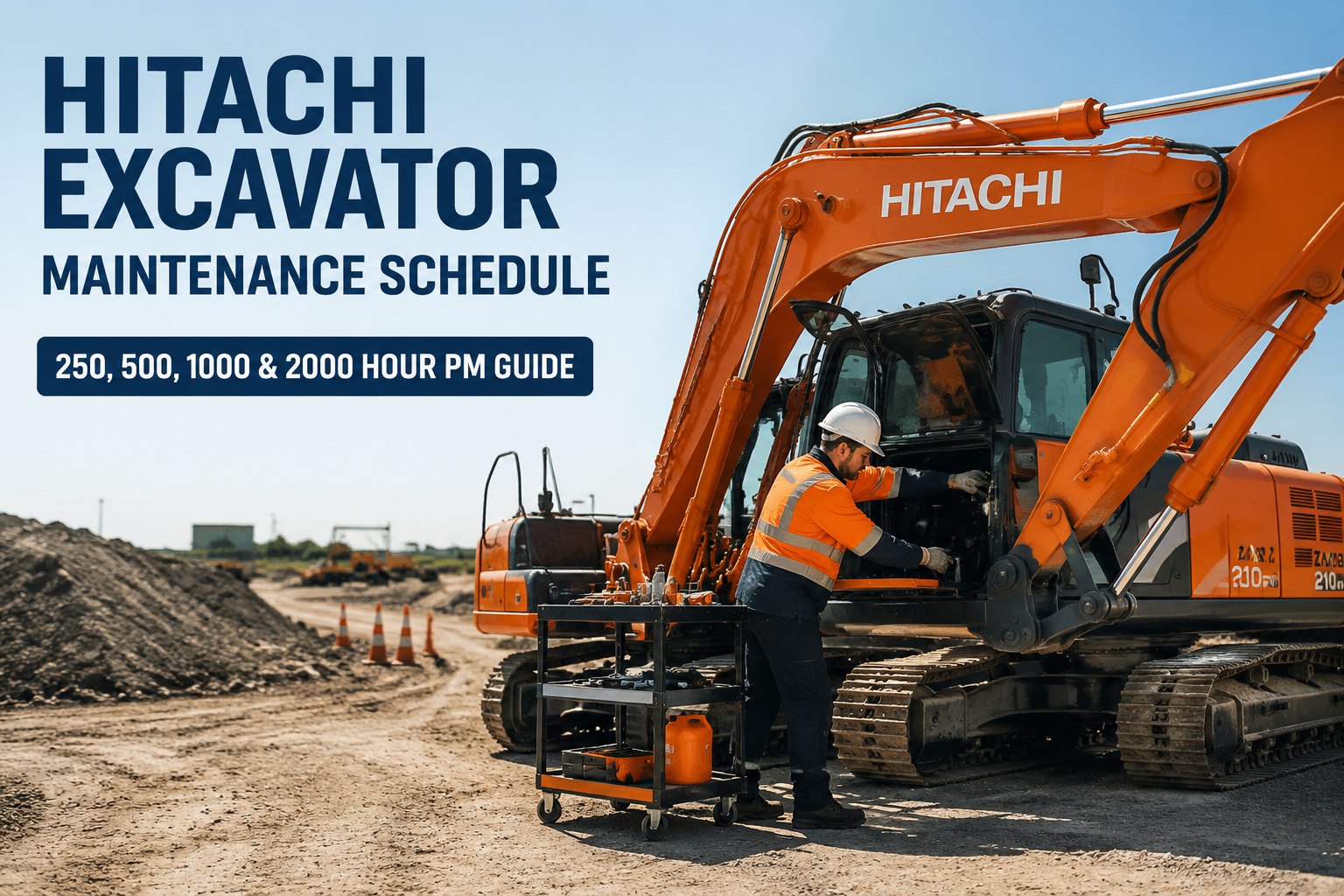
You've been there — a Hitachi ZAXIS with 987 hours on the meter, a job to finish, and the 1000-hour service that everyone knows is due but nobody wants to be the one to pull the machine off the dig. Two weeks later, the hydraulic pump is on a bench and you're writing a five-figure check for a $30 filter you never changed. That's what makes the Hitachi excavator maintenance schedule the single highest-leverage document in a fleet manager's inbox. It's not a spec-sheet formality — it's the map that separates a Hitachi that hits 20,000 hours from one that costs you a new machine at 8,000. This guide walks through every interval — Daily, 250, 500, 1000, and 2000 hours — what each service actually covers, what happens if you skip it, and how to run this schedule cleanly across a full fleet. Book a demo once you see how much this schedule is worth.
The 5 Milestones Every Hitachi Excavator Hits
Each interval builds on the last. Skip one, and the next one costs you 10× more.
Here's what most fleets miss: Hitachi's PM intervals are additive, not standalone. The 500-hour service isn't 500 alone — it's every 250-hour task plus the 500-hour additions. Same for 1000 (includes 250 + 500 items) and 2000 (includes everything below it). Skip a 250 and the 500 doesn't compensate — you just carry that risk into the next window. That's why disciplined interval tracking outperforms disciplined mechanics.
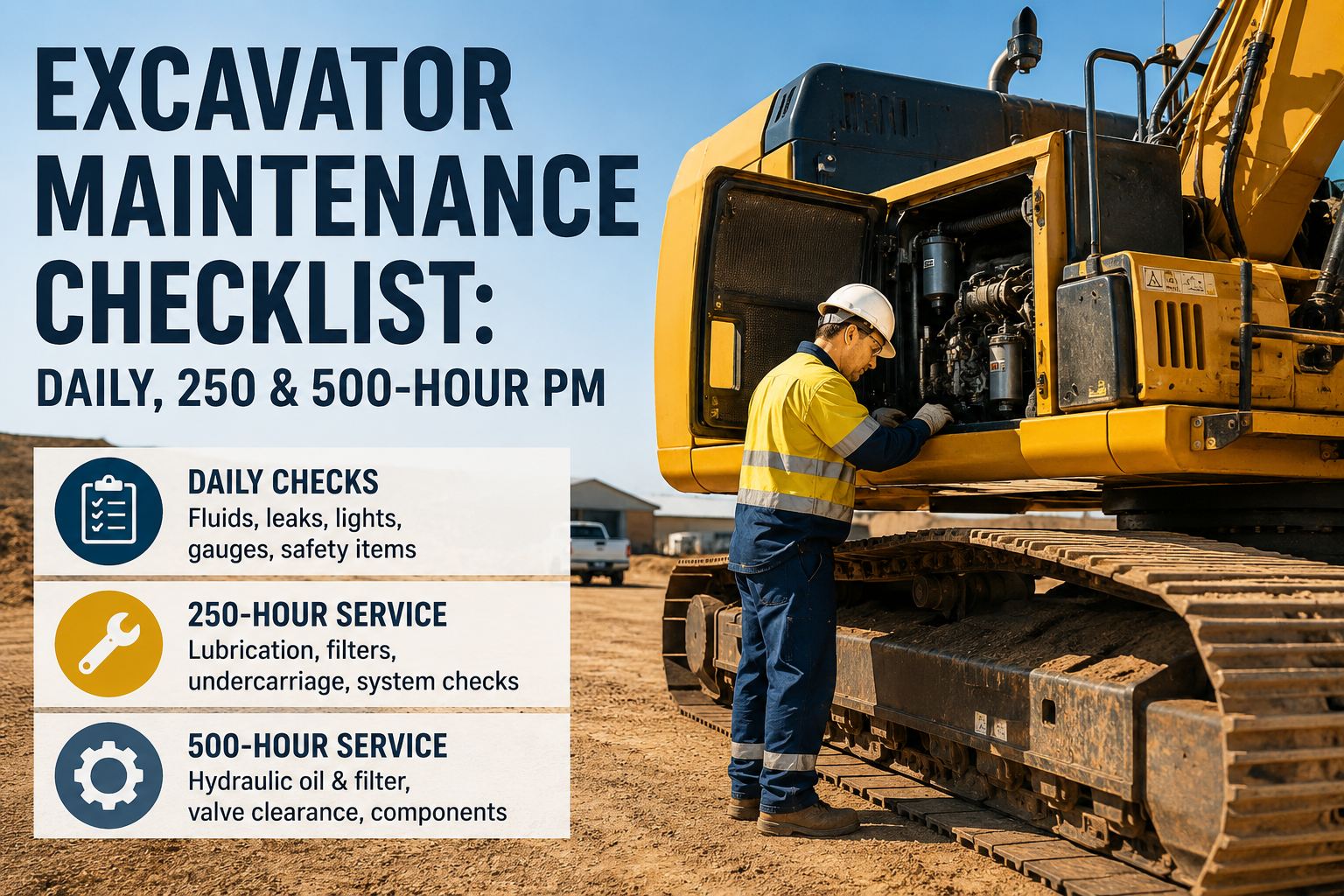
Daily Hitachi excavator walkaround: the 10-minute check that prevents 10 hours of downtime
Every Hitachi ZAXIS, ZX-series, and TATA Hitachi operator's manual starts with the same premise — the daily pre-shift inspection is the foundation of the whole maintenance schedule. Skip the daily and every scheduled interval becomes reactive damage control instead of preventive care. It takes 10 minutes with the engine cold and the machine on level ground, and it catches the failures that would otherwise cost 10 to 15 hours of unplanned downtime.
The daily is also where digital inspection tooling earns its keep — a paper form gets lost, illegible, or filled out in the truck at the end of the shift. A mobile inspection with mandatory photos on the hour meter, fluid gauges, and any flagged defect gives you an audit trail the moment it's done. HVI's daily operator reporting is built exactly for this cadence, and pairs the walkaround with automatic hour-meter capture so the next PM interval never sneaks up. Book a demo to see the Hitachi checklist configured live
The 250-hour service: First real fluid change
This is the routine maintenance interval — the equivalent of a standard oil change on a car, just scaled up. Most in-house maintenance teams can handle it in a few hours if parts are staged. What makes the 250-hour service so important on a Hitachi excavator specifically is that the engine oil breaks down under heat and load faster than most operators expect. By 250 hours in dusty jobsite conditions, that oil is done its job, and continuing to run it accelerates cylinder wear that shows up nowhere on a daily inspection.
Routine service — first major fluid change
2–4 hours- Engine oil & filter change — drain warm; use Hitachi-spec CJ-4 or higher grade per your regional emission tier
- Grease all pin points — boom, arm, bucket pivots, swing bearing grease nipples (Hitachi manuals list ~20–25 points on standard ZAXIS)
- Air filter inspection — check restriction indicator; clean primary or replace per condition
- Fuel/water separator — drain sediment bowl, check for water contamination
- Belt tension check — alternator, A/C compressor, fan belt
- Track tension adjustment — confirm sag is within Hitachi spec for the model
- Battery terminals & electrolyte — clean posts, top off if not sealed
- Bucket teeth / cutting edge — measure wear, rotate or replace
The failure mode most fleets hit here isn't the mechanic missing a step — it's the service getting delayed by 50 or 100 hours because nobody was watching the meter. That gap is where cylinder scoring, injector fouling, and premature filter overload begin. This is why hour-based automation matters more than any individual step on the checklist.
The 500-hour service: Where oil sampling starts paying you back
Everything from the 250 gets done again, plus the additions. This is the interval where a well-run fleet starts oil sampling — drawing samples of engine oil, hydraulic oil, coolant, and travel gear case oil and sending them to a lab. It sounds fussy, but the first sample creates a baseline that every future sample gets compared against. Metal wear counts trending up, moisture appearing in hydraulic oil, glycol contamination from a cracked cooler — these are things no visual inspection catches at 500 hours, but a $30 oil sample catches every time.
Adds to 250: fuel, hydraulic filter, lab sampling
4–6 hours- Hydraulic pilot filter replacement — return filter on most Hitachi ZAXIS models; check for metallic debris on the magnet
- Fuel filter replacement — primary and secondary; dirty fuel is the #1 killer of modern common-rail injectors
- Oil sampling — engine, hydraulic, coolant, final drives (lab analysis, ~$25–40 per sample)
- Air filter replacement — primary element out; secondary if restriction indicator triggered
- Hydraulic pump inspection — listen for cavitation, check for external seepage, verify no unusual vibration
- Undercarriage measurement — track shoe height, sprocket tooth profile, roller wear against Hitachi wear limits
- Swing gear grease inspection — check grease condition, top off swing bearing race
- Cooling system inspection — radiator/condenser fin cleaning (critical in dusty applications), coolant condition test
The 500 is also where telematics data from Hitachi's Global e-Service (ConSite) starts becoming useful — the machine has enough operating history to show behavioral patterns. Idle time, DEF consumption, DPF regen frequency, and average load factor all become signals that inform whether your intervals should tighten for your specific application. A machine running mining spec in Western Australia dust or coastal salt exposure typically needs 20–30% shorter filter intervals than the manual assumes. Start free trial to layer meter-based PM triggers over your Hitachi hour data this week.
The 1000-hour service: The catch-what's-brewing service
This is the major service. Everything from 250 and 500 gets done, plus deeper diagnostics and larger fluid changes. On most Hitachi ZAXIS models this is where the hydraulic oil itself — not just the filter — comes into consideration, along with coolant replacement and a proper diagnostic hookup. A qualified heavy diesel mechanic with the right diagnostic equipment is typically required. The 1000-hour service is where you find developing problems before they become catastrophic failures. Cutting corners here costs you at 2000 or well before.
Adds to 250 + 500: full-day major service
Full day (8–10 hours)- Hydraulic oil change consideration — per lab sample results and Hitachi manual for your model (some ZAXIS models spec longer intervals with clean sampling)
- Coolant replacement — drain, flush, refill with Hitachi-spec long-life coolant
- Full ECM diagnostic scan — pull codes, review active/logged faults, check parameter drift
- Injector spray pattern verification — via diagnostic tool where accessible without disassembly
- Alternator & starter load test — catch dying components before they strand the machine
- Turbocharger inspection — shaft play, boot condition, wastegate function
- DPF assessment — regen frequency, ash load, back-pressure reading
- Boom, arm, bucket pin & bushing wear — measurement, not just visual
- Complete undercarriage measurement — documented against manufacturer wear limits
The single biggest driver of ROI at the 1000-hour interval is the diagnostic scan and lab sample review together. A trend line that shows aluminum wear counts climbing steadily over three samples means a bearing is failing 400 to 700 hours before it lets go — enough runway to schedule the repair on your terms instead of on the customer's. That's the entire premise of preventive maintenance software: turning random breakdowns into calendar events. HVI's preventive maintenance module stacks these triggers automatically. Book a demo
The 2000-hour service: The deep audit
The comprehensive interval. Everything from every previous service, plus the deep-dive items that assess the long-term health of the machine. This is when a Hitachi excavator either reveals itself to be tracking toward 20,000+ operational hours — or reveals that neglected intervals earlier have already stacked up damage that's about to force major decisions. Well-managed 2000-hour services often extend the useful life of the equipment by years; poorly managed ones become the moment the fleet manager quietly starts pricing replacements.
Adds to all prior intervals: comprehensive audit
1–2 days- Full undercarriage assessment — detailed wear measurements on shoes, sprockets, idlers, rollers, chain links against Hitachi service limits
- Swing bearing play measurement — dial indicator check for radial and axial play; grease sample for wear metals
- Complete structural inspection — boom, stick, chassis, side frames checked for cracking, fatigue, and previous unauthorized welding
- Transmission & travel motor service — full oil change on final drives, filter replacement, brake pack inspection
- Hydraulic pump & motor performance test — pressure spec check under load, flow test where equipment allows
- Complete valve bank inspection — spool condition, leak-down test, response calibration
- Cab HVAC service — A/C system pressure, evaporator/condenser condition, cabin filter replacement
- Complete electrical harness inspection — chafing, corrosion at connectors, ground strap condition
- Documentation reset — full service record signed off, next interval scheduling triggered
What each missed interval actually costs you
Numbers make the case that nagging doesn't. Every skipped interval on a Hitachi excavator has a specific cost tail — not a theoretical one. Here's what the industry data actually shows for the most common misses, across manufacturers and confirmed on Hitachi ZAXIS platforms.
Read down the middle column: total preventive spend across those five items is roughly $500 to $1,050. Read down the right column: total exposure if all five are missed is over $250,000. That's the math the Hitachi PM schedule is built to protect against. Every hour tracked automatically, every interval closed with photo documentation, every lab sample logged — that's not paperwork, that's insurance you're actually collecting on. Start a free trial and get PM triggers automated on your Hitachi fleet this week.
How to run the Hitachi excavator maintenance schedule across a whole fleet (without a whiteboard)
One Hitachi excavator on a small site is easy — anyone can eyeball the hour meter and remember. Ten Hitachis across three sites with different operators, different applications, and different rental partners is a completely different problem. The failure mode isn't that anyone stops caring; it's that no single person has a live view of every meter reading, every open work order, and every PM window at the same time. Spreadsheets go stale. Whiteboards get erased. Manuals sit in an office 200 miles from the machine.
Fleets that run this stack consistently report roughly 25% lower annual maintenance cost and a payback period of about three months on the software itself. Not because the software does the maintenance — it doesn't — but because it eliminates the missed windows that turn cheap interval work into expensive component replacement. Book a demo to see this configured for Hitachi
From a maintenance manager running 14 Hitachi excavators
We used to run the Hitachi PM schedule off a shared spreadsheet. It worked until it didn't — ZX470 hit 1080 hours before anyone noticed the 1000 was overdue, and we ended up chasing hydraulic contamination for three months.
What actually fixed it wasn't a tougher policy. It was the hour meter getting captured on the daily inspection automatically, so the PM window couldn't hide. Once the software started auto-creating work orders at 90% of interval, the missed-service problem just disappeared. Our unplanned downtime dropped roughly 40% in the first year, and the numbers on the fuel and parts lines followed.
The bottom line on your Hitachi excavator maintenance schedule
The Hitachi excavator maintenance schedule is not a document to file — it's a system to run. Daily walkarounds catch the immediate; 250-hour services handle the routine; 500-hour services introduce the diagnostic depth (oil sampling, filter refresh, undercarriage measurement); 1000-hour services do the major diagnostic work that catches developing problems; 2000-hour services confirm the machine is tracking toward long life. Miss any one, and the next one costs 10 times more. Run all of them cleanly and a well-cared-for Hitachi ZAXIS can comfortably hit 20,000+ hours before major overhaul. The math is the same whether you have one machine or fifty — only the tracking problem scales. The right tooling is what makes disciplined interval management possible instead of aspirational. Book a demo to see it live on your fleet.
Frequently asked questions
What are the standard Hitachi excavator maintenance intervals?
Hitachi excavators — including the ZAXIS, ZX-series, and TATA Hitachi models — follow the industry-standard heavy-equipment interval pattern of Daily, 250, 500, 1000, and 2000 hours. Some models add a 5000-hour major overhaul interval as well. The exact tasks at each interval depend on your specific model (compact vs. mid-size vs. large; standard vs. reduced-tail-swing; Tier 3 vs. Tier 4 Final emissions), and the definitive list is always the operator's manual for your serial number range. As a general rule: 250 is routine oil-and-filter, 500 adds hydraulic filter and oil sampling, 1000 is a full major service with diagnostic scan, and 2000 is a comprehensive audit including undercarriage measurement, swing bearing check, and structural inspection. Intervals are additive — every 500 service includes the 250 tasks, every 1000 includes the 250 and 500 tasks, and so on.
How often should engine oil be changed on a Hitachi excavator?
Most Hitachi excavator operator's manuals specify engine oil and filter replacement every 250 to 500 hours, depending on the model, engine type, and operating conditions. Under standard operating conditions, 500 hours is common; under severe conditions — heavy dust exposure, extreme heat, mining or quarry applications, or coastal salt exposure — shorten to 250 hours or even less. Oil sampling at 500 hours is the best way to confirm whether your specific application is tracking closer to the "standard" or "severe" interval. Always use engine oil that meets or exceeds Hitachi's specification for your emissions tier (typically API CJ-4 or higher for Tier 4 Final engines). Never use passenger-vehicle oil or unapproved grades — the additive package is different and can cause aftertreatment damage on modern emission-controlled engines.
What happens if I skip a scheduled Hitachi PM service?
Every skipped Hitachi PM interval has a specific cost tail. Skipping the 250-hour engine oil change risks cylinder scoring and injector fouling that show up 500 to 1500 hours later. Skipping the 500-hour hydraulic filter is the classic $30-filter-becomes-$5,000-pump scenario — contamination from a saturated filter goes straight to the hydraulic pump and valve bank. Skipping the 1000-hour service means missing the diagnostic scan and lab sample review that would catch developing bearing, injector, or aftertreatment problems 400–700 hours before they fail. Skipping the 2000-hour undercarriage measurement can turn an $8,000 sprocket replacement into an $85,000 complete undercarriage rebuild. Beyond direct repair costs, skipped intervals can also void warranty coverage and, on newer Hitachi models, are visible via Global e-Service telematics to dealers reviewing warranty claims. The insurance-and-warranty implications alone typically justify the software cost of hour-based PM tracking.
Should Hitachi PM intervals be shortened in severe conditions?
Yes. Hitachi's published intervals assume standard operating conditions. Severe conditions include heavy dust (unsealed haul roads, demolition, mining), extreme heat, coastal salt exposure, abrasive materials handling, and high-load-factor duty cycles. Under any of these conditions, industry best practice is to shorten filter and fluid intervals by 20–30%. That means a 500-hour hydraulic filter interval becomes 350–400 hours, a 250-hour air filter check becomes 175–200 hours, and radiator/cooler pack cleaning moves from weekly to every few days. The best way to confirm your specific application's actual wear rate is oil sampling — three or four samples across the first thousand hours will show whether you're tracking normal or accelerated wear, and you can calibrate future intervals from there. This is why real preventive maintenance is condition-based, not just calendar-based. Meter-based PM software makes it straightforward to run tighter intervals on the machines in harsh applications and standard intervals on the ones that aren't.
How do I track PM intervals across multiple Hitachi excavators?
Spreadsheets and whiteboards work for a single machine but break down at three or more, because the hour meter has to be manually logged and the next-PM math done by hand every week. Purpose-built fleet maintenance software solves this by automating three things: hour-meter capture (via the daily inspection app or direct telematics integration with Hitachi Global e-Service), meter-based PM triggers (the system knows every machine's next 250/500/1000/2000 window and auto-generates a work order at 90% of interval), and photo-verified completion (the technician closes the PM with photos of the drain plug, filter, gauge, and hour meter, all uploaded to a permanent service record). HVI is built exactly for this workflow — each Hitachi in the fleet is set up once with its PM template, and the system runs the interval schedule automatically from there. Fleet managers see every machine's status on a single dashboard: current hours, next PM due, days remaining, and any open defect from the last daily walkaround.
Turn your Hitachi PM schedule into a system that runs itself
HVI captures hour meter readings from every daily inspection, auto-triggers the next 250 / 500 / 1000 / 2000 service with the correct interval checklist, routes work orders to your technicians with photo verification, and gives you fleet-wide PM visibility on a single dashboard. Live for your Hitachi fleet in under two weeks — typical payback in about three months.
No credit card · Pre-built Hitachi PM templates · Works with ZAXIS, ZX, and TATA Hitachi models