Every CDL driver knows the pre-trip inspection matters. What's rarely taught clearly is that the CDL skills-test procedure and the federal daily-driving requirement under 49 CFR § 392.7 are not the same thing — and running a 7-minute "lot lizard" walk-around on a daily shift is where the majority of roadside citations start. This CDL pre-trip inspection guide walks the 7-step method examiners expect, distinguishes it from the day-to-day § 392.7 obligation, and lays out the walk-around order that produces the fewest missed defects at either bar. Book a demo .
Three Tiers of Pre-Trip — Only One Passes the Test
Not every pre-trip is created equal. The version most drivers actually do vs the version the examiner wants vs what FMCSA expects on a real shift.
During the 2025 CVSA International Roadcheck, 18.1% of vehicles inspected were placed out of service — primarily for brake defects and tire issues that a proper pre-trip would have caught before the truck left the yard. That percentage doesn't reflect drivers who don't understand the pre-trip. It reflects drivers running the 7-minute version on a daily basis and hoping the 15-minute version wasn't needed today. This guide walks the sequence that turns the pre-trip from an obstacle at the start of a shift into a habit that catches defects at the rate they actually occur.
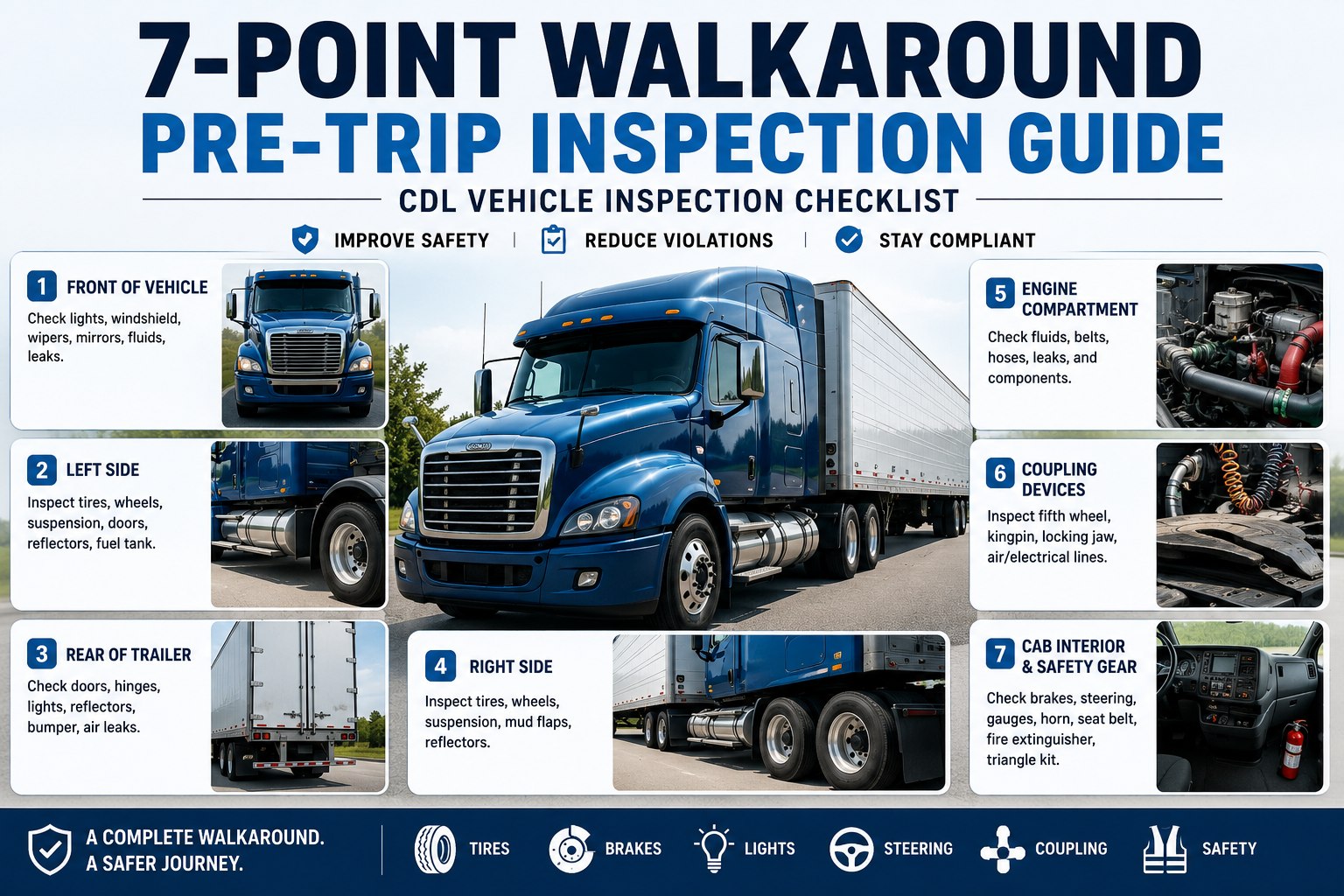
The 7-step walk-around — the order examiners and FMCSA both useVehicle overview → engine → in-cab → walk perimeter → brake test
The 7-step CDL walk-around method is taught in CDL training programs nationwide and mirrors the 7-point walk-around FMCSA references for daily pre-trips. The order matters — skipping steps or backtracking is where missed items happen. Book a demo to see the 7-step template in HVI's driver app
Vehicle overview / approach
Approach the vehicle from a distance. Overall lean, tire inflation visual, fluid puddles beneath, lights left on, any damage from previous shift. This 30-second visual before you get close catches obvious defects that a close-up walk can miss.
Engine compartment
Hood up. Fluids (oil, coolant, power steering, washer). Belts: alternator, water pump, power steering — snug (less than 3/4" play) and not cracked. Air compressor mounted securely, no leaks. Radiator and hoses no bulges or leaks. Battery terminals clean and tight.
In-cab inspection (engine off, then engine on)
Enter cab using 3 points of contact, buckle in. Seat belt latches. Steering play (max 10 degrees or 2 inches). Pedals, mirrors adjusted. Windshield, wipers, defrost. Emergency equipment: fire extinguisher charged, 3 warning triangles, spare fuses if applicable. Start engine. Gauges: oil pressure, air pressure, voltmeter, coolant temp, fuel.
Driver-side walk-around
Exit cab. Steer axle: tires (steer tread ≥ 4/32"), wheels, lug nuts, brake chamber, slack adjuster, hoses. Fuel tank mounted, no leak, cap secure. Exhaust mounted, no leak. Mirrors, door hinges, DEF tank. Drive axle: tires (drive tread ≥ 2/32"), duals matched, brakes.
Coupling & trailer front (Class A)
Fifth wheel: no cracks, mounted securely. Kingpin: locked in jaws, no daylight between plates, safety latch engaged. Air lines: red emergency + blue service, connected to glad hands, no rubs. Electrical (green pigtail) connected, locked. Landing gear fully retracted with crank secured.
Rear + passenger-side walk-around
Trailer tandem tires, wheels, brakes. Mud flaps, splash guards. Cargo doors closed, secured. Rear lights: brake, turn, tail, license lamp, reflectors, conspicuity tape. ICC bumper. Cross back to cab via passenger side: mirror-image of driver-side items, plus landing gear position.
Signal check & air brake test (L.A.B.)
Signal walk: 4-way flashers, headlights (low/high), turn signals, brake lights. Air brake test: Leaks (static leak ≤ 3 psi/min single, ≤ 4 psi/min combo), Alarm (low-air warning at 60 psi), Button (spring brakes pop at 20–40 psi). Failing the air brake portion is an automatic CDL test fail.
The 7-step order is not preference — it's what CDL examiners are trained to score against and what § 392.7 compliance looks like on a real shift. Book a demo to see per-step guidance in HVI's driver app
CDL skills-test procedure vs § 392.7 daily driving — the distinction most training blursTwo different standards, both required, applied at different times
The single biggest source of confusion in CDL pre-trip training is treating the skills-test procedure and the federal daily-driving obligation as one thing. They aren't. Understanding the difference matters both for passing the license test and for staying compliant on daily shifts afterward.
CDL skills-test procedure
§ 392.7 daily driving obligation
The 6 defects that produce most CDL pre-trip failures and roadside citationsWhat examiners flag and what CVSA inspectors flag — same list, different context
The defects most commonly missed on the CDL skills test are the same defects most commonly flagged at roadside. Learning to catch these six in the yard is where a pre-trip earns its time. Start a free trial and build a checklist that captures each of these before dispatch.
Wheel seal leaks & brake chamber boots
Both require getting low to the ground to see clearly. Overlooked in rushed pre-trips because the driver stays at eye level. Leaks indicate axle seal failure; torn boots indicate imminent brake failure. CVSA OOS-eligible.
Inner-dual tire tread depth
Outer tire looks fine; inner is worn below 2/32". Missed because inspecting the inner dual requires bending down and looking through the wheel. One of the most-cited tire defects at roadside.
Steering play beyond 10 degrees / 2 inches
In-cab check most drivers do casually; CDL examiners require deliberate wheel-turn to verify. Steering play out of spec = OOS. Test with engine running and front wheels off the ground if possible.
Air brake test air-pressure buildup + leak-down
Buildup from 85 to 100 psi within 2 min. Leak-down ≤ 3 psi/min single, ≤ 4 psi/min combo. Failing either is an automatic CDL test failure and an OOS order at roadside. The L.A.B. sequence catches this.
Lights: license plate lamp & conspicuity tape
Both are federally required, both easy to overlook. License plate lamp burnout is one of the most-cited "small" defects at roadside inspection. Reflective conspicuity tape must be intact along trailer sides and rear.
Coupling: kingpin safety latch engaged
Fifth wheel jaws can close on the kingpin without the safety latch engaging. Tug-test after coupling confirms actual engagement. CDL examiners will fail candidates who don't verify latch position. On the road, this defect separates tractor from trailer.
All six show up on both CDL skills-test failure logs and CVSA roadside citation reports — the same list, different context. Book a demo to see defect-capture with photo evidence in HVI
From a CDL trainer on the sequence-vs-checklist debate
I have students come in with the 100-point checklist memorized and they still fail the pre-trip portion of the skills test. Not because they don't know the items — because they walk the truck in a random order. Examiner sees them jump from steer axle to trailer lights to coupling and back to fuel tank, and it registers as disorganized inspection, not thorough inspection.
What actually passes the test is the same 7-step order every time: overview, engine, cab, driver-side, coupling, rear/passenger-side, brake test. Same order every practice run. By test day it's muscle memory, and the examiner sees the pattern they're trained to look for. Same principle applies to the daily § 392.7 pre-trip after the license — the drivers who catch defects consistently are the ones running a fixed order, not a random walk.
Frequently asked questions
What is the correct CDL pre-trip inspection order?
The standard 7-step CDL pre-trip inspection order, taught in CDL training programs nationwide and used by state skills-test examiners, is: (1) vehicle overview and approach — visual scan for lean, fluid leaks, damage; (2) engine compartment — fluids, belts, air compressor, radiator; (3) in-cab inspection — seat belt, steering play, mirrors, emergency equipment, gauges, engine-start check; (4) driver-side walk-around — steer axle tires and brakes, fuel tank, exhaust, drive axle tires and brakes; (5) coupling and trailer front — fifth wheel, kingpin, safety latch, air lines, electrical, landing gear (Class A specific); (6) rear and passenger-side walk-around — trailer tires and brakes, cargo doors, rear lights, ICC bumper, passenger-side items; (7) signal check and L.A.B. air brake test — leaks, alarm at 60 psi, button pop at 20–40 psi. Follow the same order every time so the sequence becomes muscle memory rather than a decision. Specific procedures can vary by state CDL manual and vehicle class.
How long does a CDL pre-trip inspection take?
On the CDL skills test, the pre-trip portion typically runs 30 to 45 minutes and requires the candidate to verbally identify and explain approximately 100+ items on a Class A combination vehicle. On daily shifts after licensing, an efficient driver-level pre-trip covering the same 7 steps at a working pace typically takes 10 to 15 minutes with paper and can be shorter with a guided digital checklist. FMCSA does not specify a minimum time in 49 CFR § 392.7 — the standard is that the driver must be satisfied 11 categories of parts and accessories are in good working order. A 7-minute walk-around covering only tires and lights (the "lot lizard" pre-trip) is common in practice but legally insufficient if a defect elsewhere causes an incident on the road. The skills-test standard is for licensing; the 10–15 minute daily standard is for § 392.7 compliance.
What is the difference between a CDL skills-test pre-trip and a federal § 392.7 pre-trip?
Two different standards applied at different times in a driver's career. The CDL skills-test procedure is governed by the state CDL manual and administered once during initial licensing (Class A, B, or endorsement). It's a verbal, from-memory exam of the 7-step walk-around, typically 30–45 minutes, scored on completeness of items identified, quality of verbal explanation of what's being checked, and successful completion of the air brake test sequence. The federal § 392.7 daily obligation is governed by 49 CFR § 392.7 and applies every day the driver operates a CMV throughout their career. No verbal callouts required; no minimum time specified; the standard is that the driver be satisfied 11 categories of parts and accessories are in good working order before operating. Violations of § 392.7 attach at roadside inspection when a competent pre-trip would have caught a defect — producing citations, OOS orders, and CSA points on the Vehicle Maintenance BASIC. Both matter; they're not the same thing.
Does HVI support digital pre-trip inspection workflows?
Yes. HVI supports configurable digital fleet inspections and DVIRs including CDL pre-trip workflows — guided templates that walk drivers through each of the 7 steps in sequence, per-step photo evidence, defect documentation with severity flags, driver signature, and automatic visibility to fleet and maintenance teams. Templates can be tailored per vehicle class (Class A tractor-trailer, Class B straight truck, tanker, hazmat, passenger/school bus) so drivers see only the applicable items for the equipment they're operating. Records are timestamped, GPS-stamped if configured, and can be produced during an FMCSA compliance review as evidence pre-trips were actually performed. When a defect is flagged, a maintenance work order can be generated automatically. HVI does not replace the driver's fitness-to-drive judgment required under § 392.7 — the driver still makes the go/no-go call.
Is a written pre-trip inspection report required?
No federal requirement for a written pre-trip report itself. FMCSA § 392.7 requires the pre-trip inspection to happen but does not mandate a written report documenting it. The written report requirement lives in § 396.11 for the DVIR at end of shift, and § 396.13 requires the driver to review the previous shift's DVIR before departure. However, most compliance-focused fleets require a written or digital pre-trip record as company policy — not because federal law demands it but because it provides evidence the inspection actually happened when FMCSA auditors review compliance history. During roadside inspection, an inspector cannot cite a driver for having no pre-trip report, but can cite for any defect a competent pre-trip would have caught. A documented pre-trip record protects both the driver and the carrier when defect-related citations are contested. Documentation is a best-practice compliance measure, not a federal mandate for pre-trips specifically.
Build pre-trip habits your drivers keep — and your fleet can defend
HVI supports guided digital pre-trip inspections tailored per vehicle class, per-step photo evidence, defect documentation with severity flags, maintenance work-order generation, and searchable inspection history. The 7-step walk-around, the defects captured, the go/no-go record — all in one document instead of scattered paper. HVI is the fleet-side documentation layer; the driver's fitness-to-drive judgment stays with the driver.
No credit card · No hardware · Per-class pre-trip templates ready on day one