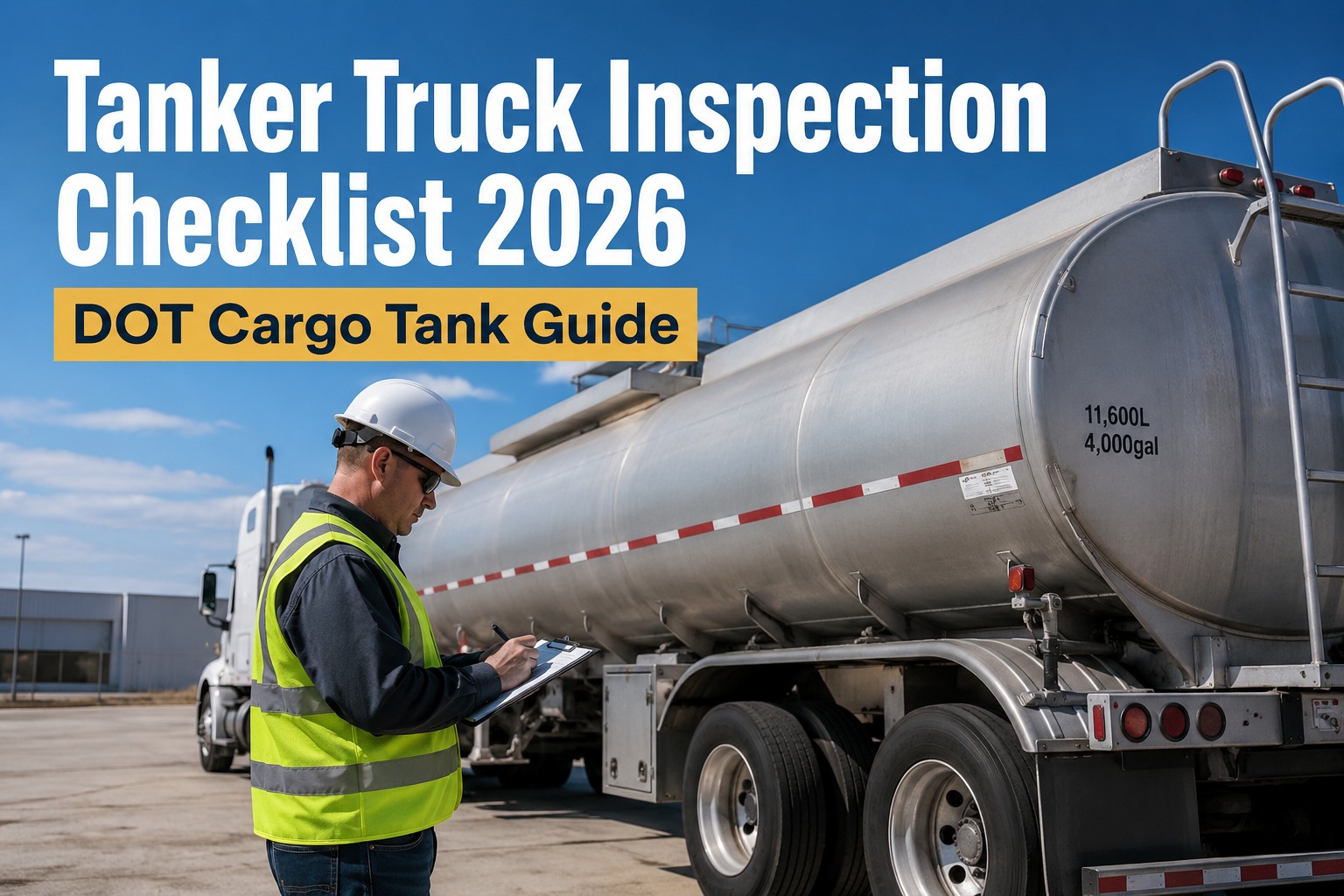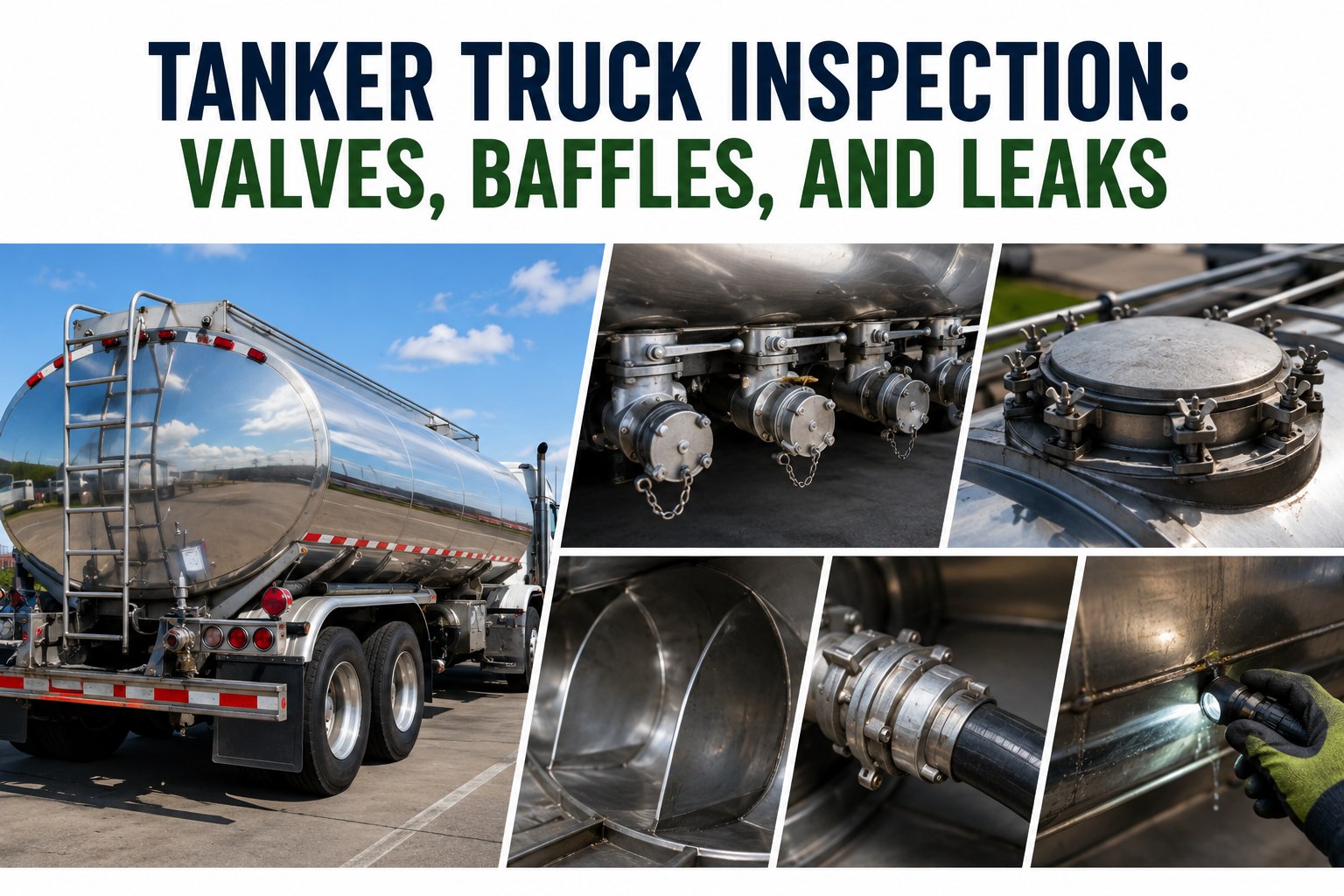
A dry van driver can pull away with a minor air leak and fix it at the next stop. A tanker driver pulling 9,000 gallons of unleaded fuel does not have that luxury. When your cargo is liquid, every valve, seam, and bulkhead becomes a potential environmental incident, a fire hazard, or a rollover risk. A proper tanker truck inspection goes far beyond checking brakes and tires—it dives into the specific mechanics of liquid transport, surge dynamics, and hazmat containment. Missing a failing excess-flow valve or skipping a 49 CFR 180.407 pressure test isn't just a maintenance oversight; it's a direct path to a roadside shutdown or worse. Digitize your tanker inspections with HVI to keep every valve test and pressure check documented and audit-ready.
Tanker Truck Inspection: Valves, Baffles, and Leaks
The complete guide to inspecting cargo tanks under DOT and hazmat rules — covering internal and external visual tests, leakage tests, upper coupler checks, and surge control.
- Ext. Visual14 Jan 2026
- Leakage Test14 Jan 2026
- Int. Insp.Due 2028
- StatusCertified
- 5 min
minimum hold time for a 49 CFR 180.407 leakage test at test pressure
49 CFR 180.407(e) - 2 yrs
required interval for pulling the upper coupler on tanks in corrosive service
49 CFR 180.407(i) - N + H
CDL endorsements required for hazmat tankers (or combined X endorsement)
FMCSA CDL standards - 1 yr
minimum record retention past the next scheduled test date
49 CFR 180.417
Bulkheads vs Baffles: Controlling the Surge
If you are new to liquid carriers, the terminology can trip you up. Bulkheads and baffles are not the same thing, and inspecting them requires understanding what they actually do. Bulkheads are full liquid-tight partitions that divide a tank into separate compartments. You can put diesel in one compartment and unleaded in another, and the bulkhead keeps them isolated. Baffles, on the other hand, are partial partitions. They do not seal the compartment. They have holes or slots in them to let liquid pass through slowly. Their entire job is to fight surge.
Surge is the sloshing motion of a partly-full tank. When a driver hits the brakes, thousands of gallons of liquid slam forward, shifting the vehicle's center of gravity and violently pushing the truck forward even after the brakes are applied. In a turn, the liquid sloshes to the outside, drastically increasing rollover risk. A tanker's rollover risk is disproportionately tied to this surge dynamic rather than to speed alone. This is exactly why FMCSA's cargo tank training requirements under Part 380 specifically cover surge behavior, not just general defensive driving. During your tanker pre-trip workflow, inspectors and drivers must verify that baffles are structurally sound, free of cracks at the welds, and not clogged with debris that would restrict the flow holes.
Bulkheads
Full Partition- Function: Liquid-tight separation of compartments
- Allows: Carrying multiple products simultaneously
- Inspection Focus: Weld integrity, seal leaks, manway gaskets per compartment
- Surge Impact: Eliminates surge between compartments, but surge still occurs within each individual compartment
Baffles
Partial Partition- Function: Slow down liquid forward/back momentum
- Allows: Liquid to flow through holes or slots
- Inspection Focus: Cracks around flow holes, structural welds, debris blockage
- Surge Impact: Dampens surge within a single compartment, improving stability and braking
The Layered 180.407 Testing Schedule
A standard dry van gets an annual DOT inspection. A cargo tank operates on a layered testing schedule under 49 CFR 180.407, and the intervals change based on what the tank is rated to carry. You cannot just run a generic annual checklist and call it compliant. The external visual inspection happens at least once a year, looking for dents, corrosion, leaks, and damaged valves. The internal inspection happens every two to five years depending on the lading, requiring the manways to be opened and the interior baffles, bulkheads, and welds examined. Then there is the leakage test and the periodic thickness testing.
Managing these rolling intervals across a fleet of 20 or 30 tankers manually is a recipe for expired stickers and roadside violations. A missing or expired external visual inspection sticker is one of the most common roadside catches for tankers. It is a paperwork gap on an otherwise sound tank, but it puts the vehicle out of service just the same. Automate your 180.407 test scheduling so your maintenance team gets alerts weeks before a tank's certification expires.
External Visual Inspection
Inspect the tank shell and head for dents, corrosion, cuts, gouges, or weld defects. Check all valves, gaskets, and closures. Verify the emergency relief devices are free of obstructions.
Leakage Test
Hold the tank with all valves and accessories in place at test pressure for at least 5 minutes. Any vent set to discharge below test pressure must be removed or disabled. Inspect all seams, joints, and fittings for leaks.
Internal Inspection & Upper Coupler
Required every 2 years for tanks in corrosive service. The upper coupler (fifth-wheel mounting area) must be pulled off to inspect for hidden corrosion, dents, or weld defects on the tank's underside.
Thickness Testing & Pressure Test
Ultrasonic thickness testing of the tank shell and heads to ensure minimum thickness is met. Combined with a hydrostatic or pneumatic pressure test to verify structural integrity under maximum design pressure.
Valve-by-Valve Breakdown: What to Actually Check
On a dry van, a door latch either works or it doesn't. On a tanker, every valve is a safety-critical device that must be individually inspected and, in many cases, functionally tested. You cannot just look at a valve and say it looks fine. The self-closing and remote-closure mechanisms must be physically demonstrated to confirm they actually close under operation, not just visually appear intact. Missing bolts, nuts, or fusible links must be replaced outright, not just noted on a defect sheet.
Self-Closing Stop Valves
Internal or external valves that automatically close to prevent product loss. Must be free of corrosion, distortion, or damage. Test: Verify the self-closing mechanism functions properly under demonstration.
Excess-Flow Valves
Designed to snap shut if flow exceeds a set rate, preventing massive spills if a hose breaks. Test: Check for unrestricted operation and ensure the closing mechanism isn't seized by product buildup.
Pressure Relief Valves
Reclosing relief valves need external inspection for corrosion or damage. If the lading is corrosive to the valve material, the relief valve must be pulled off the tank entirely for bench testing.
Remote Closure Devices
Allows the driver to shut off valves from a safe distance. Test: Functionally test the remote mechanism to ensure it successfully closes the intended valves without delay or mechanical binding.
To keep these tests standardized across your technicians, you can build digital valve testing workflows that require a pass/fail confirmation and a photo for every single valve position on the tank.
The Leakage Test and Upper Coupler Hidden Damage
The leakage test is not a quick visual once-over. It is a controlled pressure test. The tank must be held with all valves and accessories in place and operative at test pressure for at least 5 minutes. Any vent set to discharge below that test pressure must be removed or disabled for the duration of the test. For tanks in liquefied compressed gas service, this includes an external leak inspection under pressure, with strict safeguards in place for personnel. You are actively pressurizing a vessel to verify it holds. If a fitting fails during this test, you need a documented process to tag it out, repair it, and re-test.
Separately, the upper coupler—the fifth-wheel mounting area—hides some of the most dangerous damage on a tanker. Because it sits under the tank, road grime, salt, and corrosiveladings drip down and accumulate here. The upper coupler must be inspected for corrosion, dents, or weld defects. On tanks carrying corrosive lading, this area must be physically pulled off the tank at least once every two years for a proper look. Skipping this hides structural weakening that could cause the trailer to separate from the tractor under heavy braking. See how HVI tracks upper coupler pull dates alongside your standard PMs.
Upper Coupler Pull (Corrosive Service)
Hazmat Endorsements & Placarding
Expert view from the shop floor
"The worst near-miss we ever had wasn't a blown brake line—it was an excess-flow valve that looked perfectly fine from the outside but was seized open with sulfur buildup. Now, during our tanker inspection, if a technician doesn't physically trigger the closure and film it on their phone, the work order doesn't close. We tied that rule directly into our CMMS.
-- Marcus R., Maintenance Director, regional petroleum carrier
Frequently asked questions
What is the difference between a bulkhead and a baffle in a tanker truck?
Bulkheads are full liquid-tight partitions that divide a tank into separate compartments, allowing you to carry different products simultaneously. Baffles are partial partitions with holes that allow liquid to pass through slowly; their purpose is to reduce surge (the sloshing of liquid) within a single compartment to improve vehicle stability and braking.
How often does a cargo tank need a leakage test?
Under 49 CFR 180.407, a leakage test is generally required at least once every 12 months. The test involves holding the tank at its specified test pressure for a minimum of 5 minutes with all valves and accessories in place and operative, while inspecting all seams and fittings for leaks.
Why does the upper coupler need to be pulled off the tank?
The upper coupler (the fifth-wheel mounting area) hides damage from road grime, salt, and corrosive ladings. For tanks in corrosive service, 49 CFR 180.407 requires the upper coupler to be physically pulled off the tank at least once every two years so technicians can properly inspect the tank's underside for hidden corrosion, dents, or weld defects.
What CDL endorsements are required to haul a hazmat tanker?
Drivers hauling hazmat in a tank vehicle must hold a CDL with a Tank (N) endorsement and a Hazmat (H) endorsement, or the combined Tanker/Hazmat (X) endorsement. Additionally, every load requires correct placarding under 49 CFR Part 172.
How long must tanker inspection and test records be retained?
Records for cargo tank inspections and tests must be retained until at least one year past the next required test date. If the tank was involved in a hazmat incident, the retention period may be longer. These records must be available for inspection by DOT officials.
Put the entire 180.407 testing schedule on autopilot
From valve-by-valve functional tests to upper coupler pull dates and leakage test records, HVI keeps your tanker fleet compliant, audit-ready, and safely on the road.
No credit card · No hardware · Live on your fleet in under two weeks