What does a complete milk tanker inspection checklist cover?
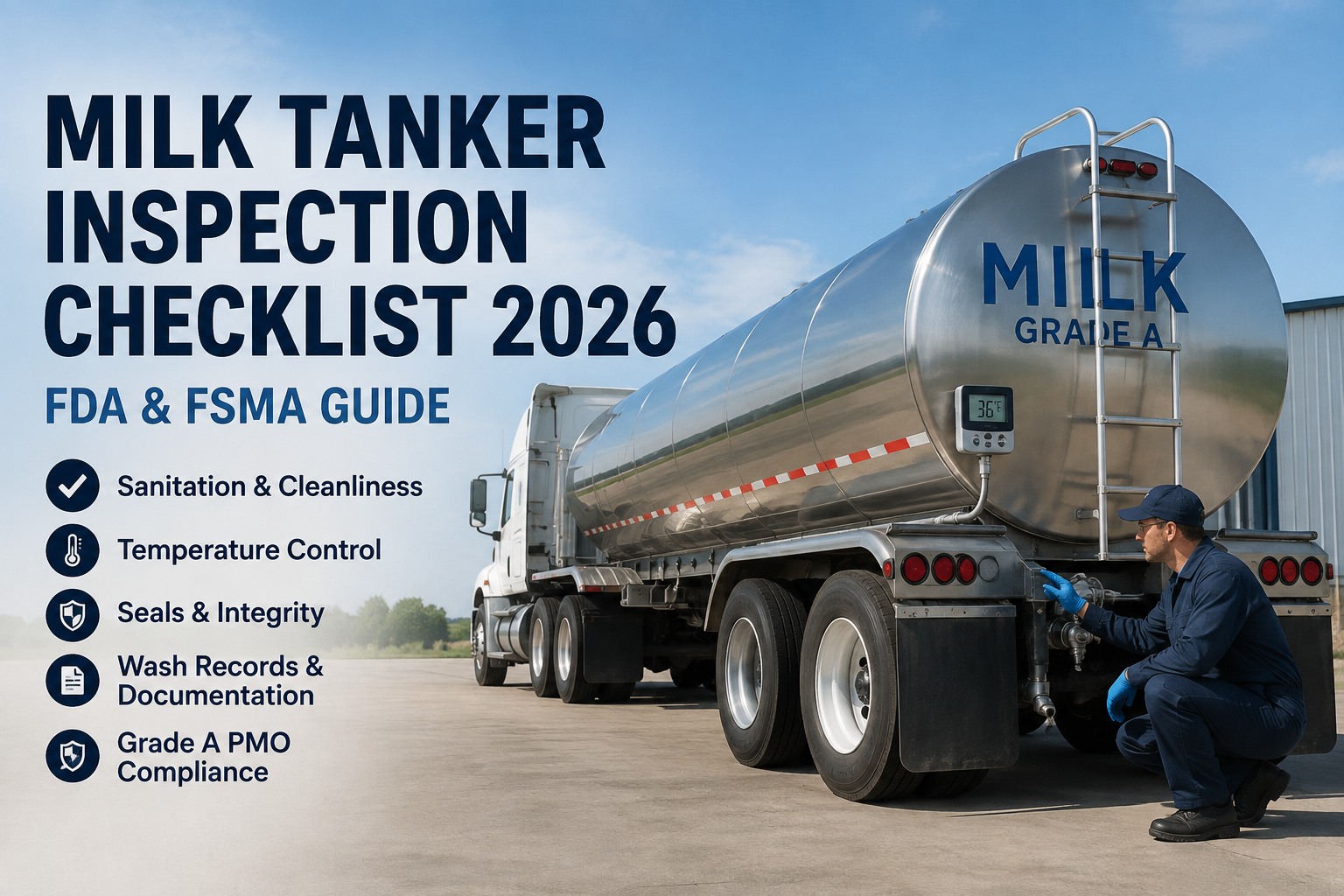
A complete milk tanker inspection combines the DOT walkaround for the mechanical rig with the food-safety layer specific to bulk milk hauling. The five dairy-specific hotspots: vent and manway seals (every dome vent, manway, and top-fill port sealed with numbered tamper-evident seal, seal numbers logged against the load); outlet valve seal (discharge valve sealed with numbered seal from wash-out through delivery, broken seal at receiver equals immediate load-rejection investigation); wash and CIP connection seal (CIP inlet sealed after wash cycle, wash tag showing date/time/facility/CIP operator initials, tag less than 72 hours old at first pickup); interior tank sanitary condition (product-contact surfaces smooth with no residue or biofilm, no odor from prior load or wash chemistry, agitator/gaskets/port covers sanitary, post-CIP visual inspection documented); and documentation bubble (current regulatory permit displayed, inspection decal within 24-month cycle, wash tag current, weigh ticket or manifest with NCIMS BTU or Milk Plant number). On top of the walkaround, the pre-trip also confirms temperature-recording equipment is functional and calibrated, refrigeration or insulation is intact, and every one of the four required documents (permit, inspection decal, wash tag, manifest) is present and current. Missing any single item on this list is a load-rejection risk at the receiving bay regardless of tanker mechanical condition.
How often does a milk tanker need to be washed under Grade A PMO?
Under Grade A Pasteurized Milk Ordinance, bulk milk tankers must be cleaned and sanitized at a permitted cleaning facility a minimum of every 72 hours. The clock runs from CIP (Clean-In-Place) cycle completion to the next milk contact. A tanker that completed CIP at 4pm Monday must be back in the wash bay by 4pm Thursday if it hasn't been washed in between — regardless of how many pickups it made in that window. Some state variations extend the interval to 96 hours in specific circumstances (certain Texas rules reference 96 hours in training materials), but the safe fleet-wide operating standard aligned with the federal PMO baseline is 72 hours. Cleaning must happen at a facility holding a valid cleaning permit: a licensed milk products plant, receiving station, or dedicated tanker cleaning facility with enclosed heated space, impervious drained floor, and appropriate chemical dosing and temperature control for effective CIP. Ad-hoc cleaning at unverified locations does not count. Every completed wash generates a tag with date, time, facility identifier, and CIP operator initials, which travels with the tanker to the next pickup. The 72-hour clock is one of the most common load-rejection triggers when a tanker arrives at a farm with an expired tag — the receiving plant will not accept product from an out-of-window tanker regardless of visual condition.
What documentation must a bulk milk tanker carry?
Four documents must be current and accessible on every load. First, the regulatory tanker permit issued by the state regulatory agency (state Department of Health Services, Department of Agriculture, or an NCIMS-listed authority depending on state), with permit number displayed on both sides of the tanker plus company name and address in legible characters. Second, the tanker inspection decal or report from the regulatory agency inspection, performed a minimum of every 24 months, with proof travelling as either an affixed decal on the tanker rear or an inspection report carried in the tanker's document "bubble." Third, the wash or CIP tag from the permitted cleaning facility, showing date and time of cleaning, facility identifier, and CIP operator credentials, with the tag less than 72 hours old at first milk pickup. Fourth, the manifest or weigh ticket per pickup, recording milk weight and temperature at pickup, the NCIMS BTU (Bulk Tank Unit) identification number or NCIMS Listed Milk Plant number for each source farm, hauler permit identification, and seal numbers on the inlet, outlet, wash connections, and vents. Missing or expired anything on this stack triggers a bay-door reject at the receiving plant — product held while paperwork gets sorted, sometimes for hours, occasionally as a lost load classified down to Class 3 or Class 4 with a significant value reduction versus Grade A.
What temperature must raw milk be maintained at during transport?
FDA Grade A PMO requires raw milk to be cooled to 45°F (7.2°C) or below within two hours of milking, and maintained at 45°F or below throughout transport to the processing plant. The farm's bulk tank does the initial cooling; the tanker's insulation and (where required) refrigeration keeps the milk at temperature during transit. Insulated tanker construction is standard on modern bulk milk trailers — the tanker holds temperature passively for most trip lengths, particularly in cool weather. On long hauls, hot ambient conditions, or where product remains in the tanker for extended periods (e.g., multi-farm pickups, transfer station holds), active refrigeration may be required. Temperature is measured at pickup and at delivery, recorded on the manifest, and increasingly logged continuously via digital temperature loggers that integrate with the fleet's DVIR record. A temperature spike above 45°F during transit is a load-rejection risk even if the milk cools back down before delivery — some plants accept the load classified down (Class 3 or Class 4) rather than reject entirely, but the value loss is significant versus Grade A pricing. Real-time temperature monitoring with alert thresholds is now expected on premium dairy operations and required by some processor contracts.
How does HVI support milk tanker inspection and dairy compliance?
HVI's dairy tanker DVIR template captures the entire compliance stack on every load. The five sanitary hotspots run in the mobile app with prompted photo capture at each seal position (vents, manway, outlet valve, CIP connection), interior post-CIP visual, and the documentation bubble. Numbered seal capture ties each seal number to the load record automatically, so chain-of-custody is proven from wash-bay to receiver bay without paper handoff. Wash-cycle tracking runs at the tanker level with 48/64/72-hour alerts firing to dispatch and driver, so no tanker rolls to a farm inside the expired-tag zone. Permit and inspection decal expiry alerts fire at 90/60/30 days ahead of cycle end. Manifest capture records milk weight, temperature, NCIMS BTU numbers, and seal numbers per pickup, and pulls automatically from the source farm record when the driver arrives on-scene. Temperature logger integration surfaces any spike above 45°F with immediate alert. Every completed load generates a signed PDF stored in the archive, searchable by tanker, driver, date, farm, or receiving plant — the DOT record, the Grade A PMO record, and the FSMA record in one signed workflow. For dairy transport managers like Diane M. running 18-tanker fleets across the Upper Midwest milk shed, the typical outcome is zero expired-tag load rejections and state milk sanitation inspector ride-alongs completed in under 30 minutes because every requested record is searchable on the laptop. Book a demo to see the dairy tanker DVIR template running live.